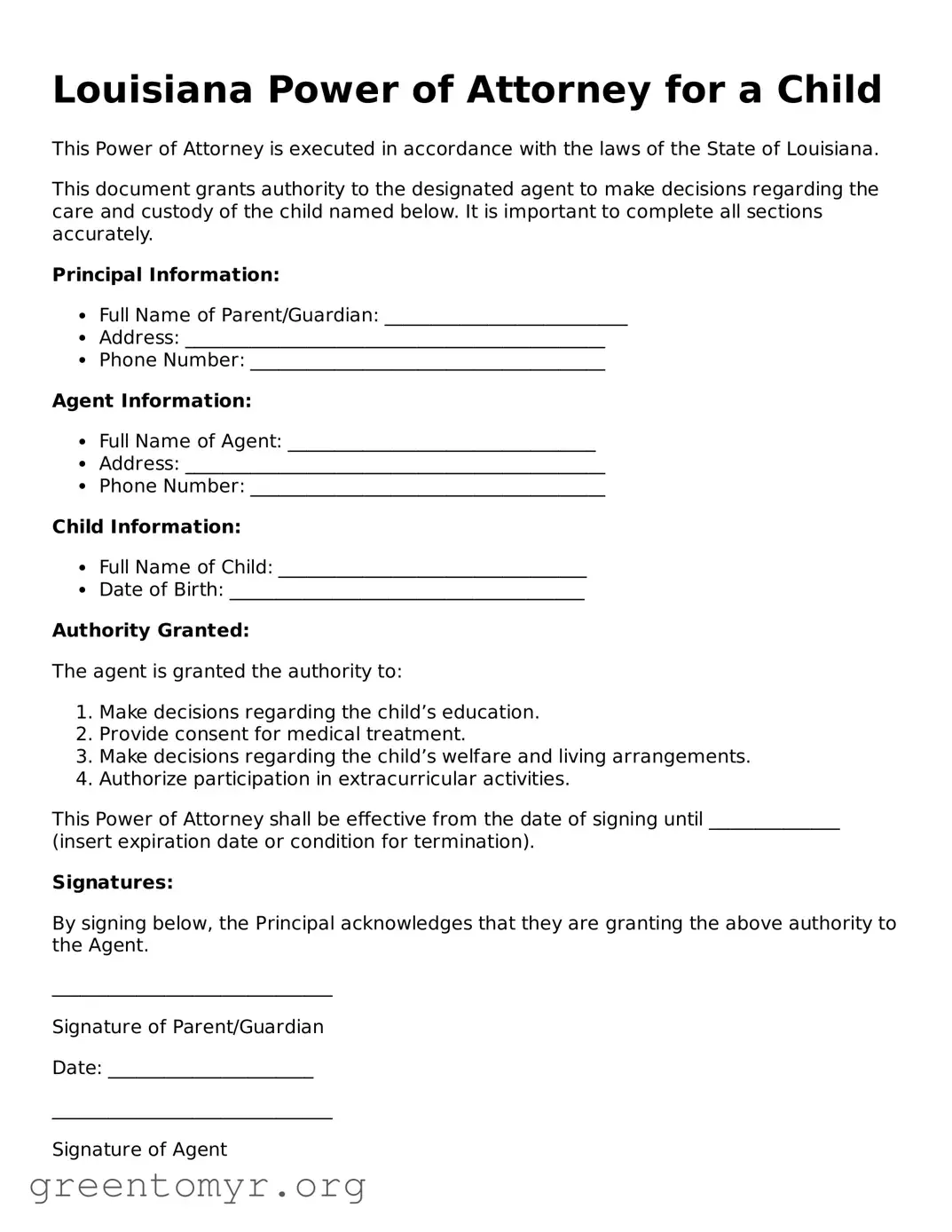
In Louisiana, the Power of Attorney for a Child form serves as a vital legal tool for parents or guardians who wish to grant authority to another individual to make decisions on behalf of their child. This document can be particularly useful in various situations, such as when a parent is temporarily unable to care for their child due to work commitments, travel, or other personal circumstances. The form allows the designated individual, often referred to as the agent, to handle essential matters, including medical decisions, educational choices, and general welfare considerations. It is important to ensure that the form is completed accurately, reflecting the specific powers being granted and the duration of the authority. By understanding the major aspects of this form, parents can better navigate the complexities of caregiving and ensure that their child's needs are met, even when they cannot be present. This proactive approach not only provides peace of mind but also safeguards the child's well-being in times of uncertainty.
Louisiana Power of Attorney for a Child
This Power of Attorney is executed in accordance with the laws of the State of Louisiana.
This document grants authority to the designated agent to make decisions regarding the care and custody of the child named below. It is important to complete all sections accurately.
Principal Information:
Agent Information:
Child Information:
Authority Granted:
The agent is granted the authority to:
This Power of Attorney shall be effective from the date of signing until ______________ (insert expiration date or condition for termination).
Signatures:
By signing below, the Principal acknowledges that they are granting the above authority to the Agent.
______________________________
Signature of Parent/Guardian
Date: ______________________
______________________________
Signature of Agent
Date: ______________________
This document must be notarized to be valid.
| Fact Name | Description |
|---|---|
| Purpose | The Louisiana Power of Attorney for a Child form allows a parent or guardian to grant temporary authority to another adult to make decisions for their child. |
| Duration | This power of attorney can be effective for a specific period, typically not exceeding one year, unless otherwise specified. |
| Governing Law | The form is governed by Louisiana Civil Code Article 4401, which outlines the rules for powers of attorney in the state. |
| Limitations | The authority granted does not include the ability to make decisions regarding the child's education or medical treatment without additional consent. |
| Revocation | A parent or guardian can revoke the power of attorney at any time, provided they notify the agent and any relevant parties. |
After obtaining the Louisiana Power of Attorney for a Child form, you will need to carefully fill it out. This document allows a designated person to make decisions for a child in specific situations. Follow these steps to complete the form accurately.
Once you have completed the form, keep a copy for your records. Provide the original to the agent and ensure they understand their responsibilities. It’s also a good idea to inform any relevant parties about this arrangement.
The Louisiana Power of Attorney for a Child is a legal document that allows a parent or guardian to grant another adult the authority to make decisions on behalf of their child. This may include decisions related to education, healthcare, and general welfare. The form is often used when parents are unavailable due to travel, work commitments, or other reasons.
Any adult can be designated as an agent in the Power of Attorney for a Child. This person should be someone the parent trusts to act in the best interest of the child. Common choices include relatives, family friends, or trusted neighbors.
The document can grant a range of powers, including but not limited to:
It is important to specify the powers granted to ensure clarity and avoid misunderstandings.
The Power of Attorney for a Child remains in effect until the specified expiration date, if one is included in the document. If no expiration date is stated, it will remain valid until the parent revokes it or until the child reaches the age of majority, which is 18 years old in Louisiana.
Yes, a parent can revoke the Power of Attorney at any time. This can be done by providing written notice to the agent and, if necessary, informing any institutions or individuals who were relying on the Power of Attorney.
While notarization is not strictly required, it is highly recommended. Having the document notarized can help ensure its validity and may be necessary for certain institutions, such as schools or healthcare providers, to accept it.
If a parent is unavailable and has not designated a Power of Attorney, decisions regarding the child's welfare may be complicated. In such cases, a relative or guardian may need to seek legal guardianship through the court system, which can be a lengthy and challenging process.
The Power of Attorney for a Child is primarily a Louisiana document. While some states may recognize it, others may have different requirements. It is advisable to check the laws in the state where the child will be residing or traveling to ensure that the document will be accepted.
The form can be obtained from various sources, including legal aid organizations, family law attorneys, or online legal document services. It is important to ensure that the form complies with Louisiana law and meets the specific needs of the parent and child.
Filling out the Louisiana Power of Attorney for a Child form can be a straightforward process, but mistakes are common. One frequent error is not providing complete information. Parents or guardians may forget to include essential details such as the child's full name or date of birth. This omission can lead to complications when the document is needed.
Another common mistake is failing to specify the powers granted to the agent. The form allows for a range of responsibilities, from making medical decisions to managing educational needs. Leaving this section vague can create confusion about what the agent is authorized to do, potentially leading to conflicts or misunderstandings.
Some individuals overlook the importance of signatures. Both the parent and the agent must sign the form for it to be valid. Additionally, witnesses may be required depending on the specific circumstances. Neglecting to gather the necessary signatures can render the document ineffective.
Another pitfall is not considering the duration of the power of attorney. Some people mistakenly assume it lasts indefinitely. However, it's crucial to specify the time frame or conditions under which the authority ends. Without this clarity, the arrangement may continue longer than intended.
People also frequently forget to review the form for accuracy before submission. Simple typos or incorrect information can lead to significant issues later on. Taking a moment to double-check every detail can save a lot of trouble down the line.
Not consulting with a legal professional can be another mistake. While the form is designed to be user-friendly, having a knowledgeable individual review it can provide peace of mind. They can ensure that all necessary elements are included and correctly filled out.
Some individuals may not understand the implications of granting power of attorney. This document gives significant authority to another person, and it’s essential to choose someone trustworthy. Failing to consider this can lead to potential misuse of power.
Finally, neglecting to keep copies of the completed form can cause issues later. It’s important to retain a copy for personal records and to provide one to the agent. This ensures that everyone involved has access to the same information, which is crucial for effective communication and decision-making.
When preparing a Power of Attorney for a Child in Louisiana, it is often beneficial to consider additional forms and documents that may complement this legal instrument. These documents can help clarify responsibilities, ensure proper care, and provide legal protections. Below is a list of commonly used forms that individuals might find useful.
These forms and documents can work together with the Power of Attorney for a Child to create a comprehensive framework for the child's care and well-being. It is always advisable to consult with a legal professional to ensure that all necessary paperwork is completed correctly and in accordance with state laws.
Filling out the Louisiana Power of Attorney for a Child form can seem daunting, but it’s a crucial step in ensuring that your child's needs are met when you cannot be there. Here’s a helpful list of things to do and avoid when completing this important document.
By following these guidelines, you can help ensure that the process goes smoothly and that your child’s well-being is prioritized. Taking the time to do it right can make all the difference.
When discussing the Louisiana Power of Attorney for a Child form, several misconceptions often arise. Understanding the nuances of this legal document is crucial for parents and guardians. Below are five common misconceptions, along with clarifications to help demystify the topic.
A Power of Attorney for a Child does not confer the same rights as a guardianship. While both documents allow someone to make decisions on behalf of a child, a guardianship typically involves a court process and grants broader authority over the child's welfare.
This form is not limited to emergency situations. It can be utilized for various reasons, including temporary travel arrangements or when parents need assistance with day-to-day decisions regarding their child.
While parents are the most common individuals to execute this form, other legal guardians or relatives may also establish a Power of Attorney for a Child, provided they have the legal authority to do so.
The Power of Attorney for a Child is not permanent. It typically remains in effect until a specified date, the parent revokes it, or the child reaches a certain age, depending on the terms outlined in the document.
While legal assistance can be beneficial, it is not a strict requirement. Parents and guardians can fill out the form themselves, as long as they understand the implications and responsibilities involved.
By addressing these misconceptions, individuals can make more informed decisions regarding the care and legal authority over children in their lives.
When filling out and using the Louisiana Power of Attorney for a Child form, keep these key takeaways in mind: