Content Navigation

Planning for the future is essential, especially when it comes to marriage. A Louisiana prenuptial agreement can help couples define their financial rights and responsibilities before tying the knot. This legal document outlines how assets will be divided in the event of a divorce or separation, providing clarity and peace of mind for both parties. It can cover various topics, including property ownership, debt responsibilities, and even spousal support. By discussing these matters openly, couples can foster trust and understanding, laying a solid foundation for their relationship. In Louisiana, specific requirements must be met for the agreement to be valid, such as full disclosure of assets and the voluntary consent of both parties. Understanding these aspects is crucial for anyone considering a prenuptial agreement in the Pelican State.

Louisiana Prenuptial Agreement Example

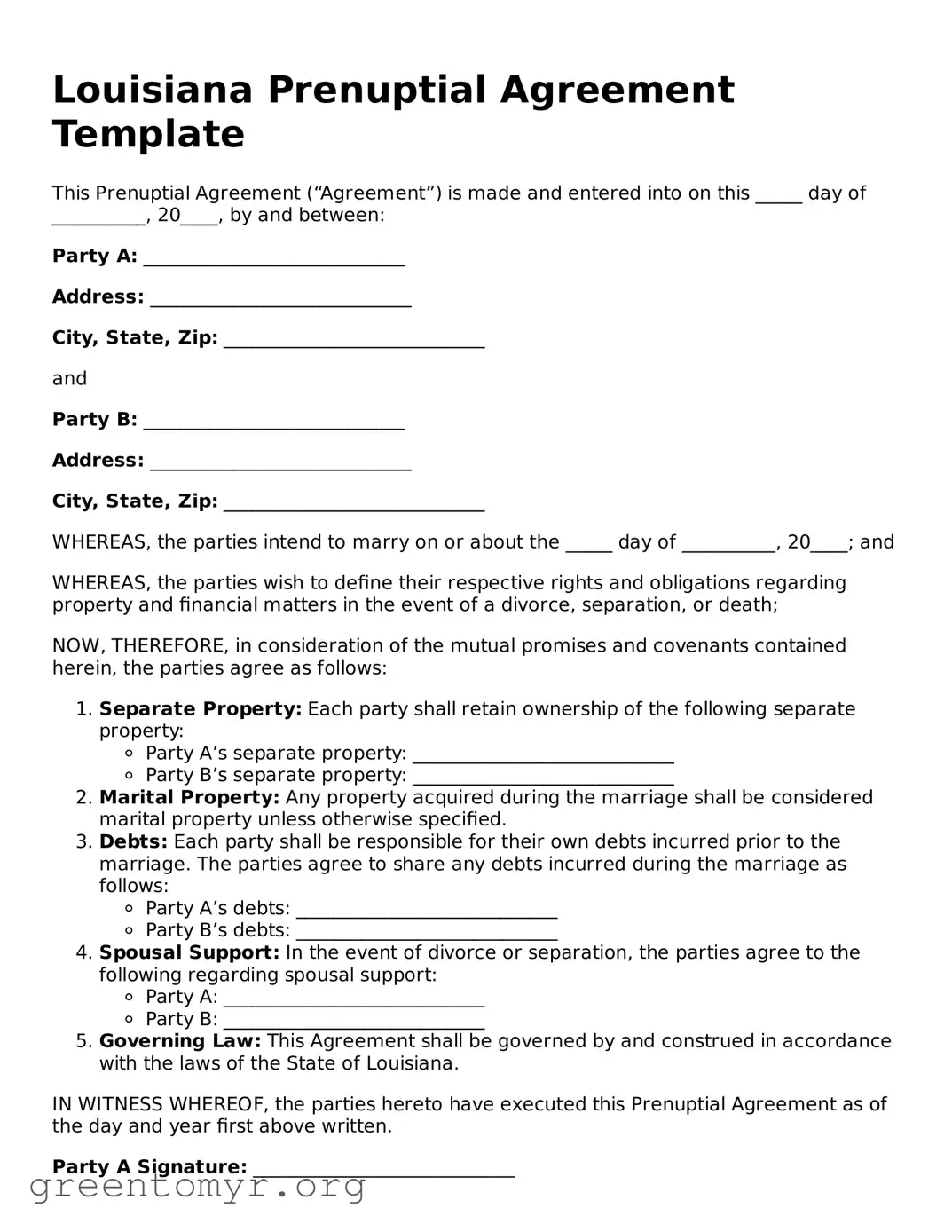
Louisiana Prenuptial Agreement Template

This Prenuptial Agreement (“Agreement”) is made and entered into on this _____ day of __________, 20____, by and between:

Party A: ____________________________

Address: ____________________________

City, State, Zip: ____________________________

and

Party B: ____________________________

Address: ____________________________

City, State, Zip: ____________________________

WHEREAS, the parties intend to marry on or about the _____ day of __________, 20____; and

WHEREAS, the parties wish to define their respective rights and obligations regarding property and financial matters in the event of a divorce, separation, or death;

NOW, THEREFORE, in consideration of the mutual promises and covenants contained herein, the parties agree as follows:

  1. Separate Property: Each party shall retain ownership of the following separate property:
    • Party A’s separate property: ____________________________
    • Party B’s separate property: ____________________________
  2. Marital Property: Any property acquired during the marriage shall be considered marital property unless otherwise specified.
  3. Debts: Each party shall be responsible for their own debts incurred prior to the marriage. The parties agree to share any debts incurred during the marriage as follows:
    • Party A’s debts: ____________________________
    • Party B’s debts: ____________________________
  4. Spousal Support: In the event of divorce or separation, the parties agree to the following regarding spousal support:
    • Party A: ____________________________
    • Party B: ____________________________
  5. Governing Law: This Agreement shall be governed by and construed in accordance with the laws of the State of Louisiana.

IN WITNESS WHEREOF, the parties hereto have executed this Prenuptial Agreement as of the day and year first above written.

Party A Signature: ____________________________

Date: ____________________________

Party B Signature: ____________________________

Date: ____________________________

Witnessed by:

Witness Signature: ____________________________

Date: ____________________________

Witness Signature: ____________________________

Date: ____________________________

PDF Form Features

Fact Name Description
Governing Law The Louisiana Prenuptial Agreement is governed by Louisiana Civil Code, specifically Articles 2325 to 2332.
Purpose This agreement helps couples outline the distribution of assets and debts in the event of divorce or death.
Voluntary Agreement Both parties must enter into the agreement voluntarily, without any pressure or coercion.
Full Disclosure Each party should provide a complete and honest disclosure of their assets and liabilities to ensure fairness.
Notarization While notarization is not required, having the agreement notarized can strengthen its validity.
Legal Representation It is advisable for both parties to seek independent legal advice before signing the agreement.
Modification and Revocation The agreement can be modified or revoked at any time, but changes must be made in writing and signed by both parties.

Guide to Using Louisiana Prenuptial Agreement

Completing the Louisiana Prenuptial Agreement form requires careful attention to detail. This document will help outline the financial arrangements and responsibilities of both parties before entering into marriage. It is essential to ensure that all information is accurate and clearly presented to avoid misunderstandings in the future.

  1. Begin by obtaining the Louisiana Prenuptial Agreement form from a reliable source, such as a legal website or a local attorney's office.
  2. At the top of the form, fill in the full names of both parties. Ensure that you use the names as they appear on legal identification.
  3. Next, provide the current addresses of both individuals. This information helps establish the jurisdiction for the agreement.
  4. Clearly state the date of the intended marriage. This date is crucial for the agreement's validity.
  5. In the designated section, outline each party's assets and debts. Be thorough and honest, as this information is vital for transparency.
  6. Include any specific provisions regarding property division, spousal support, or other financial matters that you wish to address in the agreement.
  7. Both parties should review the form together to ensure that all information is accurate and that both understand the terms outlined.
  8. After reviewing, both parties must sign and date the form in the presence of a notary public to validate the agreement.
  9. Finally, make copies of the signed agreement for both parties and consider storing the original in a safe place.

Get Answers on Louisiana Prenuptial Agreement

What is a prenuptial agreement in Louisiana?

A prenuptial agreement, often called a prenup, is a legal contract made by two individuals before they get married. In Louisiana, this agreement outlines how assets and debts will be divided in the event of divorce or death. It can also address issues like spousal support. By having a prenup, couples can set clear expectations and protect their individual interests.

Why should I consider a prenuptial agreement?

There are several reasons to consider a prenuptial agreement:

  • Asset Protection: A prenup can help protect individual assets acquired before marriage.
  • Debt Management: It can specify how debts will be handled, preventing one spouse from being responsible for the other's debts.
  • Clarity: It provides clarity and reduces conflicts during a divorce, as both parties have agreed on terms in advance.
  • Business Interests: If one or both spouses own a business, a prenup can protect that business from being divided during a divorce.

What are the requirements for a valid prenuptial agreement in Louisiana?

To ensure a prenuptial agreement is valid in Louisiana, it must meet certain requirements:

  1. It must be in writing.
  2. Both parties must voluntarily sign the agreement.
  3. There must be full disclosure of assets and liabilities by both parties.
  4. The terms must be fair and not unconscionable.

Can a prenuptial agreement be modified after marriage?

Yes, a prenuptial agreement can be modified after marriage. However, any changes must be made in writing and signed by both parties. It is advisable to consult with a legal professional to ensure that the modifications comply with Louisiana law.

What happens if a prenuptial agreement is challenged in court?

If a prenuptial agreement is challenged in court, the court will examine various factors to determine its validity. Common reasons for challenges include:

  • Lack of voluntary consent by one party.
  • Insufficient disclosure of assets.
  • Unconscionable terms that are unfair to one party.
The court will consider these factors and may uphold or invalidate the agreement based on the evidence presented.

How do I get started with a prenuptial agreement in Louisiana?

To get started with a prenuptial agreement, follow these steps:

  1. Discuss the idea with your partner to ensure mutual understanding.
  2. Gather financial information, including assets and debts.
  3. Consult with a legal professional experienced in family law to draft the agreement.
  4. Review the draft together and make any necessary adjustments.
  5. Sign the agreement in the presence of witnesses, if required.

Is a prenuptial agreement enforceable in Louisiana?

Yes, a properly executed prenuptial agreement is enforceable in Louisiana, provided it meets the legal requirements. Courts generally uphold these agreements unless they find them to be invalid due to issues such as lack of consent or unfairness. It is essential to ensure that the agreement is clear, fair, and made in good faith to increase its enforceability.

Common mistakes

Filling out a prenuptial agreement in Louisiana is a significant step for couples planning to marry. However, many individuals make common mistakes that can lead to complications down the road. Understanding these pitfalls can help ensure that the agreement serves its intended purpose.

One frequent mistake is not fully disclosing assets and debts. Transparency is crucial in a prenuptial agreement. If one party fails to provide a complete picture of their financial situation, it can lead to disputes later. It is essential for both parties to openly share all relevant information, including income, property, and liabilities.

Another common error is using vague language. A prenuptial agreement should clearly outline the terms and conditions agreed upon by both parties. Ambiguities can lead to differing interpretations, which may result in legal challenges. Specificity is key to avoiding misunderstandings in the future.

Some individuals overlook the importance of legal advice. While it may be tempting to draft an agreement without professional guidance, this can be a costly mistake. Consulting with an attorney who specializes in family law can provide valuable insights and help ensure that the agreement complies with Louisiana law.

Additionally, couples sometimes fail to consider future changes. Life circumstances can evolve, and a prenuptial agreement should account for potential shifts, such as the birth of children or significant career changes. Addressing these possibilities can help prevent conflicts later on.

Another misstep is neglecting to review the agreement together. Both parties should take the time to discuss the terms and ensure they are in alignment. Failing to do so can lead to feelings of resentment and mistrust, undermining the foundation of the marriage.

Moreover, some couples rush the process. A prenuptial agreement should not be an afterthought or a last-minute decision. Taking the time to carefully consider and negotiate the terms can lead to a more equitable and satisfying agreement for both parties.

Lastly, individuals sometimes forget to update the agreement after significant life events. Changes such as a new job, the purchase of property, or a change in financial status should prompt a review of the prenuptial agreement. Regular updates ensure that the document remains relevant and reflective of the couple's current situation.

By being aware of these common mistakes, couples can approach their prenuptial agreement with confidence. A well-prepared agreement can provide peace of mind, allowing both parties to focus on building a strong and lasting marriage.

Documents used along the form

When preparing for marriage, many couples in Louisiana consider drafting a prenuptial agreement to outline their financial arrangements and protect their individual assets. However, a prenuptial agreement is often accompanied by several other important documents that can further clarify and support the terms agreed upon by both parties. Below is a list of commonly used forms and documents that may be beneficial alongside a Louisiana Prenuptial Agreement.

  • Financial Disclosure Statement: This document provides a comprehensive overview of each partner's financial situation, including assets, debts, income, and expenses. It ensures transparency and helps both parties make informed decisions regarding their financial future.
  • Postnuptial Agreement: Similar to a prenuptial agreement, a postnuptial agreement is created after the marriage has taken place. Couples may choose to draft this document to address financial matters that have arisen since the wedding or to modify the terms of their original prenuptial agreement.
  • Separation Agreement: In the event that a couple decides to separate, a separation agreement outlines the terms of their separation, including division of property, child custody, and support obligations. This document can help mitigate disputes during a challenging time.
  • Will: A will is a legal document that specifies how a person's assets should be distributed upon their death. Having a will in place is crucial for couples, especially if they have children or specific wishes regarding their estate.
  • Power of Attorney: This document allows one partner to make financial or medical decisions on behalf of the other in the event that they become incapacitated. Establishing a power of attorney ensures that both partners' interests are protected during unforeseen circumstances.

Each of these documents plays a vital role in creating a comprehensive legal framework for couples entering into marriage. By considering these additional forms, partners can navigate their financial and personal arrangements with greater clarity and security.

Similar forms

  • Postnuptial Agreement: Similar to a prenuptial agreement, a postnuptial agreement is created after marriage. It outlines the division of assets and responsibilities, ensuring both parties understand their rights.
  • Separation Agreement: This document is used when a couple decides to live apart. It details the arrangements for property division, child custody, and support, much like a prenuptial agreement, but it is enacted during separation.
  • Divorce Settlement Agreement: In the event of divorce, this agreement outlines how assets, debts, and child custody will be handled. It shares the same goal of protecting both parties' interests, similar to a prenuptial agreement.
  • Living Together Agreement: For couples who cohabit without marrying, this agreement sets forth the rights and responsibilities of each partner regarding property and finances, akin to a prenuptial agreement.
  • Co-Ownership Agreement: This document is used by individuals who co-own property. It defines how the property will be managed and what happens if one owner wants to sell, similar to the asset management aspects of a prenuptial agreement.
  • Business Partnership Agreement: When two or more people start a business together, this agreement outlines each partner's role, contributions, and profit-sharing, much like how a prenuptial agreement addresses financial contributions in a marriage.
  • Financial Power of Attorney: This document allows one person to make financial decisions on behalf of another. While it serves a different purpose, it shares the theme of managing financial matters, similar to a prenuptial agreement.

Dos and Don'ts

When filling out the Louisiana Prenuptial Agreement form, it's important to keep a few key points in mind. Here’s a list of things you should and shouldn't do:

  • Do communicate openly with your partner about your financial situation.
  • Do ensure both parties fully understand the terms of the agreement.
  • Do consult with a lawyer to review the agreement before signing.
  • Don't rush through the process; take your time to consider all aspects.
  • Don't hide any assets or debts from your partner.
  • Don't assume that a verbal agreement is enough; everything should be in writing.

Misconceptions

Many individuals considering a prenuptial agreement in Louisiana hold misconceptions that can lead to confusion or hesitation. Here are six common misconceptions, along with clarifications to help you understand the true nature of these agreements.

  • Prenuptial agreements are only for the wealthy. This is a common myth. Prenuptial agreements can benefit couples of all financial backgrounds. They help clarify financial responsibilities and protect individual assets, regardless of wealth.
  • Prenuptial agreements are only for divorce situations. While these agreements are often associated with divorce, they can also address financial matters during the marriage. They can provide guidelines for managing finances and assets while married.
  • Prenuptial agreements are not legally binding. In Louisiana, prenuptial agreements are legally enforceable if they meet specific requirements. It is essential to follow the state's guidelines to ensure the agreement holds up in court.
  • Only one partner needs to hire a lawyer. It is advisable for both partners to seek independent legal counsel. This ensures that both parties fully understand the agreement and that it is fair and equitable.
  • Prenuptial agreements can cover any topic. While these agreements can address many financial issues, they cannot include provisions related to child custody or support. Louisiana law requires that child-related matters be determined based on the best interests of the child at the time of divorce.
  • Prenuptial agreements are permanent and cannot be changed. Couples can modify or revoke a prenuptial agreement at any time, provided both parties agree to the changes. It is important to document any amendments properly to ensure they are enforceable.

Understanding these misconceptions can help you approach the topic of a prenuptial agreement with clarity and confidence. Open communication with your partner and legal guidance can lead to a beneficial arrangement for both parties.

Key takeaways

When considering a prenuptial agreement in Louisiana, it is essential to understand the key aspects of the process. Below are nine important takeaways that can guide individuals through filling out and utilizing the Louisiana Prenuptial Agreement form.

  1. Purpose of the Agreement: A prenuptial agreement is designed to protect the assets and rights of both parties in the event of a divorce or separation.
  2. Voluntary Nature: Both parties must willingly enter into the agreement without any form of coercion or undue pressure.
  3. Full Disclosure: Each party should provide a complete and honest disclosure of their financial situation, including assets and debts, to ensure fairness.
  4. Legal Requirements: The agreement must be in writing and signed by both parties to be enforceable in Louisiana.
  5. Consideration of State Laws: Familiarity with Louisiana's community property laws is crucial, as these laws can impact the division of assets.
  6. Review by Legal Counsel: It is advisable for both parties to seek independent legal advice to understand their rights and obligations fully.
  7. Changes and Updates: The agreement can be amended or revoked in the future, but such changes must also be documented in writing.
  8. Timing of Execution: The agreement should be completed well in advance of the wedding date to avoid any claims of duress.
  9. Enforceability: Courts will enforce the agreement if it meets the legal standards and is deemed fair and reasonable at the time of enforcement.

By considering these key points, individuals can better navigate the complexities of creating a prenuptial agreement in Louisiana, ensuring that their interests are protected and clearly defined.