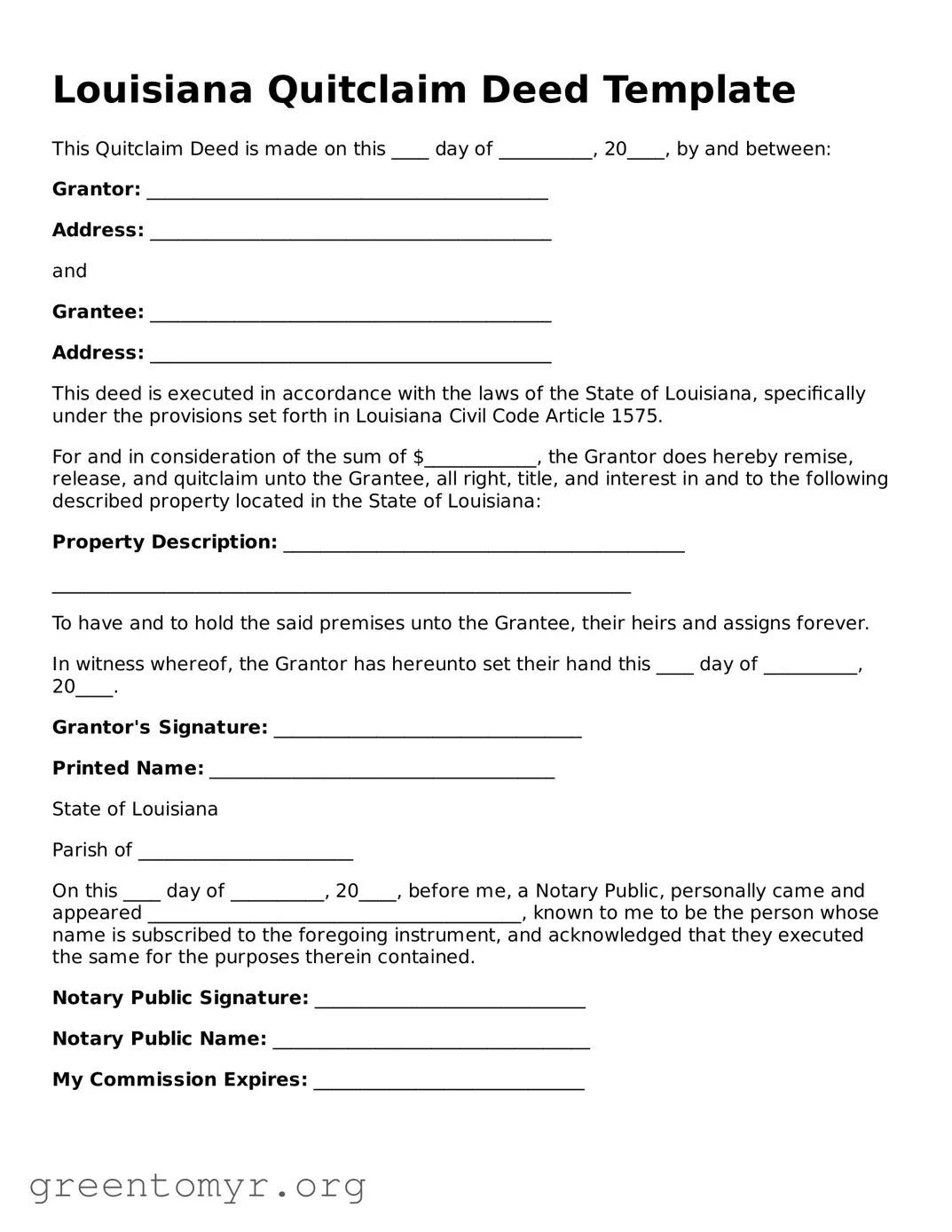
When it comes to transferring property ownership in Louisiana, the Quitclaim Deed form serves as a straightforward and efficient tool. This legal document allows one party, known as the grantor, to convey their interest in a property to another party, referred to as the grantee, without guaranteeing that the title is free from claims or encumbrances. Unlike other types of deeds, a Quitclaim Deed does not provide any warranties regarding the property’s condition or the grantor's legal right to sell it. This makes it particularly useful in situations such as transferring property between family members, settling estates, or clearing up title issues. Understanding the specific requirements for completing and filing a Quitclaim Deed in Louisiana is essential, as it involves certain formalities, including the need for notarization and proper recording with the local parish clerk. By being aware of these key aspects, individuals can navigate the process more effectively and ensure a smoother transition of property ownership.
Louisiana Quitclaim Deed Template
This Quitclaim Deed is made on this ____ day of __________, 20____, by and between:
Grantor: ___________________________________________
Address: ___________________________________________
and
Grantee: ___________________________________________
Address: ___________________________________________
This deed is executed in accordance with the laws of the State of Louisiana, specifically under the provisions set forth in Louisiana Civil Code Article 1575.
For and in consideration of the sum of $____________, the Grantor does hereby remise, release, and quitclaim unto the Grantee, all right, title, and interest in and to the following described property located in the State of Louisiana:
Property Description: ___________________________________________
______________________________________________________________
To have and to hold the said premises unto the Grantee, their heirs and assigns forever.
In witness whereof, the Grantor has hereunto set their hand this ____ day of __________, 20____.
Grantor's Signature: _________________________________
Printed Name: _____________________________________
State of Louisiana
Parish of _______________________
On this ____ day of __________, 20____, before me, a Notary Public, personally came and appeared ________________________________________, known to me to be the person whose name is subscribed to the foregoing instrument, and acknowledged that they executed the same for the purposes therein contained.
Notary Public Signature: _____________________________
Notary Public Name: __________________________________
My Commission Expires: _____________________________
| Fact Name | Description |
|---|---|
| Definition | A Quitclaim Deed is a legal document used to transfer ownership of property without any guarantees regarding the title's validity. |
| Governing Law | The Louisiana Quitclaim Deed is governed by the Louisiana Civil Code, specifically Articles 2440-2445. |
| Use Cases | This form is often used in situations such as transferring property between family members or clearing up title issues. |
| Limitations | Unlike warranty deeds, a quitclaim deed does not provide any protection against claims or liens on the property. |
| Filing Requirements | To be effective, the quitclaim deed must be signed by the grantor and recorded with the local parish clerk of court. |
After you have gathered all necessary information, you can proceed to fill out the Louisiana Quitclaim Deed form. This document is essential for transferring property ownership, and it should be completed carefully to ensure all details are accurate. Once the form is filled out, it will need to be signed and recorded with the appropriate local authority.
A Quitclaim Deed is a legal document used to transfer ownership of real estate from one party to another. Unlike other types of deeds, a quitclaim deed does not guarantee that the property title is free from claims or liens. It simply transfers whatever interest the grantor has in the property, if any.
This type of deed is commonly used in situations such as:
To complete a Quitclaim Deed in Louisiana, follow these steps:
While it is not legally required to have a lawyer to create a Quitclaim Deed, consulting one can be beneficial. A lawyer can help ensure that the deed is filled out correctly and that all legal requirements are met, which can prevent future disputes.
No, a Quitclaim Deed and a Warranty Deed are different. A Warranty Deed provides a guarantee that the grantor holds clear title to the property and has the right to transfer it. In contrast, a Quitclaim Deed offers no such guarantees. It only transfers whatever interest the grantor may have.
If there are existing liens or debts on the property, a Quitclaim Deed does not eliminate them. The grantee may still be responsible for these obligations after the transfer. It's essential to conduct a title search before proceeding with a Quitclaim Deed to understand any potential issues.
Once a Quitclaim Deed is executed and recorded, it cannot be revoked unilaterally. However, the parties involved may agree to create a new deed to reverse the transfer if both parties consent. It's advisable to consult with a legal professional for guidance on this process.
The cost to file a Quitclaim Deed varies by parish in Louisiana. Generally, there are recording fees that can range from $10 to $50 or more, depending on the length of the document and local regulations. Always check with your local clerk of court for specific fees.
Using a Quitclaim Deed may have tax implications, such as transfer taxes or property tax reassessment. It's important to consult a tax professional to understand how the transfer might affect your taxes and whether any exemptions apply.
You can obtain a Quitclaim Deed form from various sources, including:
Ensure that the form you choose complies with Louisiana state laws.
Filling out a Louisiana Quitclaim Deed form can be straightforward, but several common mistakes can lead to complications. One frequent error is failing to include all necessary parties involved in the transaction. Both the grantor (the person transferring the property) and the grantee (the person receiving the property) must be clearly identified. Omitting a co-owner or incorrectly spelling a name can create legal challenges down the line.
Another mistake often made is neglecting to provide a complete legal description of the property. This description should be precise and detailed, including the lot number, block number, and any relevant parish information. If this information is vague or incomplete, it can lead to disputes over property boundaries and ownership.
People sometimes forget to sign the document in the appropriate places. A Quitclaim Deed must be signed by the grantor, and if multiple grantors are involved, all must sign. Additionally, failing to have the signatures notarized can render the deed invalid. Notarization adds a layer of authenticity and is a crucial step in the process.
Another common oversight is the lack of proper consideration. In Louisiana, the Quitclaim Deed should indicate what the grantee is giving in return for the property, even if it is a nominal amount. Leaving this section blank or stating "for love and affection" without further clarification can lead to questions about the legitimacy of the transaction.
Lastly, many people overlook the importance of filing the Quitclaim Deed with the appropriate parish clerk's office. After completing the form, it is vital to ensure that it is recorded properly to protect the new owner's interests. Failing to do so may leave the property vulnerable to claims from third parties, undermining the very purpose of the deed.
When transferring property ownership in Louisiana, several forms and documents may accompany the Quitclaim Deed. Each of these documents serves a specific purpose and helps ensure a smooth transaction. Below is a list of commonly used documents.
Understanding these documents can simplify the property transfer process and protect the interests of all parties involved. Proper documentation is essential for a legally sound transaction in Louisiana.
A Quitclaim Deed is a unique legal document used primarily to transfer ownership of property. However, several other documents serve similar purposes in property transactions. Here’s a look at five documents that share similarities with a Quitclaim Deed:
Each of these documents plays a crucial role in property transactions, providing varying levels of protection and assurance to the parties involved. Understanding their similarities and differences can help individuals navigate the complexities of real estate law more effectively.
When filling out the Louisiana Quitclaim Deed form, it’s important to follow certain guidelines to ensure the process goes smoothly. Below are some essential dos and don'ts to keep in mind:
By following these guidelines, you can help ensure that your Quitclaim Deed is completed accurately and efficiently.
Understanding the Louisiana Quitclaim Deed can be tricky. Many people hold misconceptions about this legal document. Here are eight common misunderstandings, along with clarifications:
Clarifying these misconceptions can help individuals make informed decisions when dealing with property transfers. Always consider consulting a legal professional for personalized advice.
Filling out and using a Louisiana Quitclaim Deed form can be a straightforward process, but it’s essential to understand its key aspects. Here are nine important takeaways to keep in mind:
By keeping these key points in mind, you can navigate the process of using a Louisiana Quitclaim Deed with greater confidence and clarity.