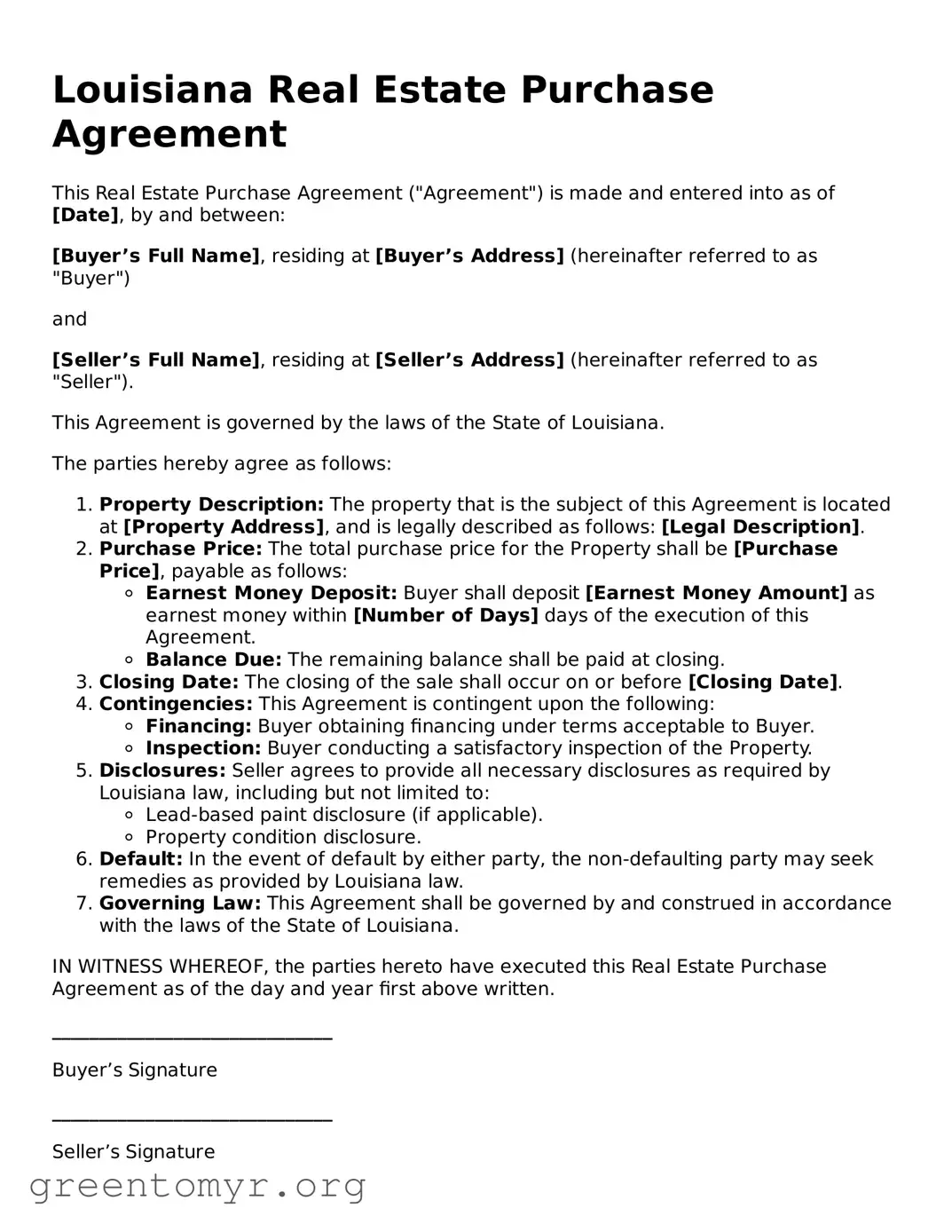
The Louisiana Real Estate Purchase Agreement form serves as a crucial document in the process of buying and selling real estate in the state. This form outlines the terms and conditions agreed upon by both the buyer and the seller, ensuring that each party understands their rights and obligations. Key components of the agreement include the purchase price, the property description, and the closing date, which are essential for establishing a clear understanding between the involved parties. Additionally, the agreement addresses contingencies, such as financing and inspections, which protect the interests of the buyer. It also includes provisions for earnest money deposits, which demonstrate the buyer's commitment to the transaction. By detailing these aspects, the Louisiana Real Estate Purchase Agreement provides a structured framework that promotes transparency and accountability throughout the real estate transaction process.
Louisiana Real Estate Purchase Agreement
This Real Estate Purchase Agreement ("Agreement") is made and entered into as of [Date], by and between:
[Buyer’s Full Name], residing at [Buyer’s Address] (hereinafter referred to as "Buyer")
and
[Seller’s Full Name], residing at [Seller’s Address] (hereinafter referred to as "Seller").
This Agreement is governed by the laws of the State of Louisiana.
The parties hereby agree as follows:
IN WITNESS WHEREOF, the parties hereto have executed this Real Estate Purchase Agreement as of the day and year first above written.
______________________________
Buyer’s Signature
______________________________
Seller’s Signature
______________________________
Date
| Fact Name | Description |
|---|---|
| Governing Law | The Louisiana Real Estate Purchase Agreement is governed by the laws of the State of Louisiana. |
| Purpose | This form serves as a legally binding contract between a buyer and a seller for the purchase of real estate. |
| Offer and Acceptance | The agreement outlines the buyer's offer and the seller's acceptance, creating a mutual understanding of the terms. |
| Earnest Money | Typically, the buyer submits earnest money to demonstrate serious intent to purchase the property. |
| Contingencies | The form allows for various contingencies, such as financing, inspections, and appraisals, which can affect the sale. |
| Closing Date | The agreement specifies a closing date, which is the date when the property ownership officially transfers. |
| Disclosures | Sellers are required to provide disclosures regarding the property's condition and any known issues. |
| Default Provisions | The agreement includes provisions outlining what happens if either party defaults on the contract. |
| Amendments | Any changes to the agreement must be made in writing and signed by both parties to be enforceable. |
Filling out the Louisiana Real Estate Purchase Agreement form is a crucial step in the home buying process. This form outlines the terms of the transaction between the buyer and seller, ensuring that both parties are clear on the details. Follow these steps to complete the form accurately.
Once the form is completed, review it carefully for accuracy. It may be beneficial to have a real estate professional or attorney review the agreement before submitting it to ensure compliance with Louisiana laws and regulations.
A Louisiana Real Estate Purchase Agreement is a legal document that outlines the terms and conditions of a real estate transaction between a buyer and a seller. It serves as a binding contract once both parties sign it. This agreement includes details such as the purchase price, property description, closing date, and any contingencies that may apply.
The agreement should contain several key elements, including:
Negotiation typically begins after the buyer submits an initial offer. The seller can accept, reject, or counter the offer. During this phase, both parties discuss terms such as price, contingencies, and closing dates. It’s common for negotiations to go back and forth until both parties reach a mutually agreeable contract.
Once both parties sign the agreement, it becomes legally binding. The buyer usually pays an earnest money deposit to show commitment. After that, the buyer will typically conduct inspections and secure financing. The closing process will then be scheduled, where the final paperwork is signed, and the property officially changes hands.
Yes, the agreement can be modified after signing, but both parties must agree to the changes. Any modifications should be documented in writing and signed by both the buyer and seller to ensure clarity and legality. It’s important to communicate openly about any changes to avoid misunderstandings.
When completing the Louisiana Real Estate Purchase Agreement form, individuals often make several common mistakes that can lead to complications in the transaction process. One frequent error is failing to provide accurate property descriptions. A precise description is essential to identify the property clearly and avoid disputes later. Omitting details such as the property address, lot number, or boundaries can create confusion and potentially jeopardize the sale.
Another mistake is neglecting to specify the purchase price. While it may seem straightforward, leaving this section blank or providing an unclear figure can lead to misunderstandings between the buyer and seller. Both parties must agree on the price to ensure a smooth transaction.
Many individuals also overlook the importance of including all necessary contingencies. Contingencies are conditions that must be met for the sale to proceed. Common examples include financing, inspections, and appraisals. Failing to address these can leave buyers vulnerable to unexpected issues that could derail the purchase.
Additionally, buyers and sellers sometimes forget to sign and date the agreement. An unsigned document is not legally binding. This oversight can cause delays and misunderstandings, as the agreement will not be enforceable until all parties have provided their signatures.
Another common error is not consulting with a real estate professional. Many individuals believe they can navigate the process without assistance. However, real estate transactions can be complex, and having guidance can help avoid pitfalls and ensure that all legal requirements are met.
Lastly, individuals may neglect to keep copies of the signed agreement. Documentation is crucial in real estate transactions. Without a copy, parties may find it challenging to reference the terms of the agreement or resolve disputes that arise later. Maintaining a clear record helps protect the interests of everyone involved.
When engaging in a real estate transaction in Louisiana, several important documents accompany the Louisiana Real Estate Purchase Agreement. Each of these forms plays a crucial role in ensuring a smooth and legally sound process. Below is a list of commonly used documents that often work alongside the purchase agreement.
These documents, when used together with the Louisiana Real Estate Purchase Agreement, help facilitate a transparent and organized real estate transaction. Understanding each of these forms can empower buyers and sellers to navigate the process with confidence.
Lease Agreement: This document outlines the terms under which a landlord allows a tenant to occupy a property. Like a Real Estate Purchase Agreement, it specifies the parties involved, property details, and obligations of each party.
Option to Purchase Agreement: This agreement gives a tenant the right to purchase the property at a later date. Similar to a Real Estate Purchase Agreement, it includes price terms and conditions for exercising the option.
Real Estate Listing Agreement: This document is between a property owner and a real estate agent. It establishes the agent's authority to sell the property, much like a Purchase Agreement outlines the terms of sale.
Purchase and Sale Agreement: This document is often used interchangeably with a Real Estate Purchase Agreement. It details the terms of sale, including price and contingencies, and is crucial in the transaction process.
Counteroffer: A counteroffer is a response to an initial offer. It modifies the terms and can lead to a finalized agreement, similar to how negotiations occur in a Purchase Agreement.
Escrow Agreement: This document outlines the terms under which a third party holds funds during a real estate transaction. It is similar in that it protects the interests of both buyer and seller until the deal is finalized.
Title Report: This document provides information about the property’s ownership history and any claims against it. It is essential for ensuring that a Purchase Agreement can be executed without legal complications.
Disclosure Statement: This document reveals any known issues with the property. It is similar to a Purchase Agreement in that it informs the buyer of potential risks before completing the sale.
Financing Agreement: This outlines the terms of a loan to finance the purchase. It is related to the Purchase Agreement as it details how the buyer will pay for the property.
Closing Statement: This document summarizes the financial details of the transaction at closing. Like a Purchase Agreement, it confirms the final terms and conditions agreed upon by both parties.
When filling out the Louisiana Real Estate Purchase Agreement form, it is important to approach the task carefully. Here are some guidelines to help you navigate the process effectively.
By following these guidelines, you can help ensure a smoother process when completing the Louisiana Real Estate Purchase Agreement form.
When dealing with real estate transactions in Louisiana, there are several misconceptions surrounding the Real Estate Purchase Agreement (REPA) form. Here are nine common misunderstandings:
While having a lawyer can be beneficial, it is not mandatory for every transaction. Many buyers and sellers successfully navigate the process with the help of real estate agents.
The REPA can be customized to fit the specific needs of the transaction. Parties can negotiate terms and conditions to suit their situation.
While licensed agents often complete the form, buyers and sellers can also fill it out themselves, as long as they understand the terms.
Amendments can be made to the REPA after it has been signed, provided both parties agree to the changes and sign the amendments.
The REPA is a binding agreement, but it does not guarantee the sale will go through. Various factors, such as financing issues or inspections, can affect the transaction.
Contingencies are common in real estate agreements. They allow buyers and sellers to protect their interests and can be included in the REPA.
Both buyers and sellers can negotiate repairs or improvements. The REPA allows for discussions regarding repairs before finalizing the sale.
In Louisiana, notarization is not a requirement for the REPA to be legally binding. However, having it notarized can provide an extra layer of security.
There are circumstances under which a party can cancel the agreement, such as if contingencies are not met or if both parties mutually agree to terminate the contract.
Understanding these misconceptions can help buyers and sellers navigate the real estate process more effectively and make informed decisions.
When navigating the Louisiana Real Estate Purchase Agreement form, several key points can help ensure a smooth transaction. Here are important takeaways to consider:
By keeping these takeaways in mind, both buyers and sellers can enhance their understanding of the Louisiana Real Estate Purchase Agreement form, leading to a more efficient and effective transaction process.