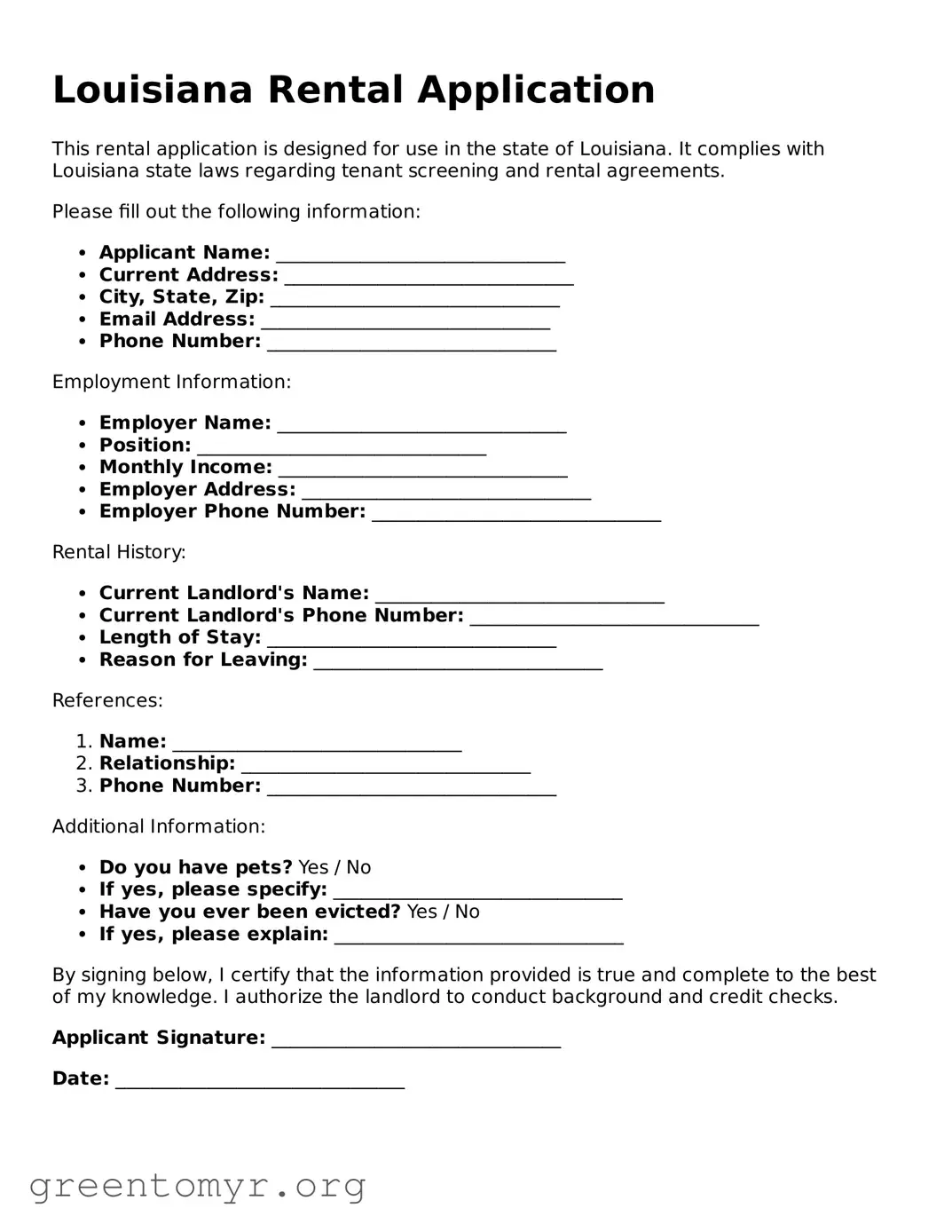
The Louisiana Rental Application form serves as a crucial document for both landlords and prospective tenants in the rental process. This form collects essential information that helps landlords assess the suitability of applicants. Typically, it requires personal details such as the applicant's name, contact information, and social security number. Additionally, it includes questions about employment history, income, and rental history, providing landlords with a comprehensive view of the applicant's background. References may also be requested to verify the applicant's reliability and character. The form often contains sections for consent to conduct background checks, which may include credit history and criminal records. By gathering this information, the Louisiana Rental Application form aims to facilitate informed decisions in the rental process, ensuring a smooth transition for both parties involved.
Louisiana Rental Application
This rental application is designed for use in the state of Louisiana. It complies with Louisiana state laws regarding tenant screening and rental agreements.
Please fill out the following information:
Employment Information:
Rental History:
References:
Additional Information:
By signing below, I certify that the information provided is true and complete to the best of my knowledge. I authorize the landlord to conduct background and credit checks.
Applicant Signature: _______________________________
Date: _______________________________
| Fact Name | Description |
|---|---|
| Purpose | The Louisiana Rental Application form is used by landlords to screen potential tenants. |
| Information Required | Applicants typically need to provide personal information, rental history, employment details, and references. |
| Application Fee | Landlords may charge an application fee to cover the costs of background checks and processing. |
| Background Check | A background check is often conducted to assess the applicant's credit history and criminal record. |
| Fair Housing Laws | The application process must comply with federal and state fair housing laws, ensuring no discrimination occurs. |
| Governing Laws | The Louisiana Rental Application form is governed by Louisiana Revised Statutes, particularly RS 9:3251 et seq. |
| Tenant Rights | Applicants have the right to know why their application was denied, as per fair housing regulations. |
| Signature Requirement | Applicants must sign the form, indicating their consent to the background check and the information provided. |
| Retention of Records | Landlords must retain rental applications for a certain period, typically one year, even if not selected. |
Completing the Louisiana Rental Application form is a crucial step in securing your desired rental property. After filling out the application, it will be reviewed by the landlord or property manager. They will assess your information to determine your suitability as a tenant. Follow these steps carefully to ensure your application is complete and accurate.
The Louisiana Rental Application form is a document used by landlords to collect essential information from prospective tenants. This form typically includes personal details such as the applicant's name, contact information, employment history, and rental history. By gathering this information, landlords can evaluate the suitability of potential tenants and make informed decisions about leasing their property.
When filling out a Louisiana Rental Application, applicants are generally required to provide a variety of information. This may include:
Providing accurate and complete information is crucial, as it helps landlords assess an applicant's reliability and ability to meet rental obligations.
Landlords evaluate rental applications based on several criteria. Common factors include:
Each landlord may have different criteria, so it is advisable for applicants to inquire about specific requirements before submitting their applications.
Once a rental application is submitted, the landlord or property manager will review the information provided. The process typically involves the following steps:
If approved, the next steps typically involve signing a lease agreement and discussing move-in details. If denied, landlords may provide reasons, though they are not always required to do so.
Completing a Louisiana Rental Application can be straightforward, but many applicants stumble over common mistakes. One prevalent error is providing incomplete information. Landlords often require specific details, such as employment history, income, and references. Omitting any of this information can lead to delays or even denial of the application. Always double-check that every section is filled out accurately.
Another frequent mistake involves inaccuracies in personal information. This includes misspellings of names, incorrect Social Security numbers, or wrong phone numbers. Such errors can raise red flags for landlords and may cause them to question the applicant's reliability. It’s crucial to verify that all information is precise before submitting the application.
Failure to disclose relevant background information is also a common pitfall. Applicants might hesitate to mention past evictions or criminal history, thinking it will improve their chances of approval. However, transparency is key. Many landlords conduct background checks, and discrepancies between the application and findings can lead to immediate disqualification.
Lastly, neglecting to sign and date the application can render it invalid. A signature indicates that the applicant agrees to the terms and conditions set forth by the landlord. Without it, the application may be considered incomplete, and the applicant could miss out on a desired rental opportunity. Always ensure that the application is signed and dated before submission.
When applying for a rental property in Louisiana, you may need to provide additional documents along with the Louisiana Rental Application form. These documents help landlords assess your suitability as a tenant. Here is a list of commonly used forms and documents:
Having these documents ready can streamline the application process and increase your chances of securing the rental property you desire.
The Rental Application form shares similarities with several other documents commonly used in real estate and rental processes. Below is a list of these documents and their key similarities.
When filling out the Louisiana Rental Application form, there are several important considerations to keep in mind. Here’s a list of things you should and shouldn’t do to ensure a smooth application process.
By adhering to these guidelines, applicants can enhance their chances of securing a rental property in Louisiana. Being thorough and honest goes a long way in the application process.
When it comes to the Louisiana Rental Application form, there are several misconceptions that can lead to confusion for both landlords and prospective tenants. Understanding these common misunderstandings can help ensure a smoother rental process.
Many people believe that once they pay the application fee, it cannot be refunded. In reality, while some landlords may choose to keep the fee regardless of the outcome, others may offer refunds if the application is denied or if the rental property is no longer available.
It is a common belief that landlords are obligated to accept every application they receive. In truth, landlords have the right to screen applicants and select tenants based on their criteria, which may include credit history, rental history, and income verification.
Some applicants think that submitting a rental application guarantees them a lease. However, the application is merely a request to be considered for tenancy. Landlords will review the application and make a decision based on various factors.
Many assume that all rental applications follow a standard format. In reality, each landlord or property management company may have its own specific form and requirements, which can vary significantly from one property to another.
When filling out the Louisiana Rental Application form, there are several important aspects to keep in mind. Understanding these can help streamline the process and ensure a smoother rental experience.