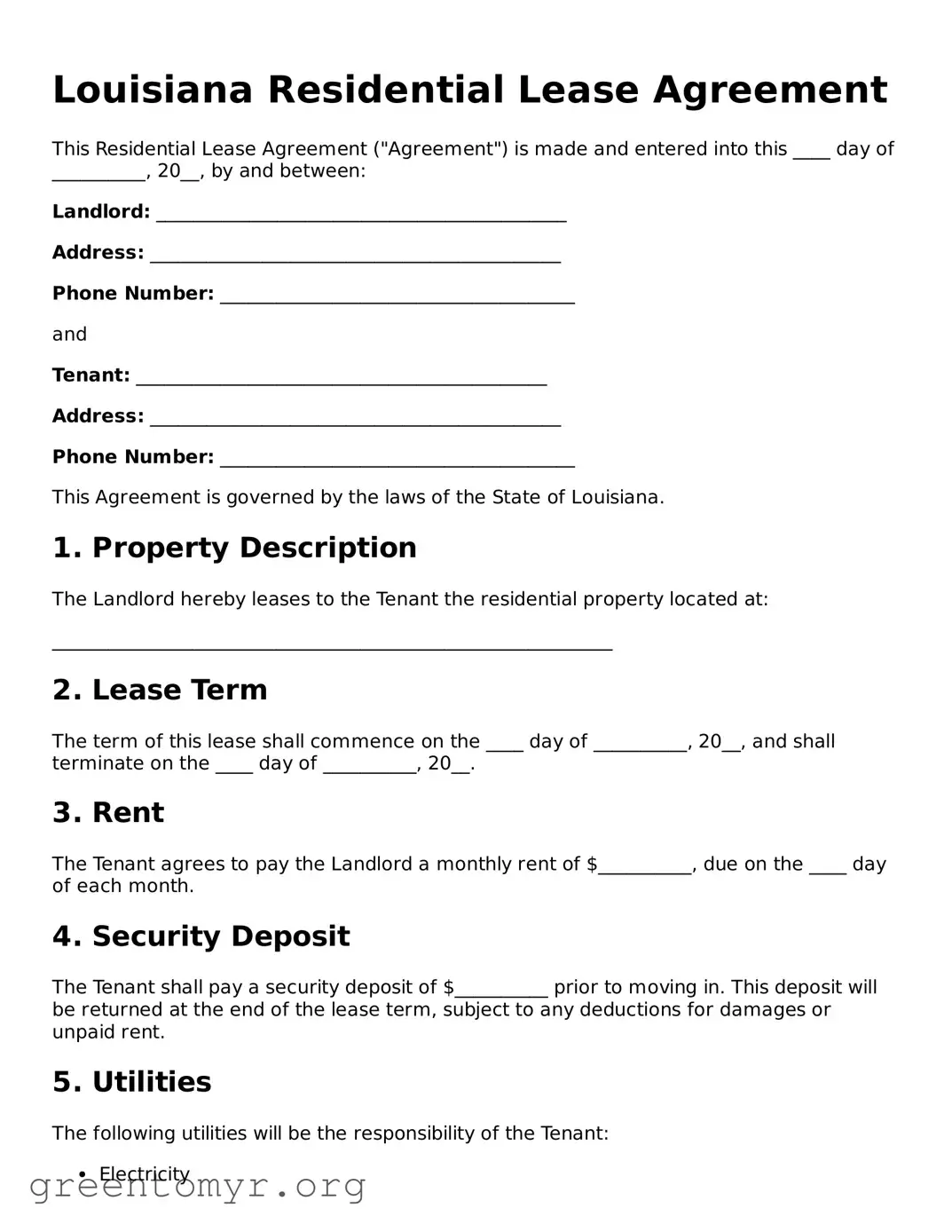
The Louisiana Residential Lease Agreement form serves as a crucial document in the landlord-tenant relationship, outlining the rights and responsibilities of both parties involved in a rental arrangement. This form typically includes essential details such as the names of the landlord and tenant, the property address, and the duration of the lease. Additionally, it specifies the amount of rent due, payment methods, and security deposit requirements. Provisions regarding maintenance responsibilities, rules for property use, and conditions for termination of the lease are also integral components of the agreement. Understanding these aspects can help prevent disputes and ensure a smooth rental experience. By clearly defining expectations, the Louisiana Residential Lease Agreement fosters a transparent and cooperative environment for both landlords and tenants.
Louisiana Residential Lease Agreement
This Residential Lease Agreement ("Agreement") is made and entered into this ____ day of __________, 20__, by and between:
Landlord: ____________________________________________
Address: ____________________________________________
Phone Number: ______________________________________
and
Tenant: ____________________________________________
Address: ____________________________________________
Phone Number: ______________________________________
This Agreement is governed by the laws of the State of Louisiana.
1. Property Description
The Landlord hereby leases to the Tenant the residential property located at:
____________________________________________________________
2. Lease Term
The term of this lease shall commence on the ____ day of __________, 20__, and shall terminate on the ____ day of __________, 20__.
3. Rent
The Tenant agrees to pay the Landlord a monthly rent of $__________, due on the ____ day of each month.
4. Security Deposit
The Tenant shall pay a security deposit of $__________ prior to moving in. This deposit will be returned at the end of the lease term, subject to any deductions for damages or unpaid rent.
5. Utilities
The following utilities will be the responsibility of the Tenant:
6. Maintenance and Repairs
The Tenant agrees to maintain the property in good condition and report any needed repairs to the Landlord promptly.
7. Termination
Either party may terminate this Agreement by providing written notice of ____ days prior to the intended termination date.
8. Governing Law
This Agreement shall be governed by and construed in accordance with the laws of the State of Louisiana.
9. Signatures
By signing below, both parties agree to the terms of this Residential Lease Agreement.
Landlord Signature: ________________________________ Date: ___________
Tenant Signature: ________________________________ Date: ___________
| Fact Name | Description |
|---|---|
| Governing Law | The Louisiana Residential Lease Agreement is governed by the Louisiana Civil Code, particularly Title 9, which covers leases. |
| Parties Involved | The agreement typically involves a landlord (lessor) and a tenant (lessee). |
| Lease Duration | Leases can be for a fixed term, such as one year, or can be month-to-month. |
| Security Deposit | Landlords may require a security deposit, which is usually capped at one month's rent. |
| Rent Payment | The lease must specify the amount of rent, due date, and acceptable payment methods. |
| Maintenance Responsibilities | The agreement outlines who is responsible for property maintenance and repairs. |
| Termination Notice | For month-to-month leases, a notice period of at least 30 days is generally required for termination. |
| Subleasing | Most agreements will address whether subleasing is permitted and under what conditions. |
| Dispute Resolution | Many leases include a clause detailing how disputes will be resolved, often through mediation or arbitration. |
Filling out the Louisiana Residential Lease Agreement form is a crucial step in establishing a rental relationship. Completing this form accurately ensures that both the landlord and tenant understand their rights and responsibilities. Follow these steps carefully to ensure all necessary information is included.
After completing the form, ensure both parties retain a signed copy for their records. This will help prevent misunderstandings in the future.
A Louisiana Residential Lease Agreement is a legally binding contract between a landlord and a tenant. This document outlines the terms under which a tenant can occupy a residential property. Key details typically include the rental amount, lease duration, security deposit requirements, and responsibilities of both parties.
Essential elements of a Louisiana Residential Lease Agreement often include:
Lease terms in Louisiana can vary widely. Common durations include:
Longer terms may also be negotiated. The lease should clearly state the duration to avoid confusion.
Generally, a landlord cannot increase the rent during the lease term unless the lease agreement specifically allows for it. Rent increases typically take effect at the beginning of a new lease term. Tenants should review their lease for any clauses regarding rent adjustments.
If a tenant needs to break the lease early, they should first review the lease agreement for any clauses related to early termination. Common consequences may include:
Communication with the landlord is essential to discuss options and potential solutions.
Yes, Louisiana has specific laws that govern residential leases. These laws outline the rights and responsibilities of both landlords and tenants. The Louisiana Civil Code includes provisions related to lease agreements, security deposits, eviction processes, and habitability standards. It is advisable for both parties to familiarize themselves with these laws to ensure compliance.
If a tenant encounters problems with the property, such as maintenance issues or safety concerns, they should take the following steps:
Maintaining open communication with the landlord can often lead to quicker resolutions.
Filling out the Louisiana Residential Lease Agreement form can be straightforward, but many people make common mistakes that can lead to complications later. One frequent error is failing to provide accurate personal information. When entering names, addresses, or contact details, it’s crucial to double-check for typos or missing information. Inaccurate data can create confusion and may affect communication between landlords and tenants.
Another common mistake involves overlooking the lease term. Tenants often fail to clearly specify the start and end dates of the lease. This oversight can lead to misunderstandings about when the lease begins and ends, potentially resulting in disputes over rent payments and occupancy. Always ensure that these dates are explicitly stated to avoid any ambiguity.
People sometimes neglect to read and understand the terms regarding security deposits. The Louisiana Residential Lease Agreement requires landlords to outline the amount of the security deposit and the conditions under which it may be withheld. Tenants should be aware of these terms to avoid losing their deposit unfairly. It is essential to clarify any conditions that could lead to deductions from the deposit.
Finally, many individuals fail to discuss or clarify maintenance responsibilities. The lease should clearly outline who is responsible for repairs and maintenance during the rental period. Without this clarity, tenants may find themselves in situations where they assume a landlord is responsible for repairs, while the landlord believes the tenant should handle them. Addressing these responsibilities upfront can prevent disputes and ensure a smoother rental experience.
When entering into a residential lease agreement in Louisiana, several other forms and documents may be necessary to ensure a comprehensive understanding of the terms and obligations involved. These documents help clarify responsibilities, protect both parties, and provide additional information related to the lease.
These documents play a crucial role in the leasing process. They ensure that both landlords and tenants have a clear understanding of their rights and responsibilities, thereby minimizing potential conflicts and misunderstandings.
When filling out the Louisiana Residential Lease Agreement form, it’s essential to be careful and thorough. Here’s a list of things to do and avoid:
When it comes to the Louisiana Residential Lease Agreement, several misconceptions can lead to confusion for both landlords and tenants. Understanding the facts can help ensure a smoother rental experience. Here are four common misconceptions:
By addressing these misconceptions, both landlords and tenants can foster a better understanding of their rights and responsibilities under the Louisiana Residential Lease Agreement.
When filling out and using the Louisiana Residential Lease Agreement form, it’s essential to understand several key points to ensure a smooth leasing process. Here are some important takeaways:
By keeping these key points in mind, both landlords and tenants can navigate the leasing process more effectively and avoid potential disputes.