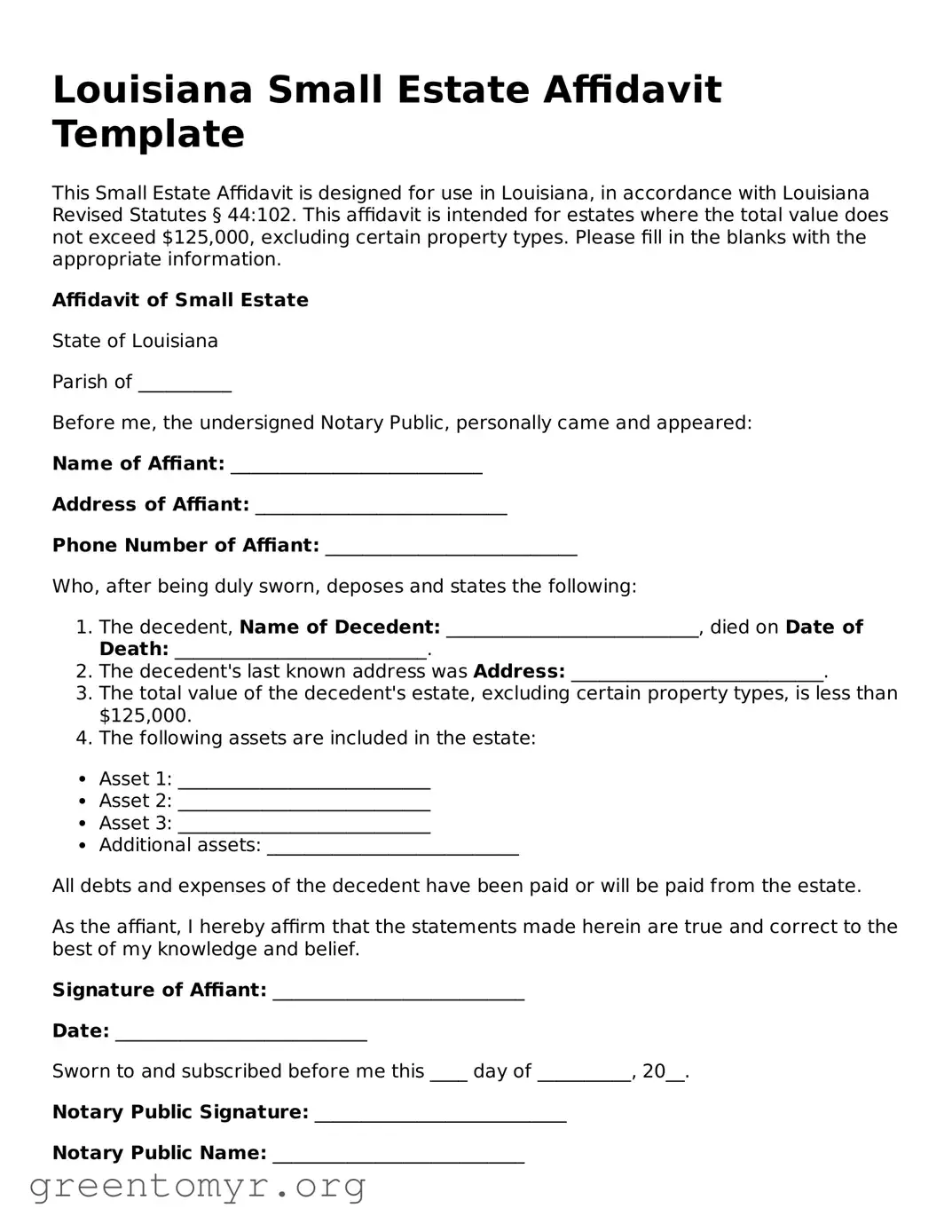
The Louisiana Small Estate Affidavit form serves as a vital tool for individuals navigating the probate process for small estates in Louisiana. Designed to simplify the transfer of assets, this form allows heirs to claim property without the need for a lengthy and costly probate proceeding. Typically applicable when the total value of the estate is below a certain threshold, the Small Estate Affidavit streamlines the process by enabling heirs to affirm their right to inherit. The form requires specific information, including the names of the decedent and the heirs, a description of the assets, and a declaration that the estate qualifies under Louisiana law. By utilizing this affidavit, heirs can efficiently access the decedent's assets, ensuring a smoother transition during a challenging time. Understanding the requirements and implications of the Small Estate Affidavit is crucial for anyone involved in the administration of a small estate in Louisiana.
Louisiana Small Estate Affidavit Template
This Small Estate Affidavit is designed for use in Louisiana, in accordance with Louisiana Revised Statutes § 44:102. This affidavit is intended for estates where the total value does not exceed $125,000, excluding certain property types. Please fill in the blanks with the appropriate information.
Affidavit of Small Estate
State of Louisiana
Parish of __________
Before me, the undersigned Notary Public, personally came and appeared:
Name of Affiant: ___________________________
Address of Affiant: ___________________________
Phone Number of Affiant: ___________________________
Who, after being duly sworn, deposes and states the following:
All debts and expenses of the decedent have been paid or will be paid from the estate.
As the affiant, I hereby affirm that the statements made herein are true and correct to the best of my knowledge and belief.
Signature of Affiant: ___________________________
Date: ___________________________
Sworn to and subscribed before me this ____ day of __________, 20__.
Notary Public Signature: ___________________________
Notary Public Name: ___________________________
My Commission Expires: ___________________________
| Fact Name | Description |
|---|---|
| Purpose | The Louisiana Small Estate Affidavit allows heirs to claim a deceased person's property without going through formal probate. |
| Eligibility | To use this affidavit, the total value of the estate must not exceed $125,000, excluding certain property types. |
| Governing Law | This form is governed by Louisiana Revised Statutes, specifically RS 9:3911 through RS 9:3915. |
| Required Information | The affidavit must include details about the deceased, the heirs, and the property being claimed. |
| Filing Process | After completing the affidavit, it must be filed with the appropriate court or presented to the financial institutions holding the deceased's assets. |
After obtaining the Louisiana Small Estate Affidavit form, you will need to complete it accurately to facilitate the transfer of assets. This process can help simplify the handling of a deceased person's estate without going through formal probate. Follow these steps to fill out the form correctly.
Once the form is filled out and notarized, you will need to submit it to the appropriate court or relevant authority to initiate the estate settlement process.
The Louisiana Small Estate Affidavit is a legal document that allows individuals to claim the assets of a deceased person without going through the formal probate process. This affidavit is typically used when the value of the estate is below a certain threshold, which is currently set at $125,000, excluding certain assets such as real estate.
To use the Small Estate Affidavit, the individual must be an heir or a legatee of the deceased. This means they are either a direct descendant or someone named in the will. Additionally, the estate must meet the value requirement and not include any property that would necessitate formal probate proceedings.
Generally, the Small Estate Affidavit can be used to claim personal property, such as bank accounts, vehicles, and personal belongings. However, it cannot be used for real estate or assets that are held in a trust. It is important to assess the total value of the estate to ensure it falls within the allowable limit.
Completing the Small Estate Affidavit involves several steps:
There is no specific deadline for filing the Small Estate Affidavit; however, it is advisable to do so promptly after the death of the individual. Delaying the process may complicate matters, especially if assets need to be accessed quickly for expenses or other obligations.
If the total value of the estate exceeds the $125,000 limit, the Small Estate Affidavit cannot be used. In such cases, formal probate proceedings will be necessary to distribute the assets. This process can be more complex and may require the assistance of a legal professional.
Yes, the Small Estate Affidavit can be contested. Interested parties, such as other heirs or beneficiaries, may challenge the affidavit if they believe it was completed incorrectly or if they have a claim to the assets. It is advisable to ensure that all information is accurate and that all potential heirs are accounted for to minimize the risk of disputes.
Filling out the Louisiana Small Estate Affidavit form can be a straightforward process, but there are common mistakes that individuals often make. One frequent error is providing incorrect or incomplete information about the deceased. It is essential to include the full legal name, date of birth, and date of death. Omitting any of these details can lead to delays in processing the affidavit.
Another mistake involves failing to list all the assets owned by the deceased. The Small Estate Affidavit is designed to address small estates, typically those valued at less than $125,000. If any assets are overlooked, it could result in complications or even the rejection of the affidavit. Individuals should take care to account for all property, bank accounts, and other valuables.
Some people neglect to include necessary supporting documentation. Along with the affidavit, it is crucial to provide a copy of the death certificate and any other relevant documents. Without these attachments, the affidavit may not be accepted by the court, causing unnecessary delays.
Inaccurate signatures can also pose a problem. The affidavit must be signed by the appropriate parties, typically the heirs or the individual handling the estate. If the signatures do not match the names listed on the affidavit or if there are missing signatures, this can lead to legal complications.
Lastly, individuals often overlook the requirement for notarization. The Small Estate Affidavit must be notarized to be valid. Failing to have the document notarized can render it ineffective, requiring individuals to start the process over again. Ensuring that all steps are followed correctly is essential for a smooth and efficient filing.
When dealing with the Louisiana Small Estate Affidavit, several other forms and documents may be necessary to ensure a smooth process. Each of these documents plays a role in clarifying ownership, verifying debts, or facilitating the transfer of assets. Below is a list of commonly used forms alongside the Small Estate Affidavit.
Having these documents prepared and organized can significantly streamline the estate settlement process. Each form serves a unique purpose and collectively helps ensure that the deceased's wishes are honored and that all legal requirements are met.
When filling out the Louisiana Small Estate Affidavit form, it is important to follow certain guidelines to ensure the process goes smoothly. Here are four essential do's and don'ts to keep in mind:
The Louisiana Small Estate Affidavit form is a valuable tool for settling the estates of deceased individuals with minimal assets. However, several misconceptions can lead to confusion and missteps in the process. Here are seven common misunderstandings about this form:
Understanding these misconceptions can help streamline the estate settlement process and ensure that the intentions of the deceased are honored efficiently.
When dealing with the Louisiana Small Estate Affidavit form, it’s essential to understand its purpose and the process involved. Here are five key takeaways that can help you navigate this important document.
Understanding these key points can streamline the process of handling a small estate in Louisiana. Always consider seeking guidance if you encounter uncertainties along the way.