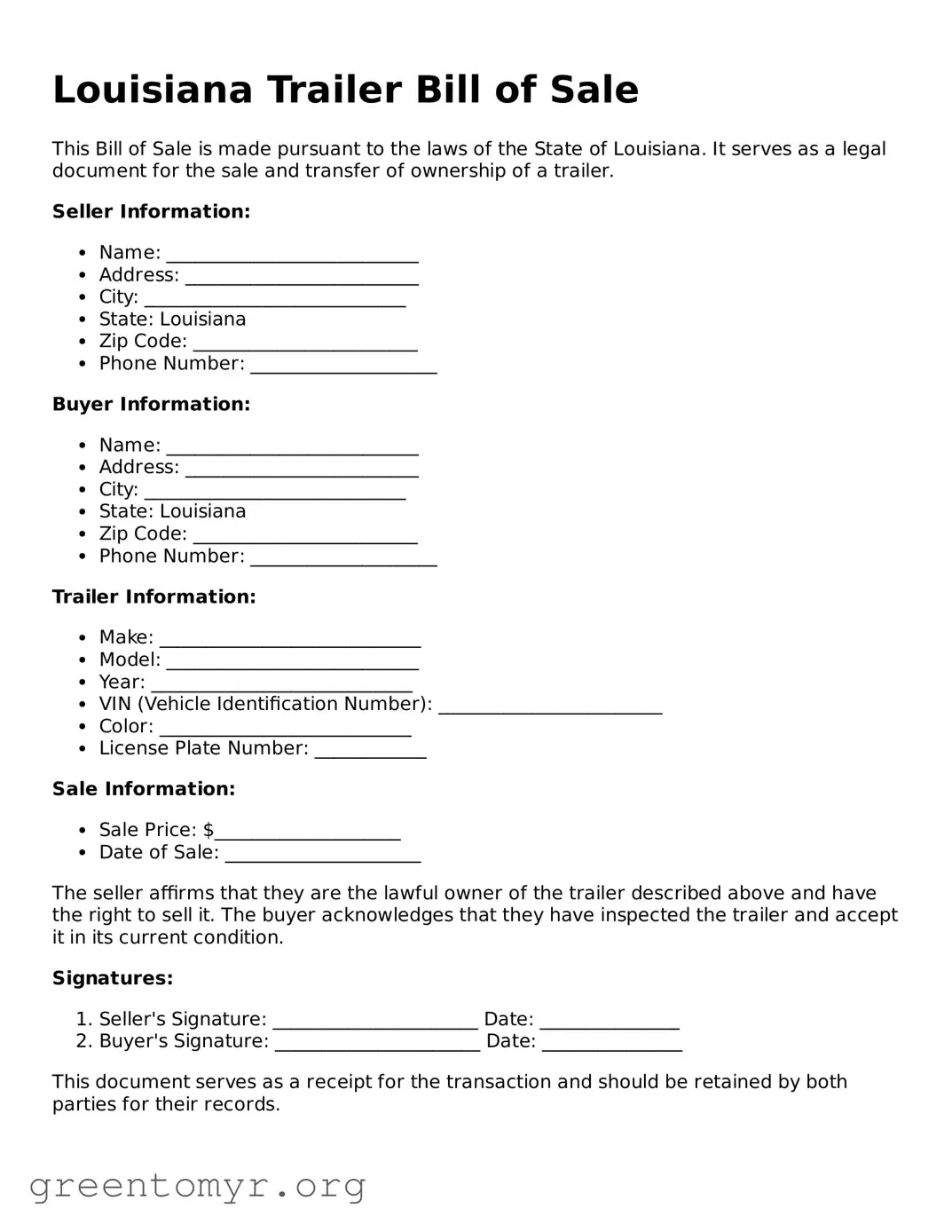
The Louisiana Trailer Bill of Sale form serves as a crucial document for individuals engaged in the buying or selling of trailers within the state. This form facilitates the transfer of ownership, providing both the seller and the buyer with a written record of the transaction. Essential details such as the identification of the trailer, including its make, model, year, and vehicle identification number (VIN), must be accurately recorded. Additionally, the form requires the names and addresses of both parties involved, ensuring clarity and transparency in the transaction. The inclusion of the purchase price and the date of sale further solidifies the agreement, while the signatures of both the buyer and seller affirm their consent to the terms outlined. By utilizing this form, individuals not only comply with state regulations but also protect their interests, making it an indispensable tool in the trailer sales process.
Louisiana Trailer Bill of Sale
This Bill of Sale is made pursuant to the laws of the State of Louisiana. It serves as a legal document for the sale and transfer of ownership of a trailer.
Seller Information:
Buyer Information:
Trailer Information:
Sale Information:
The seller affirms that they are the lawful owner of the trailer described above and have the right to sell it. The buyer acknowledges that they have inspected the trailer and accept it in its current condition.
Signatures:
This document serves as a receipt for the transaction and should be retained by both parties for their records.
| Fact Name | Description |
|---|---|
| Purpose | The Louisiana Trailer Bill of Sale form is used to document the sale or transfer of ownership of a trailer. |
| Governing Law | This form is governed by the Louisiana Revised Statutes, specifically Title 32, which covers motor vehicles and trailers. |
| Seller Information | The form requires the seller's name, address, and signature to validate the transaction. |
| Buyer Information | Buyers must provide their name and address, ensuring both parties are clearly identified. |
| Trailer Details | Essential details about the trailer, such as make, model, year, and Vehicle Identification Number (VIN), must be included. |
| Sale Price | The agreed-upon sale price of the trailer must be documented in the form for clarity and record-keeping. |
| Notarization | While notarization is not mandatory, it is recommended to add an extra layer of authenticity to the transaction. |
Filling out the Louisiana Trailer Bill of Sale form is an important step in transferring ownership of a trailer. Once you have completed the form, it will serve as a legal document that records the sale and protects both the buyer and seller. Make sure to keep a copy for your records after it has been signed.
A Louisiana Trailer Bill of Sale is a legal document that records the sale of a trailer from one party to another. This form provides proof of ownership and outlines the details of the transaction. It typically includes information about the buyer, seller, trailer specifications, and the sale price.
A Bill of Sale is important for several reasons:
The Bill of Sale typically includes the following information:
While a Bill of Sale is not legally required for all trailer sales in Louisiana, it is highly recommended. Having this document can prevent misunderstandings and provide clarity about the transaction. Additionally, it may be necessary for registering the trailer with the Louisiana Department of Motor Vehicles (DMV).
To complete a Louisiana Trailer Bill of Sale, follow these steps:
Yes, you can use a generic Bill of Sale, but it is best to use a form specifically designed for trailers in Louisiana. This ensures that you include all necessary information and comply with state regulations. A tailored form can also help avoid any potential issues during the registration process.
After completing the Bill of Sale, both the buyer and seller should keep a signed copy for their records. The buyer should then take the Bill of Sale to the DMV to register the trailer in their name. It’s also wise to check if any additional documents are required for the registration process.
Filling out the Louisiana Trailer Bill of Sale form can be straightforward, but many people make common mistakes that can lead to complications. One frequent error is failing to include the correct vehicle identification number (VIN). This number is crucial for identifying the trailer and ensuring that the sale is legitimate. Leaving it out or entering it incorrectly can cause problems when registering the trailer.
Another mistake is not providing accurate seller and buyer information. It is essential to include full names, addresses, and contact information for both parties. Omitting any of these details can lead to confusion or disputes later on. Additionally, some people forget to sign the document. A signature from both the seller and the buyer is necessary for the bill of sale to be legally binding.
Many individuals also overlook the importance of specifying the sale price. The form should clearly state how much the buyer is paying for the trailer. This amount is not only vital for the transaction but also for tax purposes. In some cases, people might write down an amount but fail to indicate the currency, leading to misunderstandings.
Another common error involves failing to date the bill of sale. The date is significant because it marks the official transfer of ownership. Without a date, it can be challenging to establish when the transaction took place, which may lead to issues in the future.
Some individuals neglect to include any warranties or disclaimers regarding the trailer's condition. If the trailer has any known issues, these should be documented in the bill of sale. Failing to do so may leave the seller liable for problems that arise after the sale.
Inaccurate descriptions of the trailer are also a frequent mistake. The form should include details such as the make, model, year, and color. Vague descriptions can create confusion and may even lead to legal disputes if the buyer feels misled.
People sometimes forget to check for additional requirements specific to their local area. While the bill of sale is a standard document, some parishes may have unique regulations or forms that need to be completed. Not being aware of these requirements can lead to delays in the registration process.
Another oversight occurs when individuals do not keep copies of the completed bill of sale. Both parties should retain a copy for their records. This documentation serves as proof of the transaction and can be helpful if any issues arise later.
Lastly, some individuals fail to seek legal advice when unsure about the process. While the bill of sale form may seem simple, having clarity on the legal implications can save time and trouble. Consulting with a professional can help ensure that all aspects of the sale are handled correctly.
When transferring ownership of a trailer in Louisiana, the Trailer Bill of Sale form is an essential document. However, several other forms and documents may accompany it to ensure a smooth and legally compliant transaction. Below is a list of these important documents, each serving a specific purpose in the process.
Utilizing these documents in conjunction with the Louisiana Trailer Bill of Sale form can facilitate a seamless transfer of ownership. Each document plays a crucial role in ensuring that both parties are protected and that the transaction adheres to state regulations.
The Trailer Bill of Sale form shares similarities with several other documents related to the transfer of ownership. Here are four key documents that resemble it:
When filling out the Louisiana Trailer Bill of Sale form, certain practices can help ensure a smooth transaction. Here is a list of things to do and avoid:
When dealing with the Louisiana Trailer Bill of Sale form, it’s important to clarify some common misconceptions. Misunderstandings can lead to confusion and potential issues down the line. Here are eight misconceptions to be aware of:
This is not true. The Bill of Sale is required for both new and used trailers to document the transfer of ownership.
In Louisiana, a properly completed Bill of Sale is a legal document that can serve as proof of ownership and can be enforced in court.
While a title is important, the Bill of Sale provides additional proof of the transaction and is often required for registration purposes.
While it is possible to handwrite the form, it is recommended to use a printed version to ensure clarity and professionalism.
Both the seller and the buyer should sign the document to validate the transaction and protect both parties.
Even informal transactions should be documented with a Bill of Sale to prevent disputes and provide a record of the sale.
While many templates exist, using the specific Louisiana Trailer Bill of Sale form ensures compliance with state laws.
Notarization is not required for the Bill of Sale in Louisiana, but it can add an extra layer of security and authenticity to the document.
Understanding these misconceptions can help you navigate the process of buying or selling a trailer in Louisiana with confidence. Always ensure that you have the right documentation in place to protect your interests.
When filling out and using the Louisiana Trailer Bill of Sale form, keep these key takeaways in mind: