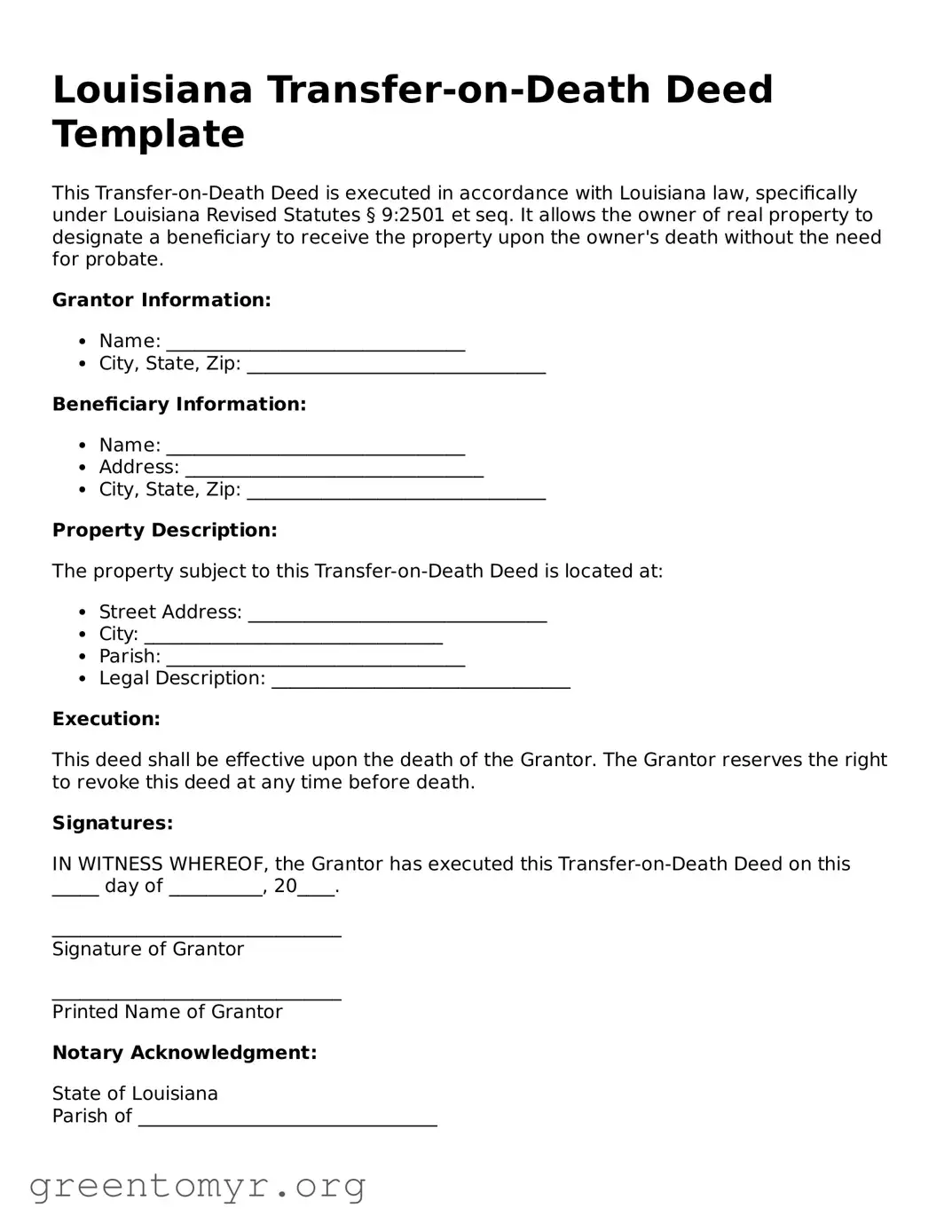
The Louisiana Transfer-on-Death Deed (TODD) form serves as a valuable estate planning tool for property owners in the state. This legal document allows individuals to designate beneficiaries who will receive their real estate upon the owner's death, bypassing the often lengthy probate process. By completing this form, property owners can maintain control over their assets during their lifetime while ensuring a smooth transfer of ownership to their chosen beneficiaries. The TODD form must be executed in accordance with specific state requirements, including notarization and proper recording with the local parish clerk. This process helps to prevent disputes and clarifies the owner's intentions, making it a straightforward option for those looking to simplify the transfer of property. Understanding the nuances of the Louisiana Transfer-on-Death Deed is essential for effective estate planning and can significantly ease the burden on loved ones during a difficult time.
Louisiana Transfer-on-Death Deed Template
This Transfer-on-Death Deed is executed in accordance with Louisiana law, specifically under Louisiana Revised Statutes § 9:2501 et seq. It allows the owner of real property to designate a beneficiary to receive the property upon the owner's death without the need for probate.
Grantor Information:
Beneficiary Information:
Property Description:
The property subject to this Transfer-on-Death Deed is located at:
Execution:
This deed shall be effective upon the death of the Grantor. The Grantor reserves the right to revoke this deed at any time before death.
Signatures:
IN WITNESS WHEREOF, the Grantor has executed this Transfer-on-Death Deed on this _____ day of __________, 20____.
_______________________________
Signature of Grantor
_______________________________
Printed Name of Grantor
Notary Acknowledgment:
State of Louisiana
Parish of ________________________________
On this _____ day of __________, 20____, before me, a Notary Public, personally appeared ________________________________, known to me to be the person whose name is subscribed to the within instrument, and acknowledged that he/she executed the same for the purposes therein contained.
_______________________________
Notary Public Signature
My Commission Expires: ________________________________
| Fact Name | Description |
|---|---|
| Definition | A Transfer-on-Death Deed allows property owners to transfer real estate to beneficiaries upon their death without going through probate. |
| Governing Law | The Transfer-on-Death Deed in Louisiana is governed by Louisiana Revised Statutes, specifically R.S. 9:2501 to 9:2507. |
| Eligibility | Any individual who owns real property in Louisiana can create a Transfer-on-Death Deed. |
| Beneficiaries | Property owners can name one or more beneficiaries in the deed. |
| Revocation | A Transfer-on-Death Deed can be revoked or changed by the property owner at any time before their death. |
| Recording Requirement | The deed must be recorded in the parish where the property is located to be effective. |
| No Immediate Transfer | The transfer of property does not occur until the death of the property owner. |
| Tax Implications | Beneficiaries may face tax implications when they inherit the property, including potential property taxes and capital gains taxes. |
Filling out the Louisiana Transfer-on-Death Deed form is a straightforward process that allows property owners to designate beneficiaries for their real estate. Once the form is completed, it must be filed with the appropriate local authority to ensure it is legally recognized.
A Transfer-on-Death Deed (TOD) allows a property owner to transfer real estate to a designated beneficiary upon their death. This deed is effective immediately upon signing but does not transfer ownership until the owner's death, allowing the owner to retain full control of the property during their lifetime.
Any individual who owns real estate in Louisiana can use a TOD deed. This includes homeowners, individuals with inherited property, and those holding property in their name alone. However, property owned jointly or in a trust may not be eligible for this type of transfer.
To create a TOD deed, follow these steps:
While it is not legally required to have a lawyer, consulting one is advisable. A lawyer can help ensure that the deed is filled out correctly and complies with all state laws, reducing the risk of future disputes.
Yes, you can change or revoke a TOD deed at any time during your lifetime. To do so, you must create a new deed that explicitly revokes the previous one or file a written revocation with the parish clerk of court.
If no beneficiary is named in the TOD deed, the property will be treated as if there was no deed. This means it may go through probate, and the property will be distributed according to Louisiana's intestacy laws.
A TOD deed does not typically affect property taxes during the owner's lifetime. However, the property may be subject to reassessment upon the transfer of ownership after death, which could impact the tax rate for the beneficiary.
Yes, you can name multiple beneficiaries in a TOD deed. It is essential to clearly specify how the property will be divided among them, whether equally or in specific proportions.
Some key benefits include:
No, not all states recognize Transfer-on-Death Deeds. Louisiana is one of the states that allows them, but it is crucial to check the laws in your specific state if you own property elsewhere.
Filling out the Louisiana Transfer-on-Death Deed form can be straightforward, but many people make common mistakes that can lead to complications later on. One frequent error is not providing accurate property descriptions. It’s essential to clearly identify the property being transferred. Vague descriptions can create confusion and may even invalidate the deed.
Another mistake is failing to include all necessary parties. If there are multiple beneficiaries, all of them must be named in the deed. Omitting even one person can result in legal issues down the road. Make sure everyone who has a claim to the property is included to avoid disputes among heirs.
Many people overlook the requirement for signatures. The deed must be signed by the person transferring the property, and in some cases, it may also require notarization. Not having the correct signatures can render the document ineffective. Always double-check that all signatures are present and properly executed.
People sometimes forget to file the deed with the appropriate parish office. After completing the form, it’s crucial to submit it to the local clerk of court or recorder of deeds. If the deed isn’t filed, it won’t be legally recognized. This step is vital to ensure that the transfer is officially recorded.
Lastly, individuals may not understand the implications of the deed. A Transfer-on-Death Deed allows for a smooth transition of property upon death, but it doesn’t eliminate the need for a will or other estate planning documents. Failing to consider the overall estate plan can lead to unintended consequences. Always think about how this deed fits into your broader plans.
When dealing with property transfer in Louisiana, several documents may accompany the Transfer-on-Death Deed. Each document serves a specific purpose in ensuring a smooth transition of ownership. Below is a list of commonly used forms that may be relevant.
Understanding these documents can help ensure that the transfer of property is handled correctly and in accordance with the law. It is always advisable to consult with a professional when navigating these processes.
The Transfer-on-Death Deed (TOD) form is a legal document that allows property owners to transfer their real estate to designated beneficiaries upon their death, bypassing the probate process. Several other documents serve similar purposes in estate planning and property transfer. Below are four such documents, along with explanations of their similarities to the TOD deed.
When filling out the Louisiana Transfer-on-Death Deed form, it's important to follow specific guidelines to ensure the document is completed correctly. Below is a list of things you should and shouldn't do.
The Louisiana Transfer-on-Death Deed (TODD) is a legal instrument that allows property owners to transfer their real estate to designated beneficiaries upon their death. However, several misconceptions surround this form. Here are nine common misunderstandings:
Understanding these misconceptions can help property owners make informed decisions about their estate planning and ensure that their wishes are honored after their passing.
The Louisiana Transfer-on-Death Deed allows property owners to transfer real estate to beneficiaries upon their death without going through probate.
To use this form, the property owner must complete the deed with accurate information about the property and the designated beneficiaries.
It is essential to sign the deed in the presence of a notary public and at least two witnesses to ensure its validity.
The deed must be recorded in the parish where the property is located to take effect. This step is crucial for the transfer to be legally recognized.
Beneficiaries can be individuals or entities, and the property owner can designate multiple beneficiaries.
Property owners retain full control of their property during their lifetime, and they can revoke or change the deed at any time.
Consulting with a legal professional is advisable to ensure that the deed complies with Louisiana laws and meets the owner's intentions.