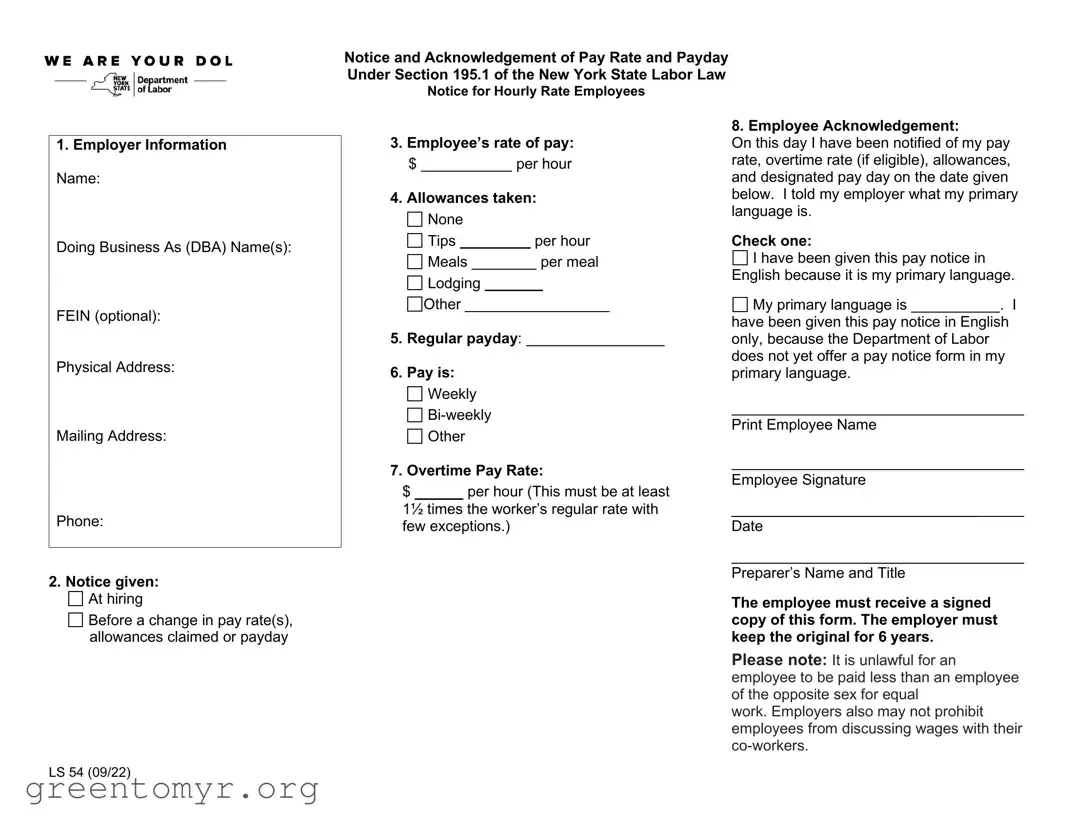
The LS 54 form serves as a crucial document for employers and employees in New York, ensuring transparency regarding pay rates and paydays. This form, officially titled the "Notice and Acknowledgement of Pay Rate and Payday," is required under Section 195.1 of the New York State Labor Law, specifically for hourly rate employees. It includes essential information such as the employer's details, including the name and address of the College of Staten Island, and the contact number for inquiries. Employees must be informed of their hourly pay rate, any allowances they may be entitled to, and the regular payday, which is set as Thursday in this case. Additionally, the LS 54 outlines the frequency of pay, which can be weekly or bi-weekly, and it highlights the importance of overtime pay, specifying that it must be at least one and a half times the regular rate, with some exceptions. The form also includes an employee acknowledgment section, where the employee confirms receipt of this important information and indicates their primary language. Employers are required to provide a signed copy to the employee while retaining the original for a period of six years. This form not only protects the rights of workers but also helps employers maintain compliance with labor laws.
1. Employer Information
Name:
Doing Business As (DBA) Name(s):
FEIN (optional):
Physical Address:
Mailing Address:
Phone:
2. Notice given: |
Notice and Acknowledgement of Pay Rate and Payday Under Section 195.1 of the New York State Labor Law
Notice for Hourly Rate Employees
3. Employee’s rate of pay:
$ |
|
per hour |
4. Allowances taken:
None |
|
|
|
||||
Tips |
|
per hour |
|||||
Meals |
|
|
per meal |
||||
Lodging |
|
|
|
|
|||
Other |
|
|
|
|
|||
5.Regular payday:
6.Pay is:
Weekly
Other
7.Overtime Pay Rate:
$ per hour (This must be at least 1½ times the worker’s regular rate with few exceptions.)
8. Employee Acknowledgement:
On this day I have been notified of my pay rate, overtime rate (if eligible), allowances, and designated pay day on the date given below. I told my employer what my primary language is.
Check one:
I have been given this pay notice in English because it is my primary language.
My primary language is |
|
. I |
have been given this pay notice in English |
|
|
only, because the Department of Labor |
|
|
does not yet offer a pay notice form in my primary language.
Print Employee Name
Employee Signature
______________________________
Date
Preparer’s Name and Title
At hiring |
Before a change in pay rate(s), allowances claimed or payday
The employee must receive a signed copy of this form. The employer must keep the original for 6 years.
Please note: It is unlawful for an employee to be paid less than an employee of the opposite sex for equal
work. Employers also may not prohibit employees from discussing wages with their
LS 54 (09/22)
| Fact Name | Description |
|---|---|
| Purpose | The LS 54 form provides employees with written notice of their pay rate, overtime rate, allowances, and payday. |
| Governing Law | This form is governed by Section 195.1 of the New York State Labor Law. |
| Employee Acknowledgment | Employees must acknowledge receipt of the pay notice by signing the form. |
| Retention Requirement | Employers must keep the original LS 54 form for a minimum of 6 years. |
| Pay Frequency | Employers can choose to pay employees weekly, bi-weekly, or other specified intervals. |
Completing the LS 54 form is a straightforward process that requires careful attention to detail. Once filled out, this form serves as a record of the pay rate and payday information for employees. It's essential to ensure that all sections are accurately completed to avoid any misunderstandings in the future.
Once completed, ensure the employer retains the original for six years, while the employee should keep their signed copy for their records. This will help in maintaining transparency and clarity regarding pay rates and schedules.
The LS 54 form is a notice and acknowledgment of pay rate and payday required under Section 195.1 of the New York State Labor Law. It is specifically designed for hourly rate employees. This form ensures that employees are informed about their pay rate, overtime rate (if applicable), allowances, and designated paydays. Employers must provide this form at the time of hiring or before any changes to pay rates or paydays.
Both employers and employees are involved in filling out the LS 54 form. Employers must provide the necessary information, including their name, address, and pay rate details. Employees must acknowledge receipt of the form by signing it. This form is essential for hourly rate employees to ensure they understand their compensation structure.
The LS 54 form includes several key pieces of information:
Employees who receive the LS 54 form are typically paid on a bi-weekly basis, as indicated in the form. However, the employer can choose to pay employees weekly or through other arrangements, as long as this information is clearly stated in the form.
If an employee does not receive the LS 54 form, they should first discuss the matter with their employer. It is important for employees to have this documentation for their records. If the issue persists, employees can contact the New York State Department of Labor for assistance. Keeping a record of pay and working conditions is crucial for employee rights.
Employers are required to retain the original LS 54 form for a period of six years. This retention period is important for compliance with labor laws and to ensure that there is a record of the pay rate and other related information in case of disputes or audits.
Filling out the LS 54 form correctly is essential for ensuring compliance with New York State Labor Law. However, several common mistakes can lead to complications. Understanding these pitfalls can help both employers and employees navigate the process more smoothly.
One frequent error is leaving out the employee's rate of pay. This section is crucial, as it establishes the basis for compensation. Without this information, the form is incomplete, and it can lead to misunderstandings about pay expectations.
Another mistake involves the selection of allowances taken. Some individuals may mistakenly check the box for allowances when they do not apply. For example, if an employee does not receive tips, meals, or lodging, they should select None. Failing to do so can create confusion regarding the employee's compensation structure.
Additionally, many people overlook the importance of accurately indicating the regular payday. It is essential to specify whether the payday is weekly, bi-weekly, or another frequency. Incorrectly marking this section can lead to payment delays or disputes over pay periods.
Another common oversight is neglecting to complete the employee acknowledgment section. This part of the form confirms that the employee has been informed of their pay rate and other relevant details. If this section is left blank, it may appear that the employee was not properly notified, which can lead to compliance issues.
Some individuals also fail to provide a primary language indication. Employees should check the appropriate box to clarify whether they have received the pay notice in their primary language. This detail is important for ensuring clear communication and understanding of pay-related information.
Finally, not ensuring that the employee receives a signed copy of the form is a significant mistake. The employee must have this documentation for their records, while the employer is responsible for keeping the original for six years. Neglecting this step can lead to difficulties in case of disputes or audits.
By being aware of these common mistakes, both employers and employees can ensure that the LS 54 form is completed accurately and comprehensively, fostering a smoother working relationship.
The LS 54 form serves as a crucial document for employers in New York, ensuring that employees are informed about their pay rates and paydays. However, there are several other forms and documents that often accompany the LS 54 to facilitate compliance with labor laws and enhance workplace communication. Here’s a list of some commonly used documents:
Understanding these forms and their purposes can help both employers and employees navigate the complexities of employment law. By ensuring that all necessary documents are completed and understood, both parties can foster a transparent and compliant workplace environment.
When filling out the LS 54 form, it is important to follow certain guidelines to ensure accuracy and compliance. Here are seven things you should and shouldn't do:
Understanding the LS 54 form can be crucial for both employers and employees. However, several misconceptions surround this important document. Here are nine common misunderstandings:
Clearing up these misconceptions can help ensure that both employers and employees are on the same page regarding pay and labor laws.
Here are some key takeaways about filling out and using the LS 54 form:
Keep in mind that the employer must retain the original form for six years. This is crucial for compliance with New York State Labor Law.