The Lynch Beneficiary Designation form is a crucial document for individuals managing various types of accounts at Merrill Lynch, including IRAs, Health Savings Accounts, and Education Savings Accounts. This form allows account holders to designate beneficiaries who will receive the account balance upon their death, ensuring that their assets are distributed according to their wishes. It replaces any prior beneficiary designations, emphasizing the importance of keeping beneficiary information current. The form requires account holders to provide detailed information about their chosen beneficiaries, including names, relationships, and tax identification numbers, which helps streamline the distribution process later on. Additionally, the form outlines instructions for both primary and contingent beneficiaries, ensuring that there is a clear plan in place should the primary beneficiaries not survive the account holder. Importantly, it allows for customization of beneficiary designations and provides options for the method of distribution, such as “per stirpes” or “per capita.” Completing this form accurately is essential, as it has significant legal and financial implications. Consulting with a tax or legal professional before finalizing the designations is highly recommended to navigate the complexities involved.

Beneficiary Designation Form
MERRILL~.
A BANIK OF AMIUl'ICA C:OMPAN"I'
This form is to be used to designate beneficiaries or to replace all prior beneficiary designations at Merrill for the accounts listed below.
n IRA |
n BASIC™ |
n Archer Medical Savings Account (MSA) |
n IRRA® |
n SEP IRA |
n Health Savings Account (HSA) |
n Roth IRA |
n SIMPLE IRA |
n Merrill Lynch Education Savings Account® (MLESA)* |
Instructions:
nUse one form per client. Additional clients must use a separate Beneficiary Designation Form.
nAdditional instructions for completing this form appear below and throughout the form.
nForward your completed form, in its entirety (pages
Advisory Center. |
|
Merrill Lynch Wealth Management Clients |
Merrill Edge |
Please contact your personal advisor to obtain your |
Investing Clients |
advisor's office fax number or address for |
Fax to: 866.994.7807 |
prompt processing. |
Or, you can mail to the following address: |
|
Merrill • P.O. Box 29002, Hot Springs, AR |
nPlease retain a copy of this form for your records.
Completing Designation/Change of Beneficiary(ies):
nDesignating or changing your beneficiary(ies) has important consequences. We urge you to consult your attorney and/or tax advisor before completing this form.
nYou may name one or more individuals and/or entities to be the primary or contingent beneficiary(ies) of your account, including your estate, trust or other entity. For all beneficiary(ies) named, the percentages must total 100%, (Percentages up to the hundredth decimal may be used).
For individuals, please indicate the legal name, social security number, date of birth, and relationship for each beneficiary. Depending on your designation, the relationship field may affect your Required Minimum Distribution (RMD) calculation. Therefore, it is important to specify the correct relationship (i.e. spouse,
nPlease do not submit copies of your will or trust document. If an estate or trust is designated, Merrill shall rely solely upon the instructions of the executor/administrator or trustee and shall have no responsibility for monitoring the terms of the will or trust.
nAfter your death, the balance in your account(s) shall be distributed to the primary beneficiary(ies) in proportion to the payment percentages indicated. If a primary beneficiary predeceases you, his/her share will be distributed to the remaining primary beneficiary(ies) in proportion to the payment percentages. If no primary beneficiary(ies) survive you, the balance will be distributed to your contingent beneficiary(ies) in the same manner. If no primary or contingent beneficiary(ies) survive you, or if no beneficiary is in effect at the time of your death, we will pay your IRA balance to your surviving spouse, or, if you are not survived by a spouse, to your estate.
nChanging your beneficiary – You may change your beneficiary designation at any time and as often as you wish. Any designation or change of beneficiary is not effective until we receive and accept it. All beneficiary designations must be compatible with our administrative and operational requirements, which may change at any time.
nOptional Designations – Please consult a tax and/or legal professional for further explanation. You may choose only “per stirpes” or “per capita”, but not both, for beneficiaries in the same class (i.e., primary or contingent).
n Per Stirpes is a method of dividing an account where surviving descendants of a deceased beneficiary effectively take the place of their deceased ancestor as primary beneficiary(ies) so that they take the share to which their ancestor was entitled (had he/she lived).
n A Per Capita division of property is an equal division among all named beneficiaries and surviving descendants of deceased ancestors.
n Customized Designations – If your beneficiary designation includes any alterations to the form, provisions in addition to the election of beneficiaries, or if you require additional space to write your designation, please submit your designation on a separate page(s) and attach it to this form. Please write “See Attached” in Section 2, under the Name field. This will be considered a “customized beneficiary designation.” Please note: all customized beneficiary designations must be reviewed for compatibility with Merrill administrative and operational requirements, which may change over time. Please contact your Merrill Lynch Wealth Management Advisor, Client Associate, or the Merrill Advisory Center for more information on customized designations.
*For Merrill Lynch Education Savings Accounts (MLESA), the words “me” and “my” shall refer to the “Student” or “Students,” and the words “you” and “yours” refer to the “Guardian” or the “Guardians” where applicable.
1 of 3
|
|
|
Branch Office Instructions: Form must be branch scanned to each account. |
|
||
|
|
|
|
|
|
|
1: Account Information |
|
|
|
|
|
|
|
|
|
|
|
||
|
|
|
Account Numbers (Designation will apply to all accounts listed below.) |
|
||
|
|
|
|
|
|
|
|
|
|
Required |
|
||
Client Name (One client per form. Additional clients must |
|
|
|
|
|
|
|
|
|
|
|
|
|
complete a separate Beneficiary Designation Form). |
1 |
5 |
|
|
||
|
2 |
|
6 |
|
|
|
|
3 |
|
7 |
|
|
|
|
4 |
|
8 |
|
|
|
2: Designation/Change of Beneficiary(ies)
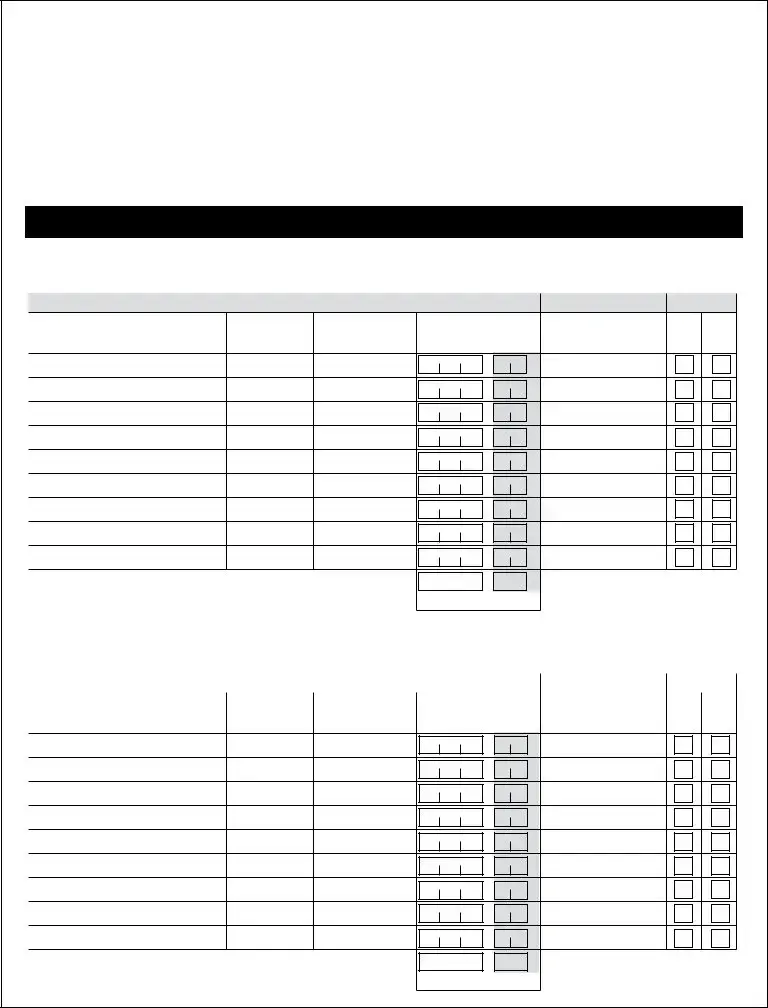
PRIMARY BENEFICIARY(IES): I hereby designate the person(s) or entity(ies) named below as primary beneficiary(ies). You may choose only
“per stirpes” or “per capita”, but not both, in this section. Please refer to the instructions page for more information on these fields required and consult a tax and/or legal professional for further explanation about per stirpes and per capita.
I |
Required |
|
|
|
Optional |
Optional |
|
Name |
Date of Birth |
Relationship |
Share % |
Tax Identification |
Per Per |
||
(MM/DD/YYYY) |
(Enter as XXX.XX) |
Number |
Stirpes Capita |
||||
|
|
||||||
|
|
I |
I |
. [u |
% |
□ □ |
|
|
|
|
|
. [u |
|
||
|
|
I |
I |
% |
□ □ |
||
|
|
|
|
. [u |
|
||
|
|
I |
I |
% |
□ □ |
||
|
|
|
|
. [u |
|
||
|
|
I |
I |
% |
□ □ |
||
|
|
|
|
. [u |
|
||
|
|
I |
I |
% |
□ □ |
||
|
|
|
|
. [u |
|
||
|
|
I |
I |
% |
□ □ |
||
|
|
|
|
. [u |
|
||
|
|
I |
I |
% |
□ □ |
||
|
|
|
|
. [u |
|
||
|
|
I |
I |
% |
□ □ |
||
|
|
|
|
. [u |
|
||
|
|
I |
I |
% |
□ □ |
||
|
|
|
100 |
00 |
% |
||
|
|
|
|
||||
|
|
|
|
. CJ |
|
|
|
|
|
Must Total 100.00% |
|
|
|||
CONTINGENT BENEFICIARY(IES): If there are no primary beneficiary(ies) living at the time of my death, I hereby specify that the balance be distributed to the contingent beneficiary(ies). You may choose only “per stirpes” or “per capita”, but not both, in this section. Please refer to the instructions page for more information on these fields required and consult a tax professional for further explanation about per stirpes and per capita.
I |
|
Required |
|
|
Optional |
Optional |
|
|
Name |
Date of Birth |
Relationship |
Share % |
Tax Identification |
Per |
Per |
|
(MM/DD/YYYY) |
(Enter as XXX.XX) |
Number |
Stirpes Capita |
|||
|
|
|
|||||
|
I |
I |
. [u |
% |
□ □ |
|
I |
I |
. [u |
% |
□ □ |
|
I |
I |
. [u |
% |
□ □ |
|
□ □ |
||||
|
I |
I |
. [u |
% |
|
|
I |
I |
. [u |
% |
□ □ |
|
I |
I |
. [u |
% |
□ □ |
|
□ □ |
||||
|
I |
I |
. [u |
% |
|
|
I |
I |
. [u |
% |
□ □ |
|
□ □ |
||||
|
I |
I |
. [u |
% |
|
|
|
100 |
. CJ |
% |
|
|
|
00 |
|
|
|
NOTE: You must sign and date this form in Section 3 on the following page. |
Must Total 100.00% |
|
|
||
|
|
|
|
|
|
2 of 3

3: Signature
INSTRUCTIONS: You must sign and date your Beneficiary Designation Form in order for it to become effective when received and accepted by Merrill. If you are signing on behalf of the client, include your title in the signature line below and ensure the proper documentation authorizing you to do so is on file and approved. The designation will not be valid without proper approval of authorization.
I understand that if no designated beneficiary survives me, or if no beneficiary designation is in effect at my death, the account balance(s) will be paid to my spouse, or if I am not survived by a spouse, to my estate. I am aware that this form replaces all prior beneficiary designations for
the account(s) listed on this form, becomes effective when received and accepted by Merrill, and will remain in effect until I deliver to Merrill another designation form with a later date.
Signature and Title (e.g. Guardian, Conservator, POA) |
Date (MM/DD/YYYY) |
Daytime Telephone |
4: To be Completed ONLY for BASIC Accounts
INSTRUCTIONS:
Spouse’s Consent to Alternate Beneficiary Designation:
nIf you are not married, the plan administrator or notary public does not have to sign the form.
nIf you are married, your spouse must sign and date this section if you designate someone other than your spouse as beneficiary.
nThe plan administrator or a notary public must sign to certify your spouse’s signature.
Unavailability of Spouse’s Consent:
If you cannot obtain your spouse’s consent, your employer must indicate and certify the reason (see below).
I certify under penalty of perjury that I am not married as of the date this form is signed. I understand that if I marry after this date, the rules for married individuals will apply to me.
Spouse’s Consent to Alternate Beneficiary designation:
“I am the spouse of the participant who made the beneficiary designation on this form and I consent to it. I understand that if someone other than me has been designated beneficiary, my consent means that I give up my rights I may have under the Plan and applicable law (other than rights I may later have as the survivor in a joint annuity with the participant)
to receive those amounts payable under the Plan by reason of the participant’s death to which I would otherwise be entitled if I were the participant’s sole beneficiary.”
Spouse’s consent unavailable because:
Participant’s spouse cannot be located.
Other
“It has been established to my satisfaction that the consent of the participant’s spouse to the participant beneficiary designation of this form cannot be obtained for the reason indicated.”
Signature of Plan Administrator |
Date (MM/DD/YYYY) |
Spouse’s Signature |
|
Date (MM/DD/YYYY) |
|
|
|
Signature of Plan Administrator or Notary Public |
Date (MM/DD/YYYY) |
|
|
|
|
Notary Title/Commission |
Expiration Date (MM/DD/YYYY) |
|
MERRILL~
A BA N!K OF' AIMI[ 'I CA C,OIMPA.N'Y
Merrill Lynch, Pierce, Fenner & Smith Incorporated (also referred to as "MLPF&S" or "Merrill") makes available certain investment products sponsored, managed, distributed or provided by companies that are affiliates of Bank of America Corporation ("BofA Corp."). MLPF&S is a registered
Investment products:
Are Not FDIC Insured
Are Not Bank Guaranteed
May Lose Value
© 2021 Bank of America Corporation. All rights reserved.
Code
3 of 3
| Fact Name | Description |
|---|---|
| Purpose | The Lynch Beneficiary Designation form is used to designate beneficiaries for various accounts at Merrill Lynch, replacing any prior designations. |
| Account Types | This form applies to multiple account types, including IRAs, Health Savings Accounts, and Education Savings Accounts. |
| Information Required | Clients must provide detailed information for each beneficiary, including legal names, Social Security numbers, and relationships to ensure accurate processing. |
| Distribution Rules | Upon the account holder's death, assets will be distributed first to primary beneficiaries, then to contingent beneficiaries, and finally to the estate if no beneficiaries survive. |
| Customization | Clients can submit customized beneficiary designations on separate pages if the standard form does not meet their needs, but these must comply with Merrill’s requirements. |
| Legal Consultation | It is recommended that clients consult legal or tax professionals before completing the form to understand the implications of their beneficiary designations. |
Completing the Lynch Beneficiary Designation form is an important step in ensuring that your assets are distributed according to your wishes. After filling out the form, it should be submitted to your Merrill Lynch Wealth Management Advisor, Client Associate, or the Merrill Advisory Center for processing.
The Lynch Beneficiary Designation form is a document used to specify who will receive the assets in your Merrill accounts after your death. This form allows you to designate primary and contingent beneficiaries, ensuring that your wishes are followed regarding the distribution of your accounts, such as IRAs, HSAs, and education savings accounts.
Any individual with a Merrill account who wants to designate or change beneficiaries should use this form. It is important to complete a separate form for each client, as only one client can be listed per form.
You can use the Lynch Beneficiary Designation form for various types of accounts, including:
To complete the form, follow these steps:
Make sure to provide as much information as possible to ensure timely identification of your beneficiaries after your passing.
If you do not have a designated beneficiary at the time of your death, the account balance will be paid to your surviving spouse. If you are not survived by a spouse, the balance will go to your estate.
Yes, you can change your beneficiary designation at any time. However, the change will only be effective once Merrill receives and accepts the new designation form. It is essential to ensure that all designations comply with Merrill’s administrative requirements.
"Per stirpes" means that if a beneficiary passes away before you, their share will be divided among their descendants. In contrast, "per capita" means that the remaining beneficiaries will equally share the account balance. You can choose only one of these methods for beneficiaries within the same class.
No, you should not submit copies of your will or trust documents with the Lynch Beneficiary Designation form. If you designate an estate or trust as a beneficiary, Merrill will rely solely on the instructions of the executor or trustee without monitoring the terms of the will or trust.
If your beneficiary designations include alterations or additional provisions, you should submit those on separate pages and attach them to the form. Indicate "See Attached" in the appropriate section. All customized designations must be reviewed for compatibility with Merrill's requirements.
If you are married and wish to designate someone other than your spouse as a beneficiary, your spouse must sign the form to consent to this designation. If you cannot obtain your spouse's consent, your employer must certify the reason for the unavailability.
Filling out the Lynch Beneficiary Designation form can seem straightforward, but several common mistakes can lead to complications. One frequent error is failing to provide complete information about each beneficiary. It’s essential to include the full legal name, date of birth, social security number, and relationship for every individual named. Incomplete information can delay the processing of your designation and may complicate the distribution of your assets after your death.
Another mistake is neglecting to ensure that the total percentage for all beneficiaries equals 100%. Each designated beneficiary must have a clearly defined share, and if the percentages do not add up correctly, the designation may be deemed invalid. This can lead to unintended consequences regarding how your assets are distributed.
Some individuals mistakenly believe that simply writing “as per will” or “as per trust” is sufficient. This is not the case. Such designations are considered invalid, which means that your assets may not be distributed according to your wishes. It is crucial to specify exact names and percentages for all beneficiaries to avoid confusion.
Another common oversight involves not consulting with a legal or tax professional before completing the form. The relationships you specify can impact Required Minimum Distribution (RMD) calculations. Without proper guidance, you may inadvertently choose a designation that could have tax implications for your beneficiaries.
Additionally, many people fail to sign and date the form properly. The signature is necessary for the designation to be effective. If you are signing on behalf of someone else, make sure to include your title and ensure that the proper documentation is on file. An unsigned form will not be honored, leaving your beneficiaries without a designated plan.
Finally, some individuals overlook the importance of reviewing the form for compatibility with Merrill’s administrative requirements. If you make any alterations or need additional space for designations, it’s vital to submit those on a separate page and indicate that in the form. Failing to do so could result in your customized designations being rejected.
When managing your financial accounts, it is essential to understand the various forms and documents that may accompany the Lynch Beneficiary Designation form. Each of these documents serves a unique purpose and can play a crucial role in ensuring that your assets are distributed according to your wishes. Below is a list of related documents that you may encounter in this process.
Understanding these documents can help you navigate the complexities of estate planning and ensure that your wishes are clearly communicated and legally binding. Each form plays a vital role in protecting your interests and those of your beneficiaries, making it important to approach this process with care and attention.
The Lynch Beneficiary Designation form is an important document for individuals looking to specify who will receive their assets after their passing. It shares similarities with several other legal documents that also serve to designate beneficiaries or manage asset distribution. Here are four documents that are similar to the Lynch Beneficiary Designation form:
When filling out the Lynch Beneficiary Designation form, it is essential to approach the task with care and attention. Here are some important do's and don'ts to keep in mind:
By following these guidelines, you can help ensure that your beneficiary designations are processed smoothly and accurately. Taking the time to fill out the form correctly can prevent complications for your loved ones in the future.
Key Takeaways for the Lynch Beneficiary Designation Form: