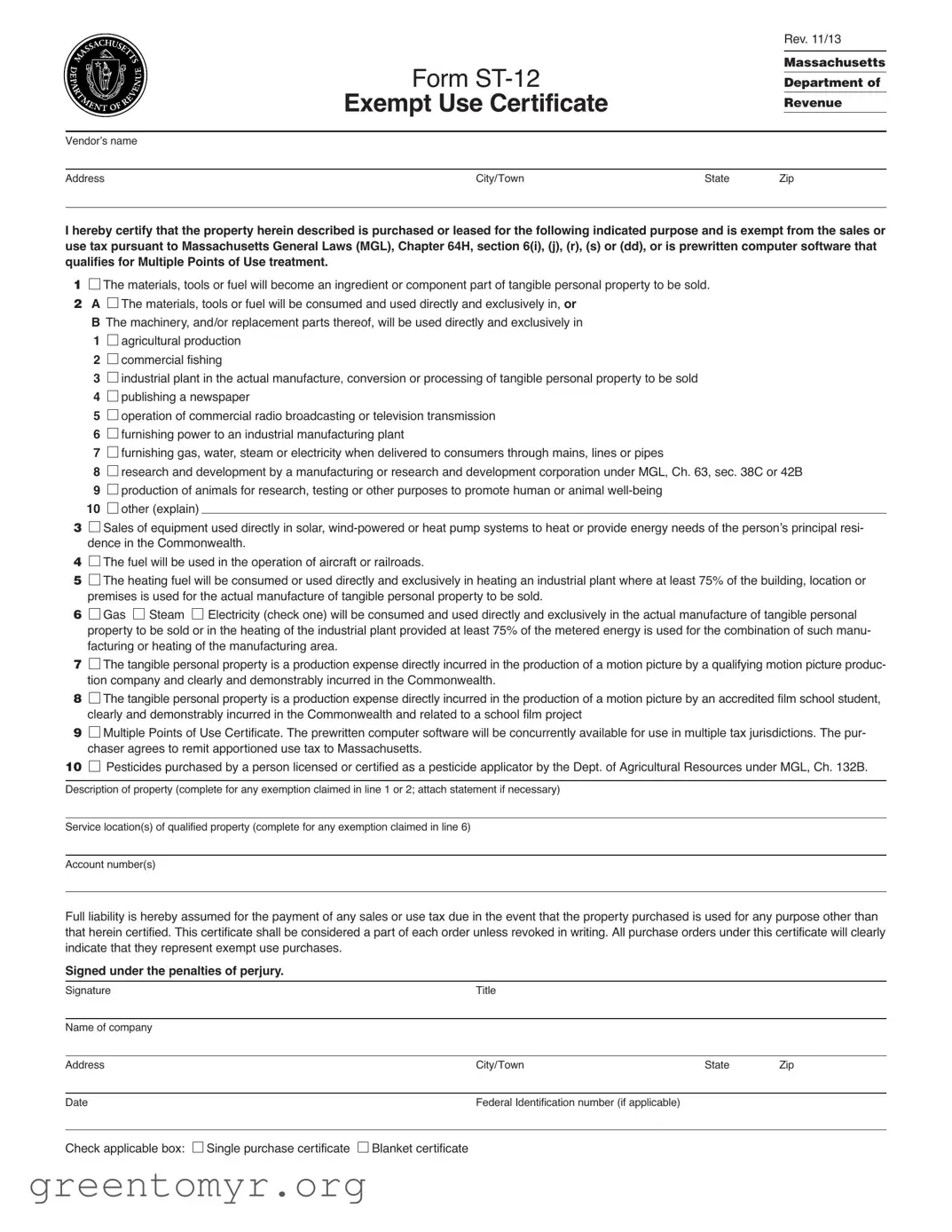
The Massachusetts Exempt Use Certificate, known as Form ST-12, plays a critical role for businesses and individuals seeking to avoid sales or use tax on specific purchases. This form certifies that the property being acquired will be utilized for exempt purposes as defined under Massachusetts General Laws. Key exemptions include materials used in manufacturing, agricultural production, and commercial fishing, among others. Additionally, the form addresses exemptions for prewritten computer software that is available for use in multiple tax jurisdictions. It is essential for both vendors and purchasers to understand the proper use of this certificate, as it shifts the burden of proof regarding tax exemption from the vendor to the purchaser. The completion of this form requires detailed information, including the description of the property and the intended use, ensuring compliance with tax regulations. Failure to adhere to these guidelines could result in significant penalties, making it imperative to handle the ST-12 form with care and accuracy.
Form
Exempt Use Certificate
Rev. 11/13
Massachusetts
Department of
Revenue
Vendor’s name
Address |
City/Town |
State |
Zip |
I hereby certify that the property herein described is purchased or leased for the following indicated purpose and is exempt from the sales or use tax pursuant to Massachusetts General Laws (MGL), Chapter 64H, section 6(i), (j), (r), (s) or (dd), or is prewritten computer software that qualifies for Multiple Points of Use treatment.
1 The materials, tools or fuel will become an ingredient or component part of tangible personal property to be sold.
2A The materials, tools or fuel will be consumed and used directly and exclusively in, or B The machinery, and/or replacement parts thereof, will be used directly and exclusively in 1 agricultural production
2 commercial fishing
3 industrial plant in the actual manufacture, conversion or processing of tangible personal property to be sold 4 publishing a newspaper
5 operation of commercial radio broadcasting or television transmission
6 furnishing power to an industrial manufacturing plant
7 furnishing gas, water, steam or electricity when delivered to consumers through mains, lines or pipes
8 research and development by a manufacturing or research and development corporation under MGL, Ch. 63, sec. 38C or 42B
9 production of animals for research, testing or other purposes to promote human or animal
10 other (explain)
3 Sales of equipment used directly in solar,
4 The fuel will be used in the operation of aircraft or railroads.
5 The heating fuel will be consumed or used directly and exclusively in heating an industrial plant where at least 75% of the building, location or premises is used for the actual manufacture of tangible personal property to be sold.
6 Gas Steam Electricity (check one) will be consumed and used directly and exclusively in the actual manufacture of tangible personal property to be sold or in the heating of the industrial plant provided at least 75% of the metered energy is used for the combination of such manu- facturing or heating of the manufacturing area.
7 The tangible personal property is a production expense directly incurred in the production of a motion picture by a qualifying motion picture produc- tion company and clearly and demonstrably incurred in the Commonwealth.
8 The tangible personal property is a production expense directly incurred in the production of a motion picture by an accredited film school student, clearly and demonstrably incurred in the Commonwealth and related to a school film project
9 Multiple Points of Use Certificate. The prewritten computer software will be concurrently available for use in multiple tax jurisdictions. The pur- chaser agrees to remit apportioned use tax to Massachusetts.
10 Pesticides purchased by a person licensed or certified as a pesticide applicator by the Dept. of Agricultural Resources under MGL, Ch. 132B.
Description of property (complete for any exemption claimed in line 1 or 2; attach statement if necessary)
Service location(s) of qualified property (complete for any exemption claimed in line 6)
Account number(s)
Full liability is hereby assumed for the payment of any sales or use tax due in the event that the property purchased is used for any purpose other than that herein certified. This certificate shall be considered a part of each order unless revoked in writing. All purchase orders under this certificate will clearly indicate that they represent exempt use purchases.
Signed under the penalties of perjury.
Signature |
Title |
|
|
|
|
|
|
Name of company |
|
|
|
|
|
|
|
Address |
City/Town |
State |
Zip |
|
|
|
|
Date |
Federal Identification number (if applicable) |
|
|
Check applicable box: Single purchase certificate Blanket certificate

Form
General Information
Certain consumers may not be required to pay a sales tax if the property they purchase is to be used in a manner which exempts it from taxation.
If tangible personal property, including fuel, gas, steam or electric- ity is purchased and that purchase qualifies for an exemption from the sales or use tax, the purchaser may present an exempt use certificate to the vendor to certify that the property will be used in an exempt manner. The burden of proving that a sale of tangible personal property by any vendor is exempt from tax is on the ven- dor, unless the vendor accepts from the purchaser a certificate declaring that the property is exempt from tax. The Multiple Points of Use Certificate claimed on line 9 is only applicable to prewritten computer software that will be concurrently available for use in multiple tax jurisdictions.
Notice to Vendors
The vendor must make sure that the certificate is completed prop- erly and signed before accepting it.
An exempt use certificate relieves the vendor from the burden of proof only if it is taken in good faith from a purchaser who, at the time of purchase, intends to use the property in an exempt man- ner, or is unable to ascertain at the time of purchase that it will be used in an exempt manner.
A Multiple Points of Use Certificate claimed on line 9 relieves the vendor from the obligation to collect, pay, or remit the applicable tax on sales of prewritten software.
The exemption claimed on line 10 for sales to a person licensed or certified as a pesticide applicator by the Department of Agricultural Resources under MGL, Ch. 132B only applies to sales of pesticides, including insecticides, herbicides, fungicides, miticides and all mate- rials registered with the Environmental Protection Agency as pesti- cides under Federal Insecticide, Fungicide and Rodenticide Act as well as other pesticides commonly regarded in the same category and for the same purpose. See TIR
The vendor must retain this certificate as part of his/her tax rec- ords. For further information regarding the requirements for retain- ing records, see Massachusetts Regulation, 830 CMR 62C.25.1.
Notice to Contractors
This form may be used by a contractor when purchasing or leasing tangible personal property from a vendor in connection with fulfilling a contract with its customer if the property will be used for one of the exempt uses described in Massachusetts General Laws (MGL) chapter 64H, section 6(r) or (s), which include the following: use di- rectly and exclusively in an industrial plant in the actual manufac- ture of tangible personal property to be sold; in the furnishing of power to an industrial manufacturing plant; in the furnishing of gas, water, steam or electricity when delivered to consumers through mains, lines or pipes; in research and development by a manufac- turing corporation or research and development corporation; in ag- ricultural production; in commercial fishing.
A contractor purchasing property exempt under MGL chapter 64H, section 6(r) or (s), may sign and present this form to its vendor. The contractor bears the burden of proof of demonstrating on audit that the items purchased are or will be used in an exempt manner. In the event that the items do not qualify for exemption under section 6(r) or (s), the contractor will be liable for the tax. An exempt use cer- tificate furnished by the contractor’s customer to the contractor will not relieve the contractor from liability. See DD
Notice to Purchasers
This form is not to be used by an exempt organization (use Form
If a purchaser makes any use of the property other than an exempt use, such property will be subject to the Massachusetts sales or use tax, as of the time the property is first used.
For any exemption claimed in line 1 or 2, the purchaser must pro- vide a description of the exempt property. For any exemption claimed in line 6 for the purchase of gas, steam or electricity, the purchaser must provide the service locations of the qualified prop- erty and utility account numbers. Attach an additional statement if more space is needed.
A purchaser submitting a Multiple Points of Use Certificate by checking line 9 agrees to report and remit the applicable sales or use tax to the jurisdictions where the software will be used, using any reasonable, but consistent and uniform, method of apportion- ment that is supported by the purchaser’s business records, as they exist at the time a return is filed. See TIR
If at any time a business that has presented this certificate ceases to qualify for the exemption, it must revoke in writing the Form ST- 12 it has given to its vendor(s).
For further information regarding the acceptance or use of exempt use certificates see Massachusetts Regulation, 830 CMR 64H.8.1.
Warning: Willful misuse of this certificate may result in crimi- nal tax evasion penalties of up to one year in prison and $10,000 ($50,000 for corporations) in fines.
If you have any questions about the acceptance or use of this cer- tificate, please contact: Massachusetts Department of Revenue,
Customer Service Bureau, PO Box 7010, Boston, MA 02204; (617)
printed on recycled paper
| Fact Name | Description |
|---|---|
| Purpose of Form | The ST-12 form is used to certify that certain purchases are exempt from sales or use tax in Massachusetts. |
| Governing Laws | This form is governed by Massachusetts General Laws (MGL), Chapter 64H, sections 6(i), (j), (r), (s), and (dd). |
| Eligible Uses | Property purchased may be exempt if used for agricultural production, commercial fishing, or manufacturing tangible personal property, among other purposes. |
| Multiple Points of Use | The form includes a section for prewritten software that will be used in multiple tax jurisdictions, allowing for apportioned use tax to be remitted. |
| Vendor Responsibilities | Vendors must ensure the ST-12 form is completed correctly and signed before accepting it to relieve them from tax collection responsibilities. |
| Contractor Use | Contractors can use the ST-12 form when purchasing property for exempt purposes related to fulfilling contracts, provided they can demonstrate the exempt use. |
Completing the MA Exempt ST-12 form requires careful attention to detail. Once filled out, this form serves as a certificate to confirm that certain purchases are exempt from sales or use tax in Massachusetts. It is essential to ensure accuracy to avoid potential tax liabilities.
The MA Exempt ST-12 form serves as a certificate that allows purchasers to claim an exemption from sales or use tax on certain tangible personal property. This form is utilized when the property being purchased is intended for specific exempt purposes outlined in Massachusetts General Laws, such as agricultural production, commercial fishing, or manufacturing. By presenting this form to the vendor, the purchaser certifies that the property will be used in a manner that qualifies for exemption.
Any individual or business that intends to purchase tangible personal property for exempt use can utilize the MA Exempt ST-12 form. This includes contractors, manufacturers, and agricultural producers, among others. However, it is important to note that exempt organizations should use Form ST-5 instead, and the ST-12 form is not applicable for claiming exemptions for containers used to transport food or drink off premises.
To properly complete the MA Exempt ST-12 form, the following information is typically required:
Completing the form accurately ensures that the vendor can accept it in good faith, relieving them of the burden of proof regarding the tax exemption.
If the property purchased using the MA Exempt ST-12 form is later used for a purpose that does not qualify for exemption, the purchaser is responsible for paying the applicable sales or use tax. The purchaser assumes full liability for any taxes due if the property is misused. It is crucial for purchasers to adhere to the terms outlined in the certificate to avoid potential penalties.
Vendors should ensure that the MA Exempt ST-12 form is fully completed and signed before accepting it. They must verify that the purchaser intends to use the property in an exempt manner. Keeping a record of the certificate is essential, as it serves as proof that the vendor acted in good faith. If a vendor accepts an incomplete or improperly filled-out form, they may still be liable for the tax if the exemption is later challenged.
When filling out the Massachusetts Exempt ST-12 form, individuals often make several common mistakes that can lead to complications. One frequent error is failing to provide a complete and accurate description of the property being purchased. This detail is crucial for verifying the exemption. Without a clear description, vendors may not accept the certificate, and the purchaser may find themselves liable for sales tax.
Another common mistake is neglecting to check the appropriate box for either a single purchase certificate or a blanket certificate. This selection determines whether the exemption applies to a one-time purchase or multiple purchases over a specified period. Misunderstanding this can result in improper tax treatment, causing confusion and potential penalties.
Additionally, many individuals overlook the requirement to provide service location details when claiming exemptions related to gas, steam, or electricity. The absence of this information can invalidate the exemption claim. It is essential to include utility account numbers and specific service locations to ensure compliance with the regulations.
People also frequently forget to sign the form. A signature is a vital component, as it certifies that the purchaser understands the penalties for misuse of the certificate. Without a signature, the form may be deemed incomplete, leading to tax liabilities that could have been avoided.
Lastly, some individuals fail to understand the implications of using the form for non-qualifying purchases. The ST-12 form is strictly for exempt uses as defined by Massachusetts law. Using it for ineligible items can result in significant fines and penalties. It is important to carefully review the list of exempt purposes to ensure compliance and avoid unnecessary legal issues.
The Massachusetts Exempt ST-12 form is essential for individuals or businesses seeking to claim an exemption from sales or use tax on certain purchases. However, it is often accompanied by other important documents that help clarify and support the exemption claims. Below is a list of these documents, each serving a specific purpose.
Understanding the various forms and documents associated with the Massachusetts Exempt ST-12 form is crucial for ensuring compliance and maintaining tax exemptions. Proper documentation not only safeguards against potential tax liabilities but also streamlines the purchasing process for exempt entities.
When filling out the Massachusetts Exempt ST-12 form, it is important to follow specific guidelines to ensure compliance and accuracy. Below is a list of things you should and should not do when completing this form.
Understanding the Massachusetts Exempt Use Certificate, Form ST-12, is essential for both vendors and purchasers. However, several misconceptions can lead to confusion about its proper use. Here are six common misunderstandings:
This form can be used by various types of purchasers, including contractors and businesses in agriculture, manufacturing, and research. It is not limited to specific industries.
Not every purchase qualifies for exemption. The property must be used in a manner that meets specific criteria outlined in Massachusetts law.
Vendors must ensure that the form is properly completed and signed. Accepting an incomplete or improperly filled-out form can lead to tax liabilities for the vendor.
A purchaser can revoke the certificate in writing if they no longer qualify for the exemption. It is important to communicate this change to vendors.
This form is specific to certain exemptions related to tangible personal property. Other exemptions, such as those for exempt organizations, require different forms.
While the form provides a basis for claiming an exemption, if the property is used for a non-exempt purpose, the purchaser is responsible for any applicable sales or use tax.
By clarifying these misconceptions, both purchasers and vendors can navigate the process of using the ST-12 form more effectively, ensuring compliance with Massachusetts tax laws.
When filling out and using the Massachusetts Exempt ST-12 form, it is essential to understand the following key points:
Understanding these points will help ensure proper use of the ST-12 form and compliance with Massachusetts tax laws.