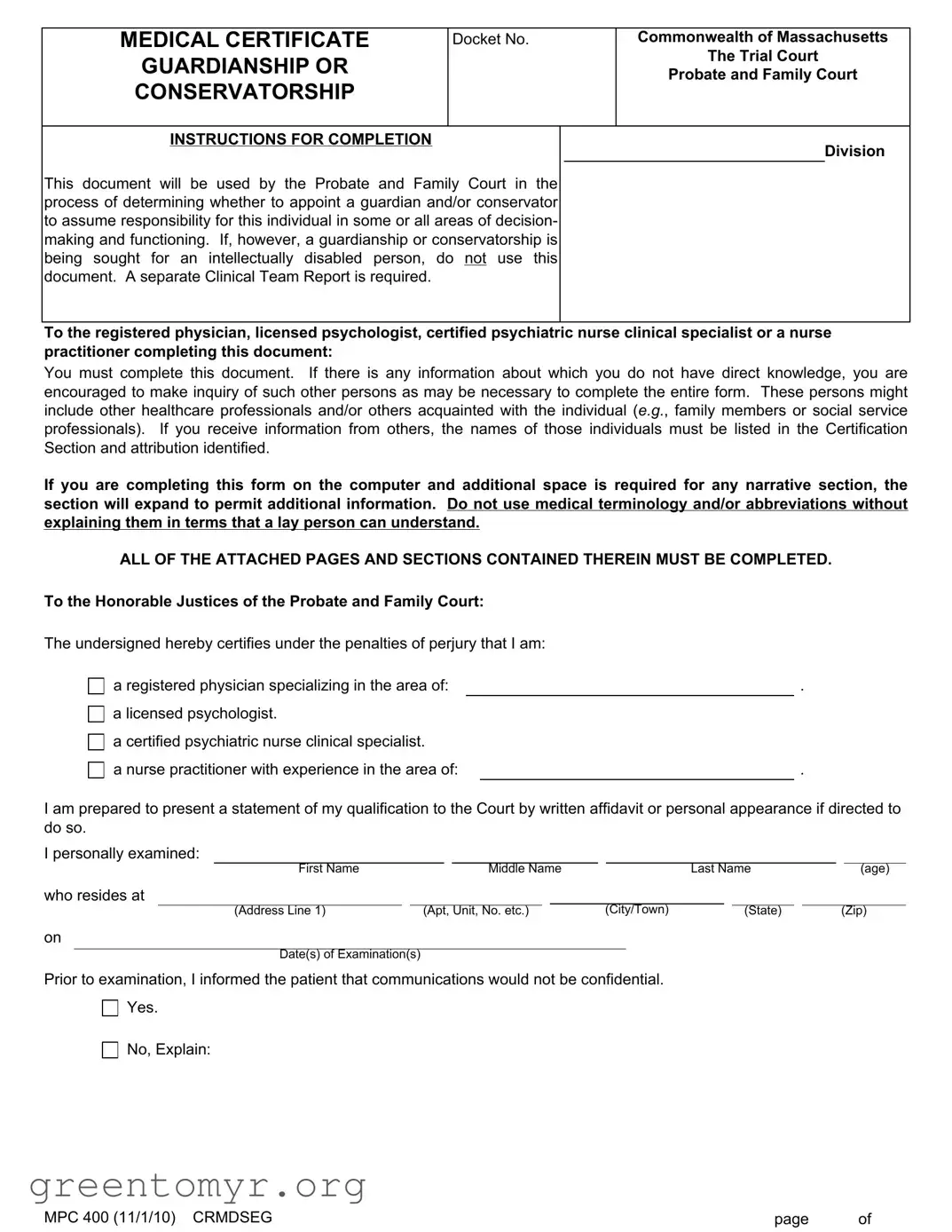
The MA Medical Certificate form serves a crucial role in the guardianship and conservatorship process within the Commonwealth of Massachusetts. This document is designed for use by the Probate and Family Court to assess whether an individual requires a guardian or conservator to assist in decision-making and daily functioning. It is essential for registered physicians, licensed psychologists, certified psychiatric nurse clinical specialists, and nurse practitioners to complete this form accurately, as it provides the court with vital information about the individual’s mental and physical health. The form requires a detailed description of the individual's condition, including the nature and stability of their impairments, as well as an evaluation of their ability to manage personal health, safety, and financial affairs. Furthermore, it includes a section for outlining the individual’s values and preferences, which helps to ensure that any decisions made are in alignment with their wishes. By detailing the individual's social networks and potential risks, the form aids the court in understanding the broader context of the individual’s situation. Completing this form is not just a procedural step; it is an opportunity to advocate for the needs and rights of those who may be vulnerable and require assistance in navigating complex life decisions.

MEDICAL CERTIFICATE
GUARDIANSHIP OR CONSERVATORSHIP
Docket No.
Commonwealth of Massachusetts
The Trial Court
Probate and Family Court
INSTRUCTIONS FOR COMPLETION |
Division |
|
This document will be used by the Probate and Family Court in the process of determining whether to appoint a guardian and/or conservator to assume responsibility for this individual in some or all areas of decision- making and functioning. If, however, a guardianship or conservatorship is being sought for an intellectually disabled person, do not use this document. A separate Clinical Team Report is required.
To the registered physician, licensed psychologist, certified psychiatric nurse clinical specialist or a nurse practitioner completing this document:
You must complete this document. If there is any information about which you do not have direct knowledge, you are encouraged to make inquiry of such other persons as may be necessary to complete the entire form. These persons might include other healthcare professionals and/or others acquainted with the individual (e.g., family members or social service professionals). If you receive information from others, the names of those individuals must be listed in the Certification Section and attribution identified.
If you are completing this form on the computer and additional space is required for any narrative section, the section will expand to permit additional information. Do not use medical terminology and/or abbreviations without explaining them in terms that a lay person can understand.
ALL OF THE ATTACHED PAGES AND SECTIONS CONTAINED THEREIN MUST BE COMPLETED.
To the Honorable Justices of the Probate and Family Court: |
|
||
The undersigned hereby certifies under the penalties of perjury that I am: |
|
||
a registered physician specializing in the area of: |
|
. |
|
a licensed psychologist. |
|
||
a certified psychiatric nurse clinical specialist. |
|
||
a nurse practitioner with experience in the area of: |
|
. |
|
I am prepared to present a statement of my qualification to the Court by written affidavit or personal appearance if directed to do so.
I personally examined:
First NameMiddle NameLast Name(age)
who resides at
(Address Line 1) |
(Apt, Unit, No. etc.) |
(City/Town) |
(State) |
(Zip) |
on
Date(s) of Examination(s)
Prior to examination, I informed the patient that communications would not be confidential.
Yes.
No, Explain:
MPC 400 (11/1/10) CRMDSEG |
page |
of |

1.CLINICALLY DIAGNOSED CONDITION(S) THAT RESULT IN INCAPACITY
A.Description of mental and physical condition
Describe the individual's mental and physical conditions necessitating the appointment of a guardian and/or conservator, including the date of onset and disease course.
B.Stability of mental and physical condition and living setting
I.In the past 90 days, has the individual's mental and/or physical condition changed?
Yes No
If yes, please explain:
Uncertain
II. In the past 90 days, has the individual's living setting (i.e. community, hospital, nursing facility) changed?
Yes No
If yes, please explain:
C. Prognosis for Improvement
Uncertain
With reasonable medical certainty, within the next 90 days, is the individual's mental and/or physical conditions likely to change substantially?
Yes
No
Uncertain
If yes, explain whether the condition is likely to worsen or improve, as well as if there are any aggravating factors that could make the individual appear confused but could improve with time or treatment (e.g. delirium, acute medical illness, the interaction of multiple medications, hearing loss, vision loss, bereavement, etc.):
If improvement is possible, the individual should be |
weeks. |
|||||
D. List all Medications (or attach list): |
|
|
|
|
|
|
|
|
|
|
|
|
|
Name |
Dosage/Schedule |
|
If an |
|||
|
indicate with a checkmark. |
|||||
|
|
|
|
|||
|
|
|
|
|
|
|
|
|
|
|
|
|
|
|
|
|
|
|
|
|
|
|
|
|
|
|
|
|
|
|
|
|
|
|
|
|
|
|
|
|
|
|
|
|
|
|
|
|
|
|
|
|
|
|
|
|
|
|
|
|
|
|
|
|
|
|
|
|
|
|
|
|
|
|
|
|
|
|
|
|
|
|
|
|
|
|
|
|
|
|
click to add
click to remove
MPC 400 (11/1/10) CRMDSEG |
page |
of |

Could any of these medications impair mental functioning:
If yes, explain:
Yes
No
Uncertain
2. INABILITY TO RECEIVE AND EVALUATE INFORMATION OR TO MAKE OR COMMUNICATE DECISIONS
A. Alertness/Level of Consciousness
Overall Impairment: |
None |
Mild |
Moderate |
Severe |
B. Memory and Cognitive Functioning (e.g., memory, comprehension, reasoning, judgment, planning, insight)
Overall Impairment: |
None |
Mild |
Moderate |
Severe |
C. Emotional and Psychiatric Functioning (e.g., mood, anxiety, psychotic, substance use and other disorder)
Overall Impairment: |
None |
Mild |
Moderate |
Severe |
Describe how impairments in A, B, and/or C cause the individual to have an inability to receive and evaluate information or make or communicate decisions:
3.1GUARDIANSHIP: INABILITY TO MEET ESSENTIAL REQUIREMENTS FOR PHYSICAL HEALTH, SAFETY, AND
If seeking guardianship of the person, complete section 3.1. If seeking only a conservatorship, do not complete this section. Limited Guardianship is preferred by the Court; describe how the guardianship may be limited. Describe how the assessment was performed and give specific examples.
A.Areas in which the individual is able to meet the essential requirements for physical health, safety, and
Describe the individual's retained abilities and adaptive behavior for physical health, safety,
B.Areas in which the individual is unable to meet essential requirements for physical health, safety, or
C.If individual is unable to make any decisions for him or herself or is unable to meet any essential requirements for physical health, safety, and
MPC 400 (11/1/10) CRMDSEG |
page |
of |

3.2 CONSERVATORSHIP: INABILITY TO MANAGE PROPERTY OR BUSINESS AFFAIRS EFFECTIVELY
If seeking conservatorship of the estate and affairs, complete section 3.2. If seeking only a guardianship of the person, do not complete this section. Limited Conservatorship is preferred by the court; describe how the conservatorship may be limited. Describe how the assessment was performed and give specific examples.
A.Areas in which the individual is able to manage property or business affairs effectively:
Describe the individual's retained abilities and adaptive behavior for management of property and estate for which the conservatorship may be limited (e.g., ability to manage allowance, bills, donations, investments, real estate, protect assets, resist fraud).
B.Areas in which the individual is unable to manage property or business affairs effectively:
Describe the impairments in the management of property and business affairs for which the individual requires a conservator. Describe how the person has property that will be wasted or dissipated unless management is provided and/or how protection is necessary to provide money for the support, care and welfare of the person or those entitled to the person's support.
C.If the individual is unable to make any decisions about, and is unable to manage, any property or business affairs effectively (i.e. requires a full conservatorship), describe why:
4.VALUES AND PREFERENCES
Describe the individual's values, preferences, and patterns, including previously described preferences (e.g., under durable power of attorney, advance directive, health care proxy, or living will documents), whether the individual accepts or opposes the guardianship/conservatorship, where the individual prefers to live, what makes life meaningful for the individual, and religious or cultural considerations.
5.SOCIAL NETWORKS AND RISK OF HARM TO SELF OR OTHERS
A.Social Network Relationships Social Support (Check one)
Very good supportive network
Social Skills (Check one)
Very good social skills
B.Nature of Risks
Some support from family and friends
Good social skills
Limited or nonexistent support
Poor social skills
Describe the significant risks facing this individual and specify whether these risks are due to this individual's condition and/or due to another person harming or exploiting him or her:
MPC 400 (11/1/10) CRMDSEG |
page |
of |

C. |
The individual's risk of harm to self or others is: |
Mild |
Moderate |
Severe |
|
D. |
The likelihood of harm is: |
Almost Certain |
Probable |
Possible |
Unlikely |
6.RECOMMENDATIONS FOR LEVEL OF CARE/SUPERVISION NEEDED, INCLUDING HOUSING A. An institutional placement being pursued at the following:
Nursing home/Rehabilitation |
Psychiatric facility |
Other facility |
None |
If none, skip to section 7; if yes, answer:
Uncertain
B. The individual requires the following level of supervision: |
|
||
Locked facility |
24 hr. supervision |
Some |
None |
Less restrictive placement options have been pursued: |
|
||
Yes |
No |
Uncertain |
|
The placement is anticipated to be: |
|
|
|
Uncertain |
|
||
Describe the specific reasons for placement and efforts made to preserve the person's social support system (e.g. placement in community of residence or near family):
7. RECOMMENDATIONS FOR APPROPRIATE TREATMENT AND HABILITATION: The individual may benefit from:
Educational potential, training, or rehabilitation |
Yes |
No |
Uncertain |
||
Technological assistance or accommodations |
Yes |
No |
Uncertain |
||
Mental health treatment |
Yes |
No |
Uncertain |
||
Occupational, physical, or other therapy |
Yes |
No |
Uncertain |
||
Home and/or social services |
Yes |
No |
Uncertain |
||
Medical treatment, operation or procedure |
Yes |
No |
Uncertain |
||
Other: |
|
|
|
|
|
Describe any specific recommendations: |
|
|
|
||
8. ATTENDANCE AT HEARING
It would be clinically harmful for the individual to attend the hearing. Describe why:
MPC 400 (11/1/10) CRMDSEG |
page |
of |

The individual is able to attend the court hearing
What accommodations, if any, would enable the individual to attend the hearing:
9. CERTIFICATIONS
This form was completed based on an
who |
is |
is not a patient under my continuing care and treatment. |
In addition to a clinical examination, other sources of information for this examination:
Review of medical record.
Discussion with health care professionals involved in the individual's care.
Discussion with family or friends.
Other
Names and titles/relationships of those individuals who assisted in preparation of this report:
Name |
Title/Relationship |
|
|
|
|
|
|
|
|
|
|
click to add |
|
click to remove |
List any tests which bear upon the issues of incapacity and date of tests: |
|
|
|
|
|
|
|
|
|
Test |
|
Date |
|
|
|
|
|
|
|
|
|
|
|
|
|
|
|
|
|
|
|
|
|
|
click to add
click to remove
MPC 400 (11/1/10) CRMDSEG |
page |
of |

This document must be signed and dated by the person completing it. It does not need to be notarized.
I hereby certify that the evaluation of diagnosis, cognition, and function is within the scope of my professional competence based upon my education, training, and experience. I further certify that this report is complete and accurate to the best of my information and belief.
Signed under the penalties of perjury:
|
|
|
|
|
|
|
Date |
|
|
|
|
|
||||
|
SIGNATURE OF CLINICIAN |
|
|
|
|
|
|
|
|
|
|
|
||||
|
|
|
|
|
|
|
|
|
|
|
|
|
|
|
|
|
|
|
(Print name) |
|
|
|
|
|
License type, number, and date |
|
|||||||
Office Address: |
|
|
|
|
|
|
|
|
|
|
|
|||||
|
|
(Address) |
|
|
(Apt, Unit, No. etc.) |
|
|
|
|
(City/Town) |
|
(State) |
|
|
(Zip) |
|
Office Phone:
Reset Form
MPC 400 (11/1/10) CRMDSEG |
page |
of |
| Fact Name | Description |
|---|---|
| Purpose of the Form | The Ma Medical Certificate form is utilized by the Probate and Family Court to assess the need for appointing a guardian or conservator for an individual who may require assistance in decision-making and functioning. |
| Exclusions | This form should not be used for individuals with intellectual disabilities, as a separate Clinical Team Report is mandated for such cases. |
| Completing the Form | Healthcare professionals must provide accurate information based on direct knowledge or inquiries from others familiar with the individual. All sections of the form must be completed. |
| Governing Laws | The form is governed by Massachusetts General Laws, Chapter 190B, which outlines the rules and procedures for guardianship and conservatorship. |
| Confidentiality Notice | Physicians must inform the patient that communications regarding their condition will not be confidential prior to examination, ensuring transparency in the evaluation process. |
Completing the MA Medical Certificate form is a critical step in the process of appointing a guardian or conservator. After filling out this form, it will be submitted to the Probate and Family Court for review. Ensure all sections are completed accurately, as this information will help the court make informed decisions regarding the individual’s care and support.
The MA Medical Certificate form is used by the Probate and Family Court to assess whether a guardian or conservator should be appointed for an individual. This decision is based on the individual's ability to make informed decisions regarding their personal and financial matters. The form helps provide a comprehensive view of the individual's mental and physical condition, ensuring that the court has the necessary information to make an informed decision.
The form must be completed by a registered physician, licensed psychologist, certified psychiatric nurse clinical specialist, or a nurse practitioner. It is essential that the individual filling out the form has direct knowledge of the person's condition. If additional information is needed, they are encouraged to consult with other healthcare professionals or individuals who know the person well, such as family members or social service professionals.
The form requires detailed information about the individual's mental and physical health, including:
All sections of the form must be completed, and clear, layman-friendly language should be used throughout.
If it would be clinically harmful for the individual to attend the hearing, the form allows the healthcare provider to explain the reasons. This information is crucial for the court to understand the potential impact of attendance on the individual's health and well-being.
The court reviews the information to determine the appropriate level of guardianship or conservatorship needed for the individual. The details about the individual's mental and physical health, decision-making capabilities, and social support networks help the court decide how best to protect the individual's interests while respecting their rights and preferences.
Filling out the MA Medical Certificate form is a critical task that requires careful attention to detail. One common mistake is failing to provide complete information about the individual being evaluated. This includes not only their name and address but also the specifics of their mental and physical conditions. Incomplete information can lead to misunderstandings about the individual's needs and the level of care required. Each section must be filled out thoroughly to ensure that the court has a clear understanding of the situation.
Another frequent error involves the use of medical jargon or abbreviations that are not easily understood by laypersons. While healthcare professionals may be familiar with certain terms, the purpose of this document is to communicate effectively with the court and other parties involved. It is essential to explain any medical terminology in simple language. This ensures that everyone involved can grasp the implications of the individual's condition without confusion.
Additionally, individuals often overlook the importance of documenting the sources of information used to complete the form. If any part of the assessment is based on input from family members or other professionals, it is crucial to list those individuals in the Certification Section. This not only adds credibility to the information provided but also ensures that the court can verify the details if needed.
Finally, many people fail to review the form for accuracy before submission. Simple mistakes, such as typos or incorrect dates, can undermine the integrity of the document. Taking the time to double-check all entries can prevent unnecessary delays and complications in the guardianship or conservatorship process. Attention to detail is paramount in these situations, as the stakes are often high for the individuals involved.
The MA Medical Certificate form is an essential document used in the process of appointing a guardian or conservator for individuals who may need assistance in decision-making. Along with this form, several other documents are often required to ensure a thorough evaluation of the individual's needs. Here are four commonly used forms that accompany the MA Medical Certificate:
These documents work together to provide the court with a comprehensive understanding of the individual's situation, ensuring that the right decisions are made regarding their care and well-being.
When filling out the MA Medical Certificate form, it is essential to follow specific guidelines to ensure accuracy and clarity. Below are four critical do's and don'ts to keep in mind:
Here are four common misconceptions about the MA Medical Certificate form:
Here are some key takeaways about filling out and using the MA Medical Certificate form:
By keeping these points in mind, you can help ensure the form is completed accurately and effectively supports the individual's needs.