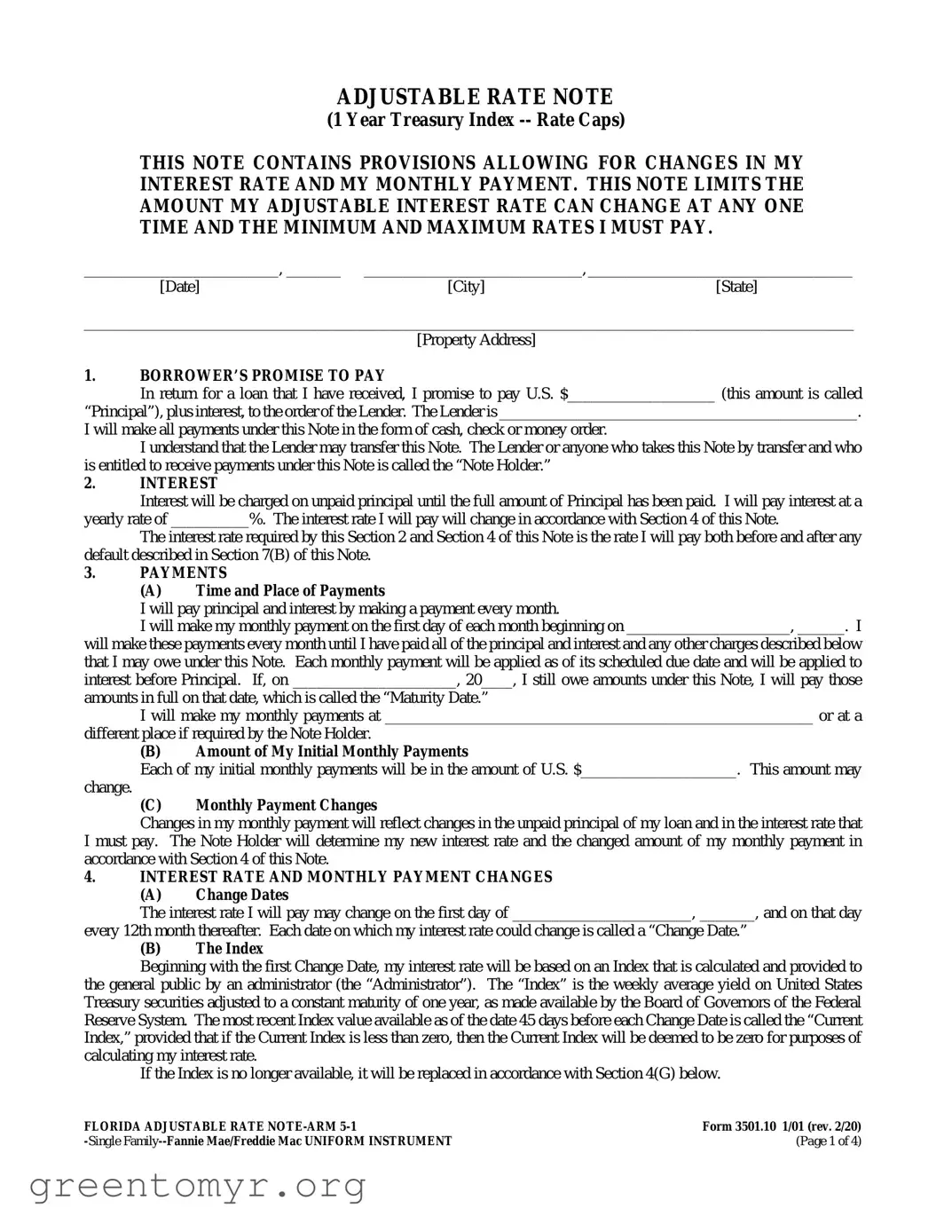
The Mae Note form is a crucial document in the realm of adjustable-rate mortgages, specifically tailored for borrowers who opt for a loan linked to the 1-Year Treasury Index. This form outlines the terms and conditions under which the borrower agrees to repay the loan amount, known as the principal, along with interest. One of the most significant features of the Mae Note is its provision for interest rate adjustments, which can affect both the interest rate and the monthly payment amount. Borrowers should be aware that these adjustments are subject to specific caps, limiting how much the interest rate can increase or decrease at any given time. The form also details the payment schedule, indicating that monthly payments are due on the first day of each month, starting from a specified date. Additionally, it includes information about the rights of the borrower, such as the ability to make prepayments without incurring penalties, and the consequences of failing to meet payment obligations. Overall, understanding the Mae Note is essential for borrowers to navigate their financial responsibilities and rights effectively.
ADJUSTABLE RATE NOTE
(1 Year Treasury Index
THIS NOTE CONTAINS PROVISIONS ALLOWING FOR CHANGES IN MY INTEREST RATE AND MY MONTHLY PAYMENT. THIS NOTE LIMITS THE AMOUNT MY ADJUSTABLE INTEREST RATE CAN CHANGE AT ANY ONE TIME AND THE MINIMUM AND MAXIMUM RATES I MUST PAY.
_________________________, _______ ____________________________, __________________________________
[Date][City][State]
___________________________________________________________________________________________________
[Property Address]
1.BORROWER’S PROMISE TO PAY
In return for a loan that I have received, I promise to pay U.S. $___________________ (this amount is called
“Principal”), plus interest, to the order of the Lender. The Lender is ______________________________________________.
I will make all payments under this Note in the form of cash, check or money order.
I understand that the Lender may transfer this Note. The Lender or anyone who takes this Note by transfer and who is entitled to receive payments under this Note is called the “Note Holder.”
2.INTEREST
Interest will be charged on unpaid principal until the full amount of Principal has been paid. I will pay interest at a yearly rate of __________%. The interest rate I will pay will change in accordance with Section 4 of this Note.
The interest rate required by this Section 2 and Section 4 of this Note is the rate I will pay both before and after any default described in Section 7(B) of this Note.
3.PAYMENTS
(A)Time and Place of Payments
I will pay principal and interest by making a payment every month.
I will make my monthly payment on the first day of each month beginning on _____________________, ______. I
will make these payments every month until I have paid all of the principal and interest and any other charges described below that I may owe under this Note. Each monthly payment will be applied as of its scheduled due date and will be applied to interest before Principal. If, on _____________________, 20____, I still owe amounts under this Note, I will pay those
amounts in full on that date, which is called the “Maturity Date.”
I will make my monthly payments at _______________________________________________________ or at a
different place if required by the Note Holder.
(B)Amount of My Initial Monthly Payments
Each of my initial monthly payments will be in the amount of U.S. $____________________. This amount may
change.
(C)Monthly Payment Changes
Changes in my monthly payment will reflect changes in the unpaid principal of my loan and in the interest rate that I must pay. The Note Holder will determine my new interest rate and the changed amount of my monthly payment in accordance with Section 4 of this Note.
4.INTEREST RATE AND MONTHLY PAYMENT CHANGES
(A)Change Dates
The interest rate I will pay may change on the first day of _______________________, _______, and on that day
every 12th month thereafter. Each date on which my interest rate could change is called a “Change Date.”
(B)The Index
Beginning with the first Change Date, my interest rate will be based on an Index that is calculated and provided to the general public by an administrator (the “Administrator”). The “Index” is the weekly average yield on United States Treasury securities adjusted to a constant maturity of one year, as made available by the Board of Governors of the Federal Reserve System. The most recent Index value available as of the date 45 days before each Change Date is called the “Current Index,” provided that if the Current Index is less than zero, then the Current Index will be deemed to be zero for purposes of calculating my interest rate.
If the Index is no longer available, it will be replaced in accordance with Section 4(G) below.
FLORIDA ADJUSTABLE RATE |
Form 3501.10 1/01 (rev. 2/20) |
(Page 1 of 4) |
(C)Calculation of Changes
Before each Change Date, the Note Holder will calculate my new interest rate by adding
__________________________ ____________________ percentage points (___________%) (the “Margin”) to the Current
Index. The Margin may change if the Index is replaced by the Note Holder in accordance with Section 4(G)(2) below. The Note Holder will then round the result of the Margin plus the Current Index to the nearest
The Note Holder will then determine the amount of the monthly payment that would be sufficient to repay the unpaid principal that I am expected to owe at the Change Date in full on the Maturity Date at my new interest rate in substantially equal payments. The result of this calculation will be the new amount of my monthly payment.
(D)Limits on Interest Rate Changes
The interest rate I am required to pay at the first Change Date will not be greater than ______________% or less than
______________%. Thereafter, my interest rate will never be increased or decreased on any single Change Date by more
than one percentage point (1.0%) from the rate of interest I have been paying for the preceding 12 months. My interest rate will never be greater than ______________% or less than _________%.
(E)Effective Date of Changes
My new interest rate will become effective on each Change Date. I will pay the amount of my new monthly payment beginning on the first monthly payment date after the Change Date until the amount of my monthly payment changes again.
(F)Notice of Changes
The Note Holder will deliver or mail to me a notice of any changes in my interest rate and the amount of my monthly payment before the effective date of any change. The notice will include information required by law to be given to me and also the title and telephone number of a person who will answer any question I may have regarding the notice.
(G) Replacement Index and Replacement Margin
The Index is deemed to be no longer available and will be replaced if any of the following events (each, a “Replacement Event”) occur: (i) the Administrator has permanently or indefinitely stopped providing the Index to the general public; or (ii) the Administrator or its regulator issues an official public statement that the Index is no longer reliable or representative.
If a Replacement Event occurs, the Note Holder will select a new index (the “Replacement Index”) and may also select a new margin (the “Replacement Margin”), as follows:
(1)If a replacement index has been selected or recommended for use in consumer products, including residential
(2)If a replacement index has not been selected or recommended for use in consumer products under Section (G)(1) at the time of a Replacement Event, the Note Holder will make a reasonable, good faith effort to select a Replacement Index and a Replacement Margin that, when added together, the Note Holder reasonably expects will minimize any change in the cost of the loan, taking into account the historical performance of the Index and the Replacement Index.
The Replacement Index and Replacement Margin, if any, will be operative immediately upon a Replacement Event and will be used to determine my interest rate and monthly payments on Change Dates that are more than 45 days after a Replacement Event. The Index and Margin could be replaced more than once during the term of my Note, but only if another Replacement Event occurs. After a Replacement Event, all references to the “Index” and “Margin” will be deemed to be references to the “Replacement Index” and “Replacement Margin.”
The Note Holder will also give me notice of my Replacement Index and Replacement Margin, if any, and such other information required by applicable law and regulation.
5.BORROWER’S RIGHT TO PREPAY
I have the right to make payments of Principal at any time before they are due. A payment of Principal only is known as a “Prepayment.” When I make a Prepayment, I will tell the Note Holder in writing that I am doing so. I may not designate a payment as a Prepayment if I have not made all the monthly payments due under the Note.
I may make a full Prepayment or partial Prepayments without paying a Prepayment charge. The Note Holder will use my Prepayments to reduce the amount of Principal that I owe under this Note. However, the Note Holder may apply my Prepayment to the accrued and unpaid interest on the Prepayment amount, before applying my Prepayment to reduce the Principal amount of the Note. If I make a partial Prepayment, there will be no changes in the due dates of my monthly payment unless the Note Holder agrees in writing to those changes. My partial Prepayment may reduce the amount of my monthly payments after the first Change Date following my partial Prepayment. However, any reduction due to my partial Prepayment may be offset by an interest rate increase.
FLORIDA ADJUSTABLE RATE |
Form 3501.10 1/01 (rev. 2/20) |
(Page 2 of 4) |
6.LOAN CHARGES
If a law, which applies to this loan and which sets maximum loan charges, is finally interpreted so that the interest or other loan charges collected or to be collected in connection with this loan exceed the permitted limits, then: (a) any such loan charge shall be reduced by the amount necessary to reduce the charge to the permitted limit; and (b) any sums already collected from me which exceeded permitted limits will be refunded to me. The Note Holder may choose to make this refund by reducing the Principal I owe under this Note or by making a direct payment to me. If a refund reduces Principal, the reduction will be treated as a partial Prepayment.
7.BORROWER’S FAILURE TO PAY AS REQUIRED
(A)Late Charges for Overdue Payments
If the Note Holder has not received the full amount of any monthly payment by the end of ______________ calendar
days after the date it is due, I will pay a late charge to the Note Holder. The amount of the charge will be ______________%
of my overdue payment of principal and interest. I will pay this late charge promptly but only once on each late payment.
(B)Default
If I do not pay the full amount of each monthly payment on the date it is due, I will be in default.
(C)Notice of Default
If I am in default, the Note Holder may send me a written notice telling me that if I do not pay the overdue amount by a certain date, the Note Holder may require me to pay immediately the full amount of Principal which has not been paid and all the interest that I owe on that amount. That date must be at least 30 days after the date on which the notice is mailed to me or delivered by other means.
(D)No Waiver By Note Holder
Even if, at a time when I am in default, the Note Holder does not require me to pay immediately in full as described above, the Note Holder will still have the right to do so if I am in default at a later time.
(E)Payment of Note Holder’s Costs and Expenses
If the Note Holder has required me to pay immediately in full as described above, the Note Holder will have the right to be paid back by me for all of its costs and expenses in enforcing this Note to the extent not prohibited by applicable law. Those expenses include, for example, reasonable attorneys’ fees.
8.GIVING OF NOTICES
Unless applicable law requires a different method, any notice that must be given to me under this Note will be given
by delivering it or by mailing it by first class mail to me at the Property Address above or at a different address if I give the Note Holder a notice of my different address.
Any notice that must be given to the Note Holder under this Note will be given by delivering it or by mailing it by first class mail to the Note Holder at the address stated in Section 3(A) above or at a different address if I am given a notice of that different address.
9.OBLIGATIONS OF PERSONS UNDER THIS NOTE
If more than one person signs this Note, each person is fully and personally obligated to keep all of the promises
made in this Note, including the promise to pay the full amount owed. Any person who is a guarantor, surety or endorser of this Note is also obligated to do these things. Any person who takes over these obligations, including the obligations of a guarantor, surety or endorser of this Note, is also obligated to keep all of the promises made in this Note. The Note Holder may enforce its rights under this Note against each person individually or against all of us together. This means that any one of us may be required to pay all of the amounts owed under this Note.
10.WAIVERS
I and any other person who has obligations under this Note waive the rights of Presentment and Notice of Dishonor. “Presentment” means the right to require the Note Holder to demand payment of amounts due. “Notice of Dishonor” means the right to require the Note Holder to give notice to other persons that amounts due have not been paid.
11.UNIFORM SECURED NOTE
This Note is a uniform instrument with limited variations in some jurisdictions. In addition to the protections given
to the Note Holder under this Note, a Mortgage, Deed of Trust, or Security Deed (the “Security Instrument”), dated the same date as this Note, protects the Note Holder from possible losses which might result if I do not keep the promises which I make in this Note. That Security Instrument describes how and under what conditions I may be required to make immediate payment in full of all amounts I owe under this Note. Some of those conditions are described as follows:
If all or any part of the Property or any Interest in the Property is sold or transferred (or if Borrower is not a natural person and a beneficial interest in Borrower is sold or transferred) without Lender’s prior written consent, Lender may require immediate payment in full of all sums secured by this Security Instrument. However, this option shall not be exercised by Lender if such exercise is prohibited by Applicable Law. Lender also shall not exercise this option if: (a) Borrower causes to be submitted to Lender information required by Lender to evaluate the intended transferee as if a new loan were being made to the transferee; and (b) Lender reasonably determines that Lender’s security will not be impaired
FLORIDA ADJUSTABLE RATE |
Form 3501.10 1/01 (rev. 2/20) |
(Page 3 of 4) |
by the loan assumption and that the risk of a breach of any covenant or agreement in this Security Instrument is acceptable to Lender.
To the extent permitted by Applicable Law, Lender may charge a reasonable fee as a condition to Lender’s consent to the loan assumption. Lender may also require the transferee to sign an assumption agreement that is acceptable to Lender and that obligates the transferee to keep all the promises and agreements made in the Note and in this Security Instrument. Borrower will continue to be obligated under the Note and this Security Instrument unless Lender releases Borrower in writing.
If Lender exercises the option to require immediate payment in full, Lender shall give Borrower notice of acceleration. The notice shall provide a period of not less than 30 days from the date the notice is given in accordance with Section 15 within which Borrower must pay all sums secured by this Security Instrument. If Borrower fails to pay these sums prior to the expiration of this period, Lender may invoke any remedies permitted by this Security Instrument without further notice or demand on Borrower.
12.DOCUMENTARY TAX
The state documentary tax due on this Note has been paid on the mortgage securing this indebtedness.
WITNESS THE HAND(S) AND SEAL(S) OF THE UNDERSIGNED.
_______________________________________ (Seal)
_______________________________________(Seal)
_______________________________________(Seal)
FLORIDA ADJUSTABLE RATE |
Form 3501.10 1/01 (rev. 2/20) |
(Page 4 of 4) |
| Fact Name | Description |
|---|---|
| Type of Note | This is an Adjustable Rate Note, which means the interest rate can change over time based on a specified index. |
| Governing Law | The form is governed by the laws of the state in which the property is located, as indicated in the document. |
| Interest Rate Changes | The interest rate can change annually based on the 1-Year Treasury Index, with specific caps on how much it can increase or decrease. |
| Monthly Payments | Borrowers must make monthly payments starting on a specified date, with the amount subject to change based on the interest rate adjustments. |
| Prepayment Rights | Borrowers have the right to make prepayments without incurring penalties, allowing them to reduce their principal balance at any time. |
| Late Payment Charges | If a payment is not received within a specified number of days, a late fee will be applied to the overdue amount. |
| Borrower Obligations | All signers of the note are fully responsible for the obligations outlined, meaning that any one borrower can be held accountable for the entire debt. |
Filling out the Mae Note form is an important step in securing your adjustable rate mortgage. Ensure that you have all necessary information ready before you begin, as this will streamline the process. Once completed, the form will need to be signed and submitted to the lender.
The Mae Note form is a legal document that outlines the terms of an adjustable-rate mortgage. It details the borrower's promise to repay the loan amount, referred to as the Principal, plus interest. The form specifies how the interest rate may change over time based on an index, the payment schedule, and the rights and responsibilities of both the borrower and the lender. This document is essential for establishing the terms of the loan agreement and ensuring that both parties understand their obligations.
The interest rate on the Mae Note is tied to a specific index, which is the weekly average yield on United States Treasury securities for a one-year maturity. Changes to the interest rate can occur annually on designated Change Dates. The lender will calculate the new interest rate by adding a specified percentage to the Current Index. This new rate will be rounded to the nearest one-eighth of a percentage point. There are limits on how much the interest rate can increase or decrease at each Change Date, ensuring that the borrower is protected from extreme fluctuations.
Borrowers must make monthly payments that include both principal and interest. Payments are due on the first day of each month, starting from a specified date. If a borrower fails to make a payment by the due date, late charges may apply. The lender will apply payments first to interest, then to principal. If the borrower wishes to make extra payments, known as Prepayments, they can do so without incurring a Prepayment charge, but they must notify the lender in writing. Partial Prepayments may affect future monthly payment amounts, depending on the lender's calculations.
If a borrower does not make a payment on time, they will be considered in default. The lender may send a written notice to the borrower, stating the overdue amount and a deadline for payment. If the borrower does not pay by this deadline, the lender can demand immediate repayment of the entire outstanding balance. The borrower may also be responsible for any costs incurred by the lender in enforcing the note, including attorney fees. It is crucial for borrowers to communicate with their lender if they anticipate difficulty in making payments.
When filling out the Mae Note form, individuals often make several common mistakes that can lead to confusion or complications later on. One frequent error is neglecting to provide complete and accurate personal information. Missing details such as the date, city, state, or property address can create issues in processing the loan. It's crucial to ensure that all sections are filled out correctly to avoid delays.
Another mistake is failing to specify the correct principal amount. Borrowers sometimes write an incorrect figure or leave it blank. This amount is fundamental, as it determines the loan size and affects the interest calculations. Double-checking this figure can prevent misunderstandings about the loan terms.
Many people also overlook the interest rate section. They might either leave it blank or enter an incorrect percentage. The interest rate directly impacts monthly payments and the total cost of the loan. Therefore, it is essential to ensure that the rate is accurate and reflects the agreed-upon terms.
In addition, borrowers often misunderstand the payment schedule. They may not specify the correct start date for their monthly payments or fail to note the frequency of these payments. This oversight can lead to missed payments and potential late fees. Clarity in this section is vital for maintaining good standing with the lender.
Lastly, some individuals neglect to read the terms regarding changes in interest rates and payments. Understanding how and when these changes occur is crucial for financial planning. Failing to grasp these provisions can lead to unexpected increases in monthly payments. It's advisable to review this section thoroughly to ensure awareness of potential changes in the loan agreement.
The Mae Note form is a crucial document in the process of securing a loan, particularly for adjustable-rate mortgages. However, several other forms and documents are often used in conjunction with the Mae Note to ensure that all aspects of the loan agreement are clear and legally binding. Below is a list of these documents, each accompanied by a brief description.
Each of these documents plays a vital role in the loan process, helping to protect both the borrower and the lender. Understanding these forms can facilitate a smoother transaction and ensure that all parties are aware of their rights and responsibilities.
The Mae Note form shares similarities with several other documents used in the context of loans and mortgages. Below are four documents that are comparable, along with a brief explanation of their similarities:
When filling out the Mae Note form, there are several important practices to keep in mind. Below is a list of things you should do and things you should avoid:
Understanding the Mae Note form can be challenging, and several misconceptions often arise. Here are five common misunderstandings:
By clearing up these misconceptions, borrowers can better navigate their loan agreements and make informed decisions.
Understanding the Mae Note form is crucial for anyone entering into a loan agreement. Here are some key takeaways to keep in mind:
Being informed about these aspects of the Mae Note form can empower you to manage your loan effectively and avoid potential pitfalls. Stay vigilant and proactive in your financial obligations.