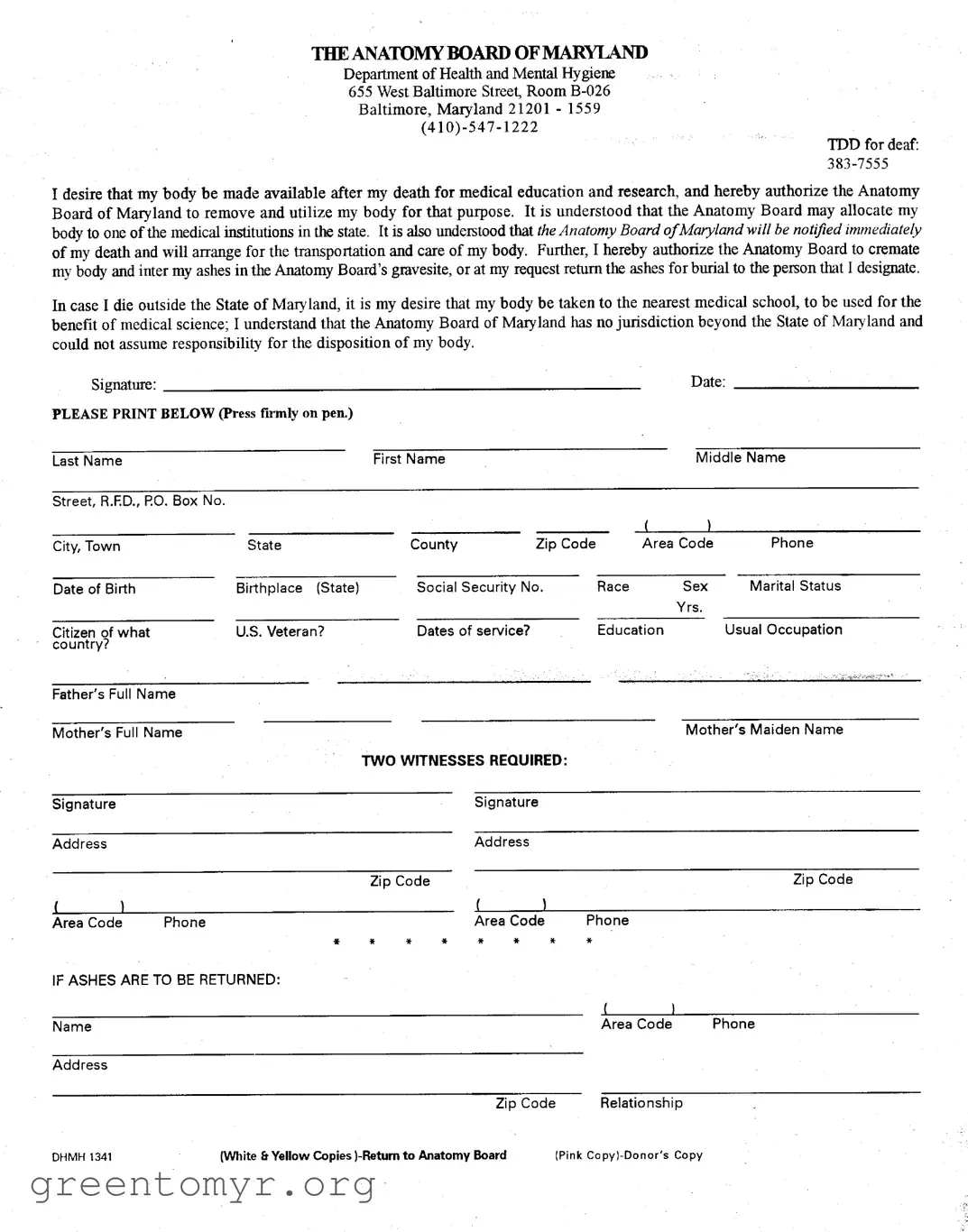
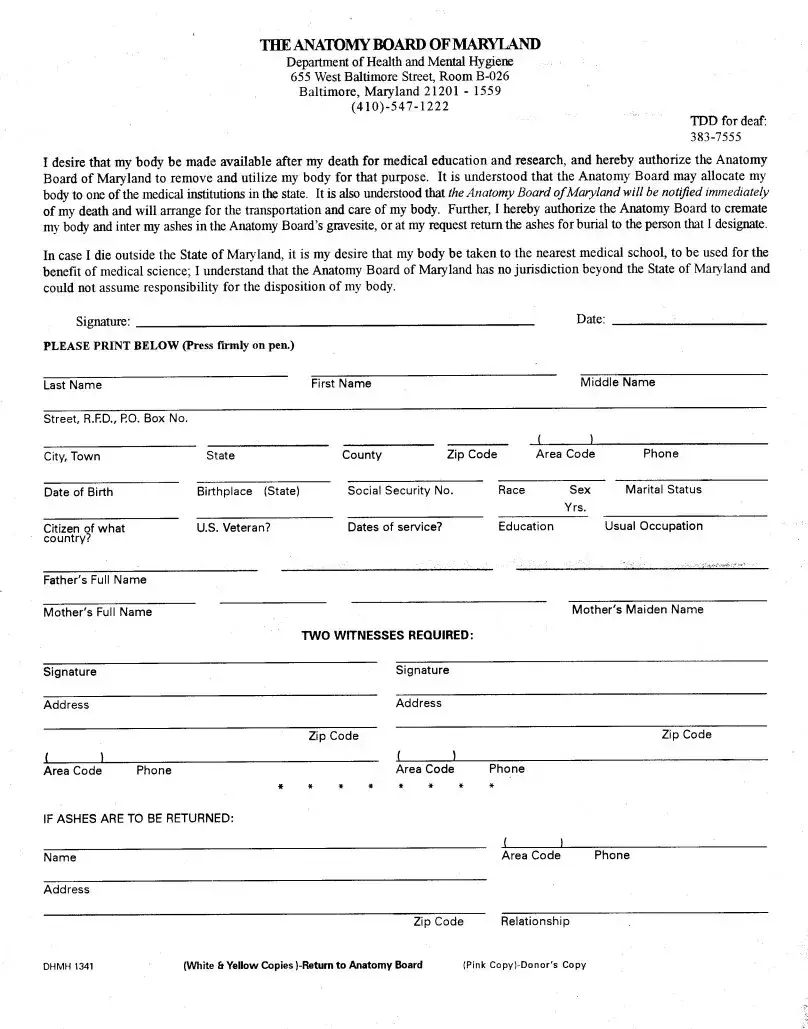
The Maryland Anatomy form plays a vital role in the donation of human bodies for medical education and research. This form allows individuals to express their desire for their bodies to be utilized after death, contributing to the advancement of medical science. By signing this document, donors authorize the Anatomy Board of Maryland to remove and use their bodies for educational purposes at medical institutions within the state. The form also outlines the responsibilities of the Anatomy Board, including the immediate notification upon the donor's death and the arrangement for transportation and care of the body. Additionally, it addresses the cremation of the body and the interment of ashes, either in the Anatomy Board’s designated gravesite or returned to a specified individual. For those who may pass away outside of Maryland, the form indicates that the body should be sent to the nearest medical school for similar purposes. It is important to note that the Anatomy Board has no jurisdiction beyond state lines. Completing this form requires personal information, including the donor’s name, date of birth, and other identifying details, along with the signatures of two witnesses to validate the request. This comprehensive approach ensures that the wishes of the donor are respected while supporting critical medical training and research.
| Fact Name | Details |
|---|---|
| Governing Law | The Maryland Anatomy Board operates under Maryland Health-General Article § 4-501 to § 4-507. |
| Purpose of the Form | This form allows individuals to donate their bodies for medical education and research after death. |
| Authorization | By signing, you authorize the Anatomy Board of Maryland to remove and use your body for educational purposes. |
| Body Allocation | The Anatomy Board may allocate your body to any medical institution within Maryland. |
| Notification of Death | The Anatomy Board must be notified immediately upon your death for proper arrangements. |
| Transportation and Care | The Anatomy Board will arrange for the transportation and care of your body after death. |
| Cremation and Ashes | You can authorize the cremation of your body and specify where the ashes should be interred or returned. |
| Out-of-State Death | If you die outside Maryland, your body should be taken to the nearest medical school for use in medical science. |
| Witness Requirement | Two witnesses must sign the form for it to be valid. |
| Personal Information | The form requires personal details like your name, date of birth, and contact information. |
Completing the Maryland Anatomy form requires careful attention to detail. This form expresses your wishes regarding the use of your body after death for medical education and research. Once filled out, the form must be signed and witnessed, ensuring that your intentions are clear and legally recognized.
The Maryland Anatomy form allows individuals to donate their bodies for medical education and research after their death. By signing this form, donors authorize the Anatomy Board of Maryland to utilize their bodies for these purposes, which can greatly benefit medical students and researchers.
The Anatomy Board of Maryland is responsible for arranging the transportation and care of your body once they are notified of your death. This ensures that your wishes are honored promptly and respectfully.
Yes, the form allows you to specify your wishes regarding the disposition of your ashes. You can choose to have your ashes interred at the Anatomy Board’s gravesite or returned to a designated person for burial.
If you pass away outside of Maryland, the form indicates that your body should be taken to the nearest medical school for use in medical science. It is important to note that the Anatomy Board of Maryland cannot assume responsibility for the disposition of your body beyond the state’s jurisdiction.
Yes, the form requires the signatures of two witnesses. This ensures that your intentions are clearly documented and verified. Witnesses should provide their addresses and contact information as part of the signing process.
Donors must provide personal information including their full name, address, date of birth, citizenship, social security number, race, sex, marital status, and details about their parents. This information helps the Anatomy Board identify the donor and fulfill their wishes accurately.
While the form does not explicitly outline the process for revocation, individuals generally have the right to change their minds. It is advisable to contact the Anatomy Board of Maryland directly to understand the procedure for revoking consent if needed.
Donating your body provides invaluable resources for medical students and researchers. It allows them to study human anatomy, conduct research, and gain practical experience, ultimately enhancing their education and improving healthcare outcomes.
If you have additional questions or need clarification about the Maryland Anatomy form, it is recommended to contact the Anatomy Board of Maryland directly. They can provide specific guidance and address any concerns you may have.
Filling out the Maryland Anatomy form can be straightforward, but many people make common mistakes that can lead to complications. One significant error occurs when individuals fail to provide complete information. For example, omitting details such as the full names of parents or the exact date of birth can cause delays in processing. It is essential to ensure that every section is filled out accurately and completely.
Another frequent mistake is not having two witnesses sign the form. The requirement for two witnesses is crucial for the validity of the document. If this step is overlooked, the form may be deemed invalid, which can prevent the intended arrangements from being honored. Always double-check that both witnesses have signed and provided their addresses.
People also often neglect to specify their wishes regarding the return of ashes. If you desire your ashes to be returned after cremation, it is vital to fill out that section clearly. Failure to do so may result in your ashes being interred without your consent. Be explicit about your preferences to avoid any misunderstandings.
Lastly, some individuals forget to sign and date the form. Without a signature, the Anatomy Board cannot process the request. This final step is crucial and should not be rushed. Make sure to review the entire form before submission to confirm that all signatures and dates are present.
The Maryland Anatomy form is essential for individuals wishing to donate their bodies for medical education and research. However, several other documents often accompany this form to ensure that all legal and procedural aspects of body donation are addressed. Below is a list of these important documents.
These documents work in tandem with the Maryland Anatomy form to provide clarity and ensure that an individual’s wishes are honored. It is advisable to keep these documents accessible and to discuss them with family members or designated representatives to avoid confusion during a difficult time.
The Maryland Anatomy form is important for individuals who wish to donate their bodies for medical education and research. Several other documents serve similar purposes. Here’s a list of those documents and how they relate to the Maryland Anatomy form:
Each of these documents plays a role in ensuring that individuals' wishes regarding their bodies and medical care are respected after death.
When filling out the Maryland Anatomy form, it is important to follow certain guidelines to ensure your wishes are clearly communicated. Below is a list of things you should and shouldn't do:
Following these guidelines will help ensure that your intentions are honored and that the process goes smoothly. Your decisions are important, and taking the time to complete the form correctly is a vital step in making your wishes known.
Here are four common misconceptions about the Maryland Anatomy form:
This is incorrect. While the Anatomy Board of Maryland has jurisdiction primarily within the state, individuals who die outside Maryland can still have their bodies sent to the nearest medical school for educational purposes, as long as the necessary arrangements are made.
This is not true. The form allows for cremation and interment of ashes, but it also provides the option to return ashes to a designated person for burial, should that be your wish.
While the Anatomy Board will arrange for the transportation and care of your body, it is essential to communicate your wishes clearly. They will not handle all aspects of the funeral unless specified in the form.
This is misleading. The form specifically states that your body will be used for medical education and research. The Anatomy Board must adhere to this purpose and cannot deviate from it.
Filling out the Maryland Anatomy form is an important step for individuals who wish to contribute their bodies to medical education and research after death. Here are some key takeaways to consider:
Completing this form thoughtfully can help ensure that your wishes are honored and that your contribution to medical science is realized.