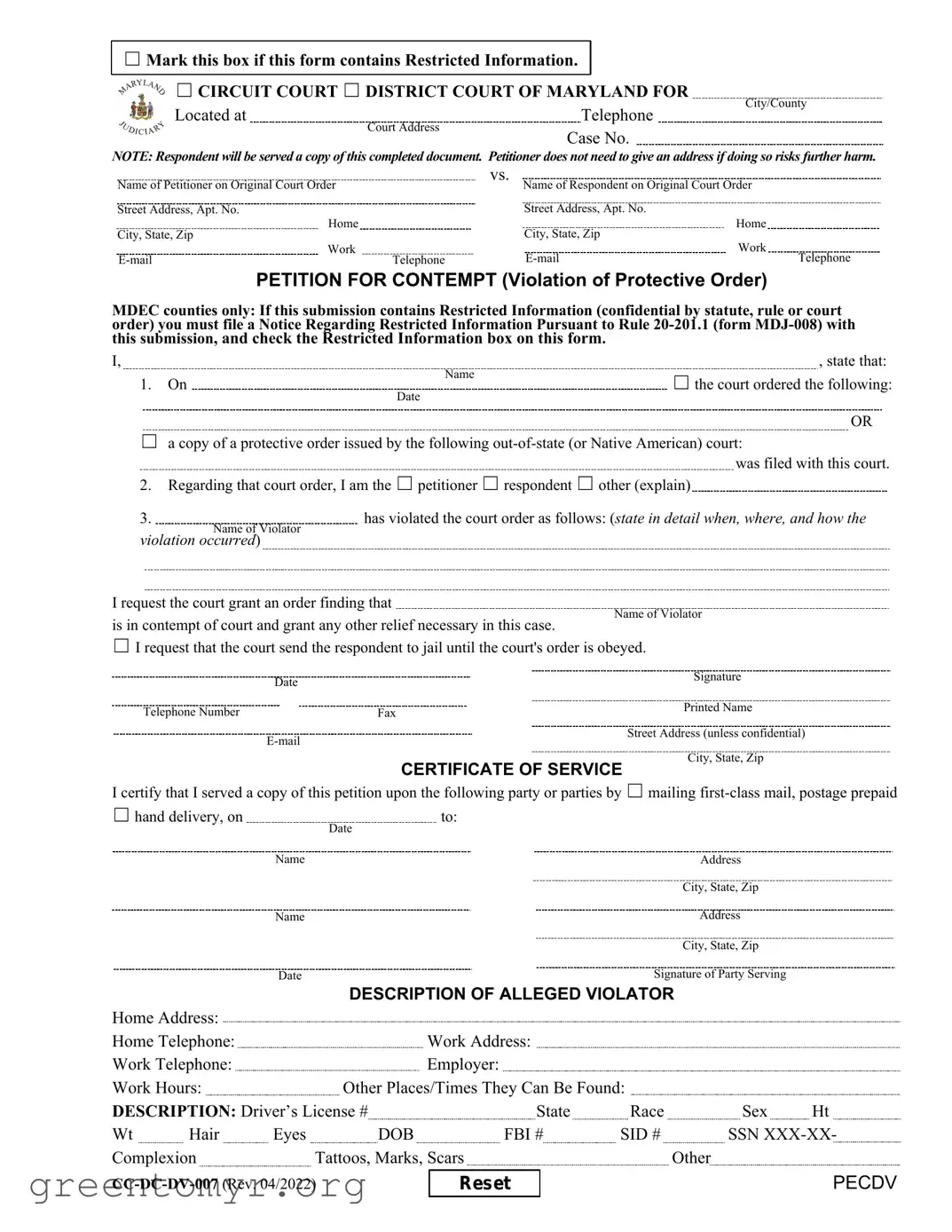
When facing violations of court orders, it is crucial to understand the Maryland Petition for Contempt form, a tool designed to help individuals seek justice and enforce protective orders. This form is used in situations where one party, known as the petitioner, believes that another party, the respondent, has failed to comply with a court order. The form requires specific information, including the names and addresses of both the petitioner and the respondent, as well as details about the violation, such as when and how it occurred. It is important to note that if there are concerns about safety, the petitioner is not obligated to provide their address. Furthermore, the form includes a section to indicate if it contains restricted information, ensuring that sensitive details are handled appropriately. By submitting this petition, the petitioner is requesting the court to find the respondent in contempt and to provide any necessary relief, which may include jail time until compliance is achieved. Completing this form accurately is essential for a successful legal process, and understanding its components can provide a sense of empowerment during a challenging time.

☐ Mark this box if this form contains Restricted Information.
☐ CIRCUIT COURT ☐ DISTRICT COURT OF MARYLAND FOR |
|
||
Located at |
|
Telephone |
City/County |
Court Address |
|
||
|
Case No. |
|
|
|
|
|
|
NOTE: Respondent will be served a copy of this completed document. Petitioner does not need to give an address if doing so risks further harm.
Name of Petitioner on Original Court Order |
vs. |
Name of Respondent on Original Court Order |
|
|||
Street Address, Apt. No. |
Home |
|
Street Address, Apt. No. |
Home |
|
|
City, State, Zip |
|
City, State, Zip |
|
|||
Work |
|
Work |
|
|||
Telephone |
Telephone |
|||||
|
|
|||||
PETITION FOR CONTEMPT (Violation of Protective Order)
MDEC counties only: If this submission contains Restricted Information (confidential by statute, rule or court order) you must file a Notice Regarding Restricted Information Pursuant to Rule
I, |
Name |
, state that: |
|
1. On |
☐ the court ordered the following: |
||
Date |
|||
|
|
|
|
OR |
☐ a copy of a protective order issued by the following |
||
|
|
was filed with this court. |
2. Regarding that court order, I am the ☐ petitioner ☐ respondent ☐ other (explain) |
||
3. |
Name of Violator |
has violated the court order as follows: (state in detail when, where, and how the |
|
|
|
violation occurred) |
|
|
I request the court grant an order finding that
is in contempt of court and grant any other relief necessary in this case.
☐I request that the court send the respondent to jail until the court's order is obeyed.
|
Date |
|
|
Signature |
|
|
|
|
|
Telephone Number |
|
Fax |
|
Printed Name |
|
|
|
||
|
|
|
Street Address (unless confidential) |
|
|
|
|
|
|
|
|
|
CERTIFICATE OF SERVICE |
City, State, Zip |
|
|
|
|
I certify that I served a copy of this petition upon the following party or parties by ☐ mailing
☐ hand delivery, on |
|
Date |
|
to: |
|
|
|
||
|
|
|
|
|
|
|
|
|
|
|
|
Name |
|
|
|
|
|
Address |
|
|
|
|
|
|
|
|
|
City, State, Zip |
|
|
|
Name |
|
|
|
|
|
Address |
|
|
|
|
|
|
|
|
|
City, State, Zip |
|
|
|
Date |
|
|
|
|
Signature of Party Serving |
|
|
Home Address: |
|
DESCRIPTION OF ALLEGED VIOLATOR |
|
||||||
|
|
|
|
|
|
|
|
||
Home Telephone: |
|
|
Work Address: |
|
|
|
|||
Work Telephone: |
|
|
Employer: |
|
|
|
|||
Work Hours: |
|
Other Places/Times They Can Be Found: |
|
|
|||||
DESCRIPTION: Driver’s License # |
|
State |
Race |
Sex |
Ht |
||||
Wt |
Hair |
Eyes |
DOB |
|
FBI # |
SID # |
SSN |
||
Complexion |
Tattoos, Marks, Scars |
|
Other |
|
|||||
|
|
Reset |
|
|
|
PECDV |
|||
| Fact Name | Description |
|---|---|
| Governing Law | The Maryland Petition for Contempt form is governed by Maryland Rule 20-201.1. |
| Purpose | This form is used to request the court to hold a violator in contempt for breaching a protective order. |
| Service Requirement | The petitioner must serve a copy of the completed petition to the respondent. |
| Restricted Information | If the petition contains restricted information, the petitioner must file a Notice Regarding Restricted Information. |
Filling out the Maryland Petition For Contempt form requires careful attention to detail. After completing the form, the next step will be to file it with the appropriate court and ensure that the respondent receives a copy. Follow these steps to fill out the form accurately.
A Maryland Petition for Contempt is a legal document filed in court when someone believes that another person has violated a court order, such as a protective order. This petition asks the court to enforce the order and may request penalties for the violation.
Any person who is affected by a court order can file a Petition for Contempt. This includes the petitioner or respondent named in the original court order. If you believe someone is not following the court's instructions, you can take this step.
You need to provide several key details in the petition:
Yes, you must serve the respondent with a copy of the completed petition. This can be done through first-class mail or hand delivery. The court requires proof that the respondent received the petition.
After you file the petition, the court will schedule a hearing. Both you and the respondent will have the opportunity to present your sides. The judge will then decide if the respondent is in contempt of court and what actions to take next.
Yes, if the court finds that the respondent is in contempt, it can order jail time until the respondent complies with the court order. However, the court may also choose other remedies, such as fines or modifications to the order.
If you are worried about your safety, you do not have to provide your address on the petition. You can indicate that your address is confidential to protect yourself from further harm.
Restricted Information refers to any details that are confidential by law, rule, or court order. If your petition contains such information, you must check the appropriate box on the form and file a Notice Regarding Restricted Information along with your petition.
The Maryland Petition for Contempt form can typically be found on the Maryland Judiciary website or at your local courthouse. Make sure you are using the most recent version of the form to ensure compliance with current laws.
Filling out the Maryland Petition for Contempt form requires careful attention to detail. One common mistake is failing to provide complete information about the violator. The form asks for the name and relevant details of the individual who allegedly violated the court order. Omitting this information can lead to delays in processing the petition.
Another frequent error is neglecting to mark the box indicating whether the form contains restricted information. This is crucial, especially if the submission includes sensitive data protected by law. Not marking this box could result in the petition being rejected or delayed.
Many individuals also overlook the importance of specifying their role in relation to the original court order. The form requires the petitioner to identify themselves as either the petitioner, respondent, or another party. Failing to do this can create confusion and complicate the proceedings.
Inadequate detail regarding the violation itself is another mistake that can undermine the petition. The form asks for a clear account of when, where, and how the violation occurred. Providing vague or incomplete descriptions may weaken the case and hinder the court's ability to take action.
Additionally, some people forget to include their contact information. While the petitioner does not need to provide an address if it risks further harm, they must still include a valid telephone number and email. Missing this information can impede communication with the court.
Another common error involves the certificate of service. This section confirms that the petition was properly served to the involved parties. Failing to complete this section or not providing accurate details about how and when the petition was served can lead to procedural issues.
Many individuals also neglect to sign the petition. A signature is necessary to validate the document and confirm that the information provided is accurate to the best of the petitioner's knowledge. Without a signature, the petition may be considered incomplete.
Finally, not keeping a copy of the completed petition for personal records is a mistake that can lead to complications later on. Having a copy allows the petitioner to reference the original submission if questions or issues arise during the legal process.
The Maryland Petition for Contempt form is an important document used when an individual believes that a court order, particularly a protective order, has been violated. In addition to this form, there are several other documents that are commonly utilized in conjunction with it. Each of these documents serves a specific purpose in the legal process, helping to ensure that the rights of individuals are protected and that the court can effectively address violations of its orders.
Understanding these documents and their purposes can significantly aid individuals navigating the legal system in Maryland. Each plays a crucial role in ensuring that the rights of all parties are respected and that the court can effectively enforce its orders.
The Maryland Petition for Contempt form is similar to several other legal documents used in family law and civil proceedings. Each document serves a specific purpose related to court orders and compliance. Below is a list of eight documents that share similarities with the Maryland Petition for Contempt form:
When filling out the Maryland Petition For Contempt form, it's essential to approach the task with care and attention to detail. Here are some guidelines to help ensure a smooth process.
By following these guidelines, you can help facilitate a more efficient process and ensure that your concerns are addressed appropriately.
Misconceptions about the Maryland Petition For Contempt form can lead to confusion and missteps in legal proceedings. Here are eight common misunderstandings:
Understanding these misconceptions can empower individuals to navigate the legal system more effectively and ensure their rights are protected.
Ensure you accurately fill out the Maryland Petition For Contempt form. This includes providing complete information about both the petitioner and the respondent.
If applicable, mark the box indicating that the form contains Restricted Information. This is crucial for protecting sensitive data.
Clearly detail the violation of the court order. Specify when, where, and how the violation occurred to strengthen your case.
Understand that the respondent will receive a copy of the completed document. This is a standard procedure in contempt cases.
Consider requesting jail time for the respondent if the court order is not obeyed. This option is available on the form.
Finally, ensure that you properly serve the petition to all involved parties. Use either first-class mail or hand delivery, and keep a record of this service.