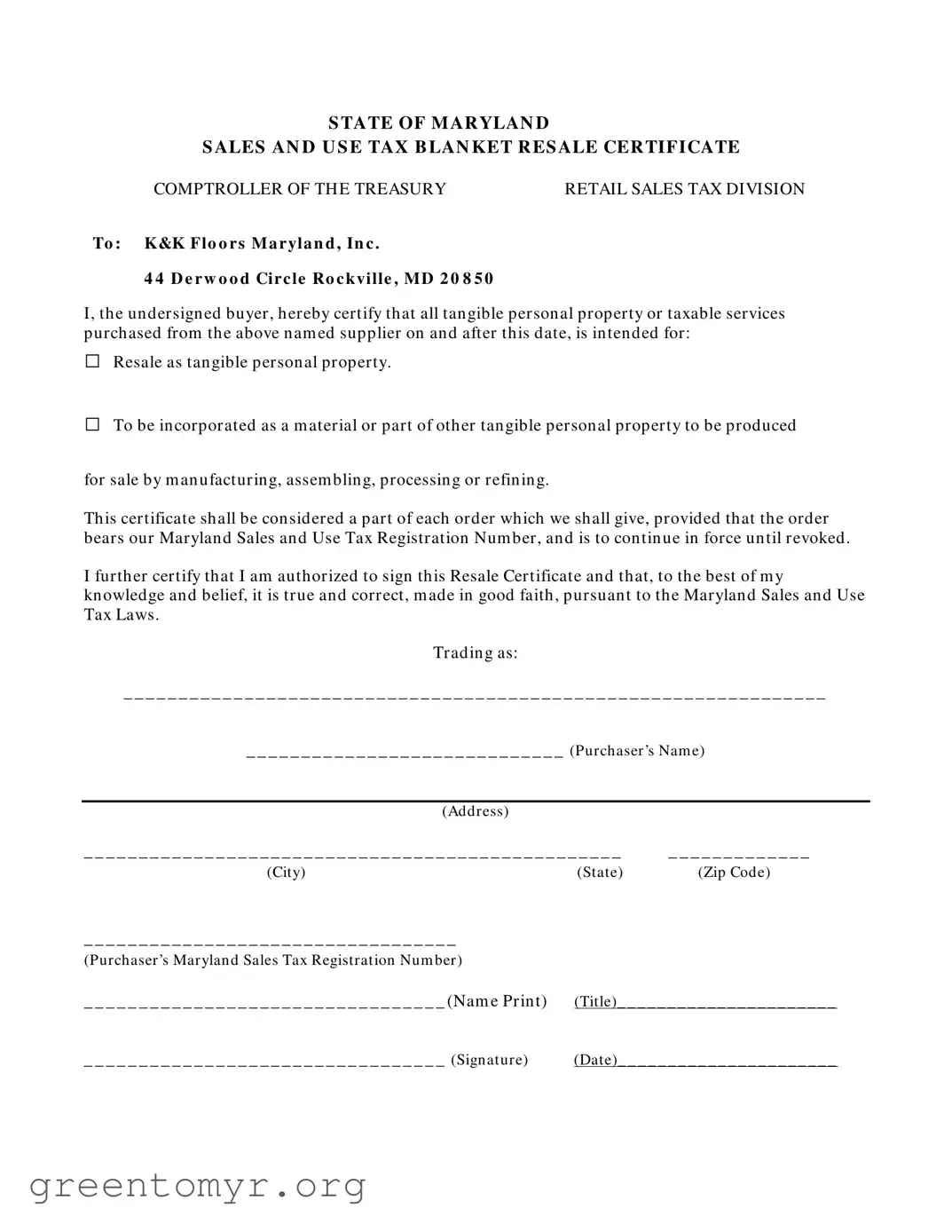
The Maryland Sales and Use Tax Resale Certificate is an essential tool for businesses engaged in the resale of tangible personal property or taxable services. This form allows buyers to certify that their purchases from a supplier are intended for resale, thereby exempting them from paying sales tax at the time of purchase. The certificate must include the buyer’s Maryland Sales and Use Tax Registration Number and is valid until revoked, ensuring that it remains in effect for future transactions. Buyers must also affirm that they are authorized to sign the document and that the information provided is accurate and made in good faith. By completing this form, businesses can streamline their purchasing processes and comply with Maryland tax laws while avoiding unnecessary tax expenses. Understanding the key components and requirements of the Resale Certificate is crucial for anyone looking to optimize their sales tax obligations in the state.

S TATE OF MARYLAN D
S ALES AN D U S E TAX B LAN KET RES ALE CERTIFICATE
COMPTROLLER OF TH E TREASURY |
RETAIL SALES TAX DIVISION |
To : K&K Flo o rs Ma ryla n d , In c .
4 4 D e rw o o d Circ le Ro c kvi lle , MD 2 0 8 5 0
I, th e un dersign ed buyer , h ereby certify th at all tan gible person al property or taxable services purch ased from th e above n am ed supplier on an d after this date, is in ten ded for:
□Resale as tan gible person al property.
□To be in corporated as a m aterial or part of oth er tan gible person al property to be produced
for sale by m an ufacturing, assem blin g, processin g or refin in g.
Th is certificate sh all be con sidered a part of each order which we sh all give, provided th at th e order bears our Marylan d Sales an d Use Tax Registration Num ber, an d is to con tin ue in force un til revoked .
I furth er certify th at I am authorized to sign th is Resale Certificate an d th at, to th e best of m y
kn owledge an d belief, it is true an d correct, m ade in good faith , pursuan t to th e Marylan d Sales an d Use Tax Laws.
Tradin g as:
_ _ _ _ _ _ _ _ _ _ _ _ _ _ _ _ _ _ _ _ _ _ _ _ _ _ _ _ _ _ _ _ _ _ _ _ _ _ _ _ _ _ _ _ _ _ _ _ _ _ _ _ _ _ _ _ _ _ _ _ _ _ _ _
_ _ _ _ _ _ _ _ _ _ _ _ _ _ _ _ _ _ _ _ _ _ _ _ _ _ _ _ _ (Purchaser’s Nam e)
(Address)
_ _ _ _ _ _ _ _ _ _ _ _ _ _ _ _ _ _ _ _ _ _ _ _ _ _ _ _ _ _ _ _ _ _ _ _ _ _ _ _ _ _ _ _ _ _ _ _ _ |
_ _ _ _ _ _ _ _ _ _ _ _ _ |
|
(City) |
(State) |
(Zip Code) |
_ _ _ _ _ _ _ _ _ _ _ _ _ _ _ _ _ _ _ _ _ _ _ _ _ _ _ _ _ _ _ _ _ _
(Purchaser’s Marylan d Sales Tax Registrat ion Num ber)
_ _ _ _ _ _ _ _ _ _ _ _ _ _ _ _ _ _ _ _ _ _ _ _ _ _ _ _ _ _ _ _ _ (Nam e Prin t) |
(Title)_ _ _ _ _ _ _ _ _ _ _ _ _ _ _ _ _ _ _ _ _ _ |
_ _ _ _ _ _ _ _ _ _ _ _ _ _ _ _ _ _ _ _ _ _ _ _ _ _ _ _ _ _ _ _ _ (Sign ature) |
(Date)_ _ _ _ _ _ _ _ _ _ _ _ _ _ _ _ _ _ _ _ _ _ |
| Fact Name | Details |
|---|---|
| Purpose | The Maryland Sales and Use Tax Resale Certificate allows buyers to purchase goods intended for resale without paying sales tax at the time of purchase. |
| Governing Law | This certificate is governed by the Maryland Sales and Use Tax Law, specifically under Title 11 of the Tax-General Article. |
| Eligibility | Only businesses registered with the Maryland Comptroller's office can use this certificate for tax-exempt purchases. |
| Validity | The certificate remains valid until it is revoked by the purchaser or the seller. |
| Required Information | Buyers must provide their Maryland Sales Tax Registration Number and the name and address of the purchaser. |
| Usage Scope | This certificate can be used for tangible personal property or taxable services intended for resale or incorporation into other products. |
| Signature Requirement | The certificate must be signed by an authorized representative of the purchasing business. |
| Record Keeping | Sellers should keep a copy of the certificate for their records to validate the tax-exempt sale. |
| Potential Consequences | Using the certificate improperly may lead to penalties, including back taxes and fines. |
Filling out the Maryland Sales and Use Tax Resale Certificate form is a straightforward process. Once completed, this form certifies that you intend to purchase tangible personal property or taxable services for resale. Follow these steps to ensure your form is filled out correctly.
The Maryland Sales and Use Tax Resale Certificate is a document that allows a buyer to purchase goods or services without paying sales tax. This certificate is used when the buyer intends to resell the items or incorporate them into a product for sale. It helps streamline transactions and ensures that sales tax is only collected when the final consumer purchases the product.
Any buyer who holds a valid Maryland Sales Tax Registration Number can use the Resale Certificate. This typically includes retailers, wholesalers, and manufacturers who intend to resell products or use them in the production of goods for sale. It is essential that the buyer is authorized to sign the certificate and that the information provided is accurate.
To complete the Resale Certificate, follow these steps:
Ensure that the certificate is accurate and complete, as it will be considered part of any orders you place with the supplier.
While there is a standard format provided by the Maryland Comptroller’s Office, it is crucial to ensure that all required fields are filled out accurately. The certificate must include the buyer’s registration number and be signed by an authorized individual. Using the official form helps avoid potential issues during transactions.
The Resale Certificate remains in effect until it is revoked by the buyer. It is important to keep the certificate updated, particularly if there are any changes to your business information or registration status. If you no longer intend to use the certificate, it is advisable to formally revoke it.
Misusing the Resale Certificate can lead to serious consequences, including penalties and interest on unpaid taxes. If a buyer uses the certificate for items that are not intended for resale, they may be held liable for the sales tax that should have been collected. It is essential to use the certificate in good faith and only for qualifying purchases.
The Resale Certificate primarily applies to tangible personal property. However, if the services purchased are part of a product that will be resold, you may be able to use the certificate. Always ensure that the services are directly related to the resale of goods to avoid any complications.
The form can be obtained from the Maryland Comptroller’s Office website. You can also request a copy directly from the office if you prefer a physical form. Make sure to use the most current version to ensure compliance with state regulations.
Filling out the Maryland Sales and Use Tax Resale Certificate form is a crucial step for businesses looking to make tax-exempt purchases for resale. However, mistakes can lead to complications and potential penalties. Here are eight common errors to avoid when completing this important document.
One frequent mistake is failing to include the Maryland Sales Tax Registration Number. This number is essential because it verifies that the buyer is a registered business authorized to make tax-exempt purchases. Without it, the certificate may be deemed invalid, resulting in the buyer being responsible for paying sales tax.
Another common error involves not specifying the intended use of the purchased items. The form provides options, such as resale as tangible personal property or incorporation into manufactured goods. Selecting neither option can create confusion and may invalidate the certificate.
Inaccurate or incomplete information about the purchaser is also a significant issue. Buyers must ensure that their name, address, city, state, and zip code are correct and clearly written. Any discrepancies can lead to challenges when attempting to use the certificate.
Some individuals forget to sign and date the form. This step is not just a formality; it confirms that the buyer is authorized to make the purchase and attests to the truthfulness of the information provided. A missing signature or date can render the certificate ineffective.
Additionally, buyers sometimes neglect to update the certificate when their business information changes. If a business moves or changes its name, a new certificate should be issued. Continuing to use an outdated certificate can result in tax liabilities.
Another mistake is assuming that the resale certificate is a blanket authorization for all future purchases. While it remains valid until revoked, it must be presented with each order. Buyers should ensure that each order references the certificate to avoid any misunderstandings.
Misunderstanding the types of purchases that qualify for tax exemption can also lead to issues. Not all items are eligible for resale certificates. For example, items purchased for personal use or non-resale purposes do not qualify. Buyers should be aware of what qualifies under Maryland law.
Lastly, some buyers fail to maintain proper records of their transactions. Keeping copies of the resale certificate and related purchase invoices is essential for tax compliance and can be helpful in case of an audit. Without proper documentation, businesses may find themselves in a difficult position.
By being mindful of these common mistakes, businesses can ensure a smoother process when using the Maryland Sales and Use Tax Resale Certificate. Careful attention to detail can save time, money, and potential legal issues down the road.
The Maryland Sales and Use Tax Resale Certificate is an essential document for businesses that wish to purchase goods for resale without paying sales tax. Alongside this form, several other documents are commonly utilized to facilitate transactions and ensure compliance with tax regulations. Below is a list of related forms and documents that may be relevant.
Understanding these documents can help businesses navigate sales tax regulations effectively. Keeping accurate records and utilizing the appropriate forms ensures compliance and streamlines the purchasing process.
The Maryland Sales and Use Tax Resale Certificate serves a specific purpose in the realm of sales tax exemption for businesses. However, it is not the only document of its kind. Here are six other documents that share similarities with the Maryland Sales and Use Tax Resale Certificate:
When filling out the Maryland Sales and Use Tax Resale Certificate form, it is important to ensure accuracy and compliance. Here are eight key dos and don’ts to guide you through the process.
Following these guidelines will help you complete the Maryland Sales and Use Tax Resale Certificate form correctly and efficiently.
Understanding the Maryland Sales and Use Tax Resale Certificate can be challenging, especially with the various misconceptions that exist. Here are seven common misunderstandings about this important document:
By clearing up these misconceptions, businesses can better navigate the requirements and ensure compliance with Maryland's sales and use tax laws. Understanding the nuances of the resale certificate is essential for making informed purchasing decisions.
When using the Maryland Sales and Use Tax Resale Certificate, it is important to understand the process and requirements. Here are some key takeaways:
Understanding these points can help streamline your purchasing process and ensure you comply with Maryland tax laws.