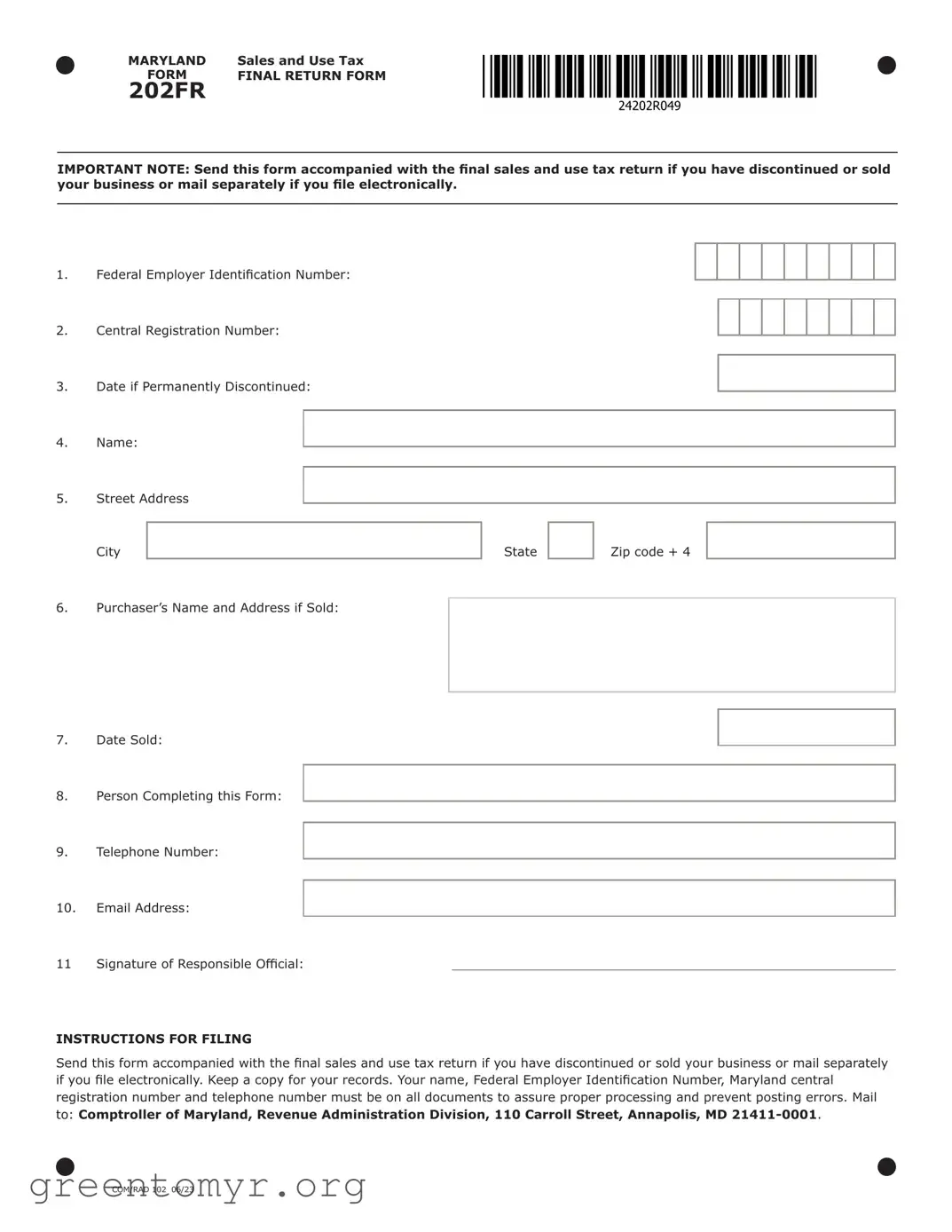
The Maryland Sales and Use Tax 202 form serves as a crucial document for businesses that have either discontinued operations or sold their assets. This form is not merely a notification; it is a final return that must be submitted to ensure compliance with state tax regulations. Key components of the form include essential identifiers such as the Federal Employer Identification Number and the Central Registration Number, which help the state track the business's tax obligations. Additionally, the form requires details about the cessation of business, including the date it was permanently discontinued and the name and address of the purchaser if the business was sold. Contact information for the person completing the form is also necessary, ensuring that any follow-up can be conducted efficiently. Furthermore, proper filing instructions emphasize the importance of submitting the form alongside the final sales and use tax return, or separately if filing electronically. This process not only aids in accurate record-keeping but also prevents potential posting errors. Businesses must remember to keep a copy for their records, as maintaining documentation is vital for future reference. The completed form should be mailed to the Comptroller of Maryland, highlighting the importance of adhering to submission guidelines to avoid complications.
MARYLAND |
Sales and Use Tax |
FORM |
FINAL RETURN FORM |
202FR |
|
IMPORTANT NOTE: Send this form accompanied with the final sales and use tax return if you have discontinued or sold your business or mail separately if you file electronically.
1.Federal Employer Identification Number:
2.Central Registration Number:
3.Date if Permanently Discontinued:
4.Name:
5.Street Address
City
6.Purchaser’s Name and Address if Sold:
7.Date Sold:
8.Person Completing this Form:
9.Telephone Number:
10.Email Address:
11 Signature of Responsible Official:
INSTRUCTIONS FOR FILING
State
Zip code + 4
Send this form accompanied with the final sales and use tax return if you have discontinued or sold your business or mail separately if you file electronically. Keep a copy for your records. Your name, Federal Employer Identification Number, Maryland central registration number and telephone number must be on all documents to assure proper processing and prevent posting errors. Mail to: Comptroller of Maryland, Revenue Administration Division, 110 Carroll Street, Annapolis, MD
COM/RAD 102 06/23
| Fact Name | Details |
|---|---|
| Form Purpose | This form is used to report the final sales and use tax return when a business is discontinued or sold. |
| Governing Law | The Maryland Sales and Use Tax is governed by the Maryland Tax-General Article, Title 11. |
| Filing Requirement | Submit this form along with the final sales and use tax return if discontinuing or selling a business. |
| Electronic Filing | If you file electronically, you may mail this form separately. |
| Identification Numbers | Include your Federal Employer Identification Number and Central Registration Number on the form. |
| Important Dates | Provide the date your business was permanently discontinued and the date of sale, if applicable. |
| Contact Information | Fill in your name, address, telephone number, and email address for communication purposes. |
| Signature Requirement | The form must be signed by a responsible official to validate the information provided. |
| Mailing Address | Send the completed form to the Comptroller of Maryland, Revenue Administration Division, Annapolis, MD. |
| Record Keeping | Keep a copy of the completed form for your records to ensure compliance and for future reference. |
Completing the Maryland Sales and Use Tax Form 202 requires attention to detail. This form is essential for those who have discontinued or sold their business. Ensure all required information is accurately filled out to avoid processing delays.
Once the form is complete, send it along with your final sales and use tax return if you have discontinued or sold your business. If you file electronically, mail it separately. Remember to keep a copy for your records. Ensure all documents include your name, Federal Employer Identification Number, and Central Registration Number for proper processing. Mail everything to the Comptroller of Maryland at the specified address.
The Maryland Sales and Use Tax Form 202 is a final return form used when a business has been discontinued or sold. This form helps ensure that all sales and use taxes are accounted for before closing the business or transferring ownership.
You should use Form 202 if you have permanently discontinued your business or if you have sold your business. It is important to file this form to properly close out your tax obligations.
The form requires several key pieces of information, including:
If you file your final sales and use tax return electronically, you should mail Form 202 separately. Ensure that you follow the instructions carefully to avoid any processing delays.
Mail Form 202 to the following address:
Comptroller of Maryland, Revenue Administration Division, 110 Carroll Street, Annapolis, MD 21411-0001.
Failing to file Form 202 may lead to complications in closing your business. You could face issues with tax liabilities or even penalties. It’s best to file the form to ensure everything is settled correctly.
It’s essential to keep a copy of Form 202 and all related documents for your records. This will help you in case of any future inquiries or audits regarding your business’s tax status.
If you have questions while completing Form 202, you can reach out to the Comptroller of Maryland’s office. They can provide guidance and clarify any uncertainties you may have.
While the specific deadline may vary, it’s important to submit Form 202 as soon as you discontinue or sell your business. This helps ensure that your tax obligations are settled in a timely manner.
Yes, there are resources available to assist you with your final sales and use tax return. You may consider consulting a tax professional or reaching out to the Comptroller’s office for help.
When filling out the Maryland Sales and Use Tax 202 form, individuals often make several common mistakes that can lead to delays or complications. Understanding these pitfalls can help ensure a smoother process. One major error is failing to include the Federal Employer Identification Number. This number is crucial for identifying your business and must be provided accurately.
Another frequent mistake involves not including the Central Registration Number. This number is essential for tax purposes and helps the state track your business activities. Omitting it can lead to confusion and potential penalties. Additionally, some individuals forget to specify the Date if Permanently Discontinued. This date is important for the state to know when your business ceased operations, and leaving it blank can result in misunderstandings regarding your tax obligations.
Many people also overlook the necessity of providing a complete Name and Street Address. It’s important to include not just the name of the business but also the full address, including city and zip code. Incomplete information can lead to processing issues. Furthermore, if the business has been sold, it is crucial to include the Purchaser’s Name and Address as well. This information helps the state update its records accurately.
Another common oversight is not including the Date Sold. This date is vital for tax records and helps clarify the timeline of the business's activities. Similarly, the section for the Person Completing this Form must be filled out correctly. This ensures that there is a clear point of contact for any follow-up questions or clarifications.
Providing a valid Telephone Number and Email Address is also essential. These contact details allow the state to reach you if there are any issues with your submission. Lastly, don’t forget to include the Signature of Responsible Official. This signature confirms that the information provided is accurate and complete. Without it, the form may be deemed invalid.
In conclusion, by paying attention to these details and avoiding these common mistakes, you can help ensure that your Maryland Sales and Use Tax 202 form is processed smoothly. Keeping a copy for your records is also a wise practice, as it provides you with documentation of your submission.
The Maryland Sales and Use Tax 202 form is essential for businesses that have ceased operations or sold their assets. However, several other documents often accompany this form to ensure compliance with state regulations. Below is a list of these documents, each serving a specific purpose in the tax filing process.
In summary, these documents work in conjunction with the Maryland Sales and Use Tax 202 form to facilitate a smooth transition for businesses that are discontinuing operations or transferring ownership. Proper documentation is crucial for compliance and to avoid any potential issues with state tax authorities.
The Maryland Sales and Use Tax 202 form is an important document for businesses that have either discontinued operations or sold their business. It shares similarities with several other tax-related documents. Below is a list of nine documents that are comparable to the Maryland Sales Use Tax 202 form, highlighting their similarities:
Each of these documents serves a specific purpose in the realm of business operations and tax compliance, sharing common themes of accountability and transparency with the Maryland Sales Use Tax 202 form.
When filling out the Maryland Sales and Use Tax 202 form, certain practices can facilitate a smoother process. Below is a list of dos and don'ts to consider.
Understanding the Maryland Sales and Use Tax 202 form can be tricky. Here are some common misconceptions that people often have:
Clearing up these misconceptions can help ensure that you complete the Maryland Sales and Use Tax 202 form correctly and on time.
Filling out the Maryland Sales and Use Tax Form 202 can seem daunting, but understanding its key components can simplify the process. Here are some important takeaways to keep in mind:
By keeping these points in mind, you can navigate the process of completing the Maryland Sales and Use Tax Form 202 with greater ease and confidence.