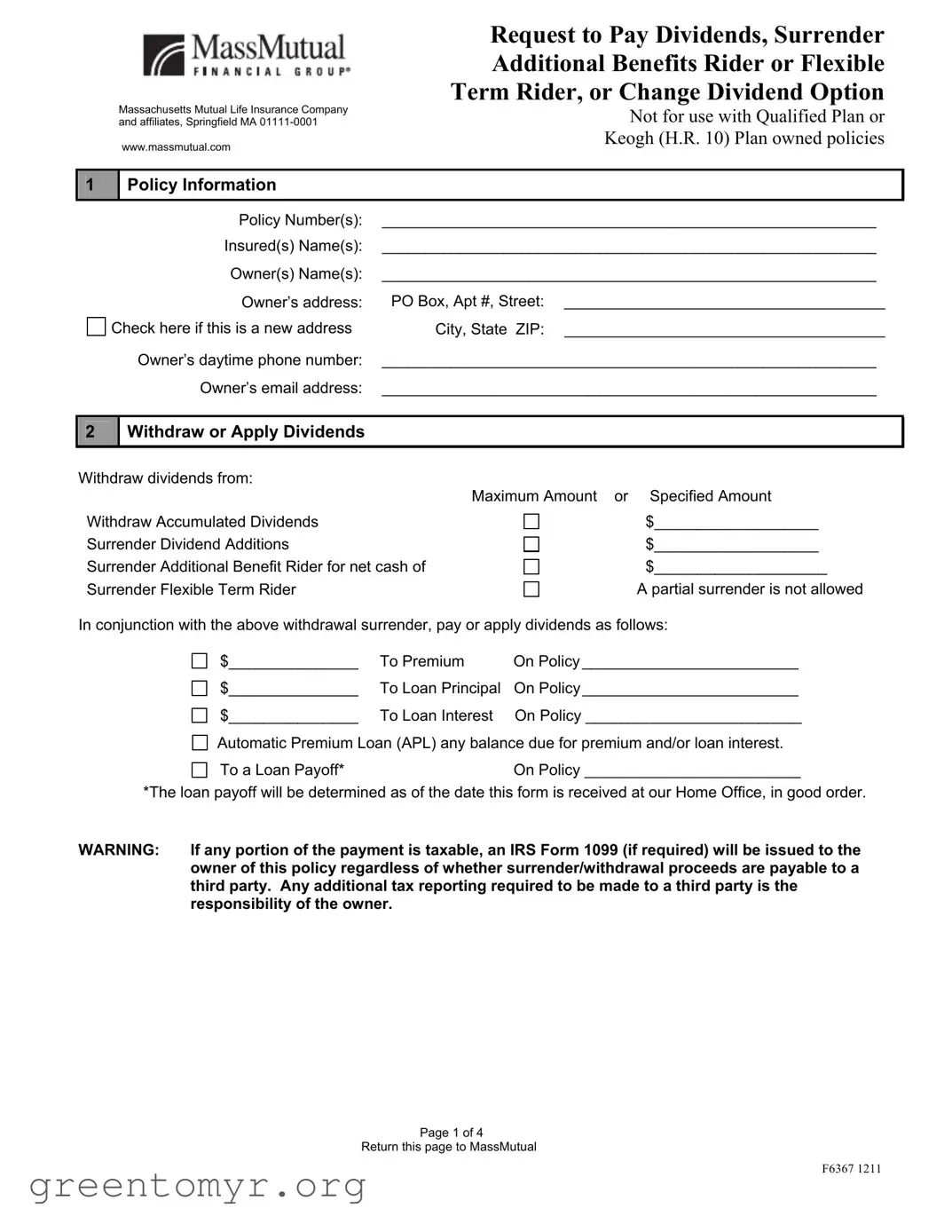
When considering the Mass Mutual Policy Surrender form, it’s essential to understand its various components and implications. This form serves multiple purposes, including requesting the payment of dividends, surrendering additional benefits riders, or changing dividend options. It is important to note that this form is not applicable for qualified plans or Keogh plans. The first section requires critical policy information such as the policy number, insured names, and owner details, ensuring that the request is properly linked to the correct policy. Following this, the form outlines options for withdrawing or applying dividends, detailing how accumulated dividends can be accessed or how benefits can be surrendered for cash value. Additionally, it includes sections for tax withholding elections, emphasizing the importance of understanding potential tax liabilities associated with any distributions. The form also requires signatures from all owners, ensuring that all parties involved acknowledge and consent to the actions being taken. Lastly, it provides instructions for mailing and delivery options, emphasizing the need for accuracy in providing payee information if proceeds are directed to someone other than the policy owner. Understanding these elements can help navigate the surrender process smoothly and ensure compliance with all necessary requirements.
Massachusetts Mutual Life Insurance Company and affiliates, Springfield MA
www.massmutual.com
Request to Pay Dividends, Surrender Additional Benefits Rider or Flexible Term Rider, or Change Dividend Option
Not for use with Qualified Plan or
Keogh (H.R. 10) Plan owned policies
1
Policy Information
Policy Number(s): |
_________________________________________________________ |
|
Insured(s) Name(s): |
_________________________________________________________ |
|
Owner(s) Name(s): |
_________________________________________________________ |
|
Owner’s address: |
PO Box, Apt #, Street: |
_____________________________________ |
Check here if this is a new address |
City, State ZIP: |
_____________________________________ |
Owner’s daytime phone number: _________________________________________________________
Owner’s email address: _________________________________________________________
2
Withdraw or Apply Dividends
Withdraw dividends from: |
|
Maximum Amount |
or Specified Amount |
Withdraw Accumulated Dividends |
$___________________ |
Surrender Dividend Additions |
$___________________ |
Surrender Additional Benefit Rider for net cash of |
$____________________ |
Surrender Flexible Term Rider |
A partial surrender is not allowed |
In conjunction with the above withdrawal surrender, pay or apply dividends as follows:
|
$_______________ |
To Premium |
On Policy _________________________ |
|
$_______________ |
To Loan Principal |
On Policy_________________________ |
|
$_______________ |
To Loan Interest |
On Policy _________________________ |
|
Automatic Premium Loan (APL) any balance due for premium and/or loan interest. |
||
|
To a Loan Payoff* |
|
On Policy _________________________ |
*The loan payoff will be determined as of the date this form is received at our Home Office, in good order. |
|||
WARNING: |
If any portion of the payment is taxable, an IRS Form 1099 (if required) will be issued to the |
||
|
owner of this policy regardless of whether surrender/withdrawal proceeds are payable to a |
||
third party. Any additional tax reporting required to be made to a third party is the responsibility of the owner.
Page 1 of 4
Return this page to MassMutual
F6367 1211
Policy Number(s): ___________________________
Name(s) of Insured(s): _______________________
Request to Pay Dividends, Surrender Additional Benefits Rider or Flexible Term Rider, or Change Dividend Option
Not for use with Qualified Plan or Keogh (H.R. 10) Plans owned policies
3
Changes
Cancel Additional Benefits Rider premium as of the current paid to date (to be used in conjunction with the above surrender, and only in those instances where premiums for the Additional Benefits Rider are still being paid).
Cancel the
Change the Dividend Option to:
Pay dividends in cash
Apply dividend to premium (this option is not available for policies that are paid monthly)
Accumulate dividends at interest
Purchase
Cancel the Modified Payment Option (MPO)
4
Withholding Election and Required Notice
The distributions you receive from this policy are subject to Federal Income Tax withholding unless you elect not to have withholding apply. Withholding will apply only to the portion of your distribution that is includable in your income. If you elect no withholding or if you do not have enough withheld, you may be responsible for payment of estimated tax, and you may incur penalties if your withholding and estimated tax payments are not sufficient. If no election is made, any applicable taxes will be withheld. If taxes are withheld, receipt of your payment may be delayed by the calculations required.
NOTE! If you elect Federal Income Tax withholding, you are also electing State Income Tax withholding if applicable under relevant State law.
I have read the above notice regarding Federal Income Tax withholding and:
I do not want Federal Income Tax withheld from my payment.
I want Federal Income Tax withheld from my payment.
MEC WARNING: If your policy has been designated a Modified Endowment Contract (MEC), and you are under age 59 ½, any taxable gain may be subject to a 10% tax penalty. Please consult your tax advisor.
5Payee/Mailing Address
This section must be completed if the proceeds are to be made payable to and mailed to someone other than the policy owner at the address of record. Notary Public stamp may
apply, see Page2. .Exception: proceeds will only be payable to the trust itself on a
Payee Name: |
___________________________ |
Payee Address: |
___________________________ |
Payee Address: |
___________________________ |
City, State, Zip: |
___________________________ |
Distributions may not be sent to an agent/broker address.
6Delivery Options
Checks are mailed through the U.S. Postal Service First Class Mail unless otherwise requested.
U.S Postal Service - Mail (No charge – please allow 10 business days for normal delivery)
UPS Priority (The carrier charges a fee and cannot ship to a P.O. Box. Please provide the information requested below. If not provided, your surrender check will be mailed through the regular U.S. Postal Service.)
UPS Account Name__________________________
UPS Account Number ________________________
Zip Code associated with account # ____________
Page 2 of 4 |
F6367 1211 |
|
Return this page to MassMutual |
||
|
|
Request to Pay Dividends, Surrender |
|
Policy Number(s): _____________________________ |
Additional Benefits Rider or Flexible |
|
Term Rider, or Change Dividend Option |
||
|
Name(s) of Insured(s): _________________________
Not for use with Qualified Plan or Keogh (H.R. 10) Plans owned policies
7 Owner Tax ID Required Please enter your TAX ID (SSN or EIN as applicable)
Check one:
SSN
EIN
Under penalties of perjury, I certify that the above is my correct Taxpayer Identification Number, and I am a U.S. person (U.S. citizen or resident alien), and the Internal Revenue Service (IRS) has NOT notified me that I am subject to backup withholding. The IRS does not require your consent to any provision of this document other than the certifications required to avoid backup withholding.
8Individual, Joint or Multiple Owners Signature Section (All owners must sign.)
______________________________ |
_____________________________________________________ |
_______________ |
Printed Name of Owner |
Signature of Owner |
Date Signed |
______________________________ |
_____________________________________________________ |
_______________ |
Printed Name of Additional Owner |
Signature of Additional Owner |
Date Signed |
______________________________ |
_____________________________________________________ |
_______________ |
Printed Name of Additional Owner |
Signature of Additional Owner |
Date Signed |
9Corporate, Partnership or Trust Owned Signature Section
________________________________________________________________________________ |
________________ |
||
Printed Name of Corporation, Partnership or Trust |
|
Date of Trust |
|
|
I am the sole officer of the corporation listed |
||
____________________________________ |
__________________________________ |
___________ |
________________ |
Printed Name of Corporate Officer or Trustee |
Signature of Corporate Officer or Trustee |
Title |
Date Signed |
____________________________________ |
__________________________________ |
____________ |
________________ |
Printed Name of Corporate Officer or Trustee |
Signature of Corporate Office or Trustee |
Title |
Date Signed |
10 |
Assignee Signature Section |
|
|
______________________________ |
_____________________________________________ |
________________ |
|
Printed Name of Assignee |
Signature & Title |
Date Signed |
|
______________________________ |
_____________________________________________ |
________________ |
|
Printed Name of Additional Assignee |
Signature & Title |
Date Signed |
|
|
|
|
|
11 |
Notary Public Stamp (if applicable) |
|
|
|
|
|
|
A Notary Public stamp is required for distributions greater than $50,000 only if in conjunction with one of the following:
•Checks are made payable to someone other than the policy owner, or
•Proceeds are sent to an address other than the address of record, or
•Proceeds are sent to an address that has been changed in the past 30 days A Notary Public stamp can be obtained from most banks or credit unions.
Subscribed and sworn to before me this ______________________ day of _______________________________
______________________________________________________________________________________________
Signature of Notary Public (Official stamp/seal required) |
My commission expires |
Page 3 of 4
Return this page to MassMutual
F6367 1211

12 Signature Instructions
The following descriptions explain the signature requirements for each type of ownership arrangement.
Corporation, partnership, |
Include the full name of the corporation. Print or type the full name and corporate title of each |
limited partnership |
officer who signs. If the officer is the insured or a family member, we require the signature of |
|
another officer who is not related or, if all officers are related, the signature of two officers. If |
|
the insured is the only officer, we require one of the following: check the box titled Sole |
|
Officer in the signature section or a letter on company stationary to that effect or the |
|
insured’s signature with the corporate seal affixed. EXAMPLE - John Doe, |
|
President/Partner/General Partner, ABC Corporation |
Trust ** |
Those trustees required to sign under the trust agreement. Include the full name of the trust, |
|
the date of the trust agreement and the title(s) of the officer(s), if corporate trust, signing. |
|
EXAMPLE – Mary Smith as Trustee under the ABC Trust Agreement dated mm/dd/yyyy |
Custodian |
• In all states except South Carolina and Vermont, include the full name of the |
|
custodian “as custodian for (insert name of minor) under the (name of state)’s |
|
UTMA.” EXAMPLE |
|
UTMA. |
|
• In South Carolina and Vermont, include the name of the custodian “as custodian for |
|
(insert name of minor) under the (name of state)’s UGMA.” EXAMPLE |
|
as custodian for Alice Doe under the Vermont UGMA. |
Executor** |
Include the full name of the appointed executor, administrator, or personal representative, as |
|
“executor, administrator, or personal representative (list only one capacity) for the estate of |
|
(insert name of deceased), deceased.” If not previously submitted, a copy of the death |
|
certificate is required. EXAMPLE – Joan Doe, executor for the estate of Sam Doe, |
|
deceased. |
Legal Guardian |
Include the full name of the legal guardian/conservator, “as guardian/conservator of the |
/Conservator** |
estate of (insert name of person affected).” EXAMPLE – Joan Doe as Guardian/Conservator |
|
of the Estate of Sam Doe. |
Include the full name of the |
|
of Attorney) |
person).”EXAMPLE – Joan Doe, |
If the policy is assigned |
The owner and assignee must sign. Include the full name of the assignee. If the assignee is |
|
a corporation, also include the title(s) of all officer(s) signing. NOTE: If the right being |
|
exercised is granted to the assignee, only the assignee’s signature is required. |
** Copies of the legal document that established authority must be submitted with this form unless already on file.
13 Customer Service Information
Once you have reviewed and completed this form, please return pages
Mail to: |
|
|
MassMutual Financial Group |
MassMutual Customer Service Center: |
Internet Service |
Enterprise Document Management Hub |
Connection: |
|
1295 State Street |
Monday through Friday, 8 a.m. – 8 p.m. |
www.massmutual.com |
Springfield MA |
Eastern Time |
|
Fax to: |
|
|
Attention Life Hub |
|
|
|
|
|
|
Page 4 of 4 |
|
|
Retain this page for your records |
|
F6367 1211
| Fact Name | Description |
|---|---|
| Policy Use | This form is not intended for use with Qualified Plans or Keogh (H.R. 10) Plan owned policies. |
| Tax Implications | If any payment is taxable, an IRS Form 1099 will be issued to the policy owner, regardless of payment recipient. |
| Withholding Election | Federal Income Tax withholding applies unless the owner elects otherwise. If no election is made, applicable taxes will be withheld. |
| Delivery Options | Checks are typically mailed via U.S. Postal Service First Class Mail unless an alternative method, such as UPS, is specified. |
| Notary Requirement | A Notary Public stamp is required for distributions greater than $50,000 under certain conditions, including address changes. |
| Owner Tax ID | Policy owners must provide their Tax ID (SSN or EIN) to avoid backup withholding penalties. |
| Signature Requirements | All owners must sign the form. Specific signature requirements apply for corporations, trusts, and other entities. |
| State-Specific Forms | Different states may have unique governing laws regarding the surrender process; consult local regulations for specifics. |
Filling out the Mass Mutual Policy Surrender form is a straightforward process. Once you've completed the form, it’s essential to submit it to MassMutual for processing. Be sure to double-check your entries for accuracy to avoid any delays.
The Mass Mutual Policy Surrender form is a document used by policyholders to request the surrender of their life insurance policy or specific benefits associated with it. This form allows policyholders to withdraw dividends, surrender additional benefits riders, or change dividend options. It is important to note that this form is not applicable for Qualified Plan or Keogh Plan owned policies.
The surrender form can be completed by the policy owner or an authorized representative. If the policy is owned by a corporation, partnership, or trust, specific signature requirements must be followed, as detailed in the form.
The form requires several key pieces of information, including:
Yes, you can withdraw dividends from your policy. The form allows you to specify either a maximum amount or a specified amount for withdrawal. However, keep in mind that a partial surrender is not permitted.
Surrendering your policy may result in tax implications, particularly if there is any taxable gain. An IRS Form 1099 will be issued for any taxable portion of the surrender. It's advisable to consult with a tax advisor to understand the potential consequences before proceeding.
Proceeds from the surrender will typically be mailed via U.S. Postal Service First Class Mail. If you prefer, you can request UPS Priority shipping, although this may incur additional charges and cannot be sent to a P.O. Box.
Yes, the form includes an option for federal income tax withholding. If you do not elect to have taxes withheld, you may be responsible for estimated tax payments, which could lead to penalties if insufficient. It’s important to read the withholding notice carefully and make an informed decision.
The form allows you to change your dividend option. Options include receiving dividends in cash, applying them to premiums, accumulating them at interest, or purchasing paid-up additions. However, some options may not be available depending on your policy type.
A notary public stamp is required only for distributions greater than $50,000 under specific conditions, such as when checks are made payable to someone other than the policy owner or when proceeds are sent to a changed address. If needed, a notary can typically be found at banks or credit unions.
You can mail or fax the completed form to MassMutual’s Customer Service Center. The mailing address and fax number are provided on the form. Ensure that you send the correct pages for processing to avoid delays.
Filling out the Mass Mutual Policy Surrender form can be a straightforward process, but many people make common mistakes that can lead to delays or complications. Here are nine mistakes to watch out for when completing this important document.
One frequent error is leaving out crucial policy information. Ensure that you fill in your policy number, the names of the insured and owners, and the owner's address completely. Omitting any of these details can result in processing delays.
Another common mistake is failing to check the box for a new address if you have moved recently. If your address has changed, it’s essential to indicate that on the form. Otherwise, you might miss important communications regarding your policy.
Many individuals also overlook the section about tax withholding. Not understanding how federal and state income tax withholding works can lead to unexpected tax liabilities. Make sure to read the withholding notice carefully and make your election clear to avoid any surprises later.
People often miscalculate the amounts they wish to withdraw or surrender. Double-check your calculations to ensure that you specify the correct amounts for accumulated dividends or additional benefits riders. Errors in this section can lead to incorrect payments.
Another mistake is not providing a valid tax identification number. Whether you use a Social Security Number or Employer Identification Number, ensure that this information is accurate. Failing to do so can complicate the tax reporting process.
Signature requirements can also trip up applicants. All owners must sign the form, and if there are multiple owners, ensure that each one has signed in the correct section. Missing signatures can halt the processing of your request.
Some people forget to include a notary public stamp when required. If your distribution exceeds $50,000 or if you are sending proceeds to a different address, a notary stamp is necessary. This step is crucial for ensuring the validity of your request.
Additionally, many fail to specify the payee’s mailing address correctly. If the proceeds are being sent to someone other than the policy owner, make sure the payee's name and address are filled out completely. Incorrect information can delay the delivery of your funds.
Lastly, individuals sometimes neglect to read the entire form and accompanying instructions. Understanding every section of the form is vital. Take the time to review the instructions carefully to avoid any oversight that could lead to complications.
By being aware of these common mistakes, you can navigate the Mass Mutual Policy Surrender form with greater confidence and ensure a smoother process for your policy surrender or dividend request.
When surrendering a MassMutual policy, several other forms and documents may be needed to ensure a smooth process. Below is a list of commonly used documents that you might encounter along with the MassMutual Policy Surrender form. Each plays a crucial role in completing your request efficiently.
Gathering these documents can expedite your policy surrender process. Ensure that you have everything ready to avoid delays and complications. If you have questions about any specific form or its requirements, seeking assistance is advisable.
When filling out the Mass Mutual Policy Surrender form, it is crucial to follow certain guidelines to ensure a smooth process. Here are 10 things you should and shouldn't do:
By adhering to these guidelines, you can help ensure that your request is processed efficiently and without unnecessary complications.
Understanding the Mass Mutual Policy Surrender form can be challenging. Here are ten common misconceptions about this form, along with clarifications to help you navigate the process more effectively.
While you can submit a surrender request at any time, doing so may have financial implications, including potential tax liabilities.
The form also allows for changes to dividend options and cancellation of additional benefits, not just cash withdrawals.
A Tax ID is required to process your request, ensuring compliance with tax regulations.
The policy explicitly states that partial surrenders are not allowed, meaning you must surrender the entire policy.
All owners must sign the form for it to be valid. Incomplete signatures can delay processing.
Proceeds can only be sent to the policy owner’s address or a designated payee’s address, which must be specified on the form.
If your address has changed recently, you must check the box indicating a new address to ensure accurate processing.
Distributions from the policy are subject to federal income tax withholding unless you specifically elect otherwise.
This form is not intended for use with qualified plans or Keogh plans, which have separate requirements.
A Notary Public stamp is required for distributions over $50,000 if certain conditions apply, such as changes in address or payee.
By addressing these misconceptions, individuals can approach the Mass Mutual Policy Surrender form with greater clarity and confidence. Always consider consulting a financial advisor for personalized guidance.
Complete all required fields: Ensure that all sections of the Mass Mutual Policy Surrender form are filled out accurately. Missing information can delay processing.
Understand tax implications: Be aware that any taxable distributions may require an IRS Form 1099. It's important to consult a tax advisor, especially if your policy is a Modified Endowment Contract (MEC).
Choose delivery options wisely: You can opt for standard mail at no charge or select UPS for faster delivery. Keep in mind that UPS requires additional information and fees.
Signature requirements: Ensure that all necessary signatures are obtained based on the type of ownership. This may include corporate officers, trustees, or legal guardians, depending on the policy's ownership structure.