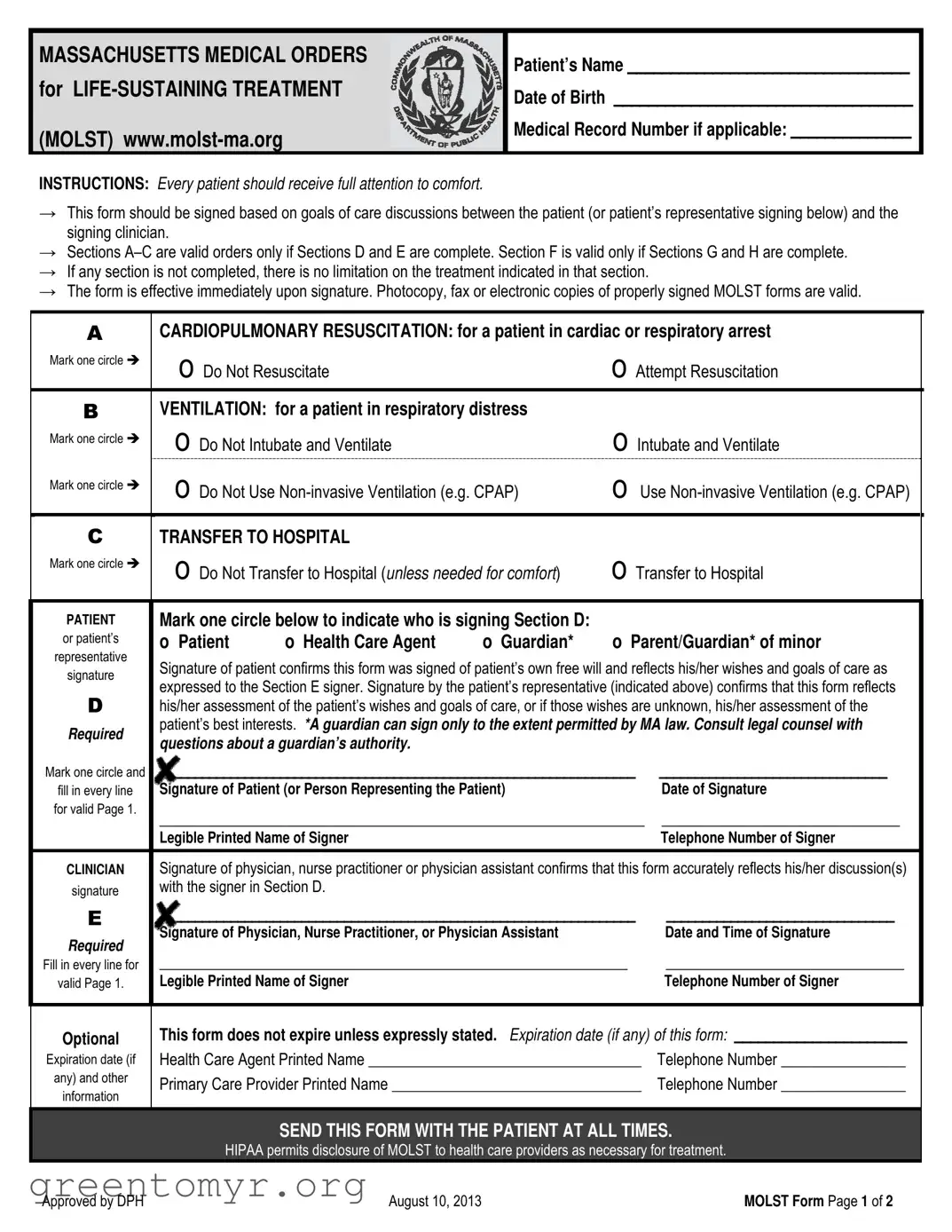
The Massachusetts Medical Orders for Life-Sustaining Treatment (MOLST) form plays a crucial role in ensuring that patients receive care aligned with their personal wishes during critical medical situations. This standardized medical order form is intended for use by licensed healthcare providers, including physicians, nurse practitioners, and physician assistants. It facilitates meaningful conversations about end-of-life care and treatment preferences, allowing patients or their designated representatives to articulate their goals clearly. The form consists of several sections that address specific medical interventions, such as resuscitation efforts, ventilation options, and transfer to a hospital. Importantly, the MOLST form becomes effective immediately upon signature and must be completed thoughtfully, as incomplete sections may lead to unintended treatment decisions. It is essential for healthcare providers to engage in thorough discussions with patients to ensure that the signed orders genuinely reflect their wishes. Additionally, the MOLST form must be printed on bright pink paper for visibility and is valid in both physical and electronic formats, underscoring its importance in emergency medical situations.
MASSACHUSETTS MEDICAL ORDERS for
(MOLST)
Patient’s Name _________________________________
Date of Birth ___________________________________
Medical Record Number if applicable: ______________
INSTRUCTIONS: Every patient should receive full attention to comfort.
→This form should be signed based on goals of care discussions between the patient (or patient’s representative signing below) and the signing clinician.
→Sections
→If any section is not completed, there is no limitation on the treatment indicated in that section.
→The form is effective immediately upon signature. Photocopy, fax or electronic copies of properly signed MOLST forms are valid.
ACARDIOPULMONARY RESUSCITATION: for a patient in cardiac or respiratory arrest
Mark one circle |
o Do Not Resuscitate |
o Attempt Resuscitation |
|
|
|||
B |
VENTILATION: for a patient in respiratory distress |
|
|
Mark one circle |
o Do Not Intubate and Ventilate |
o Intubate and Ventilate |
|
|
|
||
Mark one circle |
o Do Not Use |
o Use |
|
|
|
||
|
|
|
|
CTRANSFER TO HOSPITAL
Mark one circle |
o Do Not Transfer to Hospital (unless needed for comfort) |
o Transfer to Hospital |
||||
|
||||||
|
|
|
|
|||
PATIENT |
Mark one circle below to indicate who is signing Section D: |
|
|
|||
or patient’s |
o Patient |
o Health Care Agent |
o Guardian* |
o Parent/Guardian* of minor |
||
representative |
||||||
Signature of patient confirms this form was signed of patient’s own free will and reflects his/her wishes and goals of care as |
||||||
signature |
||||||
expressed to the Section E signer. Signature by the patient’s representative (indicated above) confirms that this form reflects |
||||||
|
||||||
D |
his/her assessment of the patient’s wishes and goals of care, or if those wishes are unknown, his/her assessment of the |
|||||
Required |
patient’s best interests. *A guardian can sign only to the extent permitted by MA law. Consult legal counsel with |
|||||
questions about a guardian’s authority. |
|
|
|
|||
|
|
|
|
|||
Mark one circle and |
___________________________________________________________________ |
________________________________ |
||||
fill in every line |
Signature of Patient (or Person Representing the Patient) |
|
Date of Signature |
|||
for valid Page 1. |
_________________________________________________________ |
____________________________ |
||||
|
||||||
|
Legible Printed Name of Signer |
|
|
Telephone Number of Signer |
||
|
|
|||||
CLINICIAN |
Signature of physician, nurse practitioner or physician assistant confirms that this form accurately reflects his/her discussion(s) |
|||||
signature |
with the signer in Section D. |
|
|
|
||
E |
___________________________________________________________________ |
________________________________ |
||||
Required |
Signature of Physician, Nurse Practitioner, or Physician Assistant |
|
Date and Time of Signature |
|||
|
|
|
|
|
||
Fill in every line for |
_______________________________________________________ |
____________________________ |
||||
valid Page 1. |
Legible Printed Name of Signer |
|
|
Telephone Number of Signer |
||
|
|
|
|
|
|
|
Optional
Expiration date (if
any) and other
information
This form does not expire unless expressly stated. Expiration date (if any) of this form: ______________________
Health Care Agent Printed Name ___________________________________ |
Telephone Number ________________ |
Primary Care Provider Printed Name ________________________________ |
Telephone Number ________________ |
SEND THIS FORM WITH THE PATIENT AT ALL TIMES.
HIPAA permits disclosure of MOLST to health care providers as necessary for treatment.
Approved by DPH |
August 10, 2013 |
MOLST Form Page 1 of 2 |

Patient’s Name: ______________________ Patient’s DOB ___________ Medical Record # if applicable__________________
FStatement of Patient Preferences for Other
INTUBATION AND VENTILATION
Mark one circle |
O Refer to Section B |
on |
|
O Use intubation and ventilation as marked |
|
O Undecided |
|
||
|
Page 1 |
|
|
in Section B, but short term only |
|
|
O Did not discuss |
|
|
|
|
|
|
|
|
||||
|
|
||||||||
Mark one circle |
O Refer to Section B |
on |
|
O Use |
|
O Undecided |
|
||
|
|
|
|||||||
|
Page 1 |
|
|
Section B, but short term only |
|
|
O Did not discuss |
|
|
|
DIALYSIS |
|
|
|
|
|
|
|
|
Mark one circle |
O No dialysis |
|
|
O Use dialysis |
|
|
|
O Undecided |
|
|
|
|
O Use dialysis, but short term only |
|
|
O Did not discuss |
|
||
|
|
|
|
|
|
|
|||
|
ARTIFICIAL NUTRITION |
|
|
|
|
|
|
|
|
Mark one circle |
O No artificial nutrition |
|
O Use artificial nutrition |
|
|
O Undecided |
|
||
|
|
|
|
||||||
|
|
|
|
O Use artificial nutrition, but short term only |
|
O Did not discuss |
|
||
|
ARTIFICIAL HYDRATION |
|
|
|
|
|
|
|
|
Mark one circle |
O No artificial hydration |
|
O Use artificial hydration |
|
|
O Undecided |
|
||
|
|
|
|
||||||
|
|
|
|
|
|
|
|
|
|
|
|
|
|
O Use artificial hydration, but short term only |
|
O Did not discuss |
|
||
|
Other treatment preferences specific to the patient’s medical condition and care |
________________________________ |
|
||||||
|
_______________________________________________________________________________________________ |
|
|||||||
|
_______________________________________________________________________________________________ |
|
|||||||
|
|
|
|
|
|
||||
PATIENT |
Mark one circle below to indicate who is signing Section G: |
|
|
|
|
||||
or patient’s |
o Patient |
o Health Care Agent |
o Guardian* |
o Parent/Guardian* of minor |
|
||||
representative |
|
||||||||
|
|
|
|
|
|
|
|
|
|
signature |
Signature of patient confirms this form was signed of patient’s own free will and reflects his/her wishes and goals of care as |
|
|||||||
|
expressed to the Section H signer. Signature by the patient’s representative (indicated above) confirms that this form reflects |
|
|||||||
G |
his/her assessment of the patient’s wishes and goals of care, or if those wishes are unknown, his/her assessment of the |
|
|||||||
patient’s best interests. *A guardian can sign only to the extent permitted by MA law. Consult legal counsel with |
|
||||||||
Required |
|
||||||||
questions about a guardian’s authority. |
|
|
|
|
|
||||
|
|
|
|
|
|
||||
Mark one circle and |
_______________________________________________________ |
____________________________ |
|
||||||
Signature of Patient (or Person Representing the Patient) |
|
|
Date of Signature |
|
|||||
fill in every line |
|
|
|
||||||
|
|
|
|
|
|
|
|
|
|
for valid Page 2. |
_______________________________________________________ |
____________________________ |
|
||||||
|
Legible Printed Name of Signer |
|
|
|
|
|
Telephone Number of Signer |
|
|
|
|
|
|||||||
CLINICIAN |
Signature of physician, nurse practitioner or physician assistant confirms that this form accurately reflects his/her |
|
|||||||
signature |
discussion(s) with the signer in Section G. |
|
|
|
|
|
|||
H |
_______________________________________________________ |
____________________________ |
|
||||||
Signature of Physician, Nurse Practitioner, or Physician Assistant |
|
|
Date and Time of Signature |
|
|||||
|
|
|
|
||||||
Required |
_______________________________________________________ |
____________________________ |
|
||||||
Fill in every line for |
|
||||||||
Legible Printed Name of Signer |
|
|
|
|
|
Telephone Number of Signer |
|
||
valid Page 2. |
|
|
|
|
|
|
|||
|
|
|
|
|
|
|
|
|
|
|
|
|
|
|
|
|
|
|
|
Additional Instructions For Health Care Professionals
→Follow orders listed in A, B and C and honor preferences listed in F until there is an opportunity for a clinician to review as described below.
→Any change to this form requires the form to be voided and a new form to be signed. To void the form, write VOID in large letters across both sides of the form. If no new form is completed, no limitations on treatment are documented and full treatment may be provided.
→
→The patient or health care agent (if the patient lacks capacity), guardian*, or parent/guardian* of a minor can revoke the MOLST form at any time and/or request and receive previously refused
Consult legal counsel with questions about a guardian’s authority.
Approved by DPH |
August 10, 2013 |
MOLST Form Page 2 of 2 |

IMPORTANT INFORMATION ABOUT MASSACHUSETTS MOLST
The Massachusetts MOLST form is a MA DPH‐approved standardized medical order form for use by licensed Massachusetts physicians, nurse practitioners and physician assistants.
While MOLST use expands in Massachusetts, health care providers are encouraged to inform patients that EMTs honor MOLST statewide, but that systems to honor MOLST may still be in development in some Massachusetts health care institutions.
PRINTING THE MASSACHUSETTS MOLST FORM
⎯Do not alter the MOLST form. EMTs have been trained to recognize and honor the standardized MOLST form. The best way to assure that MOLST orders are followed by emergency medical personnel is to download and reproduce the standardized form found on the MOLST web site.
⎯Print original Massachusetts MOLST forms on bright or fluorescent pink paper for maximum visibility.
Astrobrights® Pulsar Pink* is the color highly recommended for original MOLST forms. EMTs are trained to look for the bright pink MOLST form before initiating life‐sustaining treatment with patients.
⎯Print the MOLST form (pages 1 and 2) as a double‐sided form on a single sheet of paper.
⎯Provide an electronic version of the downloaded MOLST form to your institution’s forms department or to personnel responsible for copying/providing forms in your institution.
FOR CLINICIANS: BEFORE USING MOLST
MOLST requires a physician, nurse practitioner, or physician assistant signature to be valid. This signature confirms that the MOLST accurately reflects the signing clinician’s discussion(s) with the patient. The MOLST form should be filled out and signed only after in‐depth conversation between the patient and the clinician signer.
Before using MOLST:
⎯Access the Clinician Checklist for Using MOLST with Patients at: http://www.molst‐ma.org/health‐ care‐professionals/guidance‐for‐using‐molst‐forms‐with‐patients.
⎯Listen to MOLST Overview for Health Professionals at: http://www.molst‐ma.org/molst‐training‐line.
⎯Access the MOLST website at: http://www.molst‐ma.org periodically for MOLST form updates.
⎯For more information about Massachusetts MOLST or the Massachusetts MOLST form, visit http://www.molst‐ma.org.
* Astrobrights® Pulsar Pink paper can be purchased from office suppliers, including:
Staples ‐ Item #491620 Wausau™ Astrobrights® Colored Paper, 8 1/2" x 11", 24 Lb, Pulsar Pink, in stores or at http://www.staples.com, and
Office Depot – Item #420919 Astrobrights® Bright Color Paper, 8 1/2 x 11, 24 Lb, FSC Certified Pulsar Pink, in stores or at http://www.officedepot.com.
August 10, 2013 |
MOLST Instructions Page 1 of 1 |
| Fact Name | Description |
|---|---|
| Purpose | The Massachusetts MOLST form is designed to communicate a patient's preferences for life-sustaining treatment. |
| Governing Law | This form is governed by Massachusetts General Laws, Chapter 111, Section 70B. |
| Signature Requirement | A valid MOLST form requires signatures from both the patient (or their representative) and a licensed clinician. |
| Effective Immediately | The MOLST form becomes effective immediately upon being signed by the appropriate parties. |
| Copy Validity | Photocopies, faxes, or electronic copies of a signed MOLST form are considered valid and should be honored by healthcare providers. |
Completing the Massachusetts MOLST form is a crucial step in ensuring that a patient’s wishes regarding medical treatment are clearly documented and respected. This process involves gathering essential information about the patient and their treatment preferences. Below are the steps to fill out the form accurately.
Once the form is completed, it is essential to keep it with the patient at all times. This ensures that healthcare providers can access and honor the patient's wishes regarding life-sustaining treatment as needed.
The Massachusetts MOLST (Medical Orders for Life-Sustaining Treatment) form is a standardized medical order that allows patients to communicate their preferences regarding life-sustaining treatments. It is designed to ensure that healthcare providers honor the wishes of patients, particularly in emergency situations.
The MOLST form can be signed by the patient themselves or by a representative if the patient is unable to do so. This representative can be a healthcare agent, a guardian, or a parent/guardian of a minor. It is essential that the signer understands the patient’s wishes and goals of care.
If any section of the MOLST form is left incomplete, there will be no limitations on the treatment indicated in that section. This means that healthcare providers may proceed with full treatment unless otherwise specified in the completed sections.
To ensure maximum visibility, the MOLST form should be printed on bright or fluorescent pink paper. It is recommended to use Astrobrights® Pulsar Pink paper. The form should be printed double-sided on a single sheet of paper to maintain its integrity and ensure it is easily recognized by emergency medical personnel.
The MOLST form becomes effective immediately upon signature. This means that once it is signed by the patient or their representative and the clinician, it should be honored by healthcare providers right away.
Yes, the MOLST form can be revoked or changed at any time by the patient or their representative. If the patient's preferences change, it is important to revise the form to accurately reflect their current wishes. Any changes to the form require a new MOLST form to be completed.
For additional information about the Massachusetts MOLST form, you can visit the official MOLST website at www.molst-ma.org . This site provides resources for both patients and healthcare professionals, including guidance on using the MOLST form effectively.
When completing the Massachusetts MOLST form, there are several common mistakes that individuals often make. These errors can lead to confusion about a patient’s wishes regarding life-sustaining treatment. Understanding these pitfalls can help ensure that the form accurately reflects the patient’s preferences.
One frequent mistake is failing to complete all required sections of the form. Sections A through C are only valid if Sections D and E are filled out. If any section is left incomplete, it may lead to unintended treatment decisions. For instance, if the resuscitation section is not marked, it could imply that the patient wishes to receive full resuscitation efforts, which may not align with their actual wishes.
Another common issue is not ensuring that the signatures are provided by the appropriate individuals. The form requires the signature of the patient or their representative, such as a health care agent or guardian. If the wrong person signs the document, it may not hold legal weight. Additionally, a guardian can only sign within the limits set by Massachusetts law, which can lead to complications if not understood properly.
People sometimes overlook the importance of discussing treatment preferences in detail with the clinician. The MOLST form should reflect a thorough conversation about the patient’s wishes and goals of care. If this discussion is not comprehensive, the signed form may not accurately represent the patient’s desires, leading to potential conflicts in treatment.
Another mistake involves using outdated or altered versions of the MOLST form. The form must be the most current version approved by the Massachusetts Department of Public Health. Alterations can cause confusion for emergency medical personnel, who are trained to recognize the standardized form. Using the correct, unaltered form ensures that the patient’s preferences are honored.
Additionally, individuals may forget to print the MOLST form on the recommended bright pink paper. This specific color is essential for visibility and recognition by emergency medical technicians (EMTs). If the form is printed on regular paper, there is a risk that it may not be easily identified in urgent situations.
Finally, not providing copies of the completed MOLST form to all relevant parties is a common oversight. It is crucial that copies are given to the patient, their health care providers, and any family members involved in decision-making. This ensures that everyone is aware of the patient’s wishes and can act accordingly in case of an emergency.
The Massachusetts Medical Orders for Life-Sustaining Treatment (MOLST) form is an essential document that ensures patients' treatment preferences are respected during medical emergencies. In addition to the MOLST form, there are several other important documents and forms that can help clarify a patient’s wishes regarding medical care. Understanding these documents can provide peace of mind for both patients and their families.
By familiarizing yourself with these forms, you can better navigate the complexities of medical care preferences. Each document serves a unique purpose and collectively, they help ensure that a patient's voice is heard, even in challenging circumstances. Taking the time to complete these forms can provide both patients and their families with reassurance and clarity about their healthcare decisions.
When filling out the Massachusetts MOLST form, it is essential to approach the process with care and attention. Below are some important dos and don'ts to consider.
Key Takeaways about the Massachusetts MOLST Form