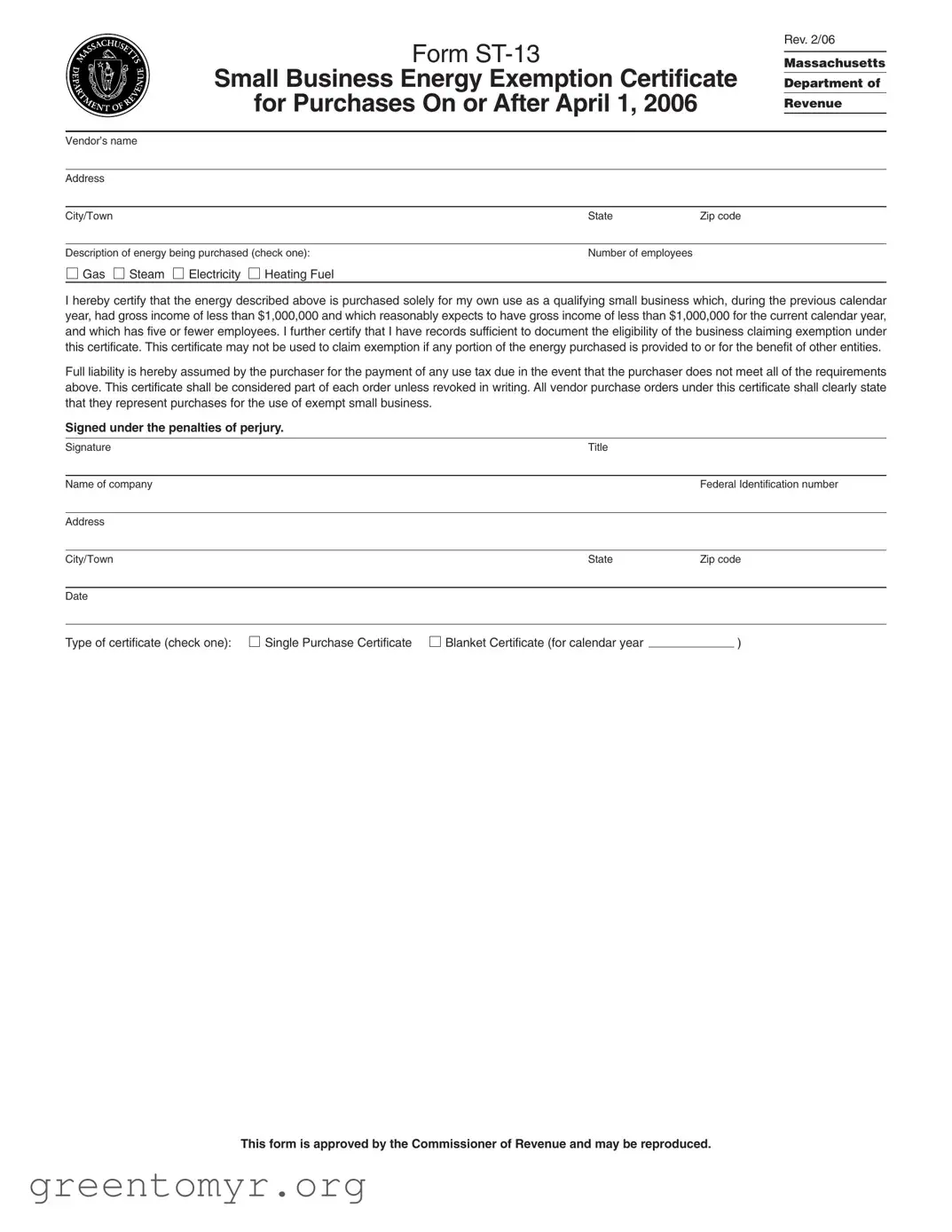
The Massachusetts ST-13 form, known as the Small Business Energy Exemption Certificate, plays a crucial role for small businesses looking to save on energy costs. Designed specifically for businesses with gross income under $1,000,000 and five or fewer employees, this form allows eligible entities to purchase gas, steam, electricity, and heating fuel without incurring sales tax. To qualify, a business must certify that the energy is for its own use and not for resale or distribution to other entities. The form requires basic information such as the vendor's name, address, and a description of the energy being purchased. Additionally, it includes a declaration that the business meets the income criteria for the previous and current calendar years. Importantly, the ST-13 form must be presented to vendors to claim the exemption, and it remains valid for the calendar year unless revoked in writing. Businesses that misuse this certificate may face serious penalties, highlighting the importance of understanding the rules and responsibilities that come with claiming this exemption. In this article, we will explore the ST-13 form in detail, covering its requirements, benefits, and the steps businesses must take to ensure compliance.
Form
Small Business Energy Exemption Certificate
for Purchases On or After April 1, 2006
Rev. 2/06
Massachusetts
Department of
Revenue
Vendor’s name
Address
City/Town |
State |
Zip code |
|
|
|
Description of energy being purchased (check one): |
Number of employees |
|
Gas
Steam
Electricity
Heating Fuel
I hereby certify that the energy described above is purchased solely for my own use as a qualifying small business which, during the previous calendar year, had gross income of less than $1,000,000 and which reasonably expects to have gross income of less than $1,000,000 for the current calendar year, and which has five or fewer employees. I further certify that I have records sufficient to document the eligibility of the business claiming exemption under this certificate. This certificate may not be used to claim exemption if any portion of the energy purchased is provided to or for the benefit of other entities.
Full liability is hereby assumed by the purchaser for the payment of any use tax due in the event that the purchaser does not meet all of the requirements above. This certificate shall be considered part of each order unless revoked in writing. All vendor purchase orders under this certificate shall clearly state that they represent purchases for the use of exempt small business.
Signed under the penalties of perjury.
Signature |
Title |
|
|
|
|
Name of company |
|
Federal Identification number |
|
|
|
Address |
|
|
|
|
|
City/Town |
State |
Zip code |
|
|
|
Date |
|
|
Type of certificate (check one):
Single Purchase Certificate
Blanket Certificate (for calendar year |
|
) |
This form is approved by the Commissioner of Revenue and may be reproduced.

Form
General Information
All business entities with gross income of less than $1,000,000 for the previous calendar year and that reasonably expect to have gross income of less than $1,000,000 in the current calendar year, that have five or fewer employees are exempt from paying a sales tax on their purchases of gas, steam, electricity and heating fuel solely for their own use. A business that may not have had gross in- come during the preceding calendar year, such as a
Any purchaser which seeks this exemption must complete Form
Instructions to Vendors
The burden of proving that a business is entitled to the small busi- ness exemption is on the vendor unless the vendor accepts in good faith a copy of this certificate, Form
For each sale exempt from sales tax under the small business ex- emption, vendors must keep a record of the name, address, and federal identification number of the small business claiming the ex- emption, the sales price of each sale and a copy of Form
Instructions to Purchasers
A purchaser ordinarily must present this certificate to the vendor for each calendar year on or before the date of its first purchase of taxable fuel in each new calendar year. If a purchaser presents the certificate after this date, the certificate only applies to purchases made on or after the date the certificate is signed and presented to the vendor.
For purposes of this exemption, an “employee” includes any part- ner, owner or officer of the business who normally works for the business for thirty hours or more per week. Unless a taxpayer dem- onstrates otherwise, the Commissioner of Revenue will presume that any partner, owner or officer who regularly works for a business normally works for the business for thirty hours or more per week.
“Employee” also includes any other individual who is an employee as defined for federal tax withholding purposes under Internal Revenue Code (I.R.C.) Sec. 3401 and who normally works for the business for thirty hours per week or more and who is hired for a period of five months or more.
In determining number or employees, a business entity must con- sider all employees, not just employees at a particular location of the business.
If a business is a member of an affiliated group, as defined in I.R.C. Sec. 1504, all employees of all members of the group must be counted to determine whether the entire affiliated group qualifies as a small business.
The business must maintain adequate weekly employee time and wage records to substantiate any claim to this exemption.
If at any time a business that has claimed a small business exemp- tion under this certificate ceases to qualify for exemption, it must notify the vendor in writing.
A purchaser is liable for the payment of any use tax in the event that the purchaser is not eligible for the exemption.
For further information about the Small Business Energy Exemp- tion, see Massachusetts Regulation 830 CMR 64H.6.11; Technical Information Release
Warning: Willful misuse of this certificate may result in criminal tax evasion penalties of up to one year in prison and $10,000 ($50,000 for corporations) in fines.
If you have any questions about the acceptance or use of this cer- tificate, please contact the Massachusetts Department of Revenue at (617)
| Fact Name | Description |
|---|---|
| Form Title | ST-13 Small Business Energy Exemption Certificate |
| Governing Law | Massachusetts Regulation 830 CMR 64H.6.11 |
| Eligibility Criteria | Gross income must be less than $1,000,000 for the previous year and expected to be less than $1,000,000 for the current year. |
| Employee Limit | The business must have five or fewer employees to qualify. |
| Energy Types | Exemption applies to gas, steam, electricity, and heating fuel purchased for own use. |
| Certificate Requirement | A signed Form ST-13 must be presented to the vendor to claim the exemption. |
| Record Keeping | Vendors must keep records of the exemption claims, including a copy of Form ST-13. |
| Use Tax Liability | The purchaser is liable for any use tax if they do not meet the exemption criteria. |
| Penalties for Misuse | Willful misuse may result in criminal penalties, including fines and imprisonment. |
Filling out the Massachusetts ST-13 form is a straightforward process. This certificate allows qualifying small businesses to claim an exemption from sales tax on certain energy purchases. Ensure you have the necessary information on hand before starting.
Once you have completed the form, ensure that you provide a signed copy to your vendor to validate your exemption. Keep a copy for your records as well. If your business circumstances change and you no longer qualify, notify the vendor in writing.
The Massachusetts ST-13 form, also known as the Small Business Energy Exemption Certificate, allows qualifying small businesses to purchase certain types of energy without paying sales tax. This exemption applies to businesses that had gross income of less than $1,000,000 in the previous calendar year and reasonably expect to maintain that level of income in the current year. Additionally, the business must have five or fewer employees. The form must be completed and submitted to the vendor to claim the exemption.
To qualify for the ST-13 exemption, a business must meet the following criteria:
Newly formed businesses that did not have income in the previous year may still qualify if they expect to meet the income threshold for the current year.
To claim the exemption, you must complete the ST-13 form and provide a signed copy to your vendor before making your first purchase of taxable fuel in the calendar year. The certificate should clearly indicate that it is for the use of an exempt small business. If the form is presented after the first purchase, it will only apply to purchases made on or after the date it is signed and presented.
Vendors are responsible for maintaining records to prove that a business is entitled to the small business exemption. This includes:
Keeping these records is essential for compliance with Massachusetts tax regulations.
If a business that has claimed the small business exemption under the ST-13 form ceases to meet the eligibility requirements, it must notify the vendor in writing. Failure to do so may result in the business being liable for any use tax due. Additionally, willful misuse of the certificate can lead to serious penalties, including fines and potential imprisonment.
Filling out the Massachusetts St 13 form can seem straightforward, but many make mistakes that could lead to complications. One common error is not providing the correct vendor information. The form requires the vendor's name, address, and other details. If any of these are missing or incorrect, the exemption may not be honored. Vendors rely on accurate information to process the exemption, so double-checking these details is crucial.
Another mistake occurs when individuals fail to accurately describe the energy being purchased. The form includes specific options such as gas, steam, electricity, and heating fuel. Selecting the wrong option can lead to confusion and potentially invalidate the exemption. It is important to check the box that corresponds precisely to the type of energy being acquired.
People often overlook the requirement to certify their eligibility as a qualifying small business. The form states that the business must have had gross income of less than $1,000,000 in the previous year and expect to have the same in the current year. Failing to meet these criteria can result in penalties. Therefore, understanding and confirming eligibility is essential before signing the form.
Additionally, some individuals do not keep sufficient records to document their eligibility. The form requires that businesses maintain adequate records, including employee counts and income statements. If the Massachusetts Department of Revenue questions a claim, lacking proper documentation can lead to the loss of the exemption and possible tax liabilities.
Finally, many forget to submit the form before making their first purchase of taxable fuel in the new calendar year. The exemption applies only to purchases made after the certificate is signed and presented to the vendor. If the form is submitted late, it will not cover earlier purchases, which could result in unexpected tax charges. Timely submission is a key aspect of ensuring that the exemption remains valid.
The Massachusetts ST-13 form is essential for small businesses seeking exemption from sales tax on energy purchases. However, several other forms and documents are often used in conjunction with it to ensure compliance and facilitate the exemption process. Understanding these documents can help small business owners navigate their responsibilities more effectively.
Utilizing these forms and documents correctly is crucial for small businesses to ensure they benefit from available exemptions while remaining compliant with state regulations. Proper documentation will not only help in claiming exemptions but also safeguard against potential tax liabilities in the future.
The Massachusetts Form ST-13 is a Small Business Energy Exemption Certificate. It serves a specific purpose, but there are other documents that share similar functions or requirements. Here are seven documents that are comparable to the ST-13 form:
When filling out the Massachusetts ST-13 form, it's essential to follow specific guidelines to ensure compliance and avoid potential issues. Here’s a list of things you should and shouldn't do:
Understanding the Massachusetts ST-13 form can be challenging, and several misconceptions often arise. Here are four common misunderstandings about this important document:
This is not entirely accurate. While the form does require that a business had gross income of less than $1,000,000 in the previous calendar year, newly formed businesses can also qualify. If they reasonably expect to have gross income under this threshold in the current year, they can still use the form.
This is misleading. The ST-13 form specifically applies to purchases of gas, steam, electricity, and heating fuel. It does not extend to other types of energy or services, so businesses should be mindful of the limitations of this exemption.
In reality, the burden of proof lies primarily with the vendor. However, if the vendor accepts the ST-13 form in good faith, they can rely on it to exempt the sale from sales tax. This means that while vendors must keep records, they do not have to independently verify each business's eligibility.
This is incorrect. A business must present the ST-13 form to the vendor each calendar year. If a business's circumstances change and it no longer qualifies for the exemption, it is required to notify the vendor in writing. Failure to do so can result in liability for use tax.
When filling out and using the Massachusetts ST-13 form, there are several important considerations to keep in mind: