Content Navigation

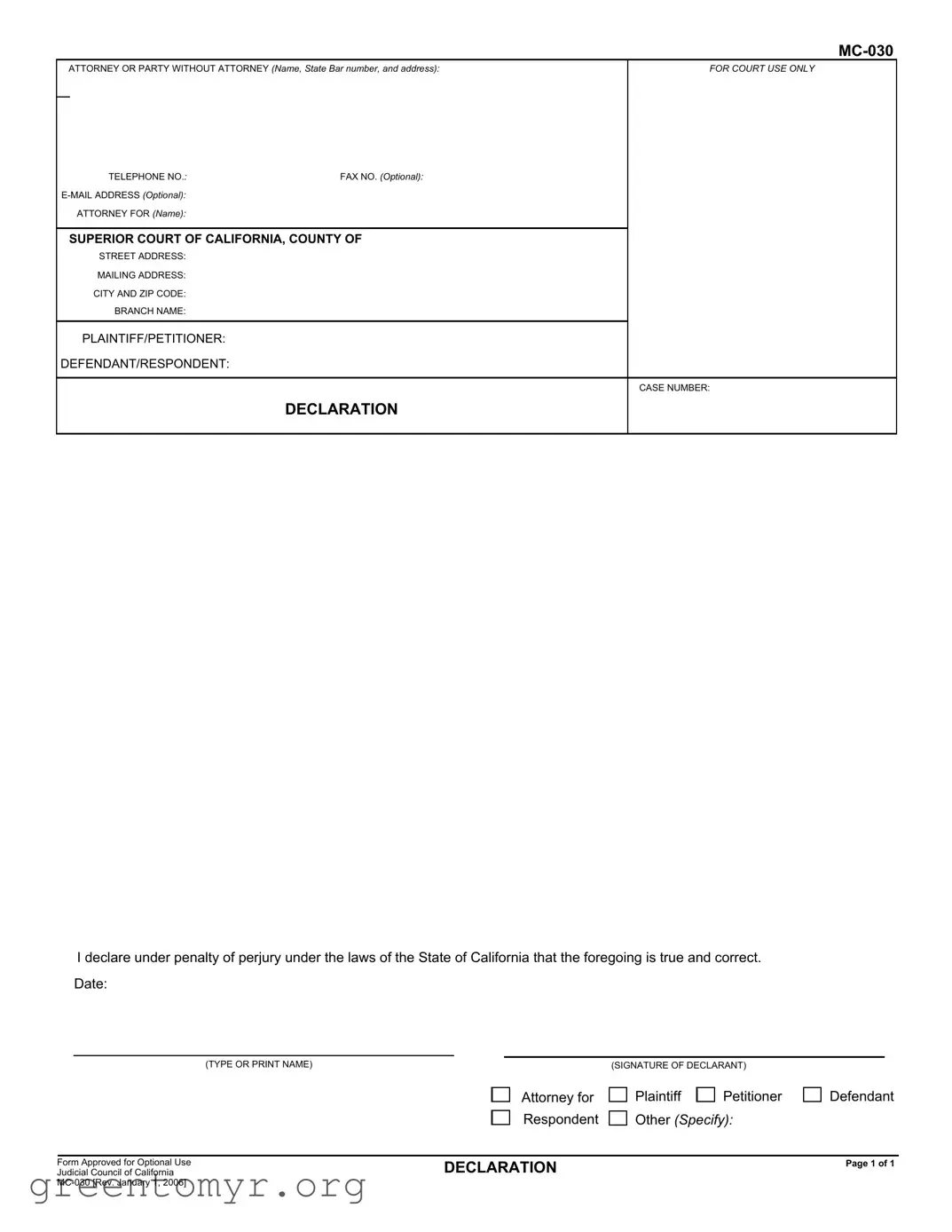
The MC-030 form is a crucial document utilized within the California legal system, particularly in the Superior Court. Designed for both attorneys and self-represented parties, this form facilitates the declaration process in various legal proceedings. It captures essential information, such as the names and contact details of the parties involved, including attorneys, if applicable. The form requires the declaration to be made under penalty of perjury, emphasizing the importance of honesty and accuracy in legal submissions. Additionally, it specifies the case number, which is vital for tracking the case within the court system. By providing a structured format for declarations, the MC-030 form ensures that all necessary information is presented clearly and concisely, aiding the court in its decision-making process. The optional fields for fax and email addresses further enhance communication between the parties and the court, making the legal process more accessible and efficient.
Mc 030 Example

MC-030

ATTORNEY OR PARTY WITHOUT ATTORNEY (Name, State Bar number, and address):

FOR COURT USE ONLY

TELEPHONE NO.:

FAX NO. (Optional):

E-MAIL ADDRESS (Optional):


ATTORNEY FOR (Name):


SUPERIOR COURT OF CALIFORNIA, COUNTY OF

STREET ADDRESS:

MAILING ADDRESS:

CITY AND ZIP CODE:

BRANCH NAME:

PLAINTIFF/PETITIONER:

DEFENDANT/RESPONDENT:

CASE NUMBER:

DECLARATION

I declare under penalty of perjury under the laws of the State of California that the foregoing is true and correct.

Date:

(TYPE OR PRINT NAME)

(SIGNATURE OF DECLARANT)


Attorney for


Plaintiff


Petitioner


Defendant


Respondent


Other (Specify):


Form Approved for Optional Use Judicial Council of California MC-030 [Rev. January 1, 2006]

DECLARATION

Page 1 of 1

File Breakdown

Fact Name Details
Form Title MC-030 - Declaration
Governing Law This form is governed by the laws of the State of California.
Purpose The form is used for declarations in court proceedings.
Parties Involved It can be filled out by an attorney or a party without an attorney.
Optional Information Fax number and email address can be provided, but they are optional.
Signature Requirement The declarant must sign the form, affirming the truth of the information provided.
Form Revision Date This version of the form was approved for optional use as of January 1, 2006.
Usage Context It is commonly used in Superior Court proceedings in California.

Guide to Using Mc 030

Filling out the MC-030 form is straightforward, but attention to detail is essential. This form is used in California courts for declarations. Make sure you have all the necessary information ready before you start. Follow the steps below to complete the form correctly.

  1. Begin by entering your name, State Bar number, and address in the designated section for ATTORNEY OR PARTY WITHOUT ATTORNEY.
  2. Provide your telephone number. If you have a fax number, include it in the optional section.
  3. If you have an email address, you can add it as well, but this is also optional.
  4. Indicate the name of the attorney you are representing in the ATTORNEY FOR section.
  5. Fill in the SUPERIOR COURT OF CALIFORNIA, COUNTY OF section with the appropriate county name.
  6. Enter the street address and mailing address of the court.
  7. Complete the CITY AND ZIP CODE field accurately.
  8. Specify the branch name of the court if applicable.
  9. List the names of the PLAINTIFF/PETITIONER and DEFENDANT/RESPONDENT.
  10. Fill in the CASE NUMBER as provided in your case documents.
  11. Read the declaration statement carefully. By signing, you confirm that the information is true and correct.
  12. Finally, type or print your name, and sign the form in the designated area.

Once the MC-030 form is completed, you can submit it to the court as required. Ensure you keep a copy for your records. This step is important for tracking your case and any future correspondence.

Get Answers on Mc 030

What is the MC-030 form used for?

The MC-030 form is a declaration form used in California courts. It allows individuals to declare certain facts under penalty of perjury. This form is often used by attorneys or parties representing themselves in legal matters to provide essential information to the court. It helps ensure that the court has accurate and truthful information regarding the case.

Who needs to fill out the MC-030 form?

Any party involved in a legal proceeding in California may need to fill out the MC-030 form. This includes attorneys representing clients as well as individuals who are self-represented. The form is typically used when a declaration is necessary to support a motion or other court documents.

What information is required on the MC-030 form?

The MC-030 form requires several pieces of information:

  • Name of the attorney or party without an attorney
  • State Bar number (if applicable)
  • Contact information, including address and phone number
  • Case number and details about the plaintiff/petitioner and defendant/respondent
  • Signature and date of the declarant

Providing accurate and complete information is crucial, as it ensures the court has everything it needs to consider the declaration.

Is the MC-030 form mandatory for all cases?

No, the MC-030 form is not mandatory for all cases. It is used when a declaration is necessary to support a specific request or motion in court. If your case does not require a declaration, you may not need to fill out this form. Always check the requirements for your specific case or consult with a legal expert if you are unsure.

How do I submit the MC-030 form?

You can submit the MC-030 form to the court either in person or by mail. Make sure to file it with the appropriate court handling your case. If you are submitting it in person, be sure to keep a copy for your records. If mailing, consider sending it via certified mail to ensure it arrives safely. Always check the specific court's submission guidelines, as procedures may vary.

Common mistakes

Filling out the MC-030 form can be a straightforward process, but there are common mistakes that people often make. One frequent error is not providing complete contact information. The form requires a telephone number and, optionally, a fax number and email address. Omitting any of these details can lead to delays in communication and processing.

Another mistake is failing to sign the declaration. The form clearly states that a signature is required. Without it, the court may reject the form, causing unnecessary setbacks. It’s essential to remember that signing the document signifies that the information provided is true and correct.

People sometimes forget to indicate their role in the case. The section where you specify whether you are the plaintiff, defendant, or another party is crucial. Leaving this blank can create confusion about your involvement in the case, which may lead to complications down the line.

Additionally, some individuals neglect to print their name clearly in the designated area. This can make it difficult for court officials to read the information, potentially resulting in errors in processing. A legible name is vital for ensuring that all parties are correctly identified.

Lastly, many overlook the importance of checking the form for accuracy before submission. Mistakes in dates, case numbers, or other details can cause significant issues. Taking a moment to review the form can prevent unnecessary complications and ensure a smoother process.

Documents used along the form

The MC-030 form is commonly used in California court proceedings for declarations. When filing this form, you may also need several other documents to support your case or fulfill court requirements. Below is a list of related forms and documents that are often used alongside the MC-030 form.

  • MC-001 Summons: This document officially notifies the defendant or respondent that a legal action has been initiated against them. It outlines the time frame in which they must respond.
  • MC-020 Notice of Hearing: This form informs all parties involved about the date, time, and location of the hearing. It ensures that everyone is aware of the proceedings.
  • MC-025 Proof of Service: This document confirms that legal papers have been properly delivered to the other party. It is essential for proving that the other party received notice.
  • MC-031 Request for Order: This form is used to ask the court for a specific order. It can be related to various issues, such as child custody or support.
  • MC-032 Response to Request for Order: This document allows the other party to respond to the Request for Order. It provides their side of the case and any objections they may have.
  • MC-033 Declaration: Similar to the MC-030, this form allows a party to provide a written statement under penalty of perjury. It is used to present evidence or facts relevant to the case.
  • MC-034 Application for Waiver of Court Fees: If a party cannot afford court fees, this form requests a waiver. It includes financial information to support the request.
  • MC-035 Order on Application for Waiver of Court Fees: This document is the court's response to the fee waiver application. It grants or denies the request based on the information provided.
  • MC-036 Notice of Entry of Judgment: This form notifies parties of the judgment entered by the court. It is important for ensuring that all parties are aware of the outcome.

Using the correct forms and documents is crucial in legal proceedings. Each of these forms serves a specific purpose and helps ensure that your case is handled properly within the court system.

Similar forms

The MC-030 form is a declaration form used in California courts. It shares similarities with several other legal documents. Below is a list of documents that are comparable to the MC-030 form, along with a brief explanation of how they are similar:

  • MC-010 Declaration: Like the MC-030, this form is used to make a formal statement under penalty of perjury, providing evidence or support for a motion or request in court.
  • MC-020 Notice of Motion: This document notifies the court and other parties of a motion being filed, similar to how the MC-030 supports a declaration in a legal proceeding.
  • MC-025 Proof of Service: This form confirms that documents have been delivered to the relevant parties, paralleling the MC-030's role in ensuring proper communication in legal matters.
  • MC-040 Request for Order: This document requests a court order, akin to how the MC-030 may accompany a request for a specific legal action.
  • MC-050 Stipulation: A stipulation is an agreement between parties that can be documented in a similar manner to the MC-030, reinforcing mutual understanding in legal proceedings.
  • MC-060 Application for Waiver of Court Fees: This application allows individuals to request fee waivers, similar to the MC-030's function of providing necessary information to the court.
  • MC-070 Ex Parte Application: This form is used for urgent requests without the other party's presence, just as the MC-030 may support urgent declarations.
  • MC-080 Request for Continuance: Similar to the MC-030, this document requests a delay in court proceedings, requiring a declaration to support the request.
  • MC-090 Statement of Decision: This document outlines the court's decision, much like the MC-030 encapsulates the declarant's statements for the court's consideration.

Dos and Don'ts

When filling out the MC-030 form, follow these guidelines to ensure accuracy and compliance.

  • Do type or print clearly to avoid any confusion.
  • Do include your full name, address, and contact information.
  • Do check the box that correctly identifies your role in the case.
  • Do sign and date the declaration at the bottom of the form.
  • Do keep a copy of the completed form for your records.
  • Don't leave any required fields blank.
  • Don't use abbreviations or nicknames for your name.
  • Don't forget to specify the case number accurately.
  • Don't submit the form without reviewing it for errors.
  • Don't ignore the optional fields; they can provide helpful context.

Misconceptions

The MC-030 form is often misunderstood. Here are six common misconceptions about it:

  • It is only for attorneys. Many believe that only licensed attorneys can use the MC-030 form. In reality, parties representing themselves can also complete this form.
  • It is mandatory to file. Some think that filing the MC-030 is required in every case. However, it is optional and used primarily when a declaration is necessary.
  • It must be notarized. There is a misconception that the MC-030 requires notarization. The form only needs a signature from the declarant, without the need for a notary public.
  • It can only be used in California. While the MC-030 is specific to California courts, people often think it has no relevance outside the state. It’s important to note that similar forms exist in other states.
  • It is outdated. Some assume the MC-030 is obsolete due to its revision date. The form is still valid and has been approved for optional use.
  • It requires detailed legal knowledge. Many feel intimidated by the legal language. In truth, the form is straightforward and can be completed with basic information about the case.

Key takeaways

The MC-030 form is a declaration form used in the Superior Court of California. It serves various purposes, depending on the context in which it is utilized. Below are key takeaways regarding the filling out and usage of the MC-030 form.

  • The form is designed for use by attorneys or parties representing themselves in court.
  • It requires the inclusion of personal information, such as name, address, and contact details.
  • Accurate completion of the form is essential to avoid delays in court proceedings.
  • The declaration must be signed by the declarant, affirming the truthfulness of the information provided.
  • It is important to indicate the role of the declarant, whether as an attorney, plaintiff, or respondent.
  • Filing the form with the court may be subject to specific deadlines, depending on the case.
  • The form can be used for various types of declarations, including those related to evidence or testimony.
  • Reviewing the form for completeness and accuracy before submission is crucial to ensure compliance with court requirements.