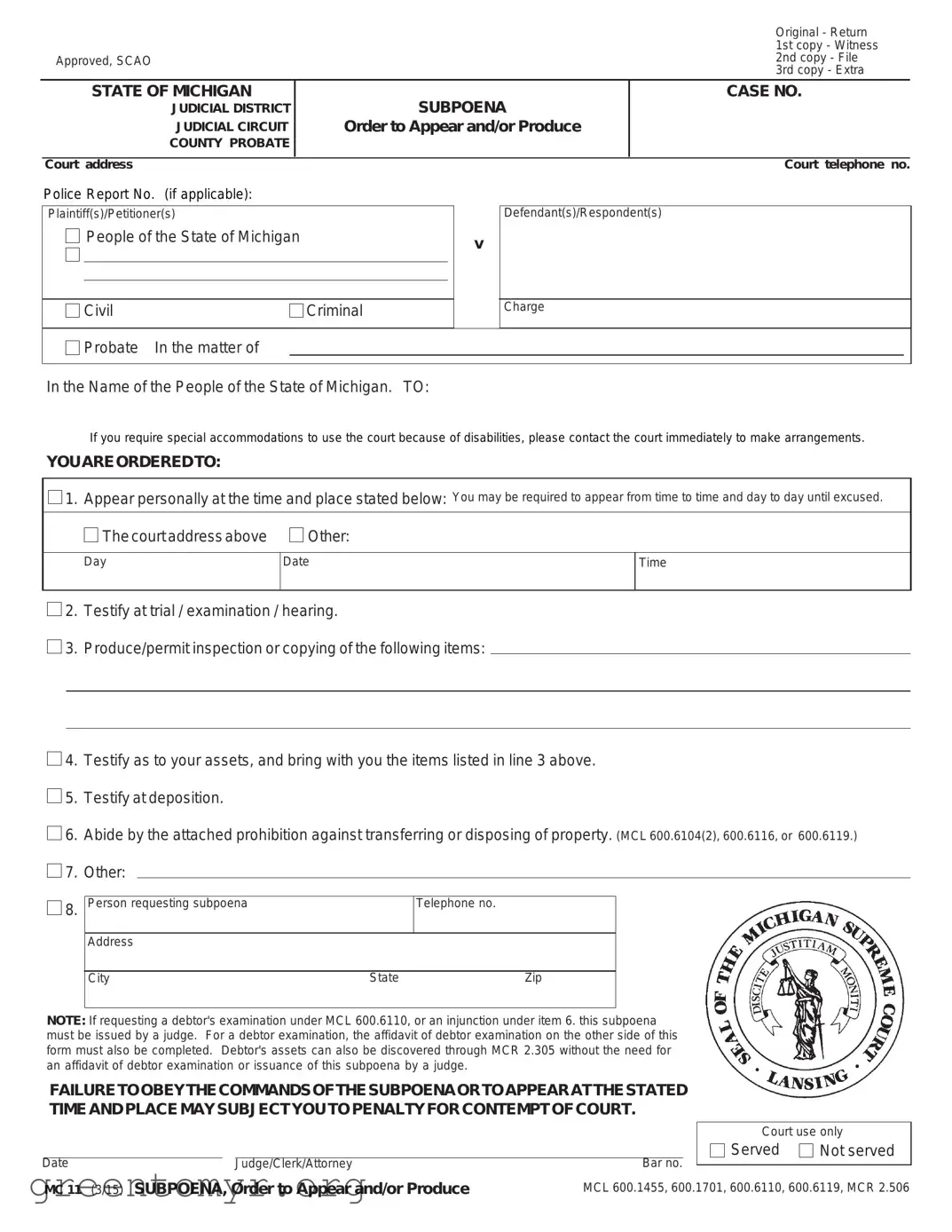
The MC 11 Subpoena form is a crucial legal document used within the Michigan judicial system, primarily to compel an individual to appear in court or produce specific evidence pertinent to a case. This form serves multiple purposes, allowing the court to require a witness to testify at various proceedings, including trials, examinations, and depositions. Additionally, it may request the production of documents or items that are vital for the case at hand. The subpoena also includes provisions for a debtor's examination, where a person may be ordered to disclose their assets. It is essential for those receiving a subpoena to understand the importance of compliance, as failure to obey its commands can lead to penalties for contempt of court. The form outlines the necessary details, such as the court address, case number, and specific instructions for the recipient. It also emphasizes the need for accommodations for individuals with disabilities, ensuring accessibility to the judicial process. Furthermore, the document includes sections for proof of service, allowing the serving party to confirm that the subpoena has been delivered appropriately. By covering these aspects, the MC 11 Subpoena form plays a vital role in maintaining the integrity and efficiency of legal proceedings in Michigan.
Original - Return
1st copy - Witness
Approved, SCAO2nd copy - File 3rd copy - Extra
STATE OF MICHIGAN
JUDICIAL DISTRICT
JUDICIAL CIRCUIT
COUNTY PROBATE
Court address
SUBPOENA
Order to Appear and/or Produce
CASE NO.
Court telephone no.
Police Report No. (if applicable):
Plaintiff(s)/Petitioner(s) |
|
|
Defendant(s)/Respondent(s) |
|||||
|
People of the State of Michigan |
v |
|
|
||||
|
|
|
|
|
|
|
||
|
|
|
|
|
|
|
|
|
|
|
|
|
|
|
|
|
|
|
|
|
|
|
|
|
|
|
|
Civil |
|
Criminal |
|
|
Charge |
||
|
|
|
|
|
|
|
|
|
|
Probate |
In the matter of |
|
|
|
|
||
|
|
|
|
|
|
|
|
|
In the Name of the People of the State of Michigan. TO: |
|
|
|
|
||||
If you require special accommodations to use the court because of disabilities, please contact the court immediately to make arrangements.
YOUAREORDEREDTO:
1. Appear personally at the time and place stated below: You may be required to appear from time to time and day to day until excused.
The court address above |
Other: |
Day
Date
Time
2. Testify at trial / examination / hearing.
3. Produce/permit inspection or copying of the following items:
4. |
Testify as to your assets, and bring with you the items listed in line 3 above. |
||||
5. |
Testify at deposition. |
|
|
|
|
6. |
Abide by the attached prohibition against transferring or disposing of property. (MCL 600.6104(2), 600.6116, or 600.6119.) |
||||
7. |
Other: |
|
|
|
|
|
|
|
|
|
|
8. |
Person requesting subpoena |
|
Telephone no. |
||
|
|
|
|
|
|
|
Address |
|
|
|
|
|
|
|
|
|
|
|
City |
State |
Zip |
|
|
|
|
|
|
|
|
NOTE: If requesting a debtor's examination under MCL 600.6110, or an injunction under item 6. this subpoena must be issued by a judge. For a debtor examination, the affidavit of debtor examination on the other side of this form must also be completed. Debtor's assets can also be discovered through MCR 2.305 without the need for an affidavit of debtor examination or issuance of this subpoena by a judge.
FAILURETOOBEYTHECOMMANDSOFTHESUBPOENAORTOAPPEARATTHESTATED
TIME AND PLACE MAY SUBJECT YOU TO PENALTY FOR CONTEMPT OF COURT.
|
|
|
|
|
|
|
Court use only |
|
|
|
|
|
|
|
|
Served |
Not served |
|
Date |
|
|
Judge/Clerk/Attorney |
Bar no. |
|
|
|
|
|
|
|
|
|
|||
|
MC 11 (3/15) |
SUBPOENA, Order to Appear and/or Produce |
MCL 600.1455, 600.1701, 600.6110, 600.6119, MCR 2.506 |
|||||

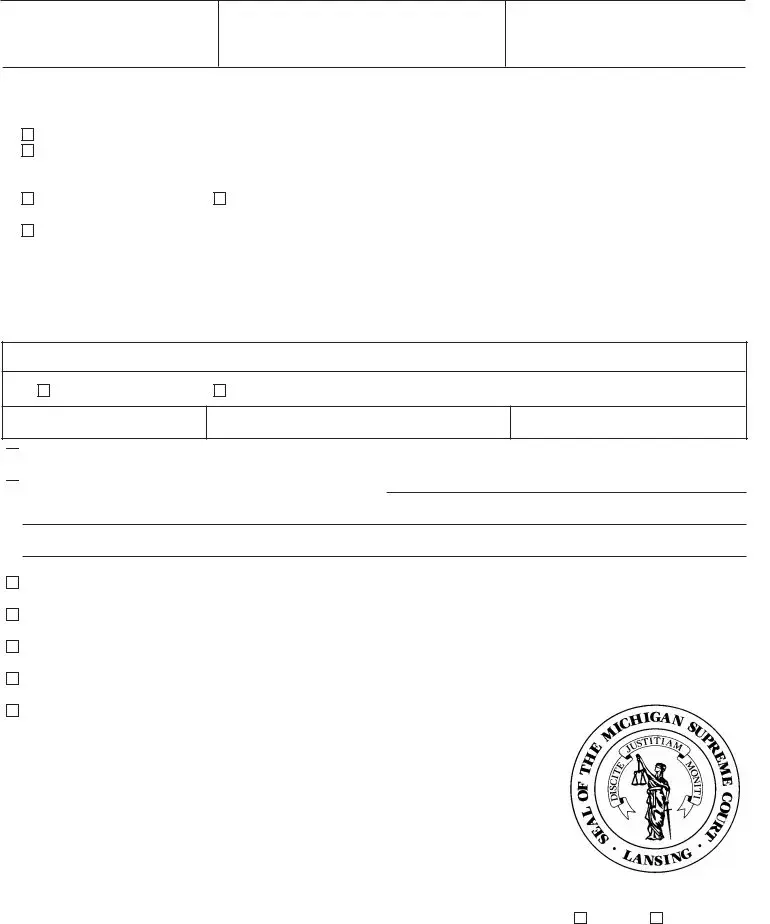
PROOF OF SERVICE
SUBPOENA
Case No.
TO PROCESS SERVER: You must make and file your return with the court clerk. If you are unable to complete service, you must return this original and all copies to the court clerk.
CERTIFICATE / AFFIDAVIT OF SERVICE / NONSERVICE
OFFICER CERTIFICATE |
OR |
AFFIDAVIT OF PROCESS SERVER |
I certify that I am a sheriff, deputy sheriff, bailiff, appointed |
Being first duly sworn, I state that I am a legally competent |
|
court officer, or attorney for a party [MCR 2.104(A)(2)], and |
adult who is not a party or an officer of a corporate party, and |
|
that: (notarization not required) |
that: |
(notarization required) |
|
|
|
I served a copy of the subpoena, together with |
|
(including any required fees) by |
|
|
Attachment |
|
|
personal service |
registered or certified mail (copy of return receipt attached) |
on: |
|
Name(s)
Complete address(es) of service
Day, date, time
I have personally attempted to serve the subpoena and required fees, if any, together with |
Attachment |
on the following person(s) and have been unable to complete service. |
Name(s)
Complete address(es) of service
Day, date, time
Service fee |
Miles traveled Fee |
$ |
|
|
$ |
|
Incorrect address fee |
Miles traveled Fee |
TOTAL FEE |
||
$ |
|
|
$ |
$ |
|
||||
|
|
|
|
|
Signature
Name (type or print)
Title
Subscribed and sworn to before me on |
, |
|
|
|
|
|
|
County, Michigan. |
||||||||||
|
|
Date |
|
|
|
|
|
|
|
|
|
|
|
|
|
|
|
|
My commission expires: |
|
|
|
Signature: |
|
|
|
|
||||||||||
|
Date |
|
|
|
|
|
Deputy court clerk/Notary public |
|
|
|
|
|||||||
Notary public, State of Michigan, County of |
|
|
|
|
|
|
|
|
|
|
|
|
|
|
|
|||
|
|
|
|
|
|
|
|
|
|
|
|
|
|
|
|
|
|
|
|
|
|
|
ACKNOWLEDGMENTOFSERVICE |
|
|
|
|
|
|||||||||
I acknowledge that I have received service of the subpoena and required fees, if any, together with |
|
|
|
|
||||||||||||||
|
|
|
|
|
|
|
|
|
|
|
|
|
|
|
|
Attachment |
||
|
|
|
|
|
on |
|
|
|
|
|
|
|
|
|
||||
|
|
|
|
Day, date, time |
|
|
|
|
||||||||||
|
|
|
|
|
|
|
|
|
||||||||||
|
|
|
|
|
|
|
|
on behalf of |
|
|
|
|
. |
|||||
Signature |
|
|
|
|
|
|
|
|
|
|
|
|
|
|
|
|||
AFFIDAVIT FOR JUDGMENT DEBTOR EXAMINATION
I request that the court issue a subpoena that orders the party named on this form to be examined under oath before a judge concerning the money or property of:
for the following reasons:
Signature
Subscribed and sworn to before me on |
, |
|
|
County, Michigan. |
|||||
|
|
Date |
|
|
|
|
|
|
|
My commission expires: |
Signature: |
|
|||||||
|
Date |
|
Deputy court clerk/Notary public |
|
|||||
Notary public, State of Michigan, County of |
|
|
|
|
|
|
|
||
MCR 2.105
| Fact Name | Details |
|---|---|
| Purpose of the MC 11 Subpoena | The MC 11 Subpoena is used to order a person to appear in court or produce documents relevant to a case. |
| Governing Laws | This subpoena is governed by Michigan Compiled Laws (MCL) sections 600.1455, 600.1701, 600.6110, and 600.6119, as well as Michigan Court Rules (MCR) 2.506. |
| Service Requirements | The subpoena must be served by a qualified process server, sheriff, or deputy sheriff, and a proof of service must be filed with the court. |
| Consequences of Non-Compliance | Failure to comply with the subpoena may result in penalties for contempt of court, which can include fines or other legal repercussions. |
| Special Accommodations | Individuals requiring special accommodations due to disabilities should contact the court immediately to make necessary arrangements. |
Completing the MC 11 Subpoena form is an important step in the legal process. It requires careful attention to detail to ensure that all necessary information is accurately provided. Following the steps below will help in filling out the form correctly.
Once the form is completed, it must be served to the individual named in the subpoena. Adhering to the proper procedures for service is crucial to ensure compliance with court orders.
The MC 11 Subpoena form is a legal document issued by a court that orders an individual to appear in court or produce certain documents or items for examination. It is used in various legal contexts, including civil, criminal, and probate cases. This form ensures that witnesses or parties involved in a case comply with court proceedings.
A judge is required to issue the MC 11 Subpoena, especially in cases involving debtor examinations or injunctions. Additionally, the party requesting the subpoena must provide their contact information and the specifics of what is being requested, such as testimony or documents.
Failing to obey the commands of the subpoena or not appearing at the designated time and place can lead to penalties for contempt of court. This may include fines or other legal repercussions, as the court takes such disobedience seriously.
If you need special accommodations due to a disability, it is important to contact the court immediately to make necessary arrangements. The court is obligated to assist individuals in accessing its services.
If you are unable to complete the service of the subpoena, you must return the original and all copies to the court clerk. Proper documentation of your attempts to serve the subpoena must also be provided, ensuring that the court is informed of the situation.
The subpoena may request various items, including documents, records, or any other relevant materials necessary for the case. The specific items should be clearly listed in the subpoena to ensure compliance.
Yes, individuals can challenge a subpoena. This may involve filing a motion with the court to quash or modify the subpoena if there are valid reasons, such as undue burden or relevance issues. It is advisable to seek legal counsel when considering this option.
Filling out the MC 11 Subpoena form can be a straightforward process, but several common mistakes can lead to complications. One major error is failing to include accurate names and addresses for all parties involved. It’s essential to ensure that the names of the plaintiff(s) and defendant(s) are spelled correctly and that their addresses are complete. Missing or incorrect information can delay the process or even render the subpoena invalid.
Another frequent mistake is neglecting to specify the date, time, and location for the appearance. This information is crucial, as it tells the recipient when and where they need to be. If these details are vague or omitted, the person receiving the subpoena may be confused about their obligations, leading to potential noncompliance.
Some individuals forget to check the box indicating whether the subpoena is for a civil or criminal case. This distinction is important for the court and the parties involved. Without this information, the court may not process the subpoena correctly, causing unnecessary delays.
Additionally, it’s not uncommon for people to overlook the requirement for special accommodations. If the recipient has a disability, the form should include a note about contacting the court for necessary arrangements. Ignoring this step can result in the recipient being unable to fulfill their obligations.
Another oversight is failing to include a clear description of the items to be produced or inspected. The form should specify what documents or evidence are needed. Ambiguous language can lead to confusion and may result in the recipient not providing the required materials.
People sometimes forget to sign the form or include their contact information. A signature is vital for the validity of the subpoena. Without it, the court may not recognize the request. Providing a phone number and address helps ensure that any questions can be promptly addressed.
Lastly, many individuals do not realize that certain subpoenas must be issued by a judge, especially those related to debtor examinations. Failing to follow this requirement can lead to the subpoena being unenforceable. Understanding these nuances can save time and prevent legal headaches.
The MC 11 Subpoena form is an important legal document used to compel a person to appear in court or produce evidence. However, several other forms and documents are often used alongside it to ensure the process runs smoothly. Here’s a list of some commonly associated documents:
Understanding these related forms can help you navigate the legal process more effectively. Each document plays a specific role in ensuring that the rights of all parties are respected while facilitating the gathering of necessary information for a case.
When filling out the MC 11 Subpoena form, it's essential to approach the task with care. Here are five key do's and don'ts to keep in mind:
Following these guidelines can help ensure that the subpoena is properly issued and enforceable. Adhering to the rules will facilitate a smoother legal process for all parties involved.
The MC 11 Subpoena form is often misunderstood. Here are nine common misconceptions about it:
Understanding these misconceptions is crucial for anyone who may receive a subpoena. Compliance is not just a matter of choice; it is a legal obligation.
The MC 11 Subpoena form is a legal document used to compel an individual to appear in court or produce certain items.
It is important to fill out the form completely, including all required details such as the case number and the names of the parties involved.
Ensure that you specify the exact items or information that the subpoena is requesting. Clarity helps avoid confusion.
Remember that the subpoena may require the individual to appear multiple times, so be clear about the dates and times.
If you need special accommodations for disabilities, contact the court as soon as possible to make necessary arrangements.
Be aware that failure to comply with the subpoena can lead to serious consequences, including penalties for contempt of court.
When serving the subpoena, you must file a return with the court clerk to confirm that it was delivered.
If you cannot serve the subpoena, return it to the court with an explanation of why service was not completed.
For certain requests, like debtor examinations, a judge must issue the subpoena, so be sure to follow the specific requirements.