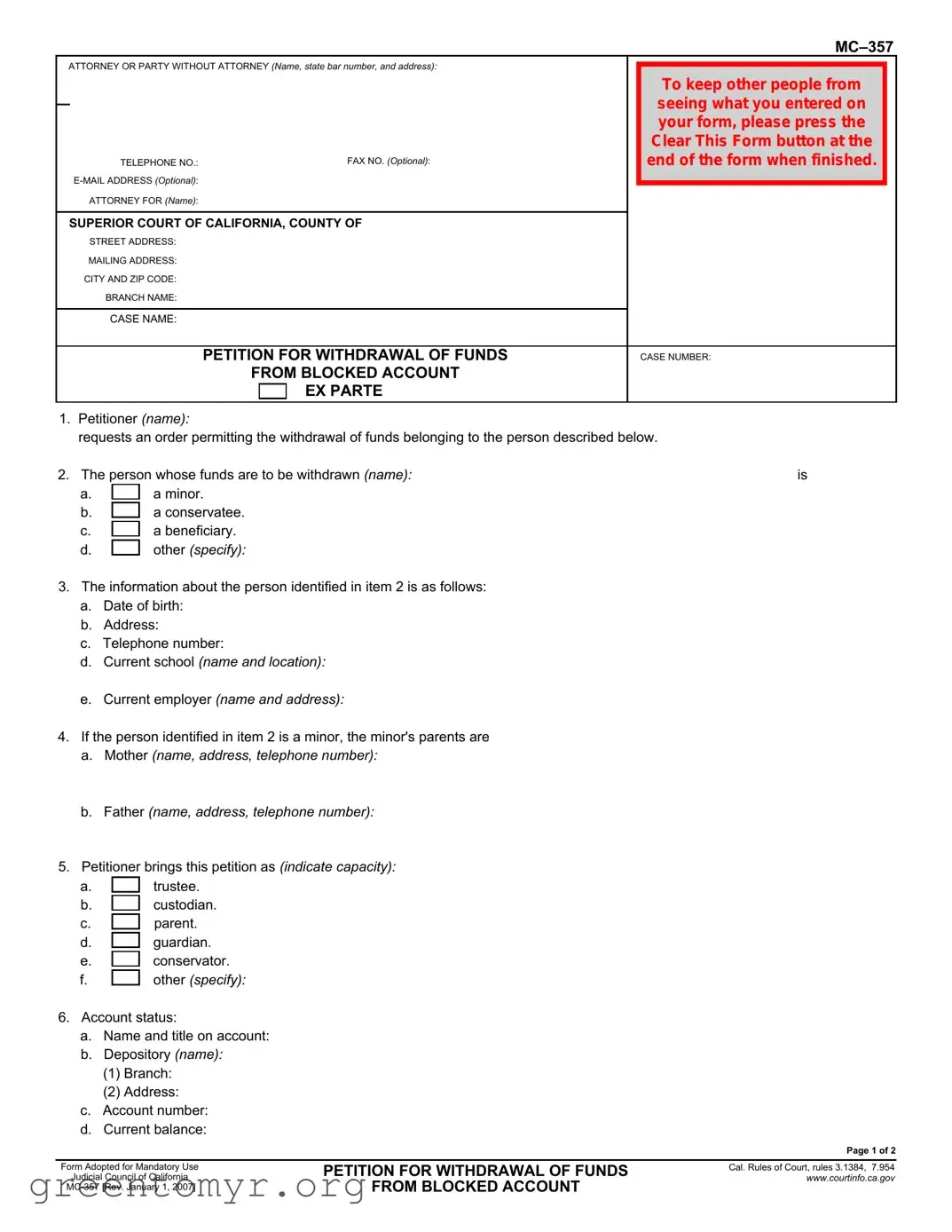
The MC 357 form is an essential legal document used in California to request the withdrawal of funds from a blocked account. This form is particularly relevant for situations involving minors, conservatees, or beneficiaries whose funds are restricted. It provides a structured way for petitioners, such as parents, guardians, or trustees, to formally seek permission from the court to access these funds. The form requires detailed information about the person whose funds are being withdrawn, including their name, date of birth, and current address. It also asks for specifics about the account, such as the account number, current balance, and any previous withdrawals. Additionally, petitioners must outline the reasons for the disbursement, whether it's due to the minor reaching adulthood or for other specified purposes. Clear instructions are provided to ensure privacy and security when filling out the form, emphasizing the importance of safeguarding sensitive information. Overall, the MC 357 form serves as a critical tool for managing and accessing funds that have been placed in a blocked account, ensuring that all legal requirements are met while protecting the interests of those involved.

ATTORNEY OR PARTY WITHOUT ATTORNEY (Name, state bar number, and address): |
|
|
|
||||
|
FOR COURT USE ONLY |
|
|||||
|
|
|
|
|
|
To keep other people from |
|
|
|
|
|
|
|
seeing what you entered on |
|
|
|
|
|
|
|||
|
|
|
|
|
|
your form, please press the |
|
|
|
|
|
|
|
Clear This Form button at the |
|
|
TELEPHONE NO.: |
|
|
FAX NO. (Optional): |
|
end of the form when finished. |
|
|
|
|
|
|
|
|
|
|
ATTORNEY FOR (Name): |
|
|
|
|
|
|
|
|
|
|
|
|
||
SUPERIOR COURT OF CALIFORNIA, COUNTY OF |
|
|
|
||||
|
STREET ADDRESS: |
|
|
|
|
|
|
|
MAILING ADDRESS: |
|
|
|
|
|
|
|
CITY AND ZIP CODE: |
|
|
|
|
|
|
|
BRANCH NAME: |
|
|
|
|
|
|
|
|
|
|
|
|
|
|
|
CASE NAME: |
|
|
|
|
|
|
|
|
|
|
|
|
|
|
|
|
PETITION FOR WITHDRAWAL OF FUNDS |
|
CASE NUMBER: |
|||
|
|
FROM BLOCKED ACCOUNT |
|
|
|
||
|
|
|
|
EX PARTE |
|
|
|
|
|
|
|
|
|
|
|
1.Petitioner (name):
requests an order permitting the withdrawal of funds belonging to the person described below.
2. The person whose funds are to be withdrawn (name): |
is |
a. a minor.
b. a conservatee.
c. a beneficiary.
d. other (specify):
3.The information about the person identified in item 2 is as follows:
a.Date of birth:
b.Address:
c.Telephone number:
d.Current school (name and location):
e.Current employer (name and address):
4.If the person identified in item 2 is a minor, the minor's parents are a. Mother (name, address, telephone number):
b.Father (name, address, telephone number):
5.Petitioner brings this petition as (indicate capacity):
a. trustee.
b. custodian.
c. parent.
d. guardian.
e. conservator.
f. other (specify):
6.Account status:
a.Name and title on account:
b.Depository (name):
(1)Branch:
(2)Address:
c.Account number:
d.Current balance:
Page 1 of 2
Form Adopted for Mandatory Use
Judicial Council of California
PETITION FOR WITHDRAWAL OF FUNDS
FROM BLOCKED ACCOUNT
Cal. Rules of Court, rules 3.1384, 7.954 www.courtinfo.ca.gov

CASE NAME:
CASE NUMBER:
6.e. Previous withdrawals from this account (select one):
(1) None.
(2) As follows:
(a)Amount: $
(b)Date:
(c)Purpose:
|
|
|
|
|
|
Additional withdrawals from this account described in Attachment 6e. |
|
|
|
|
Continued (provide information relating to each additional account from which funds are to be withdrawn on a separate |
||
|
|
|
||||
|
|
|
|
attachment designated as Attachment 6). |
||
7. |
Amount of funds to be disbursed under this petition: |
|||||
|
a. |
|
|
|
|
Balance of account or accounts. |
|
|
|
|
|
||
|
b. |
|
|
|
|
Other (specific total amount to be disbursed): $ |
|
|
|
|
|
||
8. |
Reasons for disbursement of funds: |
|||||
|
a. |
|
|
|
|
Minor has attained the age of 18 years or older, and this is a final distribution. |
b. Other (describe):
9.Payee to whom funds will be distributed:
a.Payee (name):
(1)Address:
(2)Amount: $
(3)Purpose:
b.Payee (name):
(1)Address:
(2)Amount: $
(3)Purpose:
c.Payee (name):
(1)Address:
(2)Amount: $
(3)Purpose:
d.Payee (name):
(1)Address:
(2)Amount: $
(3)Purpose:
Continued (if there are additional payees, make a list and attach it to this petition as Attachment 9).
10. Number of pages attached:
I declare under penalty of perjury under the laws of the State of California that the foregoing is true and correct.
Date:
(TYPE OR PRINT NAME) |
(SIGNATURE OF PETITIONER) |
SIGNATURE FOLLOWS LAST ATTACHMENT
PETITION FOR WITHDRAWAL OF FUNDS |
||||||
|
|
FROM BLOCKED ACCOUNT |
||||
For your protection and privacy, please press the Clear This Form |
|
|
|
|
||
|
Save This Form |
|
Print This Form |
|||
button after you have printed the form. |
|
|
|
|||
|
|
|
|
|
|
|
Page 2 of 2
Clear This Form
| Fact Name | Details |
|---|---|
| Form Purpose | The MC-357 form is used to request permission to withdraw funds from a blocked account, typically for minors or conservatees. |
| Governing Law | This form is governed by California Rules of Court, specifically rules 3.1384 and 7.954. |
| Form Usage | It is mandatory for petitioners to complete this form when seeking to withdraw funds, ensuring compliance with legal requirements. |
| Privacy Notice | The form includes a privacy notice, advising users to clear their information after use to protect sensitive data. |
Completing the MC 357 form is an essential step for those seeking to withdraw funds from a blocked account. After filling out this form, it will need to be submitted to the appropriate court for consideration. Ensure that all information is accurate and complete to avoid any delays in processing your request.
The MC 357 form is a legal document used to request permission to withdraw funds from a blocked account. This form is typically filed when the funds belong to a minor, a conservatee, or another beneficiary. The petitioner, who may be a parent, guardian, or trustee, submits this form to the court to obtain an order allowing the withdrawal of the specified funds.
Any individual who has the legal authority to manage the funds can file the MC 357 form. This includes:
It's essential that the person filing the form has the appropriate legal standing to make such a request.
The MC 357 form requires several pieces of information, including:
Providing accurate and complete information is crucial for the court's review.
After submitting the MC 357 form, the court will review the petition. If everything is in order, the court may grant the order allowing the withdrawal of funds. You may need to attend a hearing where the judge will consider the request. If the order is granted, you will receive documentation that allows you to proceed with the withdrawal.
Yes, there is typically a filing fee associated with submitting the MC 357 form. The exact amount can vary by county. It's advisable to check with your local court for the current fee schedule. If you cannot afford the fee, you may be able to request a fee waiver by submitting additional forms.
Filling out the MC 357 form can be a daunting task, and many individuals make common mistakes that can lead to delays or complications in the process. One frequent error is failing to provide complete information about the petitioner. It is essential to include the full name, address, and contact details to ensure that the court can easily reach the petitioner. Incomplete or incorrect information can lead to confusion and may result in the rejection of the application.
Another mistake often made is neglecting to specify the correct status of the person whose funds are being withdrawn. The form requires clear identification of whether the individual is a minor, conservatee, beneficiary, or another category. Misclassifying this status can cause significant issues, as the court needs to understand the context of the withdrawal request.
Many people overlook the importance of providing accurate details regarding the account from which funds are to be withdrawn. This includes the name and title on the account, the depository's name and address, and the account number. Omitting or incorrectly entering this information can create obstacles in processing the request, leading to unnecessary delays.
Additionally, the section regarding previous withdrawals is frequently filled out incorrectly. It is crucial to accurately indicate whether there have been any prior withdrawals and to provide details if applicable. Misreporting this information can raise red flags for the court and may require further clarification, prolonging the process.
In the section outlining the amount of funds to be disbursed, individuals sometimes fail to specify a clear total. Whether it’s the balance of the account or a specific amount, clarity is key. Providing vague or incomplete figures can lead to misunderstandings about the request, complicating the court's decision-making process.
Another common oversight is in the reasons for disbursement. It is vital to articulate the rationale behind the withdrawal clearly. If the funds are intended for a minor who has reached adulthood, this should be explicitly stated. Ambiguity in this section can lead to questions from the court, requiring additional time and effort to resolve.
When listing payees, individuals often forget to include complete information for each one. Each payee should have their name, address, amount to be distributed, and purpose clearly stated. Incomplete details can hinder the distribution process and may necessitate further documentation.
Lastly, individuals sometimes fail to sign the form or provide the date, which is a critical step in validating the petition. Without a signature, the court cannot process the request. It is essential to double-check that all required signatures are present before submitting the form to avoid unnecessary delays.
The MC-357 form is a critical document used in California to request the withdrawal of funds from a blocked account. When completing this form, several other documents may be necessary to support the petition. Below is a list of commonly used forms and documents that can accompany the MC-357 form.
Gathering these documents can help create a comprehensive petition that effectively communicates the needs of the individual involved. It is essential to ensure that all necessary paperwork is complete and accurate to facilitate a smooth process with the court.
When filling out the MC 357 form, it's essential to follow certain guidelines to ensure accuracy and compliance. Here are seven things you should and shouldn't do:
By adhering to these guidelines, you can help ensure that your petition is processed smoothly and efficiently.
The MC 357 form is often misunderstood. Here are six common misconceptions:
Understanding these misconceptions can help ensure a smoother process when dealing with the MC 357 form.
Filling out the MC-357 form can seem daunting, but understanding its key elements can simplify the process. Here are some important takeaways to keep in mind:
By keeping these takeaways in mind, you can navigate the MC-357 form more confidently and ensure that all necessary information is accurately provided.