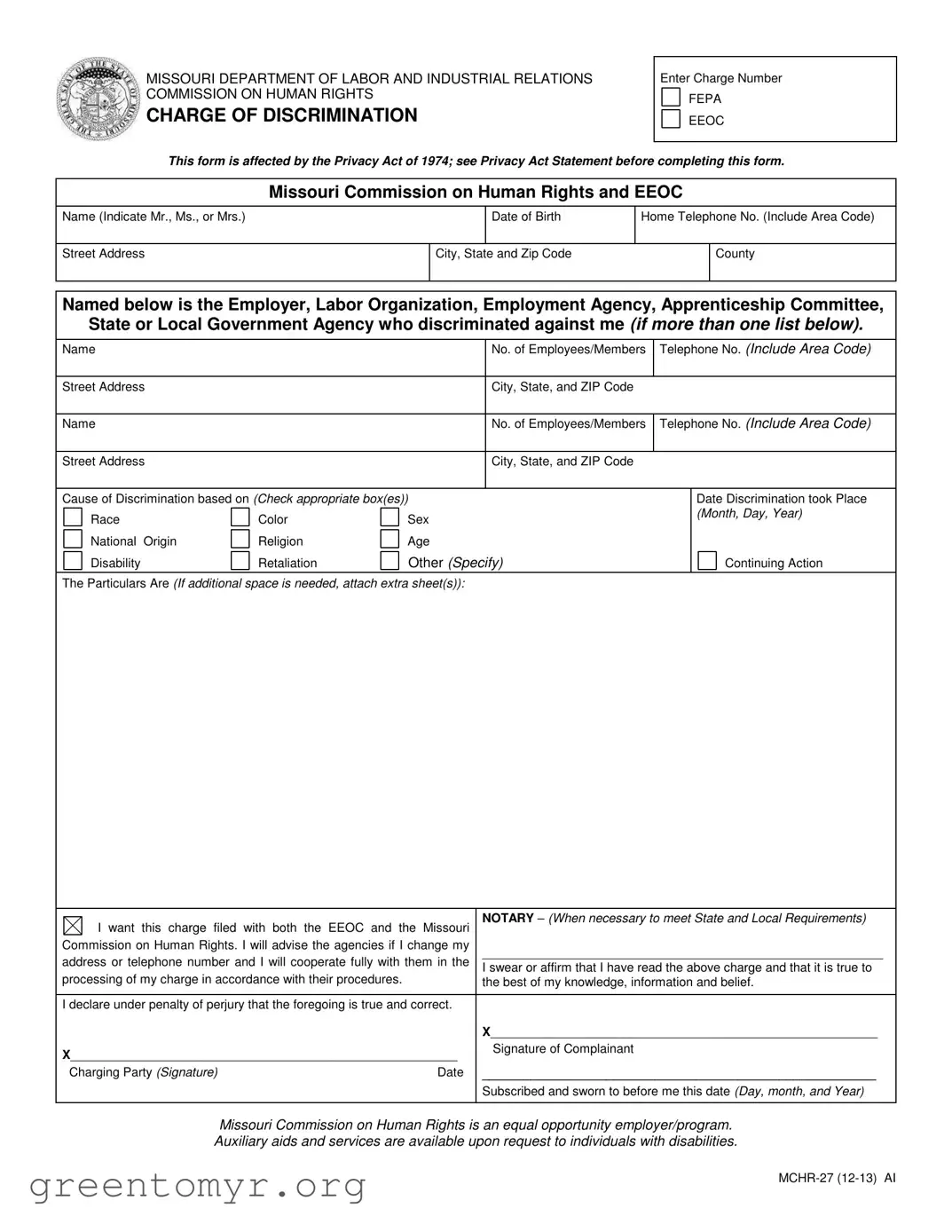
The MCHR 27 form, officially known as the Charge of Discrimination, serves as a vital tool for individuals in Missouri seeking to report instances of discrimination in various contexts, including employment, housing, and public accommodations. This form is administered by the Missouri Department of Labor and Industrial Relations, specifically through the Commission on Human Rights. It allows complainants to formally document their experiences and initiate an investigation into their claims. Key components of the form include personal identification details, such as the complainant's name, date of birth, and contact information, as well as specifics about the alleged discriminatory actions. Complainants must identify the parties involved, including employers or organizations, and select the basis for discrimination, which can range from race and sex to disability and retaliation. Additionally, the form requires a declaration affirming the truthfulness of the submitted information under penalty of perjury. By filing this charge, individuals can take a significant step toward addressing grievances and seeking justice in a structured manner.
MISSOURI DEPARTMENT OF LABOR AND INDUSTRIAL RELATIONS COMMISSION ON HUMAN RIGHTS
CHARGE OF DISCRIMINATION
Enter Charge Number
FEPA
EEOC
This form is affected by the Privacy Act of 1974; see Privacy Act Statement before completing this form.
Missouri Commission on Human Rights and EEOC
Name (Indicate Mr., Ms., or Mrs.)
Date of Birth
Home Telephone No. (Include Area Code)
Street Address
City, State and Zip Code
County
Named below is the Employer, Labor Organization, Employment Agency, Apprenticeship Committee, State or Local Government Agency who discriminated against me (if more than one list below).
Name
Street Address
Name
Street Address
No. of Employees/Members |
|
Telephone No. (Include Area Code) |
City, State, and ZIP Code |
|
|
|
|
|
No. of Employees/Members |
|
Telephone No. (Include Area Code) |
|
||
City, State, and ZIP Code |
|
|
|
|
Cause of Discrimination based on (Check appropriate box(es))
Race |
|
Color |
|
Sex |
National Origin |
|
Religion |
|
Age |
|
|
|||
Disability |
|
Retaliation |
|
Other (Specify) |
|
|
Date Discrimination took Place (Month, Day, Year)
Continuing Action
The Particulars Are (If additional space is needed, attach extra sheet(s)):
|
|
I want this charge filed with both the EEOC and the Missouri |
NOTARY – (When necessary to meet State and Local Requirements) |
||
|
|
||||
|
|
|
|||
Commission on Human Rights. I will advise the agencies if I change my |
__________________________________________________________ |
||||
address or telephone number and I will cooperate fully with them in the |
|||||
I swear or affirm that I have read the above charge and that it is true to |
|||||
processing of my charge in accordance with their procedures. |
|
||||
|
the best of my knowledge, information and belief. |
||||
|
|
||||
I declare under penalty of perjury that the foregoing is true and correct. |
|
||||
|
|
|
|
X________________________________________________________ |
|
X________________________________________________________ |
Signature of Complainant |
||||
|
|||||
|
Charging Party (Signature) |
Date |
_________________________________________________________ |
||
|
|
|
|
Subscribed and sworn to before me this date (Day, month, and Year) |
|
|
|
|
|
|
|
Missouri Commission on Human Rights is an equal opportunity employer/program.
Auxiliary aids and services are available upon request to individuals with disabilities.

|
|
|
|
|
|
|
|
I want this charge filed with both the EEOC and the Missouri |
NOTARY – (When necessary to meet State and Local Requirements) |
||
|
|
||||
|
|
|
|||
Commission on Human Rights. I will advise the agencies if I change my |
__________________________________________________________ |
||||
address or telephone number and I will cooperate fully with them in the |
|||||
I swear or affirm that I have read the above charge and that it is true to |
|||||
processing of my charge in accordance with their procedures. |
|
||||
|
the best of my knowledge, information and belief. |
||||
|
|
||||
I declare under penalty of perjury that the foregoing is true and correct. |
|
||||
|
|
|
|
X________________________________________________________ |
|
X________________________________________________________ |
Signature of Complainant |
||||
|
|||||
|
Charging Party (Signature) |
Date |
_________________________________________________________ |
||
|
|
|
|
Subscribed and sworn to before me this date (Day, month, and Year) |
|
|
|
|
|
|
|
|
|
|
|
||
| Fact Name | Details |
|---|---|
| Governing Law | The MCHR-27 form is governed by the Missouri Human Rights Act and federal laws enforced by the Equal Employment Opportunity Commission (EEOC). |
| Purpose | This form is used to file a charge of discrimination against an employer, labor organization, or government agency. |
| Privacy Act | The form is affected by the Privacy Act of 1974, which protects personal information provided in the charge. |
| Required Information | Complainants must provide personal details, including name, date of birth, address, and the name of the entity they are charging. |
| Causes of Discrimination | Discrimination can be based on race, color, sex, national origin, religion, age, disability, retaliation, or other specified reasons. |
| Signature Requirement | The complainant must sign the form, affirming that the information provided is true to the best of their knowledge. |
| Filing with Agencies | The charge can be filed with both the EEOC and the Missouri Commission on Human Rights simultaneously. |
| Notary Requirement | A notary may be required to validate the signature, depending on state and local requirements. |
Completing the MCHR 27 form is an important step in filing a charge of discrimination. The information provided on this form will be used by the Missouri Commission on Human Rights and the Equal Employment Opportunity Commission to process your complaint. Ensure that all sections are filled out accurately to avoid delays in your submission.
The MCHR 27 form is a document used to file a charge of discrimination with the Missouri Commission on Human Rights (MCHR) and the Equal Employment Opportunity Commission (EEOC). It allows individuals to report instances of discrimination based on various factors, including race, sex, age, and disability, among others.
Any individual who believes they have experienced discrimination in employment or related areas can file a charge using the MCHR 27 form. This includes employees, job applicants, and individuals who may have been discriminated against by labor organizations or employment agencies.
The form requires personal information such as your name, date of birth, contact details, and the name and address of the employer or organization you are filing against. Additionally, you must specify the cause of discrimination and provide details about the incident.
You can report discrimination based on several grounds, including:
Yes, there are specific deadlines for filing discrimination charges. Generally, you must file your charge within 180 days of the alleged discrimination. However, if your charge also falls under state law, you may have up to 300 days to file with the MCHR.
A notary is required when necessary to meet state and local requirements. If your situation necessitates notarization, you will need to sign the form in the presence of a notary public, who will then verify your identity and the authenticity of your signature.
After submission, the MCHR and EEOC will review your charge. They may conduct an investigation to determine if there is sufficient evidence to proceed. You will be kept informed about the status of your charge and may be required to provide additional information during the investigation process.
Yes, you can withdraw your charge at any time. However, it is important to communicate your decision to both the MCHR and the EEOC. Be aware that withdrawing your charge may impact your ability to pursue any legal remedies in the future.
Filling out the MCHR 27 form can be a straightforward process, but many individuals make common mistakes that can delay or complicate their claims. One significant error is failing to provide accurate personal information. This includes the complainant's name, date of birth, and contact details. Inaccuracies can lead to issues in communication and may even result in the rejection of the form.
Another frequent mistake involves neglecting to specify the employer or organization involved in the discrimination. It is crucial to include complete names and addresses. If there are multiple parties involved, all should be listed clearly. Omitting this information can hinder the investigation process and slow down the resolution of the claim.
Additionally, many individuals overlook the section where they must indicate the cause of discrimination. This part requires careful attention, as checking the wrong box or failing to check any boxes can lead to misunderstandings about the nature of the complaint. It is essential to ensure that all applicable categories, such as race, sex, or disability, are accurately marked.
Another common oversight is not providing a detailed account of the particulars of the discrimination. The form allows space for a description, and it is vital to utilize this area effectively. Providing a clear and concise narrative helps investigators understand the context and specifics of the complaint, which can significantly impact the outcome.
Lastly, individuals often forget to sign and date the form. This step is crucial, as the signature indicates that the complainant affirms the truth of the information provided. Submitting an unsigned form can result in delays or outright rejection, so it is imperative to double-check that all required signatures are present before submission.
The MCHR 27 form is essential for filing a discrimination charge with the Missouri Commission on Human Rights and the Equal Employment Opportunity Commission. Along with this form, several other documents are commonly used to support the filing process. Below is a list of these documents, each with a brief description.
These documents work together to provide a comprehensive view of the discrimination claim. Properly completing and submitting them can significantly impact the outcome of the case.
When filling out the MCHR 27 form, it's important to be thorough and accurate. Here are some guidelines to help you navigate the process:
Understanding the MCHR 27 form can be crucial for anyone seeking to file a discrimination charge in Missouri. However, several misconceptions often arise about this form. Here are six common misunderstandings:
This form covers a wide range of discrimination types, including race, color, sex, national origin, religion, age, disability, and retaliation. It is not limited to just a few categories.
While filing the form is an important step, it does not ensure immediate action or resolution. The investigation process can take time, depending on the complexity of the case.
Individuals can file the form on their own without legal representation. However, consulting with a lawyer may provide additional guidance and support throughout the process.
The MCHR 27 form allows you to file charges with both the Missouri Commission on Human Rights and the Equal Employment Opportunity Commission (EEOC) simultaneously, streamlining the process.
The form is subject to the Privacy Act of 1974, which means that personal information is protected and used solely for the purpose of processing the discrimination charge.
It is possible to amend your charge if new information arises or if you need to clarify details. Keeping the agencies informed of any changes is essential for the ongoing investigation.
When filling out the Mchr 27 form, keep the following key takeaways in mind: