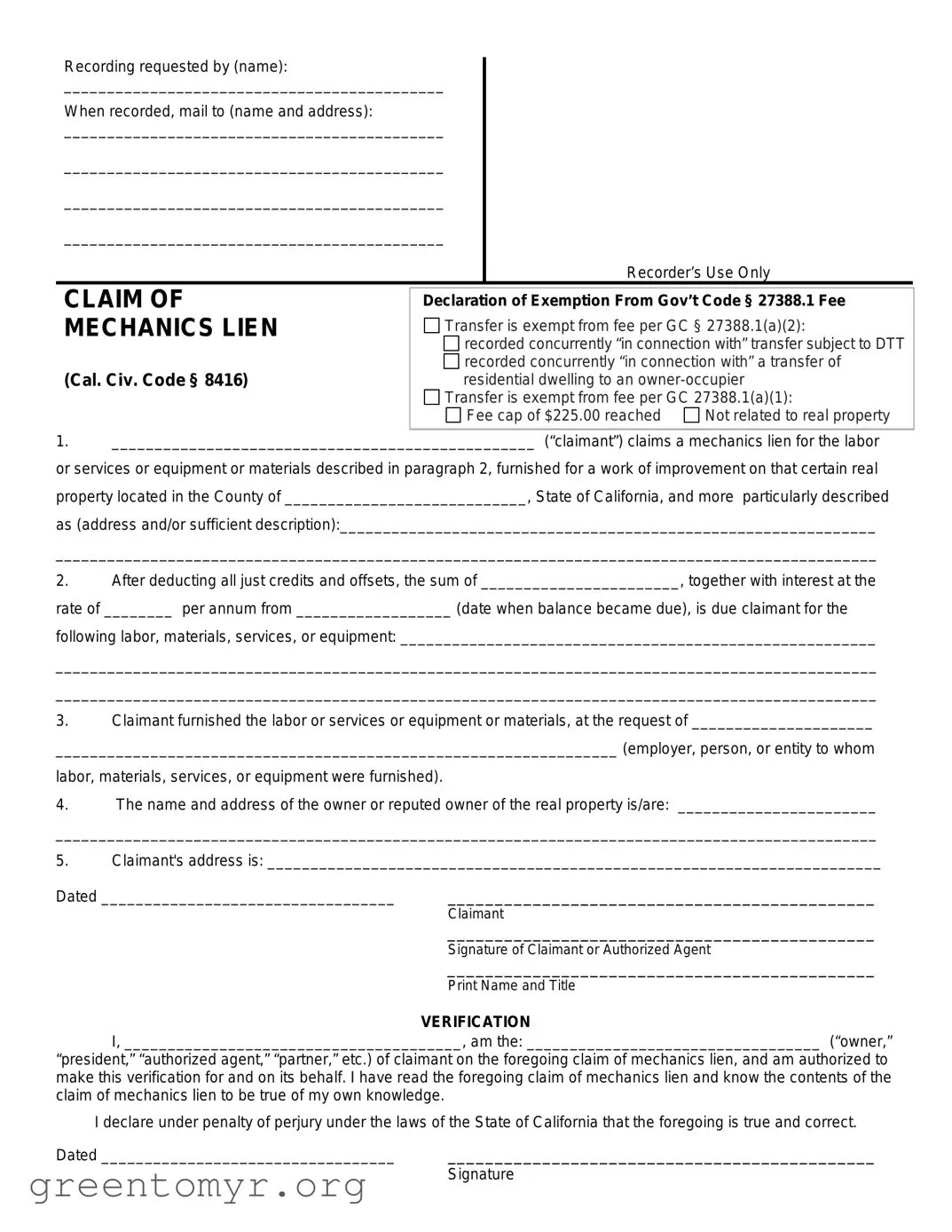
The Mechanics Lien California form serves as a crucial tool for contractors, subcontractors, and suppliers seeking payment for work performed or materials provided in the construction industry. This legal document allows those who have not been compensated for their services to assert a claim against a property, thereby ensuring their right to receive payment. The form requires specific information, including the property owner’s name, a detailed description of the work completed, and the amount owed. It must be filed with the appropriate county recorder’s office within a set timeframe to be valid. Additionally, proper notice must be given to the property owner and other interested parties. Understanding the nuances of this form is essential for anyone involved in construction projects in California, as it can significantly impact their ability to secure payment and protect their financial interests.
Recording requested by (name):
____________________________________________
When recorded, mail to (name and address):
____________________________________________
____________________________________________
____________________________________________
____________________________________________
Recorder’s Use Only
CLAIM OF MECHANICS LIEN
(Cal. Civ. Code § 8416)
Declaration of Exemption From Gov’t Code § 27388.1 Fee
Transfer is exempt from fee per GC § 27388.1(a)(2):
recorded concurrently “in connection with” transfer subject to DTT
recorded concurrently “in connection with” a transfer of residential dwelling to an
Transfer is exempt from fee per GC 27388.1(a)(1):
Fee cap of $225.00 reached |
Not related to real property |
1._________________________________________________ (“claimant”) claims a mechanics lien for the labor or services or equipment or materials described in paragraph 2, furnished for a work of improvement on that certain real property located in the County of ____________________________, State of California, and more particularly described as (address and/or sufficient description):______________________________________________________________
_______________________________________________________________________________________________
2.After deducting all just credits and offsets, the sum of _______________________, together with interest at the rate of ________ per annum from __________________ (date when balance became due), is due claimant for the following labor, materials, services, or equipment: _______________________________________________________
_______________________________________________________________________________________________
_______________________________________________________________________________________________
3.Claimant furnished the labor or services or equipment or materials, at the request of _____________________
_________________________________________________________________ (employer, person, or entity to whom labor, materials, services, or equipment were furnished).
4.The name and address of the owner or reputed owner of the real property is/are: _______________________
_______________________________________________________________________________________________
5.Claimant's address is: _______________________________________________________________________
Dated __________________________________ _____________________________________________
Claimant
_____________________________________________
Signature of Claimant or Authorized Agent
_____________________________________________
Print Name and Title
VERIFICATION
I, _______________________________________, am the: __________________________________ (“owner,”
“president,” “authorized agent,” “partner,” etc.) of claimant on the foregoing claim of mechanics lien, and am authorized to make this verification for and on its behalf. I have read the foregoing claim of mechanics lien and know the contents of the claim of mechanics lien to be true of my own knowledge.
I declare under penalty of perjury under the laws of the State of California that the foregoing is true and correct.
Dated __________________________________ _____________________________________________
Signature

NOTICE OF MECHANICS LIEN CLAIM
ATTENTION!
Upon the recording of the enclosed MECHANICS LIEN with the county recorder's office of the county where the property is located, your property is subject to the filing of a legal action seeking a
The party identified in the enclosed mechanics lien may have provided labor or materials for improvements to your property and may not have been paid for these items. You are receiving this notice because it is a required step in filing a mechanics lien foreclosure action against your property. The foreclosure action will seek to pay for unpaid labor, materials, or improvements provided to your property. This may affect your ability to borrow against, refinance, or sell the property until the mechanics lien is release.
BECAUSE THE LIEN AFFECTS YOUR PROPERTY, YOU MAY WISH TO SPEAK WITH YOUR CONTRACTOR IMMEDIATELY, OR CONTACT AN ATTORNEY, OR FOR MORE INFORMATION ON MECHANICS LIENS GO TO THE CONTRACTORS' STATE LICENSE BOARD WEB SITE AT www.cslb.ca.gov.
PROOF OF SERVICE AFFIDAVIT
California Civil Code section 8416
Failure to serve the Mechanic’s Lien and Notice of Mechanic’s Lien on the owner, or alternatively if the owner cannot be served on the lender or direct contractor, shall cause the Mechanic’s Lien to be unenforceable as a matter of law (Civil Code Section 8024(d)). Service of the Mechanic’s Lien and Notice of Mechanic’s Lien must be by (1) registered mail, (2) certified mail, or (3)
PROOF OF SERVICE AFFIDAVIT (ON OWNER)
California Civil Code section 8416(a)(7) and (c)(1)
I, ______________________________ (name), declare that I served a copy of this Mechanic’s Lien and
Notice of Mechanic’s Lien by registered mail, certified mail, or
Company/Person Served: ________________________________________________________________
Title or capacity of person served (if appropriate): ______________________________________________
Service address: ________________________________________________________________________
Said service address is the owner’s residence, place of business, or address showed by the building permit on file with the permitting authority for the work.
Executed on ___________, 20_____ (date) at __________________ (city), _____________________
(county), California.
By: _____________________________________
(Signature of person making service)
ALTERNATE PROOF OF SERVICE AFFIDAVIT (ON LENDER OR DIRECT CONTRACTOR)
California Civil Code Section 8416(a)(7) and (c)(2)
I, ____________________________________________________ (name), declare that the owner or
reputed owner cannot be served with a copy of this Mechanic’s Lien and Notice of Mechanic’s Lien by registered mail, certified mail, or
Company/Person Served: ________________________________________________________________
Title or capacity of person served (if appropriate): ______________________________________________
Service address: ________________________________________________________________________
Executed on ___________, 20_____ (date) at __________________ (city), _____________________
(county), California.
By: _____________________________________
(Signature of person making service)
| Fact Name | Description |
|---|---|
| Purpose | The Mechanics Lien form allows contractors, subcontractors, and suppliers to secure payment for work performed on a property. |
| Governing Law | California Civil Code Sections 8400-8494 govern the mechanics lien process in California. |
| Eligibility | Any party who has provided labor, materials, or services for the improvement of a property may file a mechanics lien. |
| Filing Deadline | A mechanics lien must be filed within 90 days of the completion of the work or delivery of materials. |
| Notice Requirement | Before filing, a preliminary notice must be sent to the property owner, notifying them of the potential lien. |
| Form Requirements | The form must include specific information, such as the property description, claimant's details, and the amount owed. |
| Verification | The form must be verified by the claimant, affirming that the information provided is true and correct. |
| Recording | The completed mechanics lien must be recorded with the county recorder's office in the county where the property is located. |
| Enforcement | If payment is not made, the lien can be enforced through a legal action, typically a lawsuit to foreclose on the lien. |
| Expiration | If not enforced, a mechanics lien will expire after 90 days unless an extension is filed or a lawsuit is initiated. |
Completing the Mechanics Lien form in California is an important step for ensuring that your claim is properly documented. Following these steps will help you fill out the form accurately and efficiently.
After completing these steps, ensure that you keep a copy of the filed lien for your records. It is also advisable to send a copy to the property owner to notify them of the lien. Be aware of any deadlines that may apply to your specific situation.
A Mechanics Lien is a legal claim against a property. It allows contractors, subcontractors, and suppliers to secure payment for work done or materials provided. If payment is not received, the lien can lead to a forced sale of the property to satisfy the debt.
In California, various parties can file a Mechanics Lien, including:
Essentially, anyone who contributes to the improvement of a property may have the right to file a lien if they are not paid.
The process involves several steps:
Each step is important to ensure the lien is valid and enforceable.
The Mechanics Lien form must include specific information, such as:
Providing accurate details is crucial for the lien's validity.
In California, the deadline to file a Mechanics Lien varies based on the type of work done:
It is essential to adhere to these timelines to protect your rights.
Yes, a Mechanics Lien can be removed. This can happen through:
Removing a lien is important for clearing title to the property.
If a Mechanics Lien is not resolved, the lienholder may pursue legal action. This can lead to a court judgment, allowing the lienholder to force the sale of the property to recover the owed amount. It is a serious matter that can affect the property owner's ability to sell or refinance the property.
Yes, there are costs involved. These may include:
Understanding these costs can help in planning your budget.
Filing a Mechanics Lien in California can be a straightforward process, but many people make common mistakes that can jeopardize their claims. One frequent error is not including all required information. The form demands specific details, such as the property owner’s name, a description of the work performed, and the amount owed. Omitting any of these elements can lead to delays or even the rejection of the lien.
Another mistake often seen is failing to properly serve the lien. Simply filing the lien with the county recorder's office isn't enough. The law requires that the lien also be served to the property owner and, in some cases, the general contractor. Neglecting this step can render the lien ineffective.
Many individuals also underestimate the importance of accuracy in the descriptions provided. Vague or overly broad descriptions of the work can create confusion. It's crucial to be specific about what services or materials were provided. A clear and concise description helps establish the validity of the claim.
Timing is everything when it comes to filing a Mechanics Lien. Some people mistakenly believe they can file at any time. In California, there are strict deadlines based on when the work was completed or when the last materials were supplied. Missing these deadlines can mean losing the right to file a lien altogether.
Another common pitfall is not notarizing the lien. In California, the Mechanics Lien form must be notarized to be valid. This step is often overlooked, leading to complications down the line. Always ensure that the form is signed in front of a notary public.
People also frequently fail to keep copies of their lien documents. After filing, it's essential to have a record of what was submitted. This can be helpful if there are disputes or if further action is needed later. Keeping thorough documentation can save a lot of headaches.
Some individuals mistakenly assume that filing a Mechanics Lien guarantees payment. While it is a powerful tool for securing payment, it does not automatically ensure that the debt will be settled. Understanding the lien's role in the payment process is crucial for anyone involved in construction or contracting.
Lastly, not seeking legal advice can be a significant mistake. The laws surrounding Mechanics Liens can be complex, and each situation is unique. Consulting with a legal expert can provide valuable guidance and help avoid costly errors. Taking the time to understand the process can make all the difference in successfully securing a lien.
When filing a Mechanics Lien in California, several other forms and documents may be necessary to support your claim. Understanding these documents can help ensure that your lien is valid and enforceable. Below is a list of commonly used forms that accompany the Mechanics Lien form.
Being aware of these additional forms and documents can significantly impact the success of your Mechanics Lien claim. Timely and accurate filing of these documents helps protect your rights and ensures that you are adequately compensated for your work. Always consider consulting with a legal professional to navigate the complexities of the lien process effectively.
The Mechanics Lien California form shares similarities with several other legal documents. Each of these documents serves a specific purpose in protecting the rights of individuals involved in construction and property improvement projects. Here’s a list of eight documents that are similar to the Mechanics Lien form:
Understanding these documents can help property owners, contractors, and suppliers navigate their rights and responsibilities in construction projects. Each document plays a role in ensuring that all parties are protected and informed throughout the process.
When filling out the Mechanics Lien form in California, it is essential to approach the task with care and attention to detail. This form serves as a legal document to protect the rights of those who have provided labor or materials for a construction project. Below are some key dos and don'ts to keep in mind.
By following these guidelines, you can help ensure that your Mechanics Lien is filed correctly and effectively protects your rights in the construction process.
Understanding the Mechanics Lien in California can be challenging. Here are seven common misconceptions about the Mechanics Lien form that you should know:
Being informed about these misconceptions can help you navigate the process more effectively and protect your rights in the construction industry.
When dealing with the Mechanics Lien California form, understanding the process is crucial for protecting your rights. Here are some key takeaways: