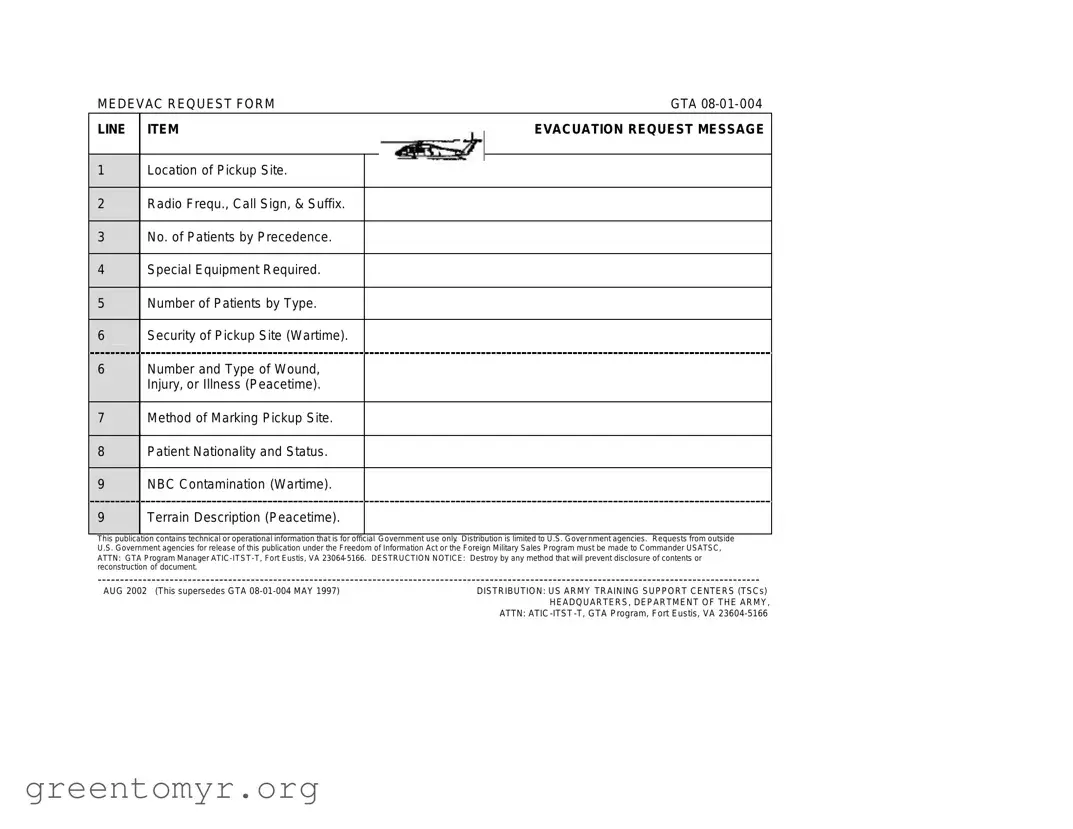
The Medevac request form GTA 08-01-004 serves as a crucial document in the medical evacuation process, ensuring that patients receive timely and appropriate care during emergencies. This form facilitates communication between medical personnel and evacuation teams, detailing essential information such as the patient's medical condition, the urgency of the situation, and the necessary resources for transport. It is designed to streamline the coordination of care, allowing for rapid decision-making and response. Key sections of the form include patient identification, medical history, and specific instructions for treatment during transit. Proper completion of this form is vital; it not only impacts the efficiency of the evacuation but also the overall outcome for the patient. Understanding its components and the procedures surrounding its use can significantly enhance the effectiveness of emergency medical services.
MEDEVAC REQUEST FORM |
GTA |
|
LINE |
ITEM |
EVACUATION REQUEST MESSAGE |
|
|
|
1 |
Location of Pickup Site. |
|
|
|
|
2 |
Radio Frequ., Call Sign, & Suffix. |
|
|
|
|
3 |
No. of Patients by Precedence. |
|
|
|
|
4 |
Special Equipment Required. |
|
|
|
|
5 |
Number of Patients by Type. |
|
|
|
|
6 |
Security of Pickup Site (Wartime). |
|
|
|
|
6 |
Number and Type of Wound, |
|
|
Injury, or Illness (Peacetime). |
|
|
|
|
7 |
Method of Marking Pickup Site. |
|
|
|
|
8 |
Patient Nationality and Status. |
|
|
|
|
9 |
NBC Contamination (Wartime). |
|
|
|
|
9 |
Terrain Description (Peacetime). |
|
|
|
|
This publication contains technical or operational information that is for official Government use only. Distribution is limited to U.S. Gover nment agencies. Requests from outside U.S. Government agencies for release of this publication under the Freedom of Information Act or the Foreign Military Sales Program must be made to Commander USATSC, ATTN: GTA Program Manager
AUG 2002 (This supersedes GTA |
DISTRIBUTION: US ARMY TRAINING SUPPORT CENTERS (TSCs) |
|
HEADQUARTERS, DEPARTMENT OF THE ARMY, |
|
ATTN: ATIC |

LINE ITEM |
EXPLANATION |
|
|
1. Location of |
Encrypt grid coordinates. When using DRYAD Numeral Cipher, the same SET line will be used to encrypt grid |
Pickup Site. |
zone letters and coordinates. To preclude misunderstanding, a statement is made that grid zone letters are in- |
|
cluded in the message (unless unit SOP specifies its use at all times). |
|
|
2. Radio Frequency, |
Encrypt the frequency of the radio at the pickup site, not a relay frequency. The call sign (and suffix if used) of |
Call Sign, Suffix. |
person to be contacted at the pickup site may be transmitted in the clear. |
|
|
3. No. of Patients |
Report only applicable info & encrypt brevity codes. A = Urgent, B = |
by Precedence. |
Convenience. (If 2 or more categories reported in same request, insert the word “break” btwn. each category.) |
|
|
4. Spec Equipment. |
Encrypt applicable brevity codes. A = None, B = Hoist, C = Extraction equipment, D = Ventilator. |
|
|
5. No. of Patients |
Report only applicable information and encrypt brevity code. If requesting MEDEVACfor both types, insert the |
by Type. |
word “break ” between the litter entry and ambulatory entry: L + # of Pnt |
|
|
6. Security Pickup |
N = No enemy troops in area, P = Possibly enemy troops in area (approach with caution), E = Enemy troops in |
Site (Wartime). |
area (approach with caution), X = Enemy troops in area (armed escort required). |
6. Number and type |
Specific information regarding patient wounds by type (gunshot or shrapnel). Report serious bleeding, along |
of Wound, Injury, |
with patient blood type, if known. |
Illness (Peacetime). |
|
|
|
7. Method of |
Encrypt the brevity codes. A = Panels, B = Pyrotechnic signal, C = Smoke Signal, D = None, E = Other. |
Marking Pickup Site. |
|
|
|
8. Patient Nation- |
Number of patients in each category need not be transmitted. Encrypt only applicable brevity codes. A = US |
ality and Status. |
military, B = US civilian, C = |
|
|
9. NBC Contami- |
Include this line only when applicable. Encrypt the applicable brevity codes. N = nuclear, B = biological, C = |
nation, (Wartime). |
chemical. |
|
|
9. Terrain Descrip- |
Include details of terrain features in and around proposed landing site. If possible, describe the relationship of |
tion (Peacetime). |
site to a prominent terrain feature ( lake, mountain, tower). |
|
|
Reference: FM
| Fact Name | Description |
|---|---|
| Medevac Request Purpose | The GTA 08-01-004 form is used to request medical evacuation for patients in need of urgent medical care. |
| Governing Laws | This form is governed by state-specific emergency medical services regulations, which may vary by state. |
| Submission Process | The form must be completed by authorized personnel and submitted to the appropriate medical response team for processing. |
| Importance of Accuracy | Accurate information on the form is crucial to ensure timely and effective medical response during emergencies. |
Filling out the Medevac request form GTA 08-01-004 is a straightforward process that requires careful attention to detail. Once you have completed the form, you will be ready to submit it for the necessary medical evacuation. Ensure that all sections are filled out accurately to avoid delays in processing.
The Medevac request form GTA 08-01-004 is a standardized document used to request medical evacuation services. It ensures that all necessary information is collected efficiently to facilitate timely medical transport for individuals requiring urgent care.
The form should be filled out by healthcare professionals or authorized personnel who are responsible for coordinating the medical evacuation. This may include doctors, nurses, or emergency response teams who assess the medical needs of the patient.
The Medevac request form typically requires the following information:
Providing complete and accurate information is crucial to ensure a swift response.
The completed Medevac request form can be submitted electronically or via fax, depending on the protocols established by the medical evacuation service provider. It is essential to follow the specific submission guidelines outlined by the service to avoid delays.
Once the form is submitted, the medical evacuation service reviews the request. They will assess the urgency of the situation and determine the appropriate resources needed for the evacuation. The requesting party will be contacted for any additional information if required.
There is no strict time limit for submitting the Medevac request form; however, it is advisable to submit it as soon as the need for evacuation is identified. Timely submission can significantly impact the speed and efficiency of the medical response.
Once the Medevac request form is submitted, modifications can be made if necessary. The requesting party should contact the medical evacuation service immediately to communicate any changes in the patient’s condition or additional requirements.
Costs for medical evacuation services can vary widely based on factors such as distance, type of transport, and medical needs. It is important to check with the service provider regarding potential charges and any insurance coverage that may apply.
If the patient’s condition changes after the Medevac request form has been submitted, it is crucial to inform the medical evacuation service immediately. This information can affect the type of transport and medical support required during the evacuation.
For more information about the Medevac request process and the GTA 08-01-004 form, individuals can consult the medical evacuation service provider’s website or contact their office directly. They can provide detailed guidance and answer any specific questions regarding the procedure.
Filling out the Medevac request form GTA 08-01-004 can be a crucial step in ensuring timely medical evacuation. However, several common mistakes can lead to delays or complications in the process. One frequent error is providing incomplete patient information. Essential details such as the patient's name, age, and medical history must be accurately filled out to facilitate proper care.
Another mistake often made is failing to specify the urgency of the request. The form requires clear indications of whether the situation is critical or non-critical. Without this information, responders may not prioritize the request appropriately, potentially impacting the patient’s health.
Some individuals neglect to include the necessary medical details. Specific symptoms and conditions should be outlined clearly. This information helps medical personnel prepare for the patient's needs during transport. Omitting these details can lead to inadequate care upon arrival.
Additionally, incorrect contact information is a common oversight. Providing accurate contact details for the requesting party ensures that medical teams can reach out for further clarification or instructions. If the information is incorrect, it may result in miscommunication and delays in response.
Another error involves not following the proper submission procedures. Each facility may have different protocols for submitting the form. Adhering to these guidelines is essential to ensure that the request is processed without unnecessary delays.
Lastly, individuals sometimes overlook the importance of double-checking the form before submission. Simple typographical errors or missing signatures can cause significant setbacks. Taking a moment to review the completed form can prevent these issues and facilitate a smoother evacuation process.
The Medevac request form GTA 08-01-004 is a crucial document for requesting medical evacuation. Alongside this form, several other documents may be necessary to ensure a smooth and efficient process. Below is a list of related forms and documents that are often used in conjunction with the Medevac request form.
Each of these documents plays a vital role in ensuring that the Medevac process is efficient and safe. Properly completing and submitting these forms can significantly improve the care and attention the patient receives during transport.
When filling out the Medevac request form GTA 08-01-004, it is essential to adhere to specific guidelines to ensure the process runs smoothly. Below is a list of things you should and shouldn't do when completing this form.
The Medevac request form GTA 08-01-004 is a crucial document used in emergency medical situations. However, several misconceptions surround this form, which can lead to confusion and inefficiencies during critical moments. Here are eight common misconceptions, along with clarifications to help ensure a better understanding.
Understanding these misconceptions can help streamline the medical evacuation process and ultimately improve patient outcomes. Accurate information, timely communication, and proper use of the Medevac request form are vital components in emergency medical situations.
When filling out the Medevac request form GTA 08-01-004, it is essential to keep a few key points in mind. This will ensure a smooth process and effective communication during emergencies.
By following these guidelines, you can help ensure that the Medevac process is efficient and effective when it matters most.