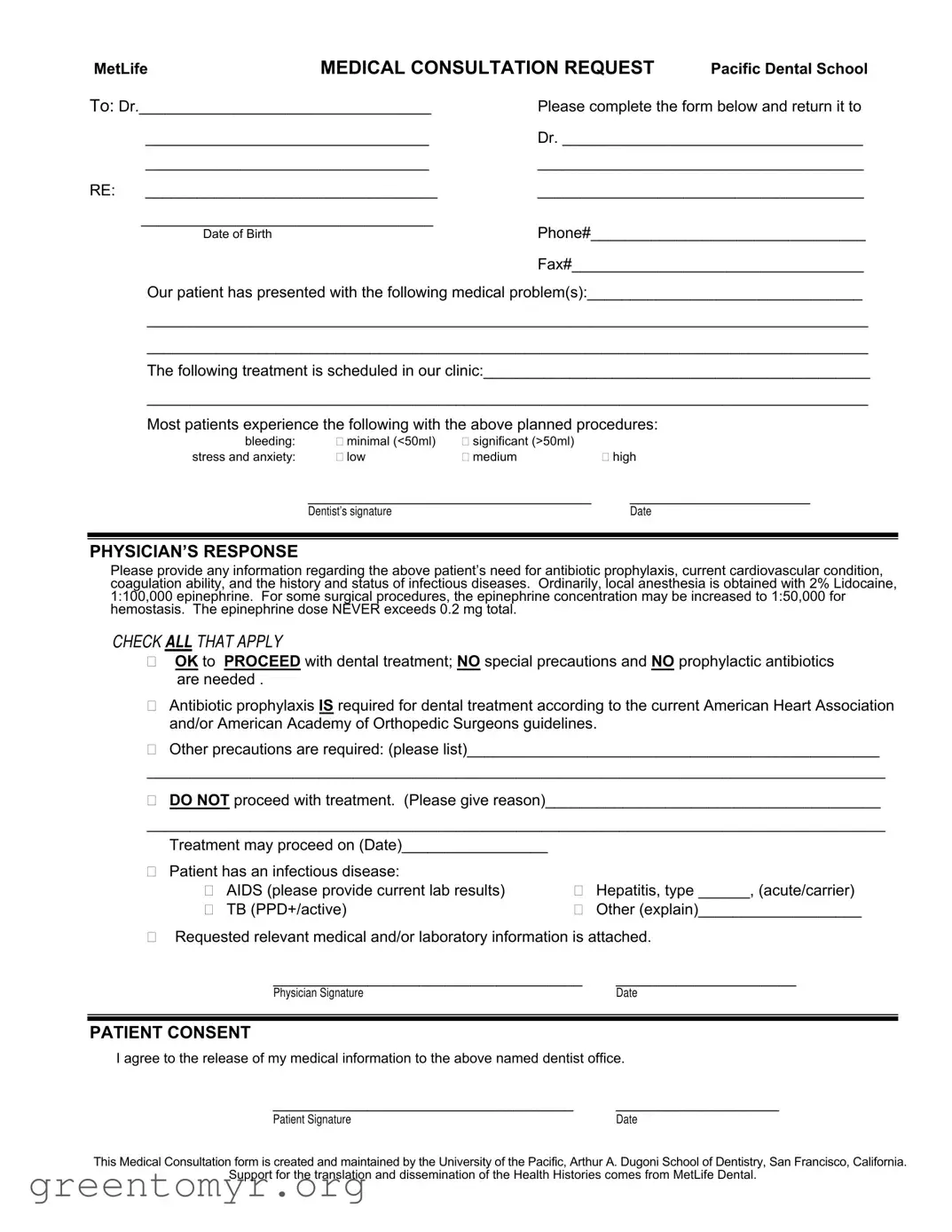
The Medical Consultation Request form serves as a vital communication tool between dental professionals and physicians, ensuring that patients receive safe and effective care. This form, utilized by the Pacific Dental School, is designed to gather essential information regarding a patient's medical history and current health status. It prompts the dentist to outline the specific medical problems presented by the patient, along with details about any scheduled dental procedures. By documenting the anticipated risks associated with these procedures, such as potential bleeding and levels of stress or anxiety, the form facilitates a comprehensive understanding of the patient's needs. Furthermore, it includes a section for the physician's response, where critical information about antibiotic prophylaxis, cardiovascular health, and coagulation ability is requested. This ensures that any necessary precautions are taken before proceeding with treatment. Additionally, the form incorporates a patient consent section, allowing for the release of medical information, which is essential for coordinated care. Ultimately, the Medical Consultation Request form is not just a bureaucratic necessity; it is an essential component of patient safety and effective interdisciplinary communication.

MetLife |
MEDICAL CONSULTATION REQUEST |
Pacific Dental School |
||
To: Dr.__________________________________ |
Please complete the form below and return it to |
|||
|
_________________________________ |
Dr. ___________________________________ |
||
|
_________________________________ |
______________________________________ |
||
RE: |
__________________________________ |
______________________________________ |
||
|
__________________________________ |
|
|
|
|
|
Date of Birth |
Phone#________________________________ |
|
|
|
|
Fax#__________________________________ |
|
|
Our patient has presented with the following medical problem(s):________________________________ |
|||
|
____________________________________________________________________________________ |
|||
|
____________________________________________________________________________________ |
|||
|
The following treatment is scheduled in our clinic:_____________________________________________ |
|||
|
____________________________________________________________________________________ |
|||
|
Most patients experience the following with the above planned procedures: |
|
||
bleeding: |
minimal (<50ml) |
significant (>50ml) |
|
stress and anxiety: |
low |
medium |
high |
_________________________________ |
_____________________ |
Dentist’s signature |
Date |
PHYSICIAN’S RESPONSE
Please provide any information regarding the above patient’s need for antibiotic prophylaxis, current cardiovascular condition, coagulation ability, and the history and status of infectious diseases. Ordinarily, local anesthesia is obtained with 2% Lidocaine, 1:100,000 epinephrine. For some surgical procedures, the epinephrine concentration may be increased to 1:50,000 for hemostasis. The epinephrine dose NEVER exceeds 0.2 mg total.
CHECK ALL THAT APPLY
OK to PROCEED with dental treatment; NO special precautions and NO prophylactic antibiotics are needed .
Antibiotic prophylaxis IS required for dental treatment according to the current American Heart Association and/or American Academy of Orthopedic Surgeons guidelines.
Other precautions are required: (please list)________________________________________________
______________________________________________________________________________________
DO NOT proceed with treatment. (Please give reason)_______________________________________
______________________________________________________________________________________
Treatment may proceed on (Date)_________________
Patient has an infectious disease:
|
AIDS (please provide current lab results) |
|
Hepatitis, type ______, (acute/carrier) |
|
TB (PPD+/active) |
|
Other (explain)___________________ |
Requested relevant medical and/or laboratory information is attached.
____________________________________ |
_____________________ |
Physician Signature |
Date |
PATIENT CONSENT
I agree to the release of my medical information to the above named dentist office.
___________________________________ |
___________________ |
Patient Signature |
Date |
This Medical Consultation form is created and maintained by the University of the Pacific, Arthur A. Dugoni School of Dentistry, San Francisco, California. Support for the translation and dissemination of the Health Histories comes from MetLife Dental.
| Fact Name | Details |
|---|---|
| Purpose | This form requests medical consultation for dental treatment. |
| Patient Information | Includes sections for the patient's name, date of birth, and contact details. |
| Medical Problems | Providers must describe the patient's medical issues related to dental care. |
| Treatment Details | The form outlines the scheduled dental procedures and expected patient experiences. |
| Physician's Response | Physicians provide input on antibiotic needs and any special precautions. |
| Consent Requirement | Patients must consent to the release of their medical information. |
| Signature Section | Requires signatures from both the dentist and physician, along with dates. |
| Infectious Disease Disclosure | Patients must disclose any infectious diseases that may affect treatment. |
| Governing Laws | California Health and Safety Code Sections 120975-120990 govern medical records. |
| Form Origin | Created by the University of the Pacific, Arthur A. Dugoni School of Dentistry. |
After completing the Medical Consultation Request form, it should be returned to the designated dentist or office. Ensure all sections are filled out accurately to avoid delays in processing.
The Medical Consultation Request form is designed to facilitate communication between dental professionals and physicians. It helps ensure that dentists have all the necessary medical information about a patient before proceeding with dental treatments. This is particularly important for patients with complex medical histories or specific health concerns.
This form is typically filled out by the dentist who is planning to perform a procedure. They provide essential details about the patient's medical history, the planned treatment, and any concerns that may arise during the procedure. The patient's physician will then review the form and provide feedback based on their medical expertise.
The patient must provide their name, date of birth, and contact information, including phone number and fax number. Additionally, they should describe their medical problems, any relevant treatment history, and consent to share their medical information with the dental office.
Relevant medical history includes information about the patient's current health status, any chronic conditions, medications they are taking, and past surgeries. Specific concerns such as cardiovascular conditions, bleeding disorders, and infectious diseases are particularly important. This information helps the dentist assess any risks associated with dental treatment.
The physician is asked to evaluate the patient's need for antibiotic prophylaxis, their cardiovascular condition, coagulation ability, and any history of infectious diseases. This assessment is critical for ensuring that the patient receives safe and appropriate dental care.
The dentist provides details about the planned procedure, including the type of treatment and any expected complications, such as bleeding or anxiety levels. This helps the physician understand the context of the dental work and advise accordingly.
If the physician advises against proceeding with the dental treatment, they must provide a reason. This could be due to the patient's medical condition, which may pose a risk during the procedure. The dentist must take this advice seriously and consider alternative treatment options or postpone the procedure until it is safe to proceed.
The patient must sign the consent section of the form, agreeing to the release of their medical information to the dental office. This consent is crucial for maintaining transparency and ensuring that the dentist has access to all necessary medical details to provide safe care.
The physician follows the guidelines set by the American Heart Association and the American Academy of Orthopedic Surgeons when determining if antibiotic prophylaxis is necessary. These guidelines help prevent potential infections during dental procedures, especially in patients with certain health conditions.
The Medical Consultation Request form is created and maintained by the University of the Pacific, Arthur A. Dugoni School of Dentistry, located in San Francisco, California. The form is supported by MetLife Dental, which aids in the translation and dissemination of health histories.
Filling out the Medical Consultation Request form can be straightforward, but there are common mistakes that can lead to delays or complications. One frequent error is leaving the physician’s name blank. This section is crucial for identifying who is responsible for completing the consultation. Without this information, the form may be returned or delayed.
Another common mistake involves incomplete patient information. It is essential to provide the patient's full name, date of birth, and contact information. Missing any of these details can hinder communication and may prevent timely processing of the request.
Patients often neglect to specify the medical problem clearly. The description should be detailed enough to inform the physician about the specific issues the patient is facing. Vague descriptions can lead to misunderstandings and inadequate responses from the physician.
Additionally, failing to check the appropriate boxes regarding treatment precautions is another mistake. The section asking whether antibiotic prophylaxis is required must be completed accurately. If this is overlooked, it could result in the patient receiving treatment without necessary precautions, potentially endangering their health.
Lastly, not signing the consent section is a significant oversight. The patient’s signature is vital for authorizing the release of medical information. Without it, the form is incomplete and cannot be processed, which can cause unnecessary delays in the patient’s treatment.
The Medical Consultation Request form is an essential document used in dental practices to facilitate communication between dentists and physicians regarding a patient's medical history and treatment needs. Alongside this form, several other documents may also be necessary to ensure comprehensive patient care. Below is a list of commonly used forms that complement the Medical Consultation Request.
Utilizing these forms in conjunction with the Medical Consultation Request ensures a thorough approach to patient care. Each document plays a vital role in fostering communication and safeguarding patient health throughout the treatment process.
When filling out the Medical Consultation Request form, there are important dos and don'ts to keep in mind. Here’s a straightforward list to guide you:
Following these guidelines will help ensure a smooth process for the patient and the dental team. Clear communication is key in healthcare.
Misconceptions about the Medical Consultation Request form can lead to confusion and delays in patient care. Here are five common misunderstandings:
When filling out and using the Medical Consultation Request form, there are several important points to keep in mind. Below are key takeaways that can guide you through the process.
By keeping these key points in mind, you can ensure that the Medical Consultation Request form is filled out correctly and used effectively, ultimately contributing to better patient care.