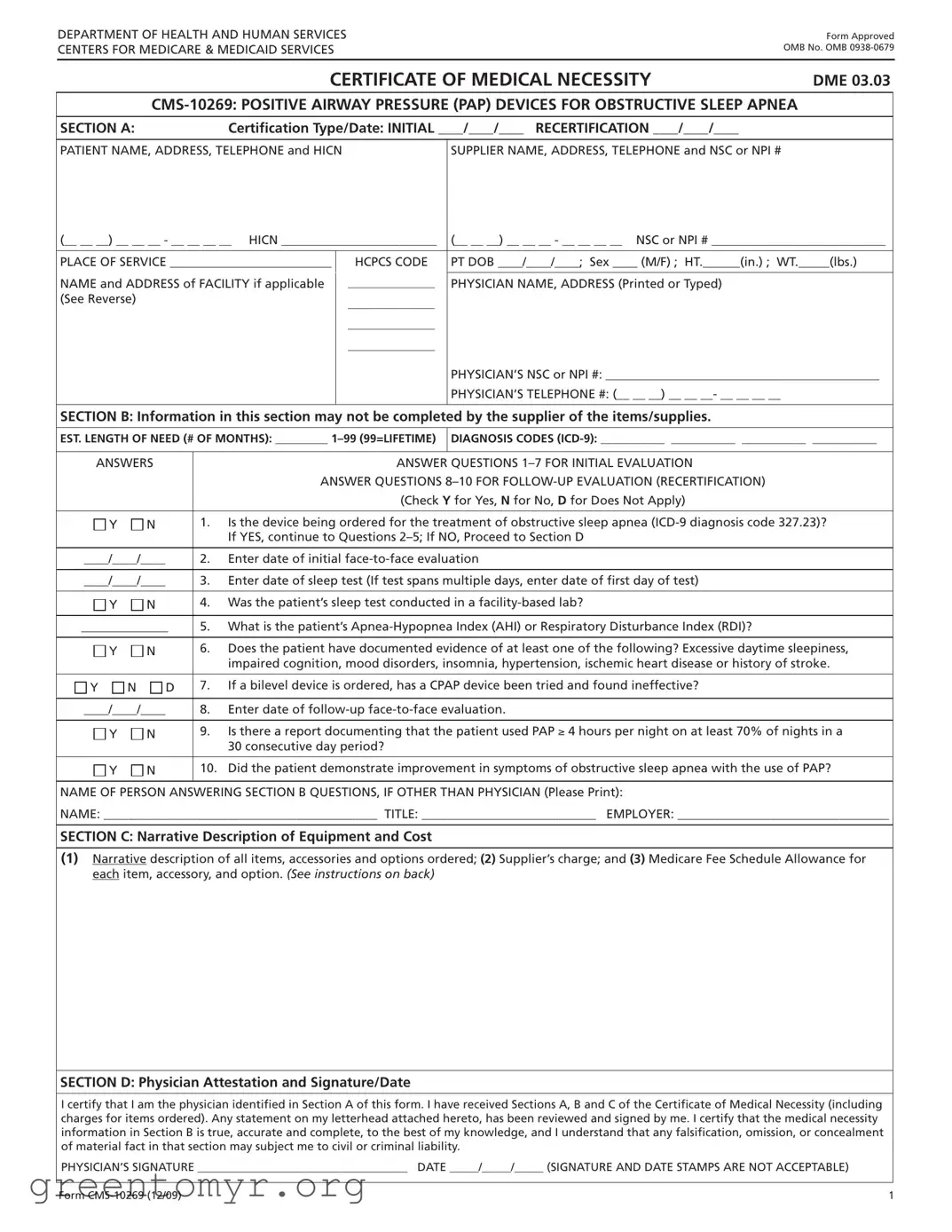
The Medical Lift Chair form, officially known as the Certificate of Medical Necessity (CMN), plays a crucial role in ensuring that patients receive the necessary equipment for managing obstructive sleep apnea. This form is approved by the Department of Health and Human Services and is essential for obtaining Medicare coverage for Positive Airway Pressure (PAP) devices. It includes several sections that gather vital information about the patient, the prescribing physician, and the medical necessity of the device. In Section A, the certification type, patient details, and supplier information are documented, allowing for a clear understanding of who is involved in the process. Section B dives deeper into the clinical aspects, requiring answers to specific questions that confirm the diagnosis and the patient’s need for the device. This section must be completed by a qualified professional, ensuring that the medical necessity is accurately represented. Section C provides a narrative description of the equipment and associated costs, while Section D includes the physician's attestation, certifying that all information is true and complete. Together, these components create a comprehensive overview that facilitates the approval process for medical equipment, ultimately supporting patients in their journey toward better health.
DEPARTMENT OF HEALTH AND HUMAN SERVICES CENTERS FOR MEDICARE & MEDICAID SERVICES
Form Approved OMB No. OMB
|
CERTIFICATE OF MEDICAL NECESSITY |
DME 03.03 |
|
|
|
||
SECTION A: |
Certification Type/Date: INITIAL ____/____/____ RECERTIFICATION ____/____/____ |
|
|
|
|
|
|
PATIENT NAME, ADDRESS, TELEPHONE and HICN |
SUPPLIER NAME, ADDRESS, TELEPHONE and NSC or NPI # |
|
|
(__ __ __) __ __ __ - __ __ __ __ HICN _________________________ |
(__ __ __) __ __ __ - __ __ __ __ NSC or NPI # ____________________________ |
|
|
|
|
PLACE OF SERVICE __________________________ |
HCPCS CODE |
PT DOB ____/____/____; Sex ____ (M/F) ; HT.______(in.) ; WT._____(lbs.) |
NAME and ADDRESS of FACILITY if applicable |
________________ |
PHYSICIAN NAME, ADDRESS (Printed or Typed) |
(See Reverse) |
________________ |
|
|
|
|
|
________________ |
|
|
________________ |
|
|
|
PHYSICIAN’S NSC or NPI #: ____________________________________________ |
|
|
PHYSICIAN’S TELEPHONE #: (__ __ __) __ __ __- __ __ __ __ |
|
|
|
SECTION B: Information in this section may not be completed by the supplier of the items/supplies.
EST. LENGTH OF NEED (# OF MONTHS): _________
DIAGNOSIS CODES
ANSWERS |
|
|
ANSWER QUESTIONS |
|
|
|
|
|
ANSWER QUESTIONS |
|
|
|
|
(Check Y for Yes, N for No, D for Does Not Apply) |
|
|
|
|
|
Y |
N |
|
1. |
Is the device being ordered for the treatment of obstructive sleep apnea |
|
|
|
|
If YES, continue to Questions |
____/____/____ |
|
2. |
Enter date of initial |
|
|
|
|
|
|
____/____/____ |
|
3. |
Enter date of sleep test (If test spans multiple days, enter date of first day of test) |
|
|
|
|
|
|
Y |
N |
|
4. |
Was the patient’s sleep test conducted in a |
|
|
|
||
______________ |
5. |
What is the patient’s |
||
|
|
|
|
|
Y |
N |
|
6. |
Does the patient have documented evidence of at least one of the following? Excessive daytime sleepiness, |
|
|
|
|
impaired cognition, mood disorders, insomnia, hypertension, ischemic heart disease or history of stroke. |
Y |
N |
D |
7. |
If a bilevel device is ordered, has a CPAP device been tried and found ineffective? |
|
|
|
|
|
____/____/____ |
|
8. |
Enter date of |
|
|
|
|
|
|
Y |
N |
|
9. |
Is there a report documenting that the patient used PAP ≥ 4 hours per night on at least 70% of nights in a |
|
|
|
|
30 consecutive day period? |
Y |
N |
|
10. |
Did the patient demonstrate improvement in symptoms of obstructive sleep apnea with the use of PAP? |
|
|
|
|
|
NAME OF PERSON ANSWERING SECTION B QUESTIONS, IF OTHER THAN PHYSICIAN (Please Print):
NAME: ____________________________________________ TITLE: ____________________________ EMPLOYER: __________________________________
SECTION C: Narrative Description of Equipment and Cost
(1)Narrative description of all items, accessories and options ordered; (2) Supplier’s charge; and (3) Medicare Fee Schedule Allowance for each item, accessory, and option. (See instructions on back)
SECTION D: Physician Attestation and Signature/Date
I certify that I am the physician identified in Section A of this form. I have received Sections A, B and C of the Certificate of Medical Necessity (including charges for items ordered). Any statement on my letterhead attached hereto, has been reviewed and signed by me. I certify that the medical necessity information in Section B is true, accurate and complete, to the best of my knowledge, and I understand that any falsification, omission, or concealment of material fact in that section may subject me to civil or criminal liability.
PHYSICIAN’S SIGNATURE ____________________________________ DATE _____/_____/_____ (SIGNATURE AND DATE STAMPS ARE NOT ACCEPTABLE)
Form |
1 |

INSTRUCTIONS FOR COMPLETING THE CERTIFICATE OF MEDICAL NECESSITY
FOR POSITIVE AIRWAY PRESSURE (PAP) DEVICES FOR OBSTRUCTIVE SLEEP APNEA
SECTION A: (May be completed by the supplier)
CERTIFICATION TYPE/DATE: If this is an initial certification for this patient, indicate this by placing date (MM/DD/YY) needed initially in the space marked “INITIAL.” If this is a revised certification (to be completed when the physician changes the order, based on the patient’s changing clinical needs), indicate the initial date needed in the space marked “INITIAL,” and also indicate the recertification date in the space marked “REVISED.” If this is a recertification, indicate the initial date needed in the space marked “INITIAL,” and also indicate the recertification date in the space marked “RECERTIFICATION.” Whether submitting a REVISED or a RECERTIFIED CMN, be sure to always furnish the INITIAL date as well as the REVISED or RECERTIFICATION date.
PATIENT INFORMATION: Indicate the patient’s name, permanent legal address, telephone number and his/her health insurance claim number (HICN) as it appears on his/her Medicare card and on the claim form.
SUPPLIER INFORMATION: Indicate the name of your company (supplier name), address and telephone number along with the National Provider Identification (NPI) number assigned to you by the National Supplier Clearinghouse (NSC).
PLACE OF SERVICE: Indicate the place in which the item is being used, i.e., patient’s home is 12, skilled nursing facility (SNF) is 31, End Stage Renal Disease (ESRD) facility is 65, etc. Refer to the DME MAC supplier manual for a complete list.
FACILITY NAME: If the place of service is a facility, indicate the name and complete address of the facility.
HCPCS CODES: List all HCPCS procedure codes for items ordered that require a CMN. Procedure codes that do not require certification should not be listed on the CMN.
PATIENT DOB, HEIGHT, WEIGHT AND SEX: Indicate patient’s date of birth (MM/DD/YY) and sex (male or female); height in inches and weight in pounds, if requested.
PHYSICIAN NAME, ADDRESS: Indicate the physician’s name and complete mailing address.
NPI: Accurately indicate the ordering physician’s National Provider Identification number (NPI).
PHYSICIAN’S TELEPHONE NO: Indicate the telephone number where the physician can be contacted (preferably where records would be accessible pertaining to this patient) if more information is needed.
SECTION B: (May not be completed by the supplier. While this section may be completed by a
EST. LENGTH OF NEED: Indicate the estimated length of need (the length of time the physician expects the patient to require use of the ordered item) by filling in the appropriate number of months. If the physician expects that the patient will require the item for the duration of his/her life, then enter 99.
DIAGNOSIS CODES: In the first space, list the ICD9 code that represents the primary reason for ordering this item. List any additional ICD9 codes that would further describe the medical need for the item (up to 3 codes).
QUESTION SECTION: This section is used to gather clinical information to determine medical necessity. Answer each question which applies to the items ordered, checking “Y” for yes, “N” for no, or fill in the blank if other information is requested.
NAME OF PERSON ANSWERING SECTION B QUESTIONS: If a clinical professional other than the ordering physician (e.g., home health nurse, physical therapist, dietician) or a physician employee answers the questions of Section B, he/she must print his/her name, give his/her professional title and the name of his/her employer where indicated. If the physician is answering the questions, this space may be left blank.
SECTION C: (To be completed by the supplier)
NARRATIVE DESCRIPTION OF EQUIPMENT & COST: Supplier gives (1) a narrative description of the item(s) ordered, as well as all options, accessories, supplies and drugs; (2) the supplier’s charge for each item, option, accessory, supply and drug; and (3) the Medicare fee schedule allowance for each item/option/accessory/supply/drug, if applicable.
SECTION D: (To be completed by the physician)
PHYSICIAN ATTESTATION: The physician’s signature certifies (1) the CMN which he/she is reviewing includes Sections A, B, C and D; (2) the answers in Section B are correct; and (3) the
PHYSICIAN SIGNATURE AND DATE: After completion and/or review by the physician of Sections A, B and C, the physician must sign and date the CMN in Section D, verifying the Attestation appearing in this Section. The physician’s signature also certifies the items ordered are medically necessary for this patient. Signature and date stamps are not acceptable.
According to the Paperwork Reduction Act of 1995, no persons are required to respond to a collection of information unless it displays a valid OMB control number. The valid OMB control number for this information collection is
15 minutes per response, including the time to review instructions, search existing resources, gather the data needed, and complete and review the information collection. If you have any comments concerning the accuracy of the time estimate or suggestions for improving this form, please write to: CMS, 7500 Security Blvd.,
Form |
2 |
| Fact Name | Description |
|---|---|
| Governing Agency | The Medical Lift Chair form is regulated by the Centers for Medicare & Medicaid Services (CMS). |
| Form Number | The official form number is CMS-10269, which is designated for Positive Airway Pressure (PAP) devices. |
| Approval Date | This form was approved under OMB No. 0938-0679, indicating its compliance with federal regulations. |
| Certification Types | The form allows for initial certification and recertification, reflecting the patient's ongoing need for medical equipment. |
| Required Information | Sections A and B require detailed patient and physician information, including diagnosis codes and treatment history. |
| State-Specific Laws | State-specific regulations may apply; for example, California requires adherence to the California Health and Safety Code, Section 1374.72. |
Completing the Medical Lift Chair form requires careful attention to detail. Each section must be filled out accurately to ensure the proper processing of the request. Follow these steps to complete the form correctly.
Once the form is completed, it should be submitted according to the specified guidelines. Ensure all required information is accurate to avoid delays in processing. Proper completion of this form is essential for the approval of the medical lift chair request.
The Medical Lift Chair form is used to certify the medical necessity for a positive airway pressure (PAP) device for patients diagnosed with obstructive sleep apnea. It ensures that the required documentation is in place for Medicare reimbursement.
The form can be partially completed by the supplier of the items. However, Section B, which contains clinical information, must be filled out by a qualified healthcare professional, typically the physician treating the patient. The physician must also review and sign the form.
Section A requires patient information, including the patient's name, address, telephone number, and health insurance claim number (HICN). It also requires the supplier's information, including their name, address, telephone number, and National Provider Identification (NPI) number. Additionally, it includes certification type and place of service details.
Section B gathers clinical information to establish medical necessity. It includes questions about the patient’s diagnosis, evaluation dates, and the results of sleep tests. The healthcare professional must answer these questions accurately to support the need for the device.
In Section C, the supplier must provide a narrative description of the ordered items, including any accessories and options. This section also requires the supplier's charge for each item and the corresponding Medicare fee schedule allowance. Accurate pricing and descriptions are crucial for reimbursement purposes.
In Section D, the physician must attest to the accuracy of the information provided in the form. They need to sign and date this section, confirming that they have reviewed all previous sections and that the items ordered are medically necessary for the patient.
To ensure compliance, all sections of the form must be completed accurately and thoroughly. The physician's signature is critical, as it certifies the information's accuracy. Additionally, it is important to follow the instructions provided and to keep copies of all documentation for future reference.
Filling out the Medical Lift Chair form can be a daunting task, and mistakes can lead to delays in receiving necessary equipment. One common error is failing to provide complete patient information. This includes the patient’s name, address, telephone number, and health insurance claim number (HICN). Omitting any of these details can result in processing delays or even denials.
Another frequent mistake involves the certification type and date. Individuals often forget to indicate whether the form is for an initial certification or a recertification. It is crucial to fill in both the initial date and the recertification date if applicable. This oversight can complicate the approval process and lead to confusion regarding the patient’s needs.
Inaccurate diagnosis codes are also a common pitfall. The form requires specific ICD-9 codes that represent the medical necessity for the lift chair. If these codes are incorrect or incomplete, the claim may be rejected. Always double-check the codes to ensure they align with the patient’s diagnosis.
Section B of the form requires answers to several questions regarding the patient’s condition. A common error is leaving these questions unanswered or marking them incorrectly. Each question must be answered accurately to demonstrate the medical necessity of the lift chair. Failing to do so can jeopardize the approval of the equipment.
Furthermore, not providing the estimated length of need is a mistake that can have significant consequences. This section should clearly indicate how long the patient is expected to require the lift chair. If this information is missing, it may raise questions about the necessity of the equipment.
Another mistake is neglecting to include the physician's information, including their National Provider Identification (NPI) number. This detail is essential for verifying the physician's credentials and ensuring that the order is legitimate. Without this information, the claim may face unnecessary delays.
Additionally, individuals often overlook the narrative description of the equipment. Section C requires a detailed account of the items ordered, including accessories and costs. Providing vague or incomplete descriptions can lead to misunderstandings about what is being requested, potentially resulting in denials.
Finally, the physician’s attestation and signature in Section D must not be overlooked. The physician must sign and date the form to certify that all information is accurate and complete. Using signature stamps is not acceptable. A missing signature can halt the entire process, leaving patients without the necessary equipment.
When applying for a Medical Lift Chair, several other forms and documents often accompany the main application. These documents help establish medical necessity, provide necessary patient information, and ensure compliance with insurance requirements. Here’s a brief overview of some commonly used forms:
Each of these documents plays a crucial role in the process of obtaining a Medical Lift Chair. They help ensure that the patient's needs are met and that all necessary information is provided for a smooth approval and reimbursement process.
The Medical Lift Chair form shares similarities with several other documents used in healthcare and medical supply processes. Each of these documents serves a specific purpose while maintaining a focus on patient care and medical necessity. Below is a list of six documents that are comparable to the Medical Lift Chair form:
When filling out the Medical Lift Chair form, it's essential to approach the task with care and attention to detail. Here’s a list of things you should and shouldn't do to ensure the process goes smoothly.
When it comes to Medical Lift Chairs, several misconceptions can create confusion for patients and caregivers alike. Understanding the truth behind these misconceptions is crucial for making informed decisions. Here are eight common misunderstandings:
By addressing these misconceptions, individuals can make better choices regarding Medical Lift Chairs, ensuring they select the right option for their specific needs and circumstances.
When dealing with the Medical Lift Chair form, understanding its components is crucial for ensuring proper completion and use. Here are some key takeaways to keep in mind:
By following these guidelines, you can navigate the Medical Lift Chair form more effectively, ensuring that all necessary information is accurately provided. This can streamline the process and help in obtaining the needed equipment without unnecessary complications.