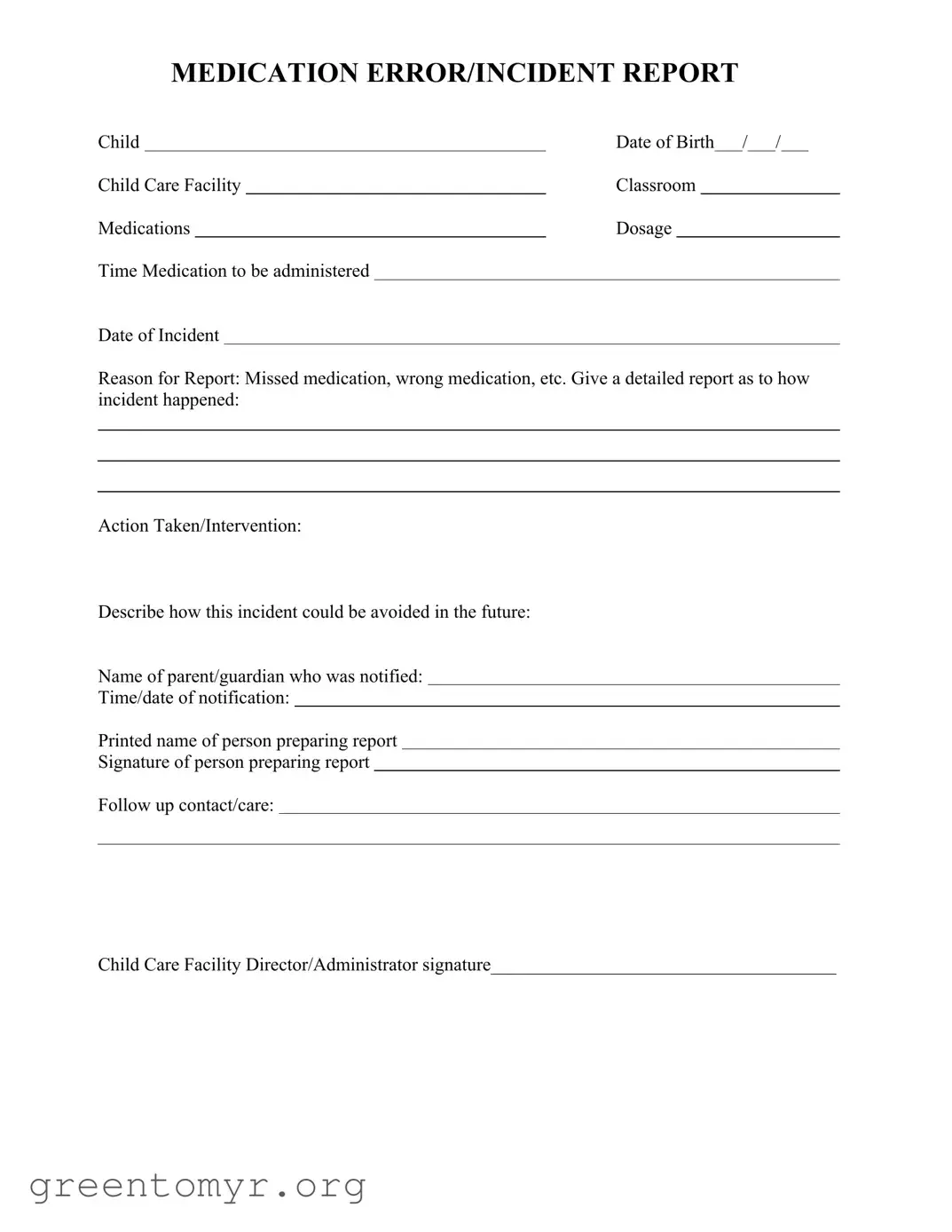
The Medication Incident Report form serves as a crucial tool in the realm of child care facilities, ensuring that any medication-related errors are documented and addressed appropriately. This form captures essential details, beginning with the child's name and date of birth, along with the specific child care facility and classroom. It requires information about the medications involved, including their dosages and the precise times they were to be administered. Additionally, the form prompts the user to indicate the date of the incident and the reason for the report, whether it be a missed medication or an administration error. A detailed narrative explaining how the incident occurred is vital, as it provides context and insight into the circumstances surrounding the error. Furthermore, the report calls for a description of the actions taken in response to the incident, along with suggestions for preventing similar occurrences in the future. The involvement of the child's parent or guardian is also noted, including the time and date they were notified of the incident. The form concludes with the printed name and signature of the individual preparing the report, along with a space for the Child Care Facility Director or Administrator to sign, ensuring accountability and follow-up care. By meticulously documenting these incidents, the form plays a significant role in enhancing safety protocols and improving medication management practices within child care settings.
MEDICATION ERROR/INCIDENT REPORT
Child |
|
Date of Birth / |
/ |
|
|
||||||||
|
|
|
|
|
|
|
|
|
|
|
|
|
|
Child Care Facility |
|
Classroom |
|
|
|
|
|
||||||
Medications |
|
Dosage |
|
|
|
|
|
||||||
Time Medication to be administered |
|
|
|
|
|
|
|
|
|
|
|||
Date of Incident
Reason for Report: Missed medication, wrong medication, etc. Give a detailed report as to how incident happened:
Action Taken/Intervention:
Describe how this incident could be avoided in the future:
Name of parent/guardian who was notified:
Time/date of notification:
Printed name of person preparing report
Signature of person preparing report
Follow up contact/care:
Child Care Facility Director/Administrator signature_____________________________________
| Fact Name | Description |
|---|---|
| Purpose | The Medication Incident Report form is used to document any medication errors or incidents involving children in care. |
| Required Information | The form requires details such as the child's name, date of birth, medications involved, and the specific incident. |
| Incident Types | Reasons for reporting can include missed medication, wrong medication, or other related incidents. |
| Action Steps | It includes sections for describing actions taken and interventions to prevent future incidents. |
| Notification | The form must include the name and notification time of the parent or guardian informed about the incident. |
| Governing Law | In California, the governing law for medication incident reporting is found in Title 22, Section 101226 of the California Code of Regulations. |
Completing the Medication Incident Report form is essential for ensuring that all necessary details regarding a medication error or incident are accurately recorded. This form helps maintain safety and accountability within the childcare environment. Follow these steps to fill it out properly.
The Medication Incident Report form is designed to document any errors or incidents related to medication administration in a child care setting. It serves to ensure that all incidents are recorded accurately, allowing for proper follow-up and preventive measures. This documentation helps improve safety protocols and communication among staff and parents.
A Medication Incident Report should be completed whenever there is a medication error, such as missed medication, wrong medication administered, or any other incident that may impact the child's health and safety. Timely reporting is crucial to address the situation effectively and prevent future occurrences.
The form requires several key pieces of information, including:
The report should be completed by the staff member who witnessed or was involved in the medication incident. This person is typically a caregiver or medical professional within the child care facility. It is essential that the individual preparing the report has firsthand knowledge of the incident to ensure accuracy.
To prevent future medication incidents, the report should include a section for recommendations. Common strategies may include:
By addressing these areas, child care facilities can enhance their safety measures and reduce the likelihood of medication errors.
Once the Medication Incident Report is completed, it should be submitted to the facility's administration for review. The administrator will typically assess the situation and may take further action, such as notifying regulatory bodies or conducting additional training. Follow-up communication with the child's parents or guardians is also important to keep them informed of the incident and any steps taken.
Yes, the information contained in the Medication Incident Report is considered confidential. It should only be shared with relevant personnel involved in the child's care and safety. Maintaining confidentiality helps protect the privacy of the child and the integrity of the reporting process.
If you have additional questions regarding the Medication Incident Report form or the reporting process, it is advisable to contact the child care facility's administration. They can provide clarification and guidance on how to properly complete the form and address any concerns you may have.
Filling out a Medication Incident Report form is a critical task that requires attention to detail. However, many individuals make mistakes that can lead to confusion or miscommunication. One common error is failing to include the child's date of birth. This information is essential for identifying the correct child and ensuring that the report is accurately linked to their medical history.
Another frequent mistake is not providing a clear reason for the report. Simply stating "medication error" without specifics does not help anyone understand what happened. It’s important to specify whether it was a missed medication, wrong dosage, or another issue. This clarity is vital for preventing future incidents.
People often overlook the section that requires a detailed report of how the incident occurred. This part should explain the sequence of events leading to the error. Without this information, it becomes challenging to analyze what went wrong and how to prevent similar mistakes in the future.
In addition, many individuals forget to document the action taken or intervention after the incident. This could include notifying a healthcare provider or administering the correct medication. This section is crucial for understanding the immediate response and ensuring that the child receives the necessary care.
Another common oversight is neglecting to describe how the incident could be avoided in the future. This proactive approach is essential for improving safety protocols. Recommendations can lead to changes in procedures that help prevent similar errors from occurring.
It’s also important to ensure that the name of the parent or guardian who was notified is included. Omitting this information can lead to misunderstandings about communication and follow-up care. Parents need to be informed about any incidents involving their child.
Many people forget to note the time and date of notification to the parent or guardian. This detail is crucial for tracking the timeline of events and ensuring that all parties are kept informed in a timely manner.
Another mistake is not signing the report. The printed name and signature of the person preparing the report are essential for accountability. This step confirms who is responsible for the information provided.
Finally, failing to include follow-up contact or care can lead to gaps in the child's treatment. This section is vital for ensuring that any necessary follow-up actions are documented and communicated to relevant parties.
When a medication incident occurs, several other forms and documents may be necessary to ensure proper communication, documentation, and follow-up. These documents help maintain clarity and accountability in the care provided. Below is a list of commonly used forms alongside the Medication Incident Report form.
Having these forms readily available can greatly assist in addressing medication incidents effectively. They ensure that everyone involved is informed and that appropriate steps are taken to enhance safety and care for the children in the facility.
The Medication Incident Report form is essential for documenting medication errors and incidents. It shares similarities with several other documents. Here are five such documents:
When filling out the Medication Incident Report form, it is crucial to ensure accuracy and clarity. Here are seven things to consider doing and avoiding.
By following these guidelines, you can help ensure that the report is thorough and useful for future reference.
Understanding the Medication Incident Report form is crucial for ensuring the safety and well-being of children in care facilities. However, several misconceptions can lead to confusion. Here are six common misconceptions:
By addressing these misconceptions, child care facilities can foster a safer environment for children and enhance communication among staff and parents.
When filling out and using the Medication Incident Report form, it is essential to approach the process with care and attention to detail. Here are key takeaways to consider:
By adhering to these takeaways, individuals can help ensure that medication incidents are reported effectively, contributing to a safer environment for all children in care.