Content Navigation

The Membership Ledger form serves as a vital record for companies managing membership interests and units. This document captures essential details about the issuance and transfer of membership interests, ensuring transparency and accountability. Each entry includes the name of the company, the certificates issued, and the parties involved in the transactions. It tracks the amount paid for each membership interest, along with the dates of issuance and transfer. The form also notes the certificates surrendered and provides a clear picture of the number of membership interests held by each member. By organizing this information, the Membership Ledger helps maintain accurate records, making it easier for companies to manage their memberships and for members to understand their holdings.

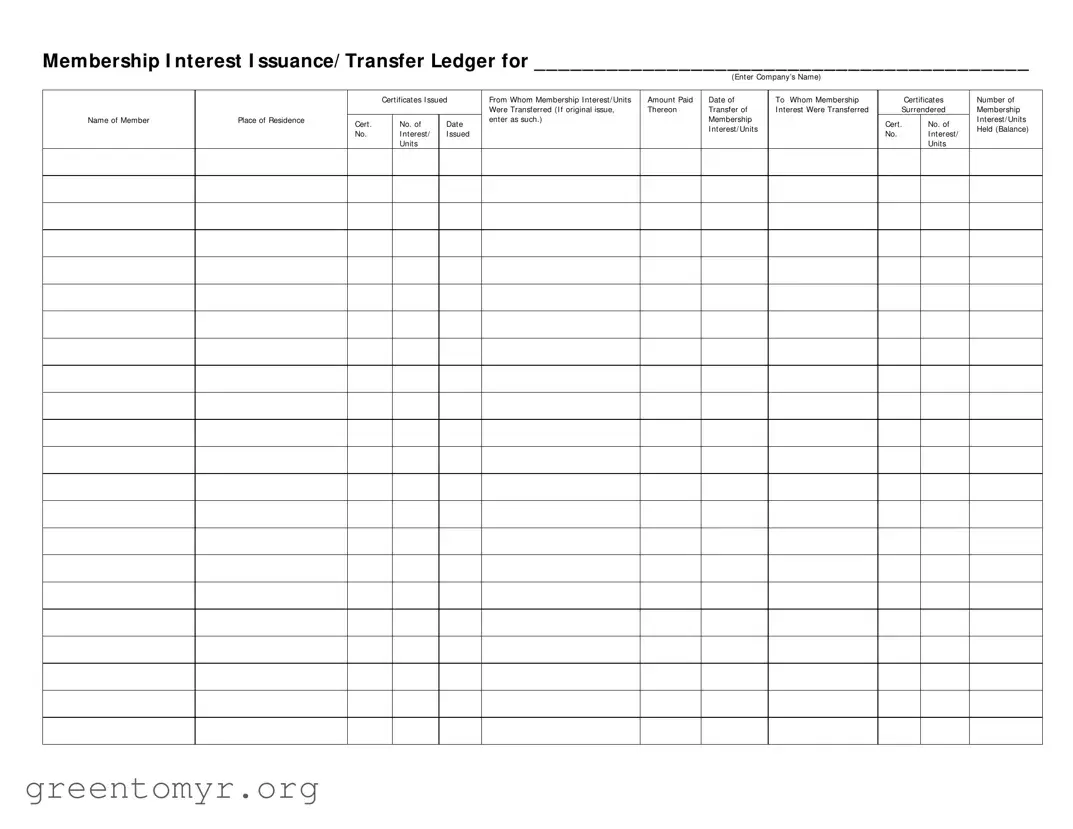
Membership Ledger Example

Membership I nt erest I ssuance/ Transfer Ledger for _ _ _ _ _ _ _ _ _ _ _ _ _ _ _ _ _ _ _ _ _ _ _ _ _ _ _ _ _ _ _ _ _ _ _ _ _ _ _ _ _

(Enter Company’s Name)


Certificates I ssued

From Whom Membership I nterest/ Units

Amount Paid

Date of

To Whom Membership


Were Transferred (I f original issue,

Thereon

Transfer of

I nterest Were Transferred

Name of Member

Place of Residence

Cert .


No. of

Date

enter as such.)


Membership


I nterest/ Units


No.


I nterest/

I ssued


Units


Certificates

Surrendered

Cert .

No. of

No.

I nterest/


Units


Number of Membership

I nterest/ Units Held (Balance)

File Breakdown

Fact Name Description
Purpose The Membership Ledger form is used to track the issuance and transfer of membership interests or units within a company.
Company Information The form requires the company's name to be entered at the top, ensuring clarity regarding which entity the ledger pertains to.
Transfer Details It includes sections for recording the details of membership interest transfers, such as the names of the parties involved and the amounts paid.
Certificates Issued The form tracks the certificates issued, including their numbers and the date they were issued or transferred.
State-Specific Laws In many states, such as Delaware, the use of a membership ledger is governed by the Delaware Limited Liability Company Act.
Balance Tracking It allows for the tracking of the balance of membership interests held by each member, which is essential for accurate record-keeping.

Guide to Using Membership Ledger

Once the Membership Ledger form is completed, it will serve as a record of membership interests issued and transferred. This documentation is essential for maintaining accurate records and ensuring compliance with relevant regulations.

  1. Begin by entering the Company’s Name in the designated space at the top of the form.
  2. In the section labeled Certificates Issued, fill in the details of the certificates issued.
  3. For each entry, provide the following information:
    • From Whom: Enter the name of the person or entity that issued the membership interest.
    • Membership Interest/Units: Specify the number of membership interests or units issued.
    • Amount Paid: Record the amount paid for the membership interest.
    • Date of Transfer: Indicate the date when the membership interest was transferred.
    • To Whom: Write the name of the person or entity to whom the membership interest was transferred.
    • Name of Member: Include the name of the member receiving the interest.
    • Place of Residence: Provide the address of the member.
    • Cert. No.: Enter the certificate number of the membership interest.
  4. If applicable, fill in the section for Membership Interest/Units Transferred with similar details for any transfers.
  5. Document the Certificates Surrendered by entering the certificate numbers and the corresponding membership interests or units surrendered.
  6. Finally, calculate and record the Number of Membership Interest/Units Held (Balance) to reflect the current holdings after all transactions.

Get Answers on Membership Ledger

What is the purpose of the Membership Ledger form?

The Membership Ledger form is designed to track the issuance and transfer of membership interests or units within a company. It serves as a record of all transactions related to membership certificates, including details about who issued them, to whom they were transferred, and the amounts paid. This form helps maintain accurate records of membership interests, ensuring compliance with company regulations and facilitating transparency among members.

What information is required to complete the form?

To complete the Membership Ledger form, you will need to provide the following information:

  • Company Name: Enter the name of the company associated with the membership interests.
  • Certificates Issued: Document details about the certificates, including the certificate number and the date they were issued.
  • Membership Interest/Units: Specify the number of membership interests or units involved in the transaction.
  • Amount Paid: Indicate the amount paid for the membership interests or units.
  • Transfer Details: Include the names and places of residence of both the original member and the new member, along with the date of transfer.

How do I handle the transfer of membership interests?

When transferring membership interests, it is important to accurately record the details in the Membership Ledger form. Follow these steps:

  1. Identify the original member and the new member.
  2. Document the date of the transfer.
  3. Record the number of membership interests or units being transferred.
  4. Ensure that both parties have signed any required documents related to the transfer.

After completing these steps, update the ledger to reflect the new ownership and maintain a clear record of the transaction.

What should I do if I need to correct an entry in the ledger?

If you need to correct an entry in the Membership Ledger, it is important to do so carefully. Follow these guidelines:

  • Cross out the incorrect entry neatly without obscuring any information.
  • Clearly write the correct information next to the crossed-out entry.
  • Initial and date the correction to indicate when it was made.
  • Consider adding a note explaining the reason for the correction if necessary.

Maintaining accuracy in the ledger is essential for legal and administrative purposes, so take the time to ensure all corrections are made thoughtfully.

Common mistakes

Filling out the Membership Ledger form can be straightforward, but mistakes often occur. One common error is leaving the company name section blank or incomplete. It’s essential to provide the full and correct name of the company. This information helps ensure that the ledger is accurately associated with the right entity. Without it, tracking membership interests can become complicated.

Another frequent mistake is misplacing or omitting the date of transfer. Each entry should clearly indicate when the membership interest was transferred. This date is crucial for record-keeping and can impact the legal standing of the transfer. Forgetting to include this information can lead to confusion and potential disputes down the line.

Individuals also tend to overlook the amount paid for the membership interests. This detail is vital for maintaining accurate financial records. If the amount is missing or incorrect, it could create discrepancies in the ledger. It’s important to double-check this figure to ensure it reflects the true transaction value.

Lastly, people often fail to fill in the certificates surrendered section properly. This part of the form is essential for tracking which certificates have been returned and ensuring that all records are up to date. Not providing this information can result in an incomplete ledger, making it difficult to ascertain the current status of membership interests.

Documents used along the form

The Membership Ledger form is an essential document for tracking the issuance and transfer of membership interests within a company. Alongside this form, several other documents are commonly utilized to ensure proper record-keeping and compliance. Below is a list of related forms that support the management of membership interests.

  • Membership Application Form: This document is completed by individuals seeking to become members of a company. It typically includes personal information, the type of membership requested, and any required signatures.
  • Membership Agreement: This agreement outlines the terms and conditions of membership. It includes rights, responsibilities, and obligations of both the member and the company, ensuring that all parties are informed and in agreement.
  • Transfer Request Form: When a member wishes to transfer their membership interest, this form is used to document the request. It includes details about the transferring member, the recipient, and the specific interests being transferred.
  • Meeting Minutes: These records capture the proceedings of meetings where membership matters are discussed. They provide a formal account of decisions made regarding membership interests and any changes to the ledger.
  • Annual Report: This document provides a comprehensive overview of the company’s activities, including membership changes. It is often shared with members and stakeholders to maintain transparency about the company’s operations.

Utilizing these documents in conjunction with the Membership Ledger form helps maintain accurate records and fosters effective communication among members and the company. Proper documentation is vital for compliance and the smooth operation of membership-related processes.

Similar forms

  • Member Registration Form: This document collects essential information from new members, such as names and contact details. Like the Membership Ledger, it tracks member participation and status within an organization.
  • Transfer of Membership Interest Form: This form is used when a member wishes to transfer their interest to another party. It shares similarities with the Membership Ledger in that it documents the transfer details, including the parties involved and the date of transfer.
  • Membership Certificate: This document serves as proof of membership. Similar to the Membership Ledger, it includes details about the member's interest and is often referenced when tracking ownership and rights.
  • Annual Membership Report: This report summarizes the status of all members over the year. It resembles the Membership Ledger in its purpose of keeping a record of member interests and any changes that occurred during the reporting period.
  • Membership Agreement: This contract outlines the rights and responsibilities of members. It relates to the Membership Ledger by establishing the framework within which membership interests are recorded and transferred.
  • Meeting Minutes: These documents record the proceedings of member meetings. They often reference changes in membership or transfers, similar to how the Membership Ledger tracks those transactions.
  • Membership Dues Payment Record: This form tracks payments made by members. Like the Membership Ledger, it helps maintain accurate records of each member's financial contributions and status.
  • Membership Withdrawal Form: When a member decides to leave the organization, this form documents their withdrawal. It parallels the Membership Ledger by recording the exit and any remaining interests or obligations.
  • Membership Interest Valuation Report: This report assesses the value of each member's interest. It is similar to the Membership Ledger in that it provides a snapshot of interests held and can inform transfer decisions.
  • Membership Renewal Form: This document is used when a member renews their membership. Like the Membership Ledger, it records changes in membership status and ensures that the organization's records remain current.

Dos and Don'ts

When filling out the Membership Ledger form, attention to detail is crucial. Here are some important guidelines to follow:

  • Do ensure that you enter the correct company name at the top of the form. This is essential for accurate record-keeping.
  • Do clearly indicate the amount paid for each membership interest or unit. This helps in tracking financial contributions.
  • Don't leave any sections blank. Each part of the form must be filled out to avoid confusion or delays.
  • Don't use abbreviations or shorthand. Write everything out in full to ensure clarity for anyone reviewing the form.

By following these simple guidelines, you can help ensure that the Membership Ledger is filled out accurately and efficiently.

Misconceptions

Misconceptions about the Membership Ledger form can lead to confusion and errors in record-keeping. Here are four common misconceptions:

  • It is only for new memberships. Many believe that the Membership Ledger form is solely for tracking new memberships. In reality, it also serves to document transfers and changes in membership interests, ensuring that all transactions are recorded accurately.
  • Only the company can fill it out. Some people think that only company officials can complete the form. However, members themselves can also provide information regarding their interests and transfers, making the process more transparent and collaborative.
  • It is not necessary for small organizations. There's a misconception that smaller organizations do not need to maintain a Membership Ledger. Regardless of size, keeping accurate records is crucial for any organization to track ownership and comply with legal requirements.
  • All information is optional. Many assume that they can skip certain sections of the form without consequence. In fact, providing complete and accurate information is essential for the integrity of the ledger and helps prevent disputes in the future.

Key takeaways

Filling out and using the Membership Ledger form is essential for maintaining accurate records of membership interests. Here are some key takeaways to consider:

  1. Accurate Company Name: Always enter the full name of the company at the top of the form. This ensures clarity and prevents confusion.
  2. Clear Certificate Issuance: Document the certificates issued clearly. This includes specifying the amount paid for each membership interest or unit.
  3. Transfer Details: When transferring membership interests, include detailed information about both the transferor and transferee. This includes their names and places of residence.
  4. Certificate Numbers: Record the certificate numbers accurately. This helps in tracking the specific membership interests involved in any transaction.
  5. Date of Transfer: Always include the date when the membership interest was transferred. This is crucial for record-keeping and legal purposes.
  6. Surrendered Certificates: If any certificates are surrendered during the transfer process, note their certificate numbers and the corresponding membership interests.
  7. Balance of Interests: Keep track of the number of membership interests or units held after each transaction. This ensures that records remain up-to-date.
  8. Original Issue Clarification: If the transfer is an original issue, indicate this clearly on the form. This distinction is important for legal documentation.
  9. Consistent Updates: Regularly update the ledger to reflect any changes in membership interests. This helps maintain accurate and reliable records.
  10. Legal Compliance: Ensure that all entries comply with applicable laws and regulations governing membership interests. This protects both the company and its members.

By following these guidelines, individuals can effectively manage their Membership Ledger form, ensuring that all transactions are accurately recorded and easily traceable.