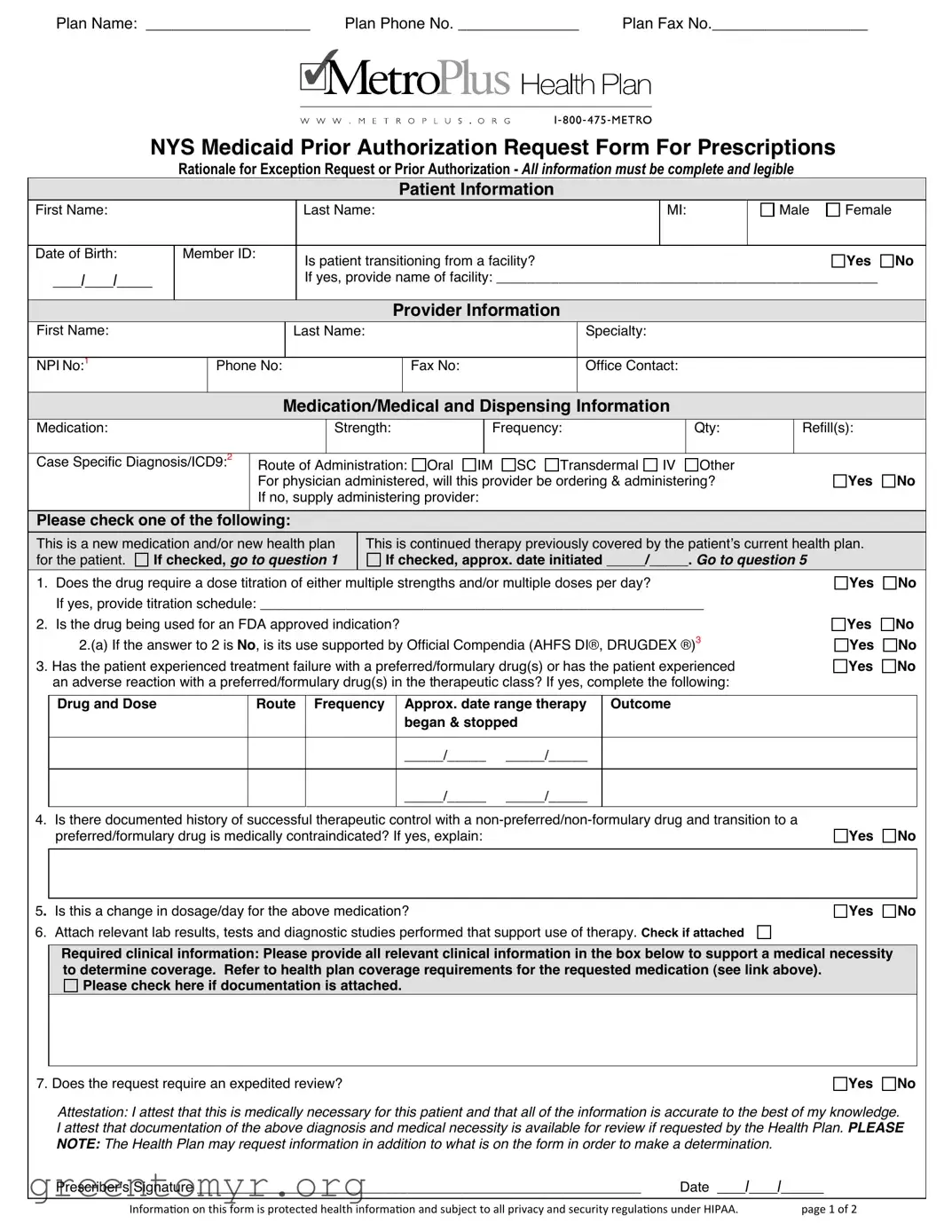
The Metroplus Health Plan form is an essential document for patients seeking prior authorization for medications under the New York State Medicaid program. This form captures vital information, including the patient's details, provider information, and specific medication requirements. It prompts the user to provide the rationale for the request, ensuring that all necessary data is complete and legible. Key sections include patient demographics, medication specifics, and clinical information to support medical necessity. The form also addresses whether the patient is transitioning from a facility and whether the medication is new or a continuation of previous therapy. Additional questions guide the provider in detailing dosage requirements, FDA approval status, and any treatment failures with preferred drugs. The prescriber must attest to the accuracy of the information provided, ensuring compliance with HIPAA regulations to protect patient privacy. This comprehensive approach helps streamline the authorization process, making it easier for patients to access the medications they need.
Plan Name: ___________________ |
Plan Phone No. ______________ |
Plan Fax No.__________________ |
NYS Medicaid Prior Authorization Request Form For Prescriptions
Rationale for Exception Request or Prior Authorization - All information must be complete and legible
Patient Information
First Name: |
|
|
|
|
|
Last Name: |
|
|
|
MI: |
Male |
Female |
|
|
|||||
|
|
|
|
|
|
|
|
|
|
|
|
|
|
|
|
|
|
|
|
Date of Birth: |
Member ID: |
|
|
Is patient transitioning from a facility? |
|
|
|
|
|
Yes |
No |
||||||||
|
|
|
|
|
|
|
|
|
|
|
|
||||||||
____/____/_____ |
|
|
|
|
|
If yes, provide name of facility: _________________________________________________ |
|
|
|||||||||||
|
|
|
|
|
|
|
|
|
|
|
|
|
|
|
|
|
|
|
|
|
|
|
|
|
|
|
|
Provider Information |
|
|
|
|
|
|
|
|
|||
|
|
|
|
|
|
|
|
|
|
|
|
|
|
|
|
|
|
||
|
First Name: |
|
|
|
|
Last Name: |
|
|
Specialty: |
|
|
|
|
|
|||||
|
|
|
|
|
|
|
|
|
|
|
|
|
|
|
|
|
|||
|
NPI No:1 |
|
Phone No: |
|
Fax No: |
Office Contact: |
|
|
|
|
|
||||||||
|
|
|
|
|
|
|
|
|
|
|
|
|
|
|
|
||||
|
|
|
|
|
|
|
|
|
|
|
|
|
|
||||||
|
|
|
|
|
Medication/Medical and Dispensing Information |
|
|
|
|
|
|||||||||
|
|
|
|
|
|
|
|
|
|
|
|
|
|
|
|
|
|
||
|
Medication: |
|
|
|
|
|
|
Strength: |
|
Frequency: |
|
|
Qty: |
|
Refill(s): |
|
|
||
|
|
|
|
|
|
|
|
|
|
|
|
||||||||
|
Case Specific Diagnosis/ICD9:2 |
Route of |
Administration: |
Oral IM SC Transdermal IV Other |
|
|
|
|
|
||||||||||
|
|
|
|
|
For physician administered, will this provider be ordering & administering? |
|
|
Yes |
No |
||||||||||
|
|
|
|
|
If no, supply administering provider: |
|
|
|
|
|
|
|
|
||||||
|
|
|
|
|
|
|
|
|
|
|
|
|
|
|
|
|
|
|
|
Please check one of the following:
This is a new medication and/or new health plan for the patient. If checked, go to question 1
This is continued therapy previously covered by the patient’s current health plan.
If checked, approx. date initiated _____/_____. Go to question 5
1.Does the drug require a dose titration of either multiple strengths and/or multiple doses per day?
If yes, provide titration schedule: _________________________________________________________
2.Is the drug being used for an FDA approved indication?
2.(a) If the answer to 2 is No, is its use supported by Official Compendia (AHFS DI®, DRUGDEX ®)3
3.Has the patient experienced treatment failure with a preferred/formulary drug(s) or has the patient experienced an adverse reaction with a preferred/formulary drug(s) in the therapeutic class? If yes, complete the following:
Yes
Yes
Yes
Yes
No
No No
No
Drug and Dose
Route Frequency Approx. date range therapy began & stopped
Outcome
_____/_____ _____/_____
_____/_____ _____/_____
4.Is there documented history of successful therapeutic control with a
Yes No
5. Is this a change in dosage/day for the above medication?
6. Attach relevant lab results, tests and diagnostic studies performed that support use of therapy. Check if attached
Yes No
Required clinical information: Please provide all relevant clinical information in the box below to support a medical necessity to determine coverage. Refer to health plan coverage requirements for the requested medication (see link above).
Please check here if documentation is attached.
7. Does the request require an expedited review?
Yes No
Attestation: I attest that this is medically necessary for this patient and that all of the information is accurate to the best of my knowledge. I attest that documentation of the above diagnosis and medical necessity is available for review if requested by the Health Plan. PLEASE NOTE: The Health Plan may request information in addition to what is on the form in order to make a determination.
Prescriber’s Signature _________________________________________________________ |
Date ____/____/______ |
|
|
|
|
Informaion on this form is protected health informaion and subject to all privacy and security regulaions under HIPAA. |
page 1 of 2 |
|

Instructional Information for Prior Authorization
Upon our review of all required information, you will be contacted by the health plan.
When providing required clinical information, the following elements should be considered within the rationale to support your medical necessity request:
OHeight/Weight
OCompound ingredients
OSpecific dosage form consideration
ODrug or Other Related Allergies
Please consider providing the following information as applicable & when available:
OHealthcare Common Procedure Coding System (HCPCS) 4
OTransition of Care (contact, phone number, length of stay)
OPatient information (address, phone number)
OProvider information (address, direct electronic contact information,
This form must be signed by the prescriber but can also be completed by the prescriber or his/her authorized agent. The completed fax form and any supporting documents must be faxed to the proper health plan.
Helpful Definitions
1NPI: A national provider identifier (NPI) is a unique
2
3AHFS Drug Information® (AHFS DI®) provides
4The HCPCS is divided into two principal subsystems, referred to as level I and level II of the HCPCS:
OLevel I of the HCPCS is comprised of CPT (Current Procedural Terminology), a numeric coding system maintained by the American Medical Association (AMA). The CPT is a uniform coding system consisting of descriptive terms and identifying codes that are used primarily to identify medical services and procedures furnished by physicians and other health care professionals.
OLevel II of the HCPCS is a standardized coding system that is used primarily to identify products, supplies, and services not included in the CPT codes, such as ambulance services and durable medical equipment, prosthetics, orthotics, and supplies (DMEPOS) when used outside a physician's office. Because Medicare and other insurers cover a variety of services, supplies, and equipment that are not identified by CPT codes, the level II HCPCS codes were established for submitting claims for these items. http://www.cms.gov/Medicare/Coding/MedHCPCSGenInfo/index.html
PAGE 2
| Fact Name | Details |
|---|---|
| Plan Name | The form requires the name of the specific Metroplus Health Plan. |
| Contact Information | Providers must provide their phone and fax numbers for communication. |
| Patient Information | Key details about the patient, including name, date of birth, and member ID, are necessary. |
| Medication Details | Information about the medication, such as strength and frequency, must be included. |
| Diagnosis Code | The form requires the case-specific diagnosis code (ICD9) to support the request. |
| Expedited Review | Providers can indicate if the request requires an expedited review for urgent cases. |
| Governing Laws | This form is governed by New York State Medicaid regulations and HIPAA privacy laws. |
Filling out the Metroplus Health Plan form requires careful attention to detail. Each section of the form must be completed accurately to ensure that the necessary information is conveyed for the prior authorization request. Once the form is completed, it should be submitted via fax to the appropriate health plan for review.
The Metroplus Health Plan form is used to request prior authorization for medications and medical services. This process ensures that the requested treatment is medically necessary and meets the health plan's coverage criteria.
The form should be completed by the prescribing provider or their authorized agent. It is essential that the information provided is accurate and complete to facilitate the review process.
Patient information needed includes the patient's first and last name, middle initial, date of birth, member ID, and whether they are transitioning from a facility. If applicable, the name of the facility should also be provided.
Details regarding the medication should include its name, strength, frequency, quantity, refills, case-specific diagnosis, and route of administration. If the medication is physician-administered, indicate whether the prescribing provider will also administer it.
This section is crucial for demonstrating the medical necessity of the requested treatment. It should include relevant clinical data, such as treatment history, documented failures with preferred medications, and any lab results that support the request.
If an expedited review is necessary, it must be indicated on the form. This will alert the health plan to prioritize the request due to urgent medical needs.
Once the form and any supporting documents are submitted, the health plan will review the information. The provider will be contacted regarding the determination of the request, which may include additional information requests.
Providing incomplete or inaccurate information can lead to delays in processing the request or denial of coverage. It is vital to ensure all sections of the form are filled out clearly and legibly.
The prescriber’s signature is a declaration of the accuracy of the information provided and confirms that the treatment is medically necessary. This signature is essential for the form to be valid.
All information on the form is considered protected health information and is subject to privacy and security regulations under HIPAA. This ensures that patient data is handled with the utmost confidentiality.
Filling out the Metroplus Health Plan form can be a daunting task, and mistakes can lead to delays in receiving necessary medical services. One common error is failing to provide complete patient information. This includes not only the patient's name and date of birth but also their Member ID. Omitting any of these details can cause confusion and may result in the request being rejected.
Another frequent mistake involves neglecting to specify the medication details accurately. When indicating the medication name, strength, and dosage frequency, it is essential to ensure that all information is precise. Inaccuracies in this section can lead to misunderstandings about the treatment plan and may delay the approval process.
People often overlook the importance of checking the box that specifies whether the medication is new or a continuation of previous therapy. This distinction is crucial, as it guides the reviewer in understanding the context of the request. Failing to make this clarification can result in unnecessary complications in the approval process.
Inadequate documentation is another significant pitfall. The form requires supporting clinical information to justify the medical necessity of the requested medication. Without sufficient evidence, the health plan may not approve the request. It's vital to attach any relevant lab results or diagnostic studies that support the case.
Additionally, individuals may forget to provide the name of the facility if the patient is transitioning from one. This information is critical for continuity of care and helps the health plan understand the patient's current situation. Leaving this section blank can hinder the approval process.
Another mistake is not answering the questions about previous treatment failures or adverse reactions to preferred drugs. This section is essential for establishing the necessity of the requested medication. If the answers are incomplete or missing, it could lead to a denial of the request.
People sometimes fail to check whether documentation is attached. This oversight can lead to delays, as the health plan may require additional information to make a decision. Ensuring that all necessary documents are included can streamline the review process.
Finally, one of the most critical errors is neglecting to sign and date the form. The prescriber’s signature is not just a formality; it attests to the accuracy and necessity of the information provided. Without this signature, the form may not be considered valid, and the request could be rejected outright.
When submitting a request for prior authorization through the Metroplus Health Plan form, several other documents may also be required or beneficial for processing the request efficiently. Each of these documents serves a specific purpose in supporting the request and ensuring that all necessary information is provided.
Collectively, these documents help create a comprehensive picture of the patient's needs and the justification for the requested services or medications. Properly completing and submitting these forms can facilitate a smoother authorization process with the Metroplus Health Plan.
The Metroplus Health Plan form shares similarities with several other documents used in healthcare and insurance processes. Here are four such documents:
When filling out the Metroplus Health Plan form, it’s essential to ensure accuracy and completeness. Here are some important dos and don’ts to keep in mind:
Misconception 1: The form can be filled out by anyone.
In reality, the form must be completed by the prescriber or an authorized agent. This ensures that the information provided is accurate and meets the necessary medical standards.
Misconception 2: All required information is optional.
This is not the case. Complete and legible information is mandatory for the health plan to process the prior authorization request. Missing details can lead to delays or denials.
Misconception 3: Only the patient's information is needed.
The form requires comprehensive details, including provider information and specific medication details. This holistic approach aids in evaluating the medical necessity of the request.
Misconception 4: The health plan will automatically approve all requests.
Approval is not guaranteed. The health plan may require additional documentation beyond what is provided on the form. Each request is evaluated based on medical necessity and coverage criteria.
When filling out the Metroplus Health Plan form, there are several important points to keep in mind. Here are ten key takeaways:
Following these guidelines can help ensure a smoother process when submitting the Metroplus Health Plan form.