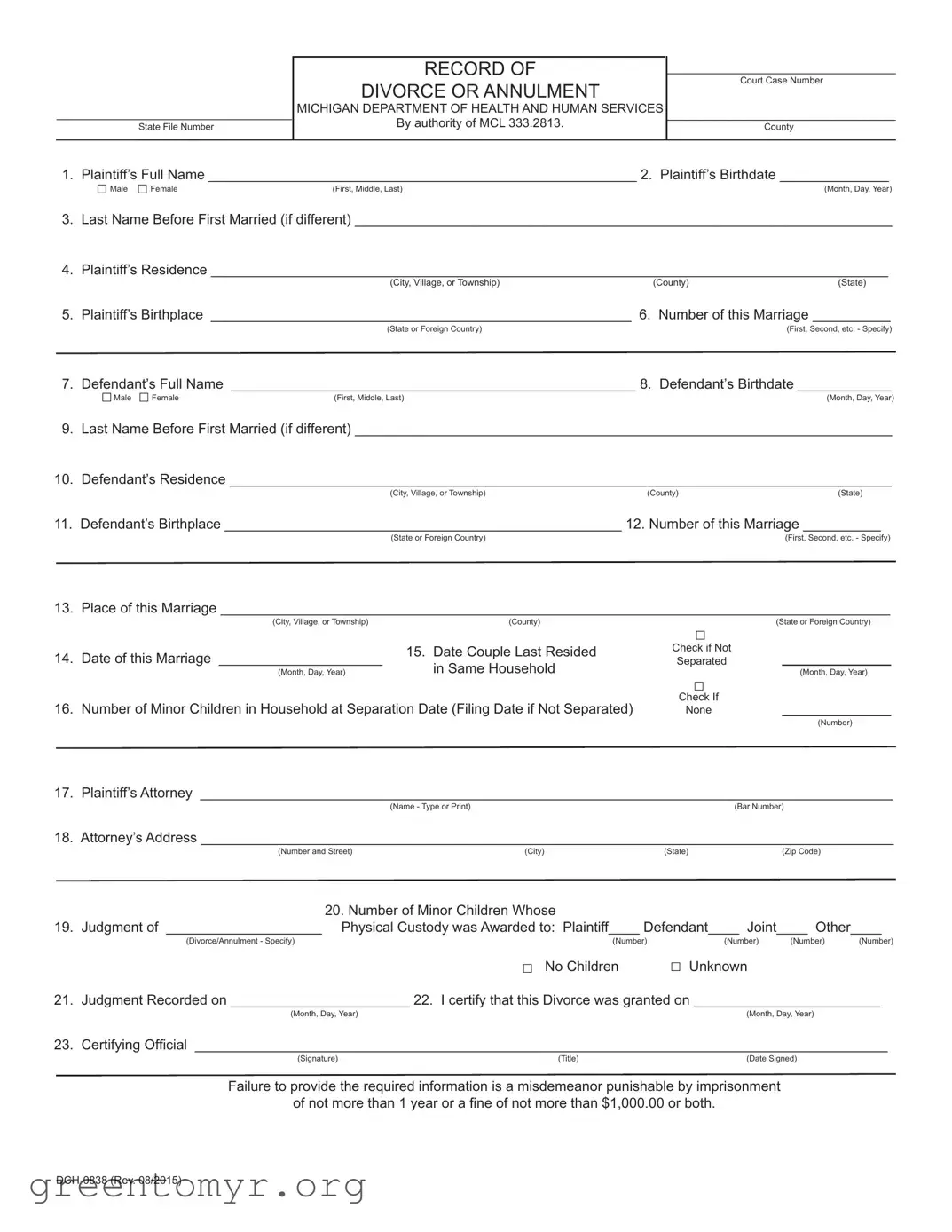
The Michigan DCH 0838 form serves as a vital document in the legal process of recording a divorce or annulment within the state. This form is utilized by the Michigan Department of Health and Human Services and is governed by the authority of the Michigan Compiled Laws. It collects essential information regarding the parties involved in the divorce, including their full names, birthdates, and residential details. The form also requires the submission of information pertaining to the marriage itself, such as the date and location of the marriage, as well as the number of the marriage in question. Additionally, it addresses the custody of minor children, if applicable, and records the details of any legal representation involved in the proceedings. The completion of this form is crucial, as it not only facilitates the official recording of the divorce or annulment but also ensures compliance with state regulations. Failure to provide the required information can result in legal penalties, underscoring the importance of accuracy and thoroughness in its completion.

__________________________________
State File Number
RECORD OF
DIVORCE OR ANNULMENT
MICHIGAN DEPARTMENT OF HEALTH AND HUMAN SERVICES
By authority of MCL 333.2813.
_________________________________
Court Case Number
_________________________________
County
1. Plaintiff’s Full Name _______________________________________________________ 2. |
Plaintiff’s Birthdate ______________ |
||||
□ |
Male |
□ |
Female |
(First, Middle, Last) |
(Month, Day, Year) |
|
|
||||
3.Last Name Before First Married (if different) _____________________________________________________________________
4.Plaintiff’s Residence _______________________________________________________________________________________
(City, Village, or Township)(County)(State)
5. |
Plaintiff’s Birthplace ______________________________________________________ 6. Number of this Marriage __________ |
|||||
|
|
|
|
|
(State or Foreign Country) |
(First, Second, etc. - Specify) |
7. |
Defendant’s Full Name ____________________________________________________ 8. Defendant’s Birthdate ____________ |
|||||
|
□ |
Male |
□ |
Female |
(First, Middle, Last) |
(Month, Day, Year) |
9.Last Name Before First Married (if different) _____________________________________________________________________
10.Defendant’s Residence _____________________________________________________________________________________
(City, Village, or Township)(County)(State)
11. Defendant’s Birthplace ___________________________________________________ 12. Number of this Marriage __________
|
|
(State or Foreign Country) |
|
(First, Second, etc. - Specify) |
||
13. |
Place of this Marriage ______________________________________________________________________________________ |
|||||
|
(City, Village, or Township) |
(County) |
□ |
(State or Foreign Country) |
||
|
|
|
|
|
||
14. |
Date of this Marriage _____________________ |
15. Date Couple Last Resided |
Check if Not |
|
|
|
Separated |
______________ |
|||||
in Same Household |
||||||
|
(Month, Day, Year) |
□ |
(Month, Day, Year) |
|||
|
|
|
|
|
||
|
|
|
Check If |
|
|
|
16. |
Number of Minor Children in Household at Separation Date (Filing Date if Not Separated) |
None |
______________ |
|||
|
|
|
|
(Number) |
|
|
17. |
Plaintiff’s Attorney _________________________________________________________________________________________ |
|||||
|
|
(Name - Type or Print) |
(Bar Number) |
|
||
18. |
Attorney’s Address _________________________________________________________________________________________ |
|||||
|
(Number and Street) |
(City) |
(State) |
(Zip Code) |
|
|
|
20. Number of Minor Children Whose |
|
|
|
||
19. |
Judgment of ____________________ Physical Custody was Awarded to: Plaintiff____ Defendant____ Joint____ Other____ |
|||||
|
(Divorce/Annulment - Specify) |
(Number) |
(Number) |
(Number) |
(Number) |
|
|
|
□ No Children |
□ Unknown |
|
|
|
21. |
Judgment Recorded on _______________________ 22. I certify that this Divorce was granted on ________________________ |
|||||
|
(Month, Day, Year) |
|
(Month, Day, Year) |
|
||
23. |
Certifying Oficial _________________________________________________________________________________________ |
|||||
|
(Signature) |
(Title) |
(Date Signed) |
|
||
Failure to provide the required information is a misdemeanor punishable by imprisonment
of not more than 1 year or a ine of not more than $1,000.00 or both.
| Fact Name | Fact Description |
|---|---|
| Form Purpose | The DCH-0838 form is used to record a divorce or annulment in Michigan. |
| Governing Law | This form is governed by Michigan Compiled Laws (MCL) 333.2813. |
| Filing Requirement | It is required to file this form with the Michigan Department of Health and Human Services. |
| Information Collected | The form collects personal information about both the plaintiff and defendant, including names and birthdates. |
| Marriage Details | It asks for details about the marriage, such as the date and place of marriage. |
| Children Information | The form includes sections to report the number of minor children involved in the divorce. |
| Attorney Information | Plaintiffs are required to provide their attorney's name and bar number, if applicable. |
| Certification | A certifying official must sign the form, confirming the divorce was granted. |
| Penalties | Failure to provide required information can result in a misdemeanor charge, including fines or imprisonment. |
| Revision Date | The current version of the DCH-0838 form was revised in August 2015. |
To complete the Michigan DCH 0838 form, individuals must provide specific personal information regarding both parties involved in the divorce or annulment. This includes details such as names, birthdates, and addresses, as well as information about the marriage itself. After gathering all necessary information, follow the steps outlined below to ensure the form is filled out accurately.
Once the form is completed, it is essential to review all entries for accuracy. After verification, submit the form to the appropriate court or agency as directed. Ensure that all required signatures are present before submission.
The Michigan DCH 0838 form is a record of divorce or annulment issued by the Michigan Department of Health and Human Services. It is used to document the details surrounding a divorce or annulment, including information about both spouses, the marriage, and any children involved.
This form is typically filled out by the plaintiff in a divorce or annulment case. It requires personal details about both spouses, such as their names, birthdates, and residences. If there are minor children involved, information regarding their custody must also be included.
The form requires a variety of information, including:
Once the form is completed, it should be submitted to the court where the divorce or annulment was filed. It is important to ensure that all required information is accurately provided to avoid any delays in processing.
Failing to provide the necessary information can lead to legal consequences. It is classified as a misdemeanor, which may result in a fine of up to $1,000 or imprisonment for up to one year, or both. Therefore, it is crucial to complete the form thoroughly.
While there may be fees associated with filing for divorce or annulment in Michigan, the form itself does not have a separate filing fee. However, it is advisable to check with the court for any applicable fees related to your specific case.
Yes, assistance is available for completing the Michigan DCH 0838 form. You can seek help from legal professionals, family law clinics, or court staff. They can provide guidance to ensure that you fill out the form correctly.
If you have further questions, consider reaching out to the Michigan Department of Health and Human Services or the court where your case is filed. They can provide additional information and clarify any uncertainties you may have regarding the form or the divorce process.
Yes, the Michigan DCH 0838 form is used for both annulments and divorces. The form allows you to specify the type of judgment being recorded, ensuring that it accurately reflects your situation.
Filling out the Michigan DCH-0838 form can be a straightforward process, but many people make common mistakes that can lead to delays or complications. One frequent error is not providing complete names. It’s essential to include the full names of both the plaintiff and defendant, including middle names. Omitting any part of a name can create confusion and may require additional documentation later on.
Another mistake often seen is incorrectly marking the gender of the parties involved. It’s important to check the appropriate box for male or female next to each person's birthdate. Failing to do so can result in processing delays, as the information may need to be verified or corrected before the form can be accepted.
People also frequently overlook the date of marriage. This is a critical piece of information that needs to be accurate. Entering the wrong date can lead to issues with legal records and could affect custody arrangements or division of assets. Always double-check the date you provide to ensure it matches official records.
Lastly, many individuals forget to sign the form or provide the necessary certifications. The certification by the official is crucial, and without it, the form will not be valid. Ensure that all signatures are in place before submitting the form to avoid any unnecessary setbacks.
The Michigan DCH 0838 form is essential for documenting a divorce or annulment in the state of Michigan. When completing this form, several other documents may also be necessary to ensure a smooth legal process. Below is a list of commonly used forms that accompany the DCH 0838.
Each of these documents plays a significant role in the divorce process. Having them prepared and filed correctly can help facilitate a more efficient resolution to the legal proceedings.
The Michigan DCH 0838 form, which records a divorce or annulment, shares similarities with several other important documents. Below is a list of ten such documents, each with a brief explanation of how they relate to the DCH 0838 form.
When filling out the Michigan DCH 0838 form, attention to detail is crucial. Here are some guidelines to help you navigate the process effectively:
Following these dos and don'ts will help ensure that your form is completed correctly and submitted without unnecessary delays.
Understanding the Michigan DCH 0838 form is crucial for anyone navigating the divorce process in Michigan. Here are seven common misconceptions about this form:
Clarifying these misconceptions can help ensure that individuals complete the Michigan DCH 0838 form accurately and understand its significance in the divorce process.
Here are some key takeaways regarding the Michigan DCH 0838 form: