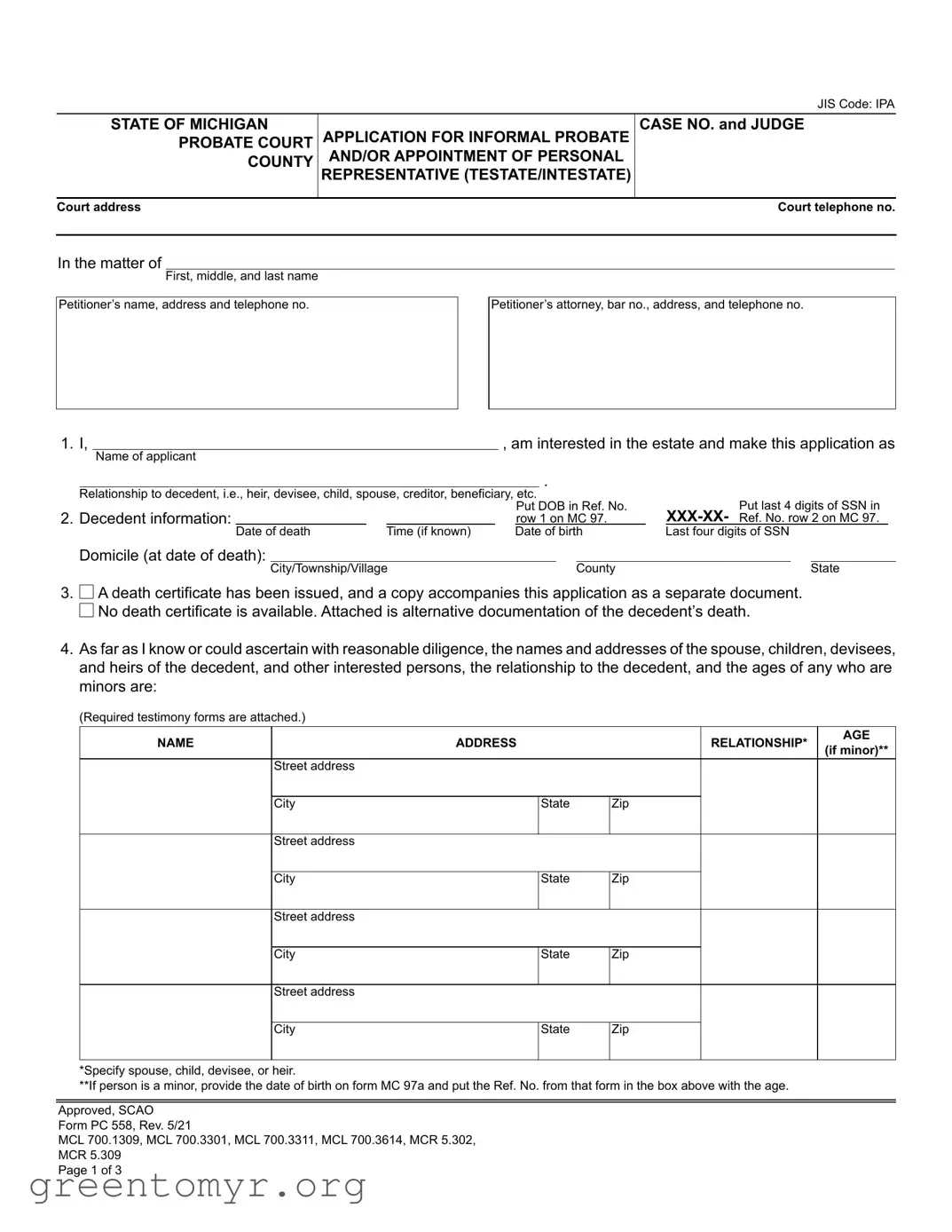
The Michigan PC 558 form plays a crucial role in the probate process, serving as a formal application for informal probate or the appointment of a personal representative. This form is essential for individuals seeking to manage the estate of a deceased person, whether the decedent left a will or died intestate. It begins by collecting the petitioner’s information, including their name, address, and relationship to the decedent, which establishes their standing in the probate process. The form also requires detailed information about the decedent, such as their date of birth, date of death, and domicile at the time of death. An accompanying death certificate or alternative documentation must be provided to validate the claim. Additionally, the form seeks to identify all interested parties, including heirs and beneficiaries, and requires information about any individuals who may have legal disabilities. Venue considerations are addressed, ensuring that the probate proceedings occur in the correct jurisdiction. The petitioner must also indicate whether there is a will and provide details about its status. Finally, the form allows the petitioner to nominate a personal representative and outlines whether bond requirements apply. Overall, the Michigan PC 558 form is a comprehensive document that facilitates the orderly management of a decedent's estate, helping to ensure that the wishes of the deceased are honored and that the estate is settled fairly and efficiently.

|
|
|
JIS Code: IPA |
|
STATE OF MICHIGAN |
APPLICATION FOR INFORMAL PROBATE |
CASE NO. and JUDGE |
|
|
|
PROBATE COURT |
|
|
|
|
COUNTY |
AND/OR APPOINTMENT OF PERSONAL |
|
|
|
|
REPRESENTATIVE (TESTATE/INTESTATE) |
|
|
|
|
|
|
|
Court address |
|
Court telephone no. |
|
|
|
|
|
|
|
|
|
|
|
|
Petitioner’s attorney, bar no., address, and telephone no.
1. |
I, |
|
|
|
|
|
|
, am interested in the estate and make this application as |
|||||||||
Name of applicant |
|
|
|
||||||||||||||
|
|
|
|
|
|
. |
|
|
|
|
|
|
|
||||
|
Relationship to decedent, i.e., heir, devisee, child, spouse, creditor, beneficiary, etc. |
|
Put last 4 digits of SSN in |
||||||||||||||
2. |
Decedent information: |
|
|
Put DOB in Ref. No. |
|
||||||||||||
row 1 on MC 97. |
|||||||||||||||||
|
|
|
Date of death |
|
Time (if known) |
|
|
Date of birth |
|
Last four digits of SSN |
|
||||||
|
Domicile (at date of death): |
|
|
|
|
|
|
|
|
|
|
|
|||||
|
City/Township/Village |
|
|
|
|
County |
|
|
State |
||||||||
3. A death certificate has been issued, and a copy accompanies this application as a separate document.
No death certificate is available. Attached is alternative documentation of the decedent’s death.
4.As far as I know or could ascertain with reasonable diligence, the names and addresses of the spouse, children, devisees, and heirs of the decedent, and other interested persons, the relationship to the decedent, and the ages of any who are minors are:
(Required testimony forms are attached.)
NAME |
|
ADDRESS |
|
RELATIONSHIP* |
AGE |
|
|
|
(if minor)** |
||||
|
|
|
|
|
|
|
|
Street address |
|
|
|
|
|
|
|
|
|
|
|
|
|
City |
|
State |
Zip |
|
|
|
|
|
|
|
|
|
|
Street address |
|
|
|
|
|
|
|
|
|
|
|
|
|
City |
|
State |
Zip |
|
|
|
|
|
|
|
|
|
|
Street address |
|
|
|
|
|
|
|
|
|
|
|
|
|
City |
|
State |
Zip |
|
|
|
|
|
|
|
|
|
|
Street address |
|
|
|
|
|
|
|
|
|
|
|
|
|
City |
|
State |
Zip |
|
|
|
|
|
|
|
|
|
*Specify spouse, child, devisee, or heir.
**If person is a minor, provide the date of birth on form MC 97a and put the Ref. No. from that form in the box above with the age.
Approved, SCAO
Form PC 558, Rev. 5/21
MCL 700.1309, MCL 700.3301, MCL 700.3311, MCL 700.3614, MCR 5.302,
MCR 5.309
Page 1 of 3

Application for Informal Probate and/or Appointment of Personal Representative (5/21) |
Case No. |
Page 2 of 3 |
|
4.(continued)
Of the interested persons listed above, the following are under legal disability or otherwise represented and presently have or will require representation:
NAME
LEGAL DISABILITY
REPRESENTED BY
Name, address, and capacity
5. a. Venue is proper in this county because the decedent was domiciled in this county on the date of death.
b. The decedent was not domiciled in Michigan, but venue is proper in this county because property of the decedent was located in this county at the date of death.
6. a. The decedent died intestate and after exercising reasonable diligence, I am unaware of any unrevoked testamentary instrument relating to property located in this state as defined under MCL 700.1301.
b. I am aware of an unrevoked testamentary instrument relating to property located in this state as defined under MCL700.1301, but the instrument is not being probated because (if this statement is true, the probate register must deny this
application according to MCL 700.3311):
The instrument is attached to this application. is already in the court’s possession.
c. The decedent’s will, dated |
|
|
, with codicil(s) dated |
|
|
, |
||
is/are offered for probate and |
is/are attached to this application. |
is/are already in the court’s |
|
|
||||
possession. |
|
|
|
|
|
|
|
|
d. An authenticated copy of the will and codicil(s), if any, probated in |
|
|
|
County, |
||||
State
is/are offered for probate, and documents establishing its probate are attached to this application.
7.To the best of my knowledge, I believe that the instrument(s) subject to this application, if any, was/were validly executed and is the decedent’s last will. After exercising reasonable diligence, I am unaware of an instrument revoking the will or codicil(s).
8. |
A personal representative has been previously appointed in |
|
County, |
|
||||||||
|
and the appointment has not been terminated. The personal |
representative’s name and address are: State |
||||||||||
|
|
|
|
|
|
|
|
|
|
|
|
|
|
Name |
|
Address |
|
|
|
||||||
|
|
|
|
|
|
|
|
|
|
|
||
|
City |
|
State |
|
Zip |
|||||||
9. |
I nominate |
|
|
as personal representative, who is qualified and has the following |
||||||||
Name |
||||||||||||
|
priority for appointment: |
|
|
|
. His/her address is: |
|
|
|
|
|||
|
|
|
|
Address |
|
|
|
|||||
|
|
|
|
|
|
|
|
|
|
. |
||
|
City |
|
State |
|
Zip |
|
||||||
10. Other persons have prior or equal right to appointment as personal representative. They are:
Name |
Name |
Name |
Name |
Suitable renunciations, nominations, and/or a Notice of Intent to Seek Informal Appointment and proof of its service have been or will be filed.

Application for Informal Probate and/or Appointment of Personal Representative (5/21) |
Case No. |
Page 3 of 3 |
|
11. The will expressly requests that the personal representative serve with bond.
12. A special personal representative is necessary because
.
I REQUEST:
13. Informal probate of the will.
14. Informal appointment of the nominated personal representative with without bond.
15. The appointment of a special personal representative pending the appointment of the nominated personal representative.
I declare under the penalties of perjury that this application has been examined by me and that its contents are true to the best of my information, knowledge, and belief.
Date |
Applicant signature |
Date |
Attorney signature |
| Fact Name | Description |
|---|---|
| Purpose of Form | The Michigan PC 558 form is used to apply for informal probate of a will or to appoint a personal representative for an estate, whether the decedent died with or without a will. |
| Governing Laws | This form is governed by several laws, including MCL 700.1309, MCL 700.3301, MCL 700.3311, and MCL 700.3614, as well as court rules MCR 5.302 and MCR 5.309. |
| Required Information | The applicant must provide details such as the decedent's name, date of birth, date of death, and the relationship to the decedent. Additional information about interested persons must also be included. |
| Death Certificate Requirement | The application requires that a death certificate is submitted, or if unavailable, alternative documentation must be provided to verify the decedent's death. |
| Venue Justification | The applicant must state the proper venue for the application, which is based on the decedent's domicile at the time of death or the location of the decedent's property. |
Filling out the Michigan PC 558 form requires careful attention to detail. This form is essential for initiating the probate process and appointing a personal representative. Ensure that all information is accurate and complete to avoid delays in processing.
The Michigan PC 558 form is an application for informal probate and/or the appointment of a personal representative. This form is typically used when a person passes away, and their estate needs to be settled. It allows interested parties, such as heirs or beneficiaries, to initiate the probate process in a straightforward manner, whether the deceased left a will (testate) or did not (intestate).
Any interested person can file the Michigan PC 558 form. This includes individuals who are heirs, devisees, children, spouses, creditors, or beneficiaries of the decedent. The applicant must provide their name, address, and relationship to the deceased on the form. It is important that the applicant has a legitimate interest in the estate.
The form requires several key pieces of information, including:
If a death certificate is not available, the applicant can provide alternative documentation to prove the decedent's death. This could include hospital records, a coroner's report, or other legal documents that confirm the death.
When a decedent dies intestate, it means they did not leave a valid will. In such cases, the estate will be distributed according to Michigan's intestacy laws, which dictate how assets are divided among surviving relatives. The PC 558 form allows the applicant to seek informal probate even if no will exists.
A personal representative is responsible for managing the decedent's estate during the probate process. This includes gathering assets, paying debts, and distributing the remaining assets to beneficiaries. The PC 558 form allows the applicant to nominate a personal representative who is qualified to handle these responsibilities.
The need for a bond depends on the specifics of the decedent's will and the applicant's request. If the will expressly states that the personal representative must serve with a bond, then it is required. If not specified, the applicant can request the personal representative to serve with or without a bond on the PC 558 form.
To ensure the application is completed correctly, it is advisable to review the form carefully and provide all necessary information. Consulting with an attorney who specializes in probate law can also be beneficial. They can offer guidance on the process and help ensure that all required documents are submitted accurately.
Filling out the Michigan PC 558 form can be a daunting task, and several common mistakes can lead to delays or complications in the probate process. One frequent error is failing to provide complete and accurate information about the decedent. This includes essential details such as the date of birth, date of death, and last four digits of the Social Security number. Omitting or incorrectly entering these details can result in the application being rejected or requiring additional documentation, which can prolong the probate proceedings.
Another mistake often encountered is neglecting to include the necessary documentation. The form requires that a death certificate be attached, or if it is unavailable, alternative documentation must be provided. If applicants overlook this requirement, the probate court may not process the application, leading to unnecessary delays. It is crucial to ensure that all supporting documents are included to facilitate a smoother review process.
Additionally, individuals sometimes misidentify the relationships of interested parties. Accurately listing the names, addresses, and relationships of the decedent's heirs, beneficiaries, and other interested persons is vital. This information must be thorough and precise, as it helps the court understand who has a stake in the estate. Mislabeling a relationship or failing to list a potential heir can create legal complications later on, potentially affecting the distribution of the estate.
Lastly, applicants may overlook the importance of understanding the venue requirements. The form stipulates that the application must be filed in the correct county based on the decedent's domicile at the time of death. If the decedent was not domiciled in Michigan but had property in the state, the application must still be filed in the county where the property is located. Misunderstanding these venue rules can lead to jurisdictional issues, further complicating the probate process. Ensuring that all these elements are correctly addressed can help streamline the application and avoid unnecessary setbacks.
When dealing with the Michigan PC 558 form, several other documents often accompany it to ensure a smooth probate process. These forms help clarify the estate's details and the roles of individuals involved. Below is a list of common forms that may be used alongside the PC 558.
Each of these forms plays a vital role in the probate process, ensuring that the decedent's wishes are honored and that all legal requirements are met. Properly completing and submitting these documents can help facilitate a smoother transition for the estate and its beneficiaries.
The Michigan PC 558 form is an important document used in the probate process. It has similarities with several other legal documents that serve related purposes. Here’s a look at four documents that share characteristics with the Michigan PC 558 form:
When filling out the Michigan PC 558 form, it is essential to follow specific guidelines to ensure accuracy and compliance. Below are four key do's and don'ts to keep in mind:
Understanding the Michigan PC 558 form is essential for anyone involved in the probate process. However, several misconceptions can lead to confusion. Here are seven common misconceptions about this form:
Clarifying these misconceptions can help individuals navigate the probate process more effectively and ensure that their applications are properly submitted.
Filling out the Michigan PC 558 form is a critical step in the probate process. Here are some key takeaways to consider: