Content Navigation

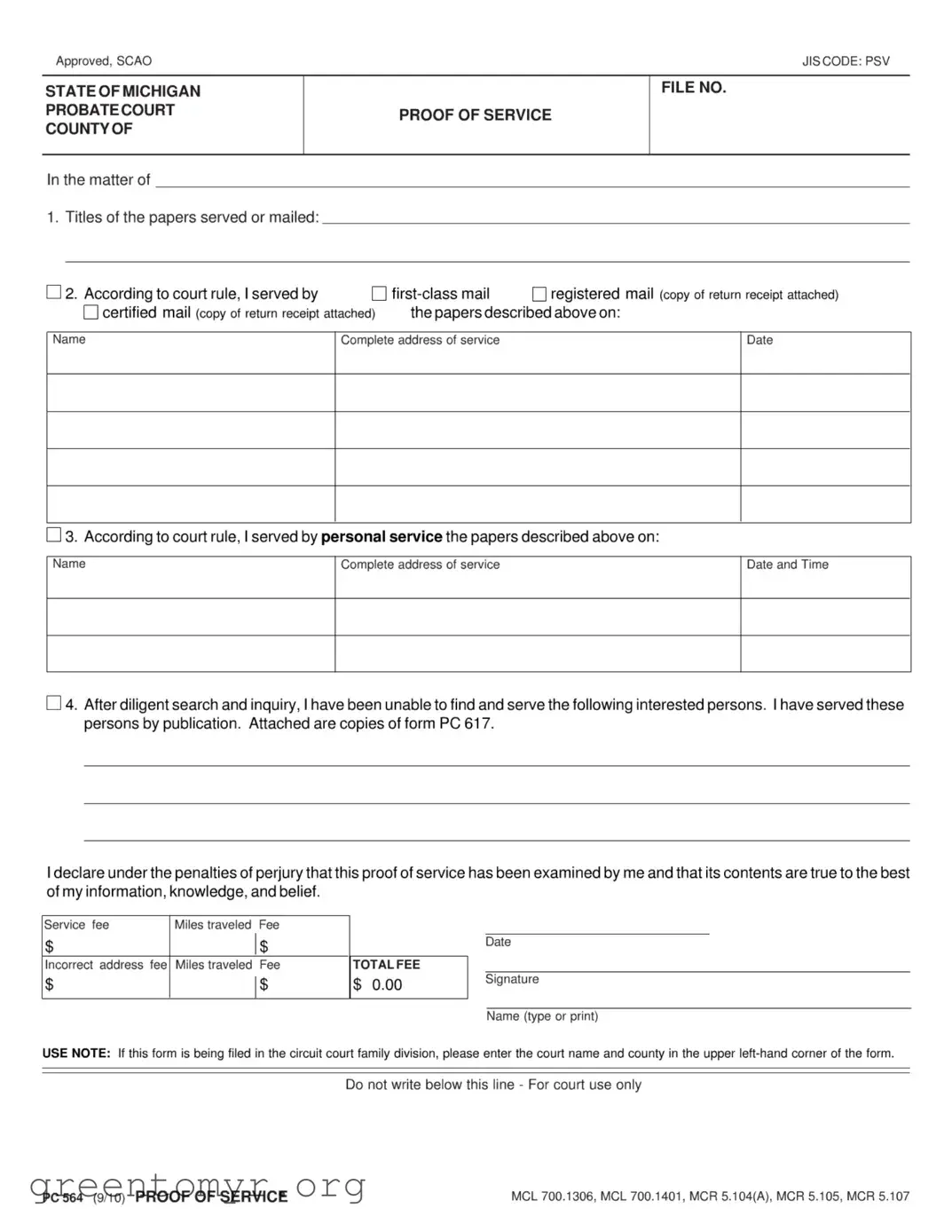
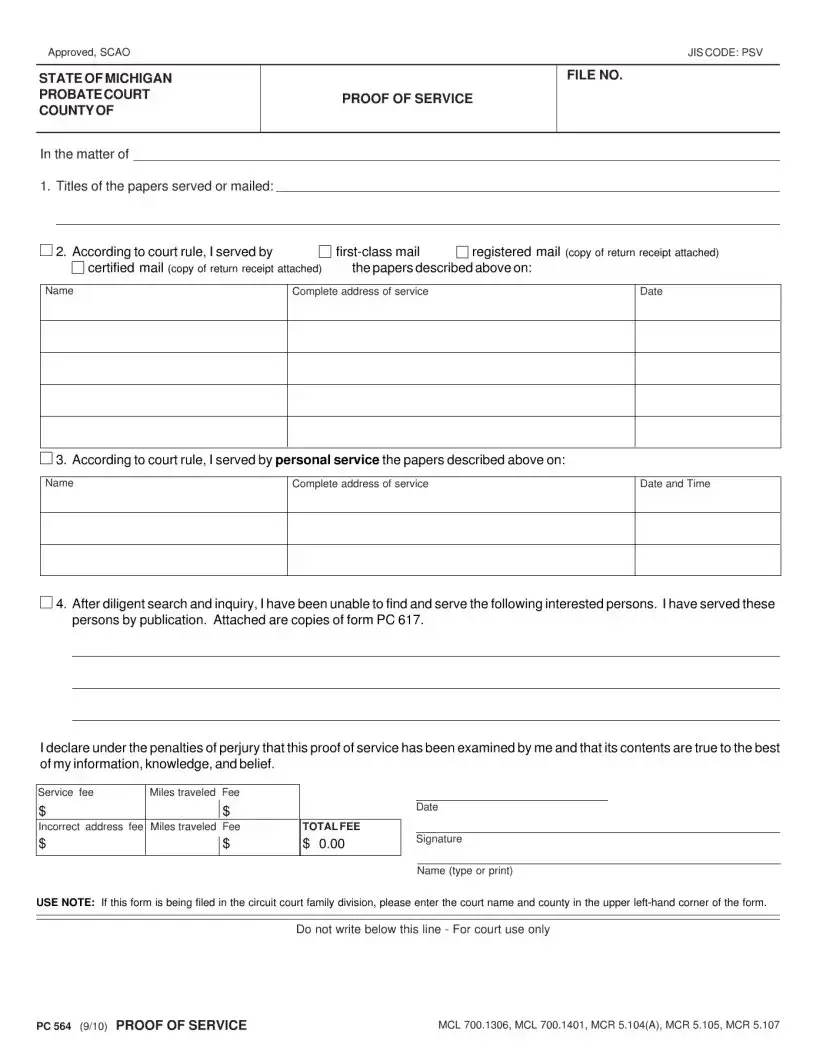
Navigating the complexities of probate can be a daunting task, especially in Michigan where specific forms and procedures must be followed. One essential document in this process is the Michigan Probate form, particularly the Proof of Service. This form plays a crucial role in ensuring that all interested parties are properly notified about the proceedings. It outlines the methods of service, which can include first-class mail, certified mail, or personal service, and requires detailed information about the individuals served, including their names and addresses. In cases where certain interested persons cannot be located, the form allows for service by publication, ensuring that the legal process can continue despite these challenges. Additionally, the form captures important logistical details, such as service fees and miles traveled, providing a comprehensive record for the court. By declaring the accuracy of the information under penalties of perjury, the individual filing the form affirms their commitment to transparency and compliance with legal standards. Understanding this form is vital for anyone involved in probate matters, as it lays the groundwork for proper legal notification and helps facilitate the overall process.
Michigan Probate Example

File Breakdown

Fact Name Description
Form Title The form is officially titled "Proof of Service" and is used in Michigan Probate Court proceedings.
Approval Status This form is approved by the State Court Administrative Office (SCAO).
Governing Laws The form is governed by Michigan Compiled Laws (MCL) 700.1306, MCL 700.1401, and Michigan Court Rules (MCR) 5.104(A), 5.105, and 5.107.
Methods of Service Service can be completed via first-class mail, registered mail, certified mail, or personal service.
Publication Requirement If interested persons cannot be found, service may be completed by publication, as indicated on the form.
Fee Disclosure The form requires disclosure of service fees, miles traveled, and total fees associated with the service.
Perjury Declaration The signer must declare under penalty of perjury that the information provided is accurate to the best of their knowledge.

Guide to Using Michigan Probate

Once you have gathered all necessary information, you can begin filling out the Michigan Probate form. This form is essential for proving that legal documents have been properly served to interested parties. Ensuring accuracy is crucial, as this form may impact the proceedings of your case.

  1. In the upper left-hand corner, enter the name of the court and the county if you are filing in the circuit court family division.
  2. In the first section, write the titles of the papers that you served or mailed.
  3. For the service method, check the appropriate box: first-class mail, registered mail, or certified mail. Attach a copy of the return receipt if applicable.
  4. Fill in the name and complete address of the person you served, along with the date of service.
  5. If you also served someone by personal service, provide their name, complete address, and the date and time of service in the next section.
  6. If you were unable to find certain interested persons after a diligent search, note that you have served them by publication. Attach copies of form PC 617 as required.
  7. List any service fees and miles traveled related to the service. Calculate the total fee and enter it in the designated area.
  8. Sign and date the form, and print your name below your signature.

After completing these steps, review the form for any errors or missing information. It is advisable to keep a copy for your records before submitting it to the court. Following the proper procedures will help ensure that your filing is accepted without unnecessary delays.

Get Answers on Michigan Probate

What is the Michigan Probate form used for?

The Michigan Probate form is primarily used to document the proof of service in probate court matters. This form ensures that all interested parties have been properly notified about proceedings related to a deceased person's estate, guardianship, or other related issues. It is a crucial step in maintaining transparency and fairness in the probate process.

Who needs to fill out the Michigan Probate form?

Anyone involved in a probate case, such as the personal representative of an estate or an attorney representing a party, must fill out this form. It is essential for those who are responsible for notifying interested persons about the proceedings, ensuring that all legal requirements for service are met.

What information is required on the form?

The form requires several key pieces of information:

  1. The titles of the papers that were served or mailed.
  2. The method of service (first-class mail, registered mail, certified mail, or personal service).
  3. The names and complete addresses of the individuals served.
  4. The date and time of service.
  5. Details about any interested persons who could not be located, along with a statement of service by publication.
  6. Any applicable service fees and miles traveled.

How do I serve documents using this form?

Documents can be served in several ways, including:

  • First-class mail
  • Registered mail
  • Certified mail
  • Personal service (hand-delivering the documents)

After serving the documents, the individual responsible must complete the form, indicating how and when the service was performed.

What should I do if I cannot locate an interested person?

If you are unable to find an interested person after making diligent efforts, you can serve them by publication. This involves publishing a notice in a local newspaper to inform the individual of the proceedings. You must attach copies of form PC 617, which is used for service by publication, to the proof of service form.

Are there any fees associated with filing this form?

Yes, there may be service fees associated with the delivery of documents, as well as fees for miles traveled if personal service was used. These fees should be documented on the form. It is important to keep track of all expenses related to the service of documents.

What happens if I make a mistake on the form?

If you make an error on the form, it is essential to correct it before filing. Inaccuracies can lead to delays in the probate process or even complications in the case. Carefully review all information for accuracy, and make any necessary corrections before submitting the form to the court.

Is this form required in all probate cases?

While the proof of service form is a standard requirement in most probate cases, specific circumstances may vary. It is advisable to consult with a legal professional or the probate court to determine if this form is necessary for your particular situation. Understanding the requirements can help ensure compliance with court rules.

Common mistakes

Filling out the Michigan Probate form can be a straightforward process, but there are common mistakes that individuals often make. One significant error occurs when people fail to provide complete and accurate information. This includes not filling in the names and addresses of all parties involved. Missing details can lead to delays or even the rejection of the form, which can complicate the probate process.

Another frequent mistake is not following the proper service method. The form requires individuals to specify how they served the documents, whether by first-class mail, certified mail, or personal service. Some individuals mistakenly check multiple boxes or fail to indicate the correct method used. This can create confusion and might necessitate additional steps to rectify the situation.

Many people also overlook the importance of the declaration section at the end of the form. This section confirms that the information provided is true and accurate. Failing to sign or date this part can result in the form being deemed incomplete. It’s crucial to ensure that this declaration is properly filled out to avoid complications.

Additionally, individuals often miscalculate the service fees. The form requires a breakdown of fees for service and travel miles. If these amounts are incorrect, it can lead to issues with the filing. Taking the time to double-check calculations can save time and prevent unnecessary problems.

Lastly, people sometimes forget to attach necessary documents, such as copies of the return receipts for mailed service or form PC 617 for publication service. Missing attachments can hinder the court’s ability to process the form, leading to delays. Always ensure that all required documents are included before submission.

Documents used along the form

When dealing with probate matters in Michigan, several forms and documents are often used alongside the Michigan Probate form. Each of these documents serves a specific purpose in the probate process, ensuring that all legal requirements are met. Below is a list of commonly used forms.

  • Petition for Probate: This document initiates the probate process. It requests the court to validate a will and appoint a personal representative to manage the estate.
  • Letters of Authority: Once the court approves the will, this document grants the personal representative the legal authority to act on behalf of the estate.
  • Inventory of Assets: This form lists all the assets owned by the deceased at the time of death. It helps the court and interested parties understand the estate's value.
  • Final Accounting: This document provides a detailed account of all financial transactions made by the personal representative during the probate process, including income and expenses related to the estate.
  • Notice to Interested Persons: This form informs all parties with a legal interest in the estate about the probate proceedings, ensuring transparency and compliance with legal requirements.
  • Claim Against Estate: Creditors can use this form to file a claim for debts owed by the deceased. It helps ensure that all legitimate claims are addressed before the estate is settled.

These documents work together to facilitate the probate process, ensuring that the deceased's wishes are honored and that the estate is settled fairly and legally. Understanding each form's role is essential for anyone navigating probate in Michigan.

Similar forms

The Michigan Probate form shares similarities with several other legal documents. Each document serves a specific purpose within the probate process or related legal proceedings. Below is a list of documents that are comparable to the Michigan Probate form, along with a brief explanation of their similarities:

  • Proof of Claim: This document is filed by a creditor to assert a claim against the estate. Like the Michigan Probate form, it requires detailed information about the claim and must be served to interested parties.
  • Notice of Hearing: This document informs interested parties of a scheduled court hearing. It parallels the Michigan Probate form in that it must be served to relevant individuals and includes proof of service.
  • Petition for Appointment of Personal Representative: This document requests the court to appoint an individual to manage the estate. Similar to the Michigan Probate form, it requires proper service to interested parties.
  • Order for Publication: This document allows for the service of notice by publication when interested parties cannot be located. It shares the goal of ensuring that all parties are informed, akin to the Michigan Probate form's proof of service.
  • Inventory of Assets: This document lists all assets of the estate. It is similar in that it must be filed with the court and may require service to interested parties for transparency.
  • Waiver of Notice: This document allows an interested party to waive their right to receive notice of proceedings. It is similar to the Michigan Probate form as it involves the acknowledgment of service and consent to proceed without formal notice.
  • Final Accounting: This document provides a detailed account of the estate's financial activities. Like the Michigan Probate form, it is submitted to the court and requires notification to interested parties regarding its contents.

Dos and Don'ts

When filling out the Michigan Probate form, it’s important to follow specific guidelines to ensure accuracy and compliance. Here’s a list of things you should and shouldn’t do:

  • Do read the entire form carefully before starting.
  • Do provide complete names and addresses for all parties involved.
  • Do use clear and legible handwriting or type the information.
  • Do double-check the dates for accuracy.
  • Do sign and date the form at the bottom.
  • Don't leave any sections blank unless instructed.
  • Don't use abbreviations or shorthand that could cause confusion.
  • Don't forget to attach any required documents, such as proof of service.
  • Don't submit the form without reviewing it for errors.
  • Don't ignore the specific court rules related to the filing process.

Misconceptions

Understanding the Michigan Probate form is essential for anyone navigating the probate process. However, several misconceptions can lead to confusion. Here are ten common misconceptions, along with clarifications to help you better understand the form.

  1. All probate cases require the same form. Many people believe that there is a one-size-fits-all probate form. In reality, the required forms can vary based on the specific circumstances of the case.
  2. Proof of service is not important. Some individuals underestimate the importance of proof of service. This document is crucial as it verifies that all interested parties were properly notified of the proceedings.
  3. You can submit the form without signatures. It is a common misconception that forms can be submitted without signatures. All necessary signatures must be present for the form to be valid.
  4. Filing fees are optional. Many believe that filing fees can be waived. However, unless you qualify for a fee waiver, these fees are generally required.
  5. Personal service is the only method of notification. Some think that personal service is the only way to notify interested parties. In fact, other methods, such as mail or publication, are also acceptable under certain conditions.
  6. You can fill out the form without legal guidance. While it's possible to fill out the form independently, many find that consulting with a legal professional can help avoid mistakes and ensure compliance with court rules.
  7. All interested persons must be located. A misconception exists that all interested parties must be found before filing. If diligent efforts to locate them fail, publication can be used as an alternative.
  8. The form is only for deceased individuals. Some people think that the probate form is exclusively for cases involving deceased individuals. However, it can also apply to guardianship and conservatorship matters.
  9. Changes to the form are not allowed. Many believe that once a form is submitted, it cannot be altered. In reality, corrections can be made, but they must be done following proper procedures.
  10. All probate cases are complicated. While some probate cases can be complex, others may be straightforward. The complexity often depends on the individual situation and the assets involved.

By addressing these misconceptions, individuals can approach the Michigan Probate form with greater confidence and clarity. Understanding the requirements and processes involved is key to navigating probate successfully.

Key takeaways

When filling out and using the Michigan Probate form, it's essential to keep a few key points in mind. Here are some takeaways to help guide you through the process:

  • Complete Information: Ensure that all fields are filled out accurately, including names, addresses, and dates. Missing information can lead to delays.
  • Service Methods: You can serve documents via first-class mail, registered mail, or certified mail. Each method has specific requirements, so choose the one that suits your needs best.
  • Personal Service: If you opt for personal service, make sure to include the date and time of service. This information is critical for the court's records.
  • Diligent Search: If you cannot locate certain interested persons, document your efforts. You may need to serve them by publication, which requires additional forms.
  • Fees: Keep track of any service fees and miles traveled. These details must be included on the form to ensure accurate reimbursement.
  • Declaration: You must declare under penalty of perjury that the information provided is true. This adds a layer of accountability to your submission.
  • Court Use: If you're filing in the circuit court family division, remember to enter the court name and county in the designated area at the top of the form.

By following these guidelines, you can navigate the Michigan Probate form with confidence and ensure that your documents are properly submitted.