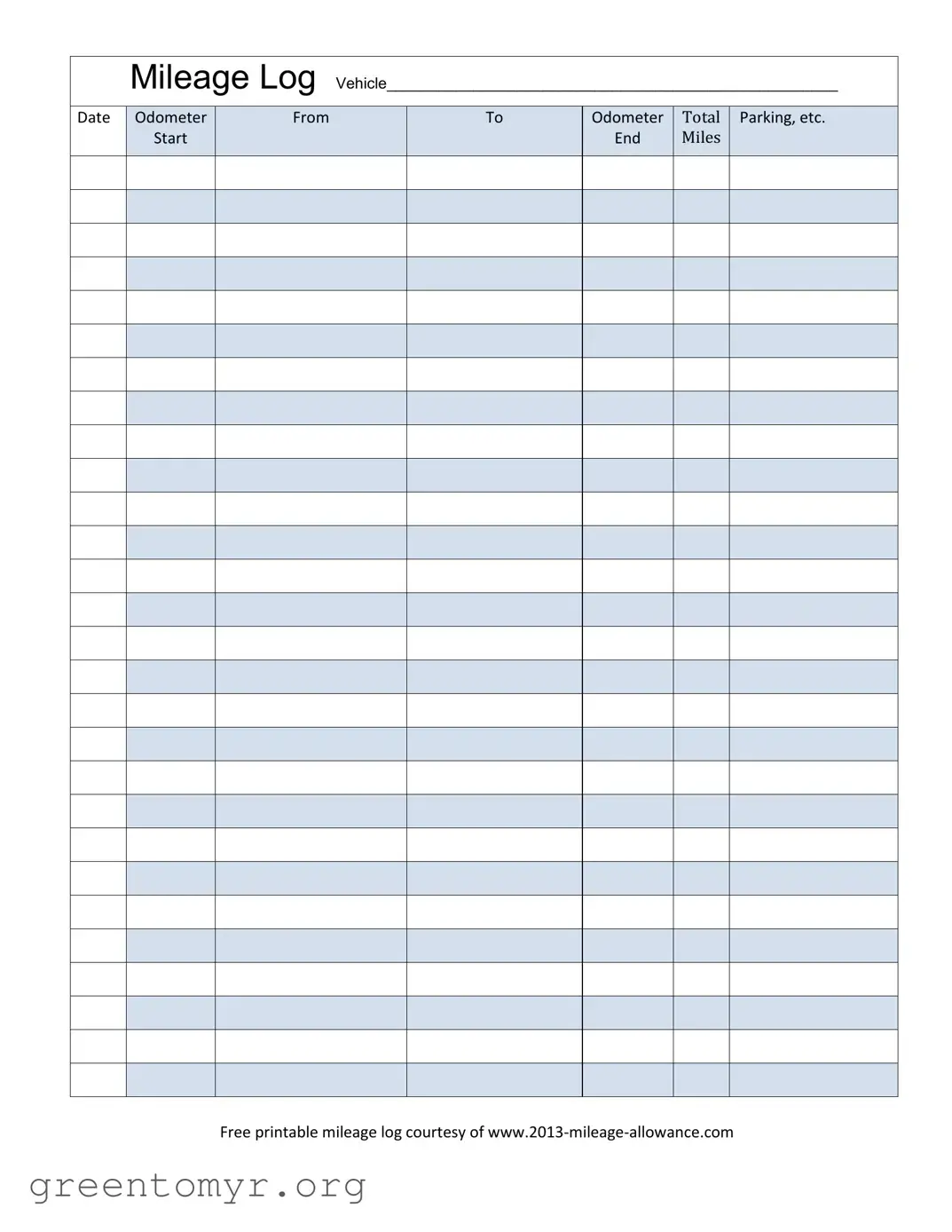
The Mileage Log form serves as an essential tool for individuals and businesses alike, facilitating the accurate tracking of vehicle usage for various purposes, including tax deductions and expense reimbursements. This form includes critical sections that capture vital information such as the vehicle's make and model, the date of each trip, and the odometer readings at both the start and end of the journey. By documenting the starting and ending points, users can calculate the total miles driven, which is crucial for financial record-keeping. Additionally, there is space allocated for noting parking fees or other related expenses incurred during the trip. With its straightforward layout, the Mileage Log form simplifies the process of maintaining detailed travel records, ensuring that users can easily refer back to their mileage history when needed. This free printable mileage log is a valuable resource for anyone looking to keep their vehicle records organized and accessible.

Mileage Log Vehicle____________________________________________________
Date
Odometer |
Start |
From
To
Odometer |
End |
TOTAL Parking, etc.
MILES
Free printable mileage log courtesy of
| Fact Name | Description |
|---|---|
| Purpose | The Mileage Log form is used to track business-related mileage for tax deductions or reimbursements. |
| Vehicle Information | Users must provide details about the vehicle used for business purposes, including make and model. |
| Date Tracking | Each entry requires the date of travel to ensure accurate record-keeping for tax purposes. |
| Odometer Readings | The form requires odometer readings at both the start and end of each trip to calculate total mileage accurately. |
| Total Miles Calculation | The form includes a section to summarize total miles driven for each trip, facilitating easier reporting. |
| State-Specific Requirements | Some states have specific laws governing mileage reimbursement, such as California's Labor Code Section 2802. |
| Free Printable Access | The Mileage Log form is often available as a free printable resource, making it accessible for users. |
After gathering the necessary information, you will be ready to fill out the Mileage Log form. Each section of the form requires specific details about your travel. Follow the steps below to ensure that you complete the form accurately.
A Mileage Log form is a document used to track the miles driven for business purposes. It typically includes sections for the vehicle used, the date of travel, the starting and ending odometer readings, and the total miles driven. Keeping an accurate log can be beneficial for tax deductions and reimbursement from employers.
Maintaining a Mileage Log is essential for several reasons:
When completing the Mileage Log form, you will need to provide the following information:
It is advisable to update your Mileage Log as soon as you complete a trip. This practice ensures that you do not forget any details. Regular updates can also help you maintain accurate records, making it easier to prepare for tax season or submit reimbursement requests.
Yes, you can use a digital Mileage Log if it suits your needs better. Many apps and software programs are available that can help you track your mileage electronically. Just ensure that the digital log captures all necessary details, including odometer readings, dates, and purposes of travel, similar to a paper log.
If you lose your Mileage Log, try to reconstruct your mileage records using any available documentation. This may include:
While it is best to keep a consistent log, having supporting documents can help substantiate your claims if you need to provide evidence of your mileage for tax or reimbursement purposes.
Filling out a Mileage Log form accurately is crucial for tracking business-related travel and ensuring proper reimbursement or tax deductions. However, many individuals make common mistakes that can lead to inaccuracies. One frequent error is failing to record the date of each trip. Without this essential information, it becomes challenging to establish the timeline of travel, which is often necessary for both tax purposes and reimbursement requests.
Another mistake is neglecting to note the starting and ending odometer readings for each trip. These figures are vital for calculating the total miles driven. Omitting them can result in an inaccurate total, which may affect financial records or tax filings. It is advisable to always double-check these numbers before submitting the log.
Some individuals also forget to include additional expenses related to the trip, such as parking fees or tolls. While the Mileage Log primarily focuses on miles driven, documenting these costs can provide a more comprehensive view of travel expenses. This information can be beneficial when seeking reimbursements or preparing tax returns.
Inconsistent or unclear recording of trip purposes is another common pitfall. Each entry should clearly state the reason for the trip, whether it is for a client meeting, a business conference, or another work-related activity. This clarity helps justify the expenses and supports the legitimacy of the mileage claims.
Additionally, some people do not keep their Mileage Log updated in real time. Waiting until the end of the month or quarter to fill it out can lead to forgotten trips or inaccuracies. Maintaining a habit of recording trips as they occur ensures that all relevant details are captured accurately.
Finally, many individuals fail to sign or date the Mileage Log upon completion. This simple step can validate the document and confirm that the information provided is accurate and complete. Neglecting to do so may raise questions during audits or reimbursement processes.
The Mileage Log form is essential for tracking vehicle usage, especially for business purposes. However, several other documents often accompany it to ensure comprehensive record-keeping and compliance. Below are some common forms and documents that work hand-in-hand with the Mileage Log.
Using these documents alongside the Mileage Log can streamline the process of tracking vehicle use and ensure that all necessary information is readily available for reimbursement or tax purposes. Staying organized with these forms can save time and reduce stress when managing travel expenses.
The Mileage Log form shares similarities with several other documents used for tracking and reporting travel-related information. Here are four documents that have comparable features:
When filling out the Mileage Log form, it's essential to be meticulous and accurate. Here are some important dos and don'ts to keep in mind:
By following these guidelines, you can ensure that your Mileage Log is accurate and complete, making the process smoother for any necessary reimbursements or tax deductions.
When it comes to using a Mileage Log form, several misconceptions can lead to confusion and errors. Understanding these misconceptions can help you accurately track your mileage and ensure compliance with tax regulations.
By clearing up these misconceptions, you can better manage your Mileage Log and ensure you are making the most of your travel records.
Using a Mileage Log form can help you keep track of your travel for business or personal purposes. Here are some key takeaways to consider when filling out and utilizing this form:
By following these guidelines, you can effectively manage your mileage documentation and ensure compliance with any relevant regulations or policies.