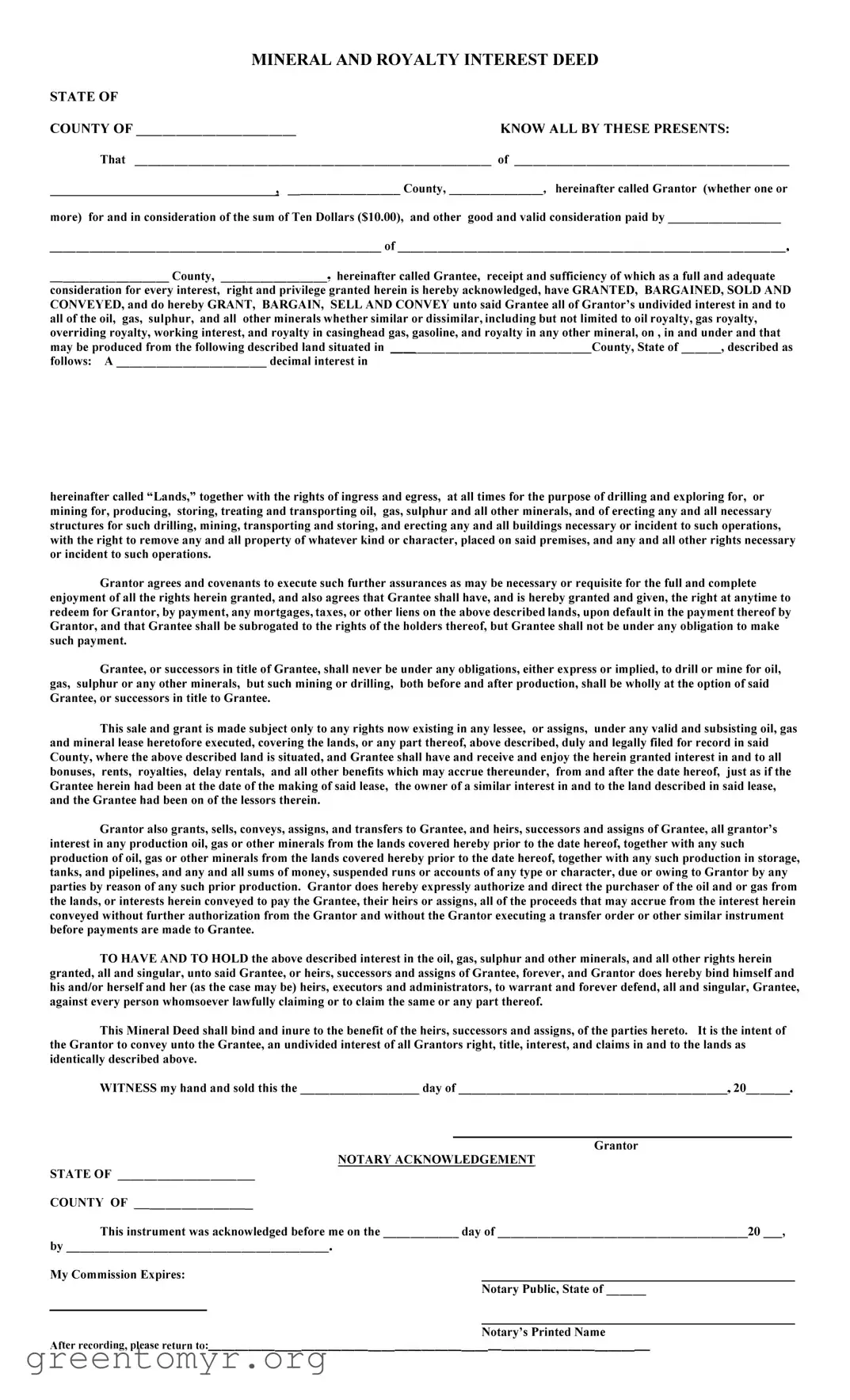
The Mineral Deed form serves as a crucial document in the transfer of mineral rights from one party to another. It outlines the terms under which a Grantor conveys their interest in minerals such as oil, gas, and sulfur, found beneath a specified piece of land. The form specifies the consideration involved, often a nominal amount, and acknowledges the Grantor's receipt of payment. It details the rights granted to the Grantee, including the ability to explore, drill, and produce minerals, along with the necessary rights of access to the land. Importantly, the Mineral Deed also addresses the obligations and rights of both parties, including the Grantor's commitment to execute further assurances if needed. Additionally, it clarifies that the Grantee is not obligated to engage in drilling or mining activities, leaving such decisions entirely at their discretion. This deed is subject to existing leases, ensuring that the Grantee can benefit from any bonuses or royalties accrued from prior agreements. The form concludes with a binding commitment from the Grantor to defend the Grantee's rights against any claims, ensuring the security of the transferred interest. Overall, the Mineral Deed form is designed to facilitate the clear and effective transfer of mineral rights, protecting the interests of both Grantor and Grantee.

MINERAL AND ROYALTY INTEREST DEED
STATE OF |
|
COUNTY OF |
KNOW ALL BY THESE PRESENTS: |
That |
of |
_________ County, _______, hereinafter called Grantor (whether one or
more) for and in consideration of the sum of Ten Dollars ($10.00), and other good and valid consideration paid by ________
_________ County,
consideration for every interest, right and privilege granted herein is hereby acknowledged, have GRANTED, BARGAINED, SOLD AND CONVEYED, and do hereby GRANT, BARGAIN, SELL AND CONVEY unto said Grantee all of Grantor's undivided interest in and to all of the oil, gas, sulphur, and all other minerals whether similar or dissimilar, including but not limited to oil royalty, gas royalty, overriding royalty, working interest, and royalty in casinghead gas, gasoline, and royalty in any other mineral, on , in and under and that may be produced from the following described land situated in ______________County, State of ___, described as
follows: A ___________ decimal interest in
hereinafter called "Lands," together with the rights of ingress and egress, at all times for the purpose of drilling and exploring for, or mining for, producing, storing, treating and transporting oil, gas, sulphur and all other minerals, and of erecting any and all necessary structures for such drilling, mining, transporting and storing, and erecting any and all buildings necessary or incident to such operations, with the right to remove any and all property of whatever kind or character, placed on said premises, and any and all other rights necessary or incident to such operations.
Grantor agrees and covenants to execute such further assurances as may be necessary or requisite for the full and complete enjoyment of all the rights herein granted, and also agrees that Grantee shall have, and is hereby granted and given, the right at anytime to redeem for Grantor, by payment, any mortgages, taxes, or other liens on the above described lands, upon default in the payment thereof by Grantor, and that Grantee shall be subrogated to the rights of the holders thereof, but Grantee shall not be under any obligation to make such payment.
Grantee, or successors in title of Grantee, shall never be under any obligations, either express or implied, to drill or mine for oil, gas, sulphur or any other minerals, but such mining or drilling, both before and after production, shall be wholly at the option of said Grantee, or successors in title to Grantee.
This sale and grant is made subject only to any rights now existing in any lessee, or assigns, under any valid and subsisting oil, gas and mineral lease heretofore executed, covering the lands, or any part thereof, above described, duly and legally filed for record in said County, where the above described land is situated, and Grantee shall have and receive and enjoy the herein granted interest in and to all bonuses, rents, royalties, delay rentals, and all other benefits which may accrue thereunder, from and after the date hereof, just as if the Grantee herein had been at the date of the making of said lease, the owner of a similar interest in and to the land described in said lease, and the Grantee had been on of the lessors therein.
Grantor also grants, sells, conveys, assigns, and transfers to Grantee, and heirs, successors and assigns of Grantee, all grantor's interest in any production oil, gas or other minerals from the lands covered hereby prior to the date hereof, together with any such production of oil, gas or other minerals from the lands covered hereby prior to the date hereof, together with any such production in storage, tanks, and pipelines, and any and all sums of money, suspended runs or accounts of any type or character, due or owing to Grantor by any parties by reason of any such prior production. Grantor does hereby expressly authorize and direct the purchaser of the oil and or gas from the lands, or interests herein conveyed to pay the Grantee, their heirs or assigns, all of the proceeds that may accrue from the interest herein conveyed without further authorization from the Grantor and without the Grantor executing a transfer order or other similar instrument before payments are made to Grantee.
TO HAVE AND TO HOLD the above described interest in the oil, gas, sulphur and other minerals, and all other rights herein granted, all and singular, unto said Grantee, or heirs, successors and assigns of Grantee, forever, and Grantor does hereby bind himself and his and/or herself and her (as the case may be) heirs, executors and administrators, to warrant and forever defend, all and singular, Grantee, against every person whomsoever lawfully claiming or to claim the same or any part thereof.
This Mineral Deed shall bind and inure to the benefit of the heirs, successors and assigns, of the parties hereto. It is the intent of the Grantor to convey unto the Grantee, an undivided interest of all Grantors right, title, interest, and claims in and to the lands as identically described above.
WITNESS my hand and sold this the ________ day of __________________� 20___
STATE OF
COUNTY OF ________
Grantor
NOTARY ACKNOWLEDGEMENT
This instrument was acknowledged before me on the ______ day of ___________________20 _,
by __________________
My Commission Expires:
Notary Public, State of ___
After recording,
please
Notary's Printed Name
return to:_________________________________
| Fact Name | Details |
|---|---|
| Definition | A Mineral Deed is a legal document used to transfer ownership of mineral rights from one party to another. |
| Consideration | The deed typically includes a nominal consideration, often as little as ten dollars, to validate the transfer. |
| Governing Law | Each state has specific laws governing mineral rights, and the deed must comply with those laws. For example, Texas law governs mineral deeds in Texas. |
| Rights Granted | The deed grants the Grantee rights to explore, drill, and produce minerals from the specified land. |
| Grantor's Obligations | The Grantor must execute any necessary documents to ensure the Grantee's enjoyment of the rights conveyed. |
| Subrogation | The Grantee may redeem any liens on the property if the Grantor defaults, allowing them to take ownership of those rights. |
| Production Rights | The Grantee is not obligated to drill or mine but has the option to do so at their discretion. |
| Notary Requirement | A notary public must acknowledge the deed to ensure its validity and enforceability. |
Filling out a Mineral Deed form is a straightforward process. This document transfers mineral rights from one party to another. After completing the form, you will need to have it notarized and then record it with the appropriate county office to ensure its legal validity.
A Mineral Deed is a legal document that transfers ownership of mineral rights from one party (the Grantor) to another (the Grantee). This deed specifically conveys rights to explore, extract, and sell minerals such as oil, gas, and sulfur from a designated piece of land. It outlines the interests being transferred and any conditions associated with that transfer.
Several essential elements make up a Mineral Deed:
The Grantee gains several rights through a Mineral Deed, including:
The Grantee is not obligated to extract minerals or conduct drilling activities. The decision to engage in such activities is entirely at the Grantee's discretion. This means that the Grantee can hold the rights without any requirement to actively pursue mineral extraction.
A Mineral Deed is subject to any existing oil, gas, or mineral leases already in place. This means that if there are active leases on the property, the Grantee will inherit the rights to any benefits, such as royalties or rents, that arise from those leases after the deed is executed. The Grantee effectively steps into the shoes of the Grantor regarding any benefits from existing agreements.
Filling out a Mineral Deed form can be a straightforward process, but there are common mistakes that individuals often make. One of the first errors occurs when the names of the Grantor and Grantee are not clearly stated. It is essential to ensure that the full legal names are used, as any ambiguity can lead to complications in ownership and rights.
Another frequent mistake is failing to provide the correct description of the land. The deed must include a precise description of the property involved. This includes not just the county and state, but also any specific details that uniquely identify the land. Omitting this information can create confusion and legal disputes down the line.
Many people also overlook the importance of the consideration amount. While the form mentions a nominal sum, it is crucial to specify the actual consideration paid. This detail is vital for establishing the legitimacy of the transaction and may be required for legal purposes.
In addition, individuals sometimes forget to include the date of the transaction. This date is critical as it marks the official transfer of rights. Without it, the deed may not be enforceable, leading to potential issues regarding the timing of rights and interests.
Another common error involves the signature of the Grantor. It is essential that the Grantor signs the document in the appropriate place. If the signature is missing or not executed correctly, it can invalidate the entire deed. Additionally, if there are multiple Grantors, each must sign to ensure the deed's effectiveness.
People often neglect the notary acknowledgment, which is a crucial part of the process. The form must be notarized to verify the identities of the parties involved and to ensure that the signatures are authentic. Without this step, the deed may not hold up in court.
Another mistake is not providing clear instructions for the return of the document after recording. This can lead to delays and confusion regarding who should receive the final, recorded deed. It is advisable to specify a clear address and name for return purposes.
Additionally, some individuals fail to understand the implications of granting rights to the Grantee. The deed should clearly outline what rights are being transferred, including any limitations or conditions. Not doing so can lead to misunderstandings about what the Grantee can and cannot do with the mineral rights.
Another oversight is not considering any existing leases or agreements that may affect the mineral rights. It is important to acknowledge any prior agreements that could impact the Grantee's rights. Failing to do so can result in legal complications and disputes over ownership.
Lastly, many people do not seek legal advice when filling out the Mineral Deed form. Consulting with a professional can help avoid common pitfalls and ensure that the deed is completed correctly. This step can save time, money, and potential legal headaches in the future.
When preparing a Mineral Deed, it is often necessary to complete additional forms and documents to ensure all aspects of the transaction are properly addressed. Below is a list of commonly used documents that accompany a Mineral Deed.
These documents play a vital role in the management and transfer of mineral rights. Each serves a specific purpose and helps protect the interests of all parties involved in the transaction. Properly completing and filing these forms can facilitate a smoother process and minimize potential legal issues in the future.
The Mineral Deed form is a crucial document in the realm of real estate and mineral rights. It shares similarities with several other legal documents, each serving a specific purpose in the transfer or acknowledgment of rights related to land and resources. Below is a list of seven documents that are similar to the Mineral Deed form, along with explanations of their similarities:
Understanding these documents can provide clarity on the complexities of mineral rights and land use. Each plays a unique role in the legal landscape surrounding mineral extraction and ownership, ensuring that rights and responsibilities are clearly defined.
When filling out the Mineral Deed form, it is important to follow certain guidelines to ensure accuracy and compliance. Here are some things to do and avoid:
Understanding the Mineral Deed form is crucial for anyone involved in the transfer of mineral rights. However, several misconceptions can lead to confusion. Here are four common misunderstandings:
This is not true. A Mineral Deed only conveys rights to the minerals beneath the land, not the land itself. The surface rights and mineral rights can be owned separately.
In fact, the Grantee has no obligation to drill or mine. The decision to explore for minerals is entirely at their discretion, both before and after production.
Once a Mineral Deed is executed, the Grantor typically relinquishes all rights to future royalties from the minerals conveyed. The Grantee receives all benefits from the mineral interests.
While a Mineral Deed is a binding legal document, it can be amended or revoked under certain circumstances, typically through mutual agreement between the Grantor and Grantee.
Filling out and using a Mineral Deed form requires careful attention to detail. Here are key takeaways to keep in mind:
By following these guidelines, you can ensure that the Mineral Deed is filled out accurately and effectively. This will help protect the interests of both parties involved in the transaction.