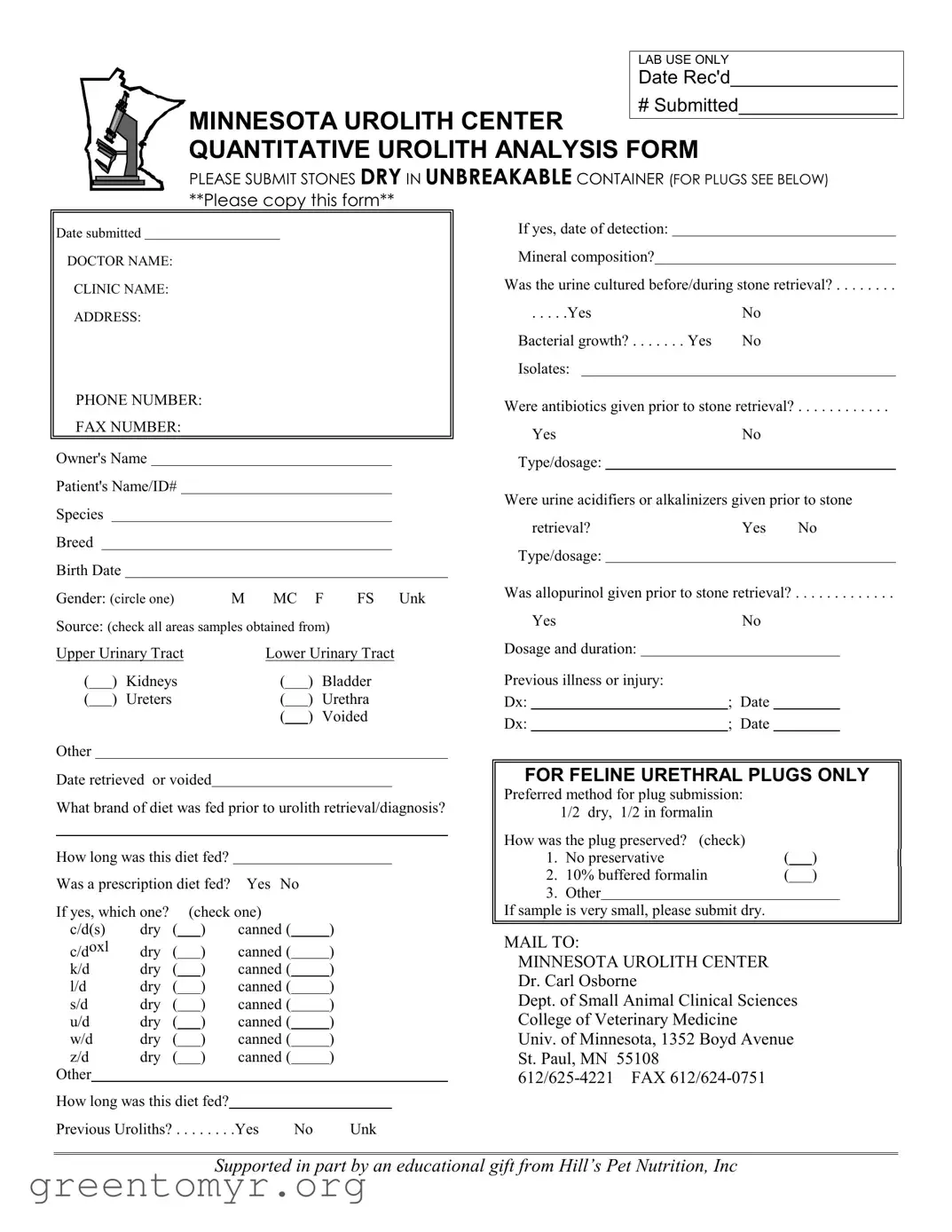
The Minnesota Urolith Center form serves as a vital tool for veterinary professionals aiming to analyze uroliths, or urinary stones, in pets. This comprehensive form is designed to collect essential information about the patient, the stones, and the circumstances surrounding their retrieval. It includes sections for the veterinarian's details, the owner's information, and specifics about the pet, such as species, breed, and medical history. The form prompts the submission of stones in a dry, unbreakable container, ensuring safe transport for accurate analysis. Additionally, it inquires about previous treatments, dietary habits, and any prior occurrences of uroliths, which can significantly influence the analysis results. There are also specific instructions for submitting feline urethral plugs, including preservation methods. By gathering this information, the Minnesota Urolith Center aims to provide a thorough quantitative mineral analysis that can guide further treatment and prevention strategies for urolith formation.
LAB USE ONLY
DATE REC'D
# SUBMITTED
MINNESOTA UROLITH CENTER QUANTITATIVE UROLITH ANALYSIS FORM
PLEASE SUBMIT STONES DRY IN UNBREAKABLE CONTAINER (FOR PLUGS SEE BELOW)
**Please copy this form**
Date submitted
DOCTOR NAME:
CLINIC NAME:
ADDRESS:
PHONE NUMBER:
FAX NUMBER:
Owner's Name
Patient's Name/ID#
Species
Breed
Birth Date
If yes, date of detection:
Mineral composition?
Was the urine cultured before/during stone retrieval? . . . . . . . .
. . . . .Yes |
No |
|
Bacterial growth? . . . . . . . Yes |
No |
|
Isolates: |
|
|
Were antibiotics given prior to stone retrieval? . . . . . . . . . . . .
YesNo
Type/dosage:
Were urine acidifiers or alkalinizers given prior to stone
retrieval?Yes No Type/dosage:
Gender: (circle one) |
M |
MC |
|
F |
FS |
Unk |
||||
Source: (check all areas samples obtained from) |
|
|
||||||||
Upper Urinary Tract |
|
Lower Urinary Tract |
|
|||||||
( |
) |
Kidneys |
|
( |
|
) |
Bladder |
|
||
|
|
|
|
|
|
|
|
|
|
|
( |
) |
Ureters |
|
( |
|
) |
Urethra |
|
||
|
|
|
|
|
( |
|
) |
Voided |
|
|
Other
Date retrieved or voided
What brand of diet was fed prior to urolith retrieval/diagnosis?
How long was this diet fed?
Was a prescription diet fed? Yes No
If yes, which one? |
|
(check one) |
|
|
|||
c/d(s) |
dry |
( |
|
) |
canned ( |
) |
|
c/doxl |
|
|
|
|
|
|
|
dry |
( |
|
) |
canned ( |
) |
||
|
|
|
|
|
|
|
|
k/d |
dry |
( |
|
) |
canned ( |
) |
|
|
|
|
|
|
|
|
|
l/d |
dry |
( |
|
) |
canned ( |
) |
|
|
|
|
|
|
|
|
|
s/d |
dry |
( |
|
) |
canned ( |
) |
|
|
|
|
|
|
|
|
|
u/d |
dry |
( |
|
) |
canned ( |
) |
|
|
|
|
|
|
|
|
|
w/d |
dry |
( |
|
) |
canned ( |
) |
|
|
|
|
|
|
|
|
|
z/d |
dry |
( |
|
) |
canned ( |
) |
|
|
|
|
|
|
|
|
|
Other
How long was this diet fed?
Previous Uroliths? . . . . . . . .Yes |
No |
Unk |
Was allopurinol given prior to stone retrieval? . . . . . . . . . . . . .
|
Yes |
|
No |
||
Dosage and duration: |
|
|
|
|
|
Previous illness or injury: |
|
|
|
||
Dx: |
|
; |
Date |
|
|
Dx: |
|
; |
Date |
|
|
FOR FELINE URETHRAL PLUGS ONLY
Preferred method for plug submission: 1/2 dry, 1/2 in formalin
How was the plug preserved? (check) |
|
|
|
||
1. |
No preservative |
( |
) |
||
|
|
|
|
|
|
2. |
10% buffered formalin |
( |
) |
||
3. |
Other |
|
|
|
|
If sample is very small, please submit dry.
MAIL TO:
MINNESOTA UROLITH CENTER
Dr. Carl Osborne
Dept. of Small Animal Clinical Sciences
College of Veterinary Medicine
Univ. of Minnesota, 1352 Boyd Avenue
St. Paul, MN 55108
Supported in part by an educational gift from Hill’s Pet Nutrition, Inc

MINNESOTA UROLITH CENTER
Hasan Albasan, DVM, MS |
• |
UNIVERSITY OF MINNESOTA |
• Carl A. Osborne, DVM, PhD |
|
Kathleen Carpenter, CVT |
• |
College of Veterinary Medicine |
• |
Laura Pederson, BS |
Thomas F. Fletcher, DVM, PhD |
• |
1352 Boyd Avenue |
• David J. Polzin, DVM, PhD |
|
Frédéric Jacob, DVM |
• |
St. Paul, MN 55108 |
• |
Sheri Ross, DVM |
Lori Koehler, CVT |
• |
Lab Phone (612) |
• |
Laurie L. Swanson, CVT |
Chalermpol Lekcharoensuk, DVM • |
Fax (612) |
• |
Lisa K. Ulrich, CVT |
|
Jody P. Lulich, DVM, PhD |
• |
|
• |
|
_______________________________________________________________________________
WHAT PREVENTATIVE MEASURES SHOULD I TAKE UNTIL I RECEIVE QUANTITATIVE MINERAL ANALYSIS RESULTS?
Urolith formation is a process that typically takes several weeks (eg. infection induced struvite), to months (eg. calcium oxalate)rather than days. The most common "cause" of rapid recurrence of uroliths is incomplete removal at the time of surgery.
Until quantitative mineral analysis on the urolith is completed, we recommend the following
steps.
1Osborne CA, Lulich JP, Unger LK: Nonsurgical retrieval of uroliths for mineral analysis. In Current Veterinary Therapy XI. pp
2Lulich JP, Osborne CA, Unger LK, et al: Nonsurgical removal of urocystoliths by voiding urohydropropulsion. In Journal of the American Veterinary Medical Association. Vol 203, pp.
Osborne CA, et al.: Canine and Feline Urolithiases: Relationship of Etiopathogenesis to Treatment and Prevention. In Canine and Feline Nephrology and Urology, Osborne and Finco 1995, pp
| Fact Name | Details |
|---|---|
| Form Purpose | This form is used for submitting urolith samples for quantitative analysis at the Minnesota Urolith Center. |
| Submission Requirements | Stones must be submitted dry and in an unbreakable container. Special instructions apply for feline urethral plugs. |
| Contact Information | Samples should be mailed to Dr. Carl Osborne at the University of Minnesota, with a contact phone number of 612-625-4221. |
| Owner and Patient Information | The form requires details such as the owner's name, patient name/ID, species, breed, and birth date. |
| Governing Laws | This form is governed by Minnesota veterinary practice regulations and applicable state laws regarding animal health. |
Filling out the Minnesota Urolith Center form is a straightforward process that requires attention to detail. Each section of the form is designed to collect specific information about the patient and the uroliths being submitted. Completing the form accurately will help ensure that the analysis is conducted smoothly and efficiently.
After completing the form, ensure that all sections are filled out clearly and accurately. Submit the form along with the urolith samples in an unbreakable container, and be sure to keep a copy for your records. Following these steps will facilitate a smooth submission process.
The Minnesota Urolith Center form is used to collect essential information about uroliths, or urinary stones, from pets. This information helps veterinarians analyze the mineral composition of the stones and understand the underlying causes. Accurate data ensures that pets receive the best possible care and treatment.
Stones should be submitted dry and placed in an unbreakable container. This prevents any damage during transport. If you are submitting plugs, follow the specific preservation methods outlined in the form. Ensure that the container is securely sealed to avoid leaks.
You will need to fill out several details, including:
Completing this information accurately is crucial for effective analysis.
If your pet has a history of uroliths, indicate this on the form. It’s also important to provide details about any treatments or dietary changes made since the last occurrence. This information helps the veterinary team assess any patterns or recurring issues.
To minimize the risk of further urolith formation, consider the following steps:
These measures can help keep your pet safe until the analysis results are available.
Once the Minnesota Urolith Center receives your submission, they will analyze the stones and provide a report detailing the mineral composition. This report will include recommendations for treatment and dietary adjustments based on the findings. Your veterinarian will then discuss these results with you to determine the best course of action for your pet.
If you have any questions regarding the Minnesota Urolith Center form or the submission process, you can contact the center directly at 612-625-4221. They can provide guidance and clarify any uncertainties you may have.
When completing the Minnesota Urolith Center form, individuals often overlook critical details that can lead to processing delays or inaccurate results. One common mistake is failing to provide complete contact information for both the veterinarian and the pet owner. Missing details, such as a phone number or fax number, can hinder communication and slow down the analysis process.
Another frequent error involves the submission of insufficient or improperly preserved samples. The form specifically requests stones to be submitted dry and in an unbreakable container. However, some individuals may send samples that are not adequately prepared, which can compromise the integrity of the analysis. Ensuring that the sample is preserved correctly is essential for accurate mineral composition results.
People also tend to neglect the importance of detailing the dietary history of the pet prior to urolith retrieval. The form asks for the brand and duration of any diet fed. Omitting this information can lead to misinterpretations of the uroliths' causes and may affect future treatment recommendations. Accurate dietary history is crucial for understanding potential contributing factors to urolith formation.
Moreover, many individuals fail to clarify whether any medications, such as antibiotics or urine acidifiers, were administered prior to stone retrieval. This omission can significantly impact the interpretation of the results. The form explicitly asks about these treatments, and providing this information can help veterinarians make informed decisions about future care.
Lastly, individuals often forget to indicate the source of the samples accurately. The form includes checkboxes for various anatomical locations from which samples may be obtained. Neglecting to check the appropriate boxes can lead to confusion and misdiagnosis. Accurate labeling of the sample source is vital for the laboratory to understand the context of the uroliths and provide appropriate recommendations.
The Minnesota Urolith Center form is essential for the analysis of urinary stones in pets. Alongside this form, several other documents may be required to ensure a comprehensive evaluation and proper treatment plan. Each of these documents serves a specific purpose in the diagnostic process.
These documents collectively enhance the diagnostic process and facilitate effective communication between pet owners and veterinary professionals. Ensuring that all necessary forms are completed accurately can significantly improve the quality of care provided to pets undergoing urolith analysis.
The Minnesota Urolith Center form serves a specific purpose in veterinary medicine, particularly concerning the analysis of urinary stones in pets. Several other documents share similarities with this form, primarily in their structure, purpose, and the type of information they collect. Below is a list of four documents that are similar to the Minnesota Urolith Center form, along with an explanation of how they relate to it.
When filling out the Minnesota Urolith Center form, there are several important guidelines to follow. Adhering to these recommendations can help ensure that the information provided is accurate and complete.
Understanding the Minnesota Urolith Center form can help pet owners and veterinarians navigate the process more effectively. However, there are several misconceptions surrounding this form that can lead to confusion. Here are five common misconceptions, along with explanations to clarify them.
This form is designed for both cats and dogs. While it may mention specific procedures for felines, such as urolith plugs, it applies to a wide range of species. Pet owners should not assume it is limited to one type of animal.
Submitting the form does not guarantee instant analysis or results. The analysis process takes time, as it involves detailed examination and testing. Pet owners should be prepared for a waiting period before receiving results.
The form specifies that stones must be submitted dry and in an unbreakable container. Using an inappropriate container could compromise the sample, leading to inaccurate analysis. It is crucial to follow these guidelines for effective testing.
On the contrary, the form emphasizes the importance of providing a complete dietary history prior to stone retrieval. Information about the type of diet fed, including any prescription diets, can significantly influence the analysis and subsequent recommendations.
The center serves a broad range of cases, not just severe ones. Even if a pet shows mild symptoms or has a history of uroliths, submitting the form can provide valuable insights for prevention and management. Early intervention can be crucial in avoiding more serious issues down the line.
When filling out and using the Minnesota Urolith Center form, consider the following key points:
By following these guidelines, you can help ensure a smooth submission process and accurate analysis of urolith samples.