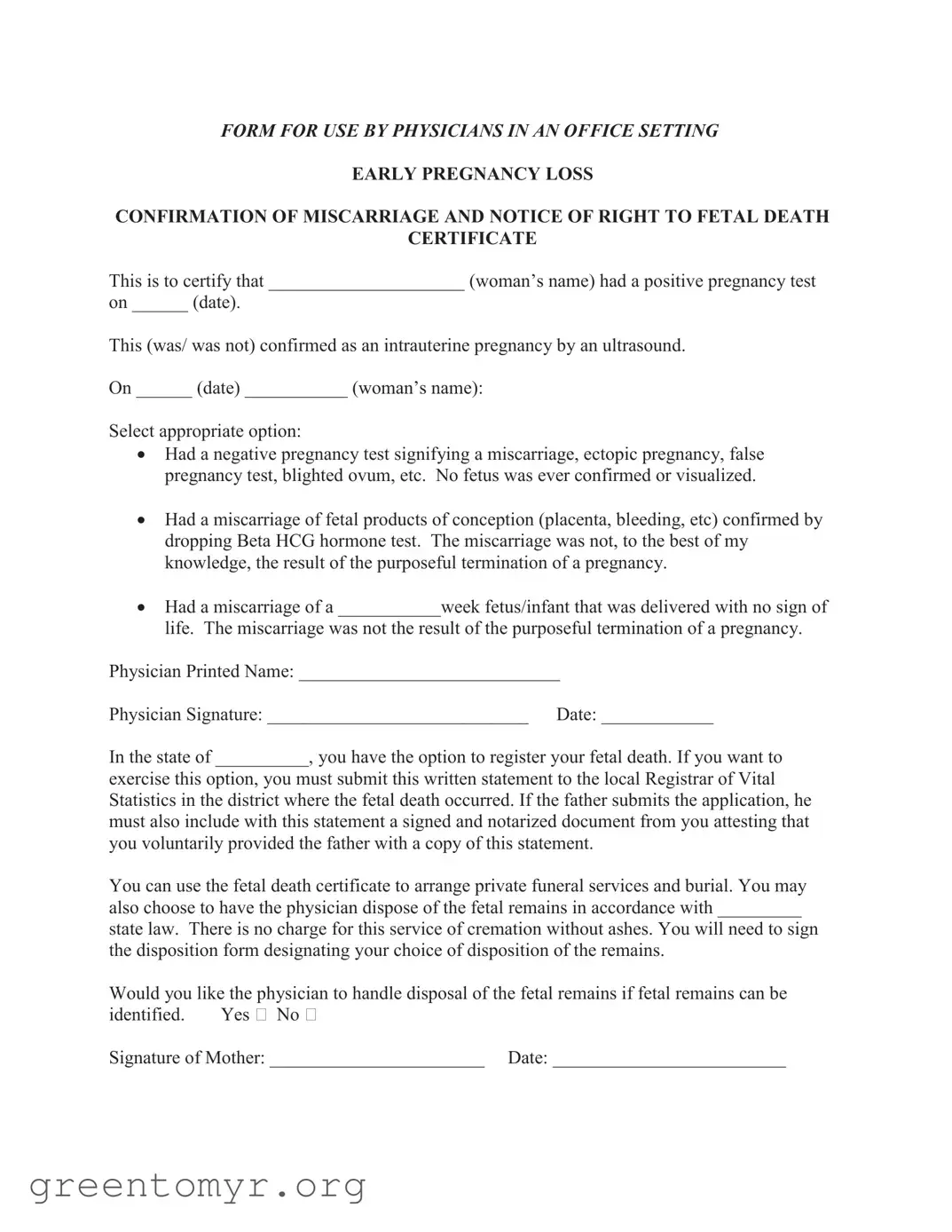
The Miscarriage Discharge Paper form serves as an essential document for women experiencing early pregnancy loss, providing both medical confirmation and important information regarding their rights. This form is utilized by physicians in an office setting to certify a woman's pregnancy status, detailing whether a positive pregnancy test was confirmed by ultrasound and outlining the circumstances surrounding the miscarriage. It includes options to indicate the nature of the pregnancy loss, such as whether it was a confirmed miscarriage, an ectopic pregnancy, or another type of early pregnancy loss. Furthermore, the form informs the mother of her right to register the fetal death with the local Registrar of Vital Statistics, should she choose to do so. In addition to facilitating the registration process, the document also addresses the handling of fetal remains, offering options for private funeral services or physician-assisted disposal in accordance with state law. Mothers are empowered to make choices regarding the disposition of remains, ensuring their preferences are respected during this sensitive time. The form concludes with spaces for the physician's signature and the mother's acknowledgment, solidifying its role as a crucial part of the care process following a miscarriage.
FORM FOR USE BY PHYSICIANS IN AN OFFICE SETTING
EARLY PREGNANCY LOSS
CONFIRMATION OF MISCARRIAGE AND NOTICE OF RIGHT TO FETAL DEATH
CERTIFICATE
This is to certify that _____________________ (woman’s name) had a positive pregnancy test
on ______ (date).
This (was/ was not) confirmed as an intrauterine pregnancy by an ultrasound.
On ______ (date) ___________ (woman’s name):
Select appropriate option:
•Had a negative pregnancy test signifying a miscarriage, ectopic pregnancy, false pregnancy test, blighted ovum, etc. No fetus was ever confirmed or visualized.
•Had a miscarriage of fetal products of conception (placenta, bleeding, etc) confirmed by dropping Beta HCG hormone test. The miscarriage was not, to the best of my knowledge, the result of the purposeful termination of a pregnancy.
•Had a miscarriage of a ___________week fetus/infant that was delivered with no sign of life. The miscarriage was not the result of the purposeful termination of a pregnancy.
Physician Printed Name: ____________________________
Physician Signature: ____________________________ Date: ____________
In the state of __________, you have the option to register your fetal death. If you want to
exercise this option, you must submit this written statement to the local Registrar of Vital Statistics in the district where the fetal death occurred. If the father submits the application, he must also include with this statement a signed and notarized document from you attesting that you voluntarily provided the father with a copy of this statement.
You can use the fetal death certificate to arrange private funeral services and burial. You may also choose to have the physician dispose of the fetal remains in accordance with _________
state law. There is no charge for this service of cremation without ashes. You will need to sign the disposition form designating your choice of disposition of the remains.
Would you like the physician to handle disposal of the fetal remains if fetal remains can be identified. Yes No
Signature of Mother: _______________________ Date: _________________________
| Fact Name | Description |
|---|---|
| Purpose | This form is used by physicians to confirm early pregnancy loss and inform the patient about their rights regarding fetal death registration. |
| Registration Option | In many states, individuals can register a fetal death. This must be done by submitting the form to the local Registrar of Vital Statistics. |
| Disposal of Remains | The form allows the mother to choose how to dispose of fetal remains. Options include burial or cremation, in accordance with state law. |
| Legal Compliance | The use of this form is governed by state laws regarding fetal death certificates and remains disposal, which vary by state. |
After completing the Miscarriage Discharge Paper form, you will need to submit it to the appropriate local authorities if you wish to register the fetal death. This step is important for legal and personal reasons, especially if you want to arrange for burial or cremation services.
The Miscarriage Discharge Paper form serves as an official document that confirms a woman's miscarriage and outlines her rights regarding the fetal death certificate. It provides important information about the pregnancy, such as the date of the positive pregnancy test and the results of any ultrasounds. This form is essential for both medical records and for any necessary legal processes that may follow a miscarriage.
When a miscarriage occurs, parents have several options for handling fetal remains. The form allows the mother to specify whether she would like the physician to manage the disposal of the remains. Here are the options typically available:
It is important for parents to consider their preferences and communicate these choices clearly on the form.
In many states, parents have the option to register a fetal death. To do so, the completed Miscarriage Discharge Paper form must be submitted to the local Registrar of Vital Statistics in the district where the fetal death occurred. If the father is submitting the application, he must also include a signed and notarized document from the mother, confirming that she has voluntarily provided him with a copy of the statement. This registration can be a significant step for parents seeking to honor their loss and obtain a formal record.
If there are any questions or uncertainties regarding the Miscarriage Discharge Paper form or the associated processes, it is advisable to reach out to the healthcare provider who issued the form. They can provide guidance on how to fill it out correctly and explain the implications of each section. Additionally, local health departments or support organizations may offer resources and support for parents navigating this difficult time.
Filling out the Miscarriage Discharge Paper form can be emotional and challenging. Many people make mistakes that can lead to delays or complications. One common error is leaving out the woman's name. This form requires the name of the individual experiencing the miscarriage. Without it, the document is incomplete and may not be processed correctly.
Another mistake involves the date of the positive pregnancy test. It’s essential to fill in the correct date accurately. If this date is incorrect, it can create confusion regarding the timeline of events. Similarly, failing to indicate whether the pregnancy was confirmed by ultrasound can lead to complications in understanding the medical situation.
Choosing the wrong option when describing the miscarriage is another frequent error. The form provides specific choices, and selecting the incorrect one can lead to misunderstandings about the nature of the loss. It’s crucial to read each option carefully and select the one that best reflects the situation.
People often forget to include the physician's printed name and signature. These elements are vital for the form's validity. Without them, the document may not hold up in legal or medical contexts. Additionally, leaving the date of the physician's signature blank can also result in complications.
Another mistake is neglecting to complete the section about registering the fetal death. Many individuals are unaware of their options and miss this important step. Not submitting the necessary documents can mean losing the opportunity to have a formal record of the loss.
Misunderstanding the requirements for the father’s involvement is also common. If the father is submitting the application, he must include a signed and notarized document from the mother. Failing to do this can lead to delays in processing the fetal death certificate.
People sometimes overlook the section regarding the disposal of fetal remains. It’s important to indicate whether the physician should handle the disposal. Not making a choice can lead to uncertainty about what will happen to the remains.
Finally, forgetting to sign and date the form is a critical mistake. This step is essential for the document to be considered valid. Without a signature, the form is incomplete and cannot be processed.
In summary, taking the time to carefully fill out the Miscarriage Discharge Paper form is crucial. Double-checking each section can help avoid these common mistakes and ensure that the process goes smoothly.
When navigating the emotional and logistical aspects of early pregnancy loss, several forms and documents often accompany the Miscarriage Discharge Paper. These documents serve various purposes, from legal requirements to personal memorialization. Understanding each of these can provide clarity during a difficult time.
These documents collectively support parents through a challenging experience, providing necessary legal, medical, and emotional frameworks. Familiarity with these forms can help ease some of the burdens during a time of grief.
The Miscarriage Discharge Paper form serves a specific purpose in documenting early pregnancy loss. Several other documents share similarities with this form in terms of their function, structure, and the information they convey. Below is a list of ten documents that are comparable to the Miscarriage Discharge Paper form:
When filling out the Miscarriage Discharge Paper form, it is crucial to approach the task with care and attention. Here are five important dos and don'ts to keep in mind:
Completing this form accurately is vital for both emotional closure and any legal requirements. Take your time to review the information before submission.
This form can also be used for women who had a positive pregnancy test but did not have a confirmed intrauterine pregnancy. It covers various scenarios, including ectopic pregnancies and false positives.
Filing this form is not a legal requirement for every miscarriage. It serves as documentation for medical purposes and to facilitate the option of registering a fetal death if desired.
While the form allows for the option to register a fetal death, it does not automatically guarantee that a certificate will be issued. Registration must be completed with the local Registrar of Vital Statistics.
The mother or father has the option to arrange private funeral services. The physician can assist with disposal of remains if requested, but it is not their responsibility to handle all funeral arrangements.
The form states that there is no charge for cremation without ashes. This service is provided at no cost, making it accessible for those who choose this option.
The father can submit the application for fetal death registration. However, he must include a notarized document from the mother confirming that she provided him with a copy of the statement.
Filling out the Miscarriage Discharge Paper form is an important step in the process of confirming a miscarriage and understanding your options. Here are key takeaways to consider:
Understanding these points can help you navigate this difficult time with clarity and support.