Content Navigation

The Mississippi Deed form serves as a crucial document in the realm of property transactions, facilitating the transfer of real estate ownership from one party to another. This form encompasses essential details, including the names of the grantor and grantee, the legal description of the property, and the consideration amount, which represents the value exchanged for the property. Additionally, it may include any relevant covenants or warranties that provide assurances regarding the title's validity. Understanding the various types of deeds—such as warranty deeds, quitclaim deeds, and special warranty deeds—is vital, as each serves a different purpose and offers varying levels of protection to the buyer. Accurate completion of the form is paramount, as errors can lead to disputes or complications in ownership rights. Furthermore, the deed must be properly executed, typically requiring signatures and notarization to ensure its legal standing. By grasping the intricacies of the Mississippi Deed form, individuals can navigate the property transfer process with confidence and clarity.

Mississippi Deed Example

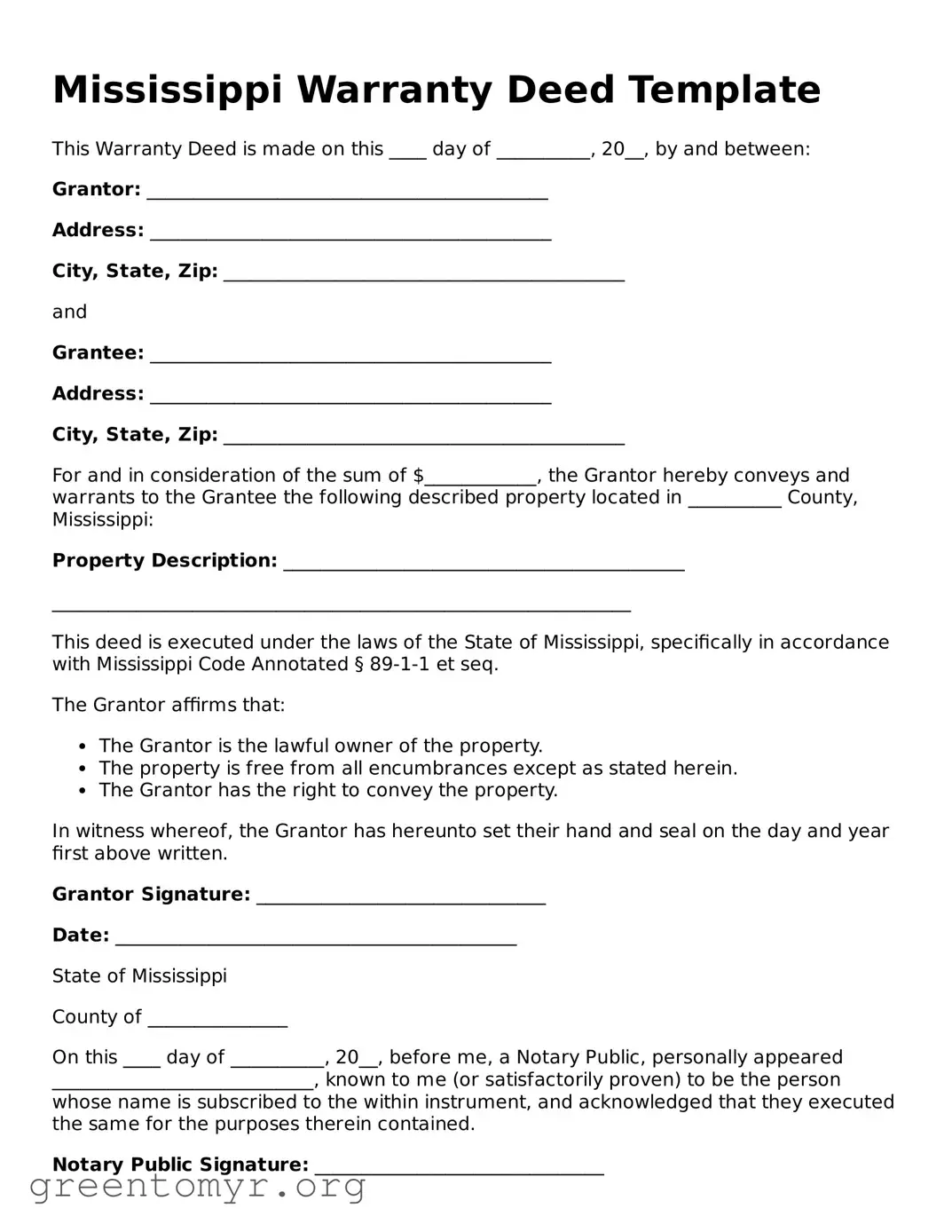
Mississippi Warranty Deed Template

This Warranty Deed is made on this ____ day of __________, 20__, by and between:

Grantor: ___________________________________________

Address: ___________________________________________

City, State, Zip: ___________________________________________

and

Grantee: ___________________________________________

Address: ___________________________________________

City, State, Zip: ___________________________________________

For and in consideration of the sum of $____________, the Grantor hereby conveys and warrants to the Grantee the following described property located in __________ County, Mississippi:

Property Description: ___________________________________________

______________________________________________________________

This deed is executed under the laws of the State of Mississippi, specifically in accordance with Mississippi Code Annotated § 89-1-1 et seq.

The Grantor affirms that:

  • The Grantor is the lawful owner of the property.
  • The property is free from all encumbrances except as stated herein.
  • The Grantor has the right to convey the property.

In witness whereof, the Grantor has hereunto set their hand and seal on the day and year first above written.

Grantor Signature: _______________________________

Date: ___________________________________________

State of Mississippi

County of _______________

On this ____ day of __________, 20__, before me, a Notary Public, personally appeared ____________________________, known to me (or satisfactorily proven) to be the person whose name is subscribed to the within instrument, and acknowledged that they executed the same for the purposes therein contained.

Notary Public Signature: _______________________________

My Commission Expires: _______________________________

PDF Form Features

Fact Name Description
Purpose of the Deed The Mississippi Deed form is used to transfer ownership of real estate from one party to another.
Governing Law This form is governed by Mississippi state law, specifically under Title 89, Chapter 1 of the Mississippi Code.
Types of Deeds Common types of deeds in Mississippi include warranty deeds, quitclaim deeds, and special warranty deeds.
Recording Requirement To ensure legal protection, the deed must be recorded with the local county clerk's office where the property is located.

Guide to Using Mississippi Deed

After gathering the necessary information, you are ready to complete the Mississippi Deed form. Ensure that all details are accurate and clear to facilitate a smooth process.

  1. Begin by entering the date at the top of the form. This should reflect the date on which the deed is being executed.
  2. Provide the name of the grantor (the person transferring the property). Ensure the name is spelled correctly and includes any necessary titles.
  3. Next, enter the name of the grantee (the person receiving the property). Double-check the spelling and accuracy of the name.
  4. In the designated section, include the complete legal description of the property. This may involve referencing a previous deed or a survey of the property.
  5. Specify the address of the property. Include the street number, street name, city, and zip code.
  6. Fill in the consideration amount, which is the value exchanged for the property. This could be a dollar amount or a description of other forms of compensation.
  7. Sign the form in the appropriate area. The grantor must sign in the presence of a notary public.
  8. Have the deed notarized. The notary will add their signature and seal, confirming the authenticity of the signatures.
  9. Make copies of the completed deed for your records and for the grantee.
  10. Finally, file the deed with the appropriate county office to ensure it is officially recorded.

Get Answers on Mississippi Deed

What is a Mississippi Deed form?

A Mississippi Deed form is a legal document used to transfer ownership of real property from one person or entity to another. This form outlines the details of the transaction, including the names of the parties involved, a description of the property, and any conditions or restrictions related to the transfer. It serves as proof of ownership once recorded with the appropriate local government office.

What types of Deeds are available in Mississippi?

In Mississippi, there are several types of Deeds, each serving different purposes. The most common types include:

  • Warranty Deed: Provides the highest level of protection to the buyer, guaranteeing that the seller has clear title to the property.
  • Quitclaim Deed: Transfers whatever interest the seller has in the property without making any guarantees about the title.
  • Special Warranty Deed: Offers limited warranties, only covering the time the seller owned the property.

How do I complete a Mississippi Deed form?

Completing a Mississippi Deed form involves several steps:

  1. Gather necessary information, including the names of the buyer and seller, property description, and any relevant legal descriptions.
  2. Choose the appropriate type of Deed based on your needs.
  3. Fill out the form accurately, ensuring all information is correct.
  4. Sign the Deed in front of a notary public, as notarization is typically required.

Do I need to have the Deed notarized?

Yes, in Mississippi, a Deed must be notarized to be considered valid. This means that both the seller and the buyer should sign the document in the presence of a notary public. The notary will then affix their seal, confirming that the signatures are genuine.

Where do I file the Deed after it's completed?

After completing and notarizing the Deed, it should be filed with the county clerk's office in the county where the property is located. This step is crucial because it officially records the transfer of ownership and protects the buyer's rights to the property.

Are there any fees associated with filing a Deed in Mississippi?

Yes, there are typically fees associated with filing a Deed in Mississippi. These fees can vary by county, so it’s important to check with your local county clerk's office for the exact amount. Additionally, there may be transfer taxes or other costs involved in the transaction, so budgeting for these expenses is advisable.

Common mistakes

When filling out the Mississippi Deed form, people often make several common mistakes that can lead to complications down the line. One of the primary errors is failing to provide accurate property descriptions. A precise description is crucial, as it identifies the property being transferred. Omitting details or using vague language can create confusion and potential legal issues.

Another frequent mistake is neglecting to include all necessary parties. The form requires the names of both the grantor and the grantee. If either party is missing, the deed may not be valid. It's essential to double-check that all individuals involved in the transaction are listed correctly.

People sometimes overlook the importance of signatures. The Mississippi Deed form must be signed by the grantor to be legally binding. In some cases, individuals forget to sign or use a signature that does not match the name provided on the form. This inconsistency can raise questions about the authenticity of the deed.

Additionally, errors in the date can pose problems. The deed must include the date of execution. If the date is missing or incorrect, it may lead to disputes regarding the timing of the property transfer. Always verify that the date is clearly stated and accurate.

Another mistake involves the acknowledgment of the deed. In Mississippi, a notary public must acknowledge the deed to make it valid. Failing to have the document notarized can render the deed ineffective. Ensure that the notary’s signature and seal are included on the form.

Lastly, people often forget to check for compliance with local regulations. Each county may have specific requirements for filing a deed. Not adhering to these rules can result in delays or rejection of the filing. Always research local guidelines to ensure that the deed meets all necessary criteria.

Documents used along the form

When engaging in real estate transactions in Mississippi, the Deed form is just one of several important documents that may be required. Each of these forms serves a specific purpose and contributes to the overall process of transferring property ownership. Below is a list of commonly used documents that often accompany the Mississippi Deed form.

  • Title Search Report: This document outlines the history of ownership for a property, identifying any liens, encumbrances, or claims against it. A clear title is essential for a smooth transaction.
  • Purchase Agreement: A legal contract between the buyer and seller detailing the terms of the sale, including price, contingencies, and closing date. This agreement sets the foundation for the transaction.
  • Disclosure Statements: Sellers are often required to provide disclosures about the property's condition, including any known defects or issues. This ensures transparency and protects the buyer's interests.
  • Affidavit of Title: This sworn statement from the seller confirms their ownership of the property and asserts that there are no undisclosed liens or claims. It helps to reinforce the buyer's confidence in the transaction.
  • Closing Statement: Also known as the HUD-1 or Settlement Statement, this document itemizes all the financial details of the transaction, including fees, taxes, and the final amount due at closing.
  • Power of Attorney: In some cases, a seller may designate another individual to act on their behalf during the transaction. This document grants that authority and must be properly executed.
  • Mortgage Documents: If the buyer is financing the purchase, various mortgage documents will be required. These include the loan application, promissory note, and mortgage agreement, outlining the terms of the loan.

Understanding these documents can greatly enhance the efficiency and clarity of real estate transactions. Each plays a crucial role in ensuring that both parties are protected and that the transfer of property is executed smoothly.

Similar forms

The Deed form is a crucial document in various legal contexts. Below are ten documents that share similarities with the Deed form, along with brief explanations of those similarities:

  • Contract: Like a Deed, a contract is a formal agreement between parties that outlines obligations and rights.
  • Lease Agreement: This document, similar to a Deed, specifies terms for renting property, including responsibilities of both landlord and tenant.
  • Power of Attorney: A Power of Attorney grants authority to another person, much like a Deed can transfer rights or responsibilities.
  • Will: A Will, like a Deed, is a legal document that expresses the wishes of an individual regarding their assets after death.
  • Trust Agreement: This document establishes a trust, similar to a Deed, which can manage assets for beneficiaries.
  • Bill of Sale: A Bill of Sale transfers ownership of personal property, akin to how a Deed transfers real property rights.
  • Mortgage Agreement: This document secures a loan with property, reflecting the transfer of interest similar to a Deed.
  • Settlement Agreement: A Settlement Agreement resolves disputes and outlines terms, sharing the formal nature of a Deed.
  • Assignment Agreement: This document transfers rights or interests from one party to another, much like a Deed does.
  • Affidavit: An Affidavit is a sworn statement that can support the validity of claims, similar to the evidentiary nature of a Deed.

Dos and Don'ts

When filling out the Mississippi Deed form, it’s important to follow certain guidelines to ensure the process goes smoothly. Here’s a list of things to do and avoid:

  • Do provide accurate and complete information about the property, including the legal description.
  • Do include the names of all parties involved in the transaction.
  • Do ensure that the form is signed in the presence of a notary public.
  • Do check for any specific requirements that may apply to your county.
  • Do keep a copy of the completed deed for your records.
  • Don't leave any sections of the form blank unless instructed.
  • Don't use abbreviations or shorthand that may cause confusion.
  • Don't forget to pay any required fees when submitting the deed.
  • Don't rush through the process; take your time to review all entries carefully.

Misconceptions

Understanding the Mississippi Deed form is essential for anyone involved in property transactions in the state. However, several misconceptions can lead to confusion. Here’s a list of common misunderstandings:

  1. All Deeds Are the Same: Many people believe that all deeds serve the same purpose. In reality, there are different types of deeds, such as warranty deeds and quitclaim deeds, each with distinct implications for ownership and liability.
  2. A Deed Must Be Notarized to Be Valid: While notarization adds credibility, it is not always a requirement for a deed to be valid in Mississippi. Certain types of deeds may not require notarization, but recording them is still crucial.
  3. Verbal Agreements Are Sufficient: Some assume that a verbal agreement regarding property transfer is enough. However, Mississippi law requires a written deed for the transfer of real estate to be legally enforceable.
  4. Only the Seller Signs the Deed: It is a common misconception that only the seller needs to sign the deed. In fact, both parties may need to sign, depending on the type of transaction and the specific deed involved.
  5. Deeds Are Irrevocable: Many believe that once a deed is executed, it cannot be changed. In certain situations, it may be possible to amend or revoke a deed, but this typically requires legal procedures.
  6. Property Taxes Are Not Affected by Deeds: Some think that changing ownership through a deed has no impact on property taxes. However, transferring property can trigger reassessment of taxes in Mississippi.
  7. All Deeds Are Recorded: There is a misconception that all deeds must be recorded with the county. While recording is recommended for legal protection, it is not mandatory for the deed to be valid.
  8. Deeds Are Only for Selling Property: Many people think deeds are only necessary for sales transactions. However, they are also used for gifting property, transferring ownership, and other legal purposes.
  9. Understanding Deeds Is Only for Lawyers: Some individuals believe that only attorneys need to understand deeds. In truth, anyone involved in real estate transactions should have a basic understanding of how deeds work.

By clarifying these misconceptions, individuals can navigate property transactions in Mississippi with greater confidence and understanding.

Key takeaways

When filling out and using the Mississippi Deed form, consider the following key takeaways:

  • Ensure that all parties involved are clearly identified. This includes the grantor (the seller) and the grantee (the buyer). Accurate names and addresses are essential.
  • Verify that the property description is complete and precise. This should include the legal description of the property, which can often be found in previous deeds or property tax records.
  • Signatures must be properly executed. The grantor must sign the deed in the presence of a notary public to ensure its validity.
  • File the completed deed with the appropriate county office. This step is crucial for the transfer of ownership to be legally recognized.