In the realm of personal and financial planning, the Mississippi Durable Power of Attorney form stands as a crucial legal instrument that empowers individuals to appoint a trusted person to make decisions on their behalf. This document is particularly significant because it remains effective even if the individual becomes incapacitated, ensuring that their affairs can be managed without interruption. The form allows for a wide range of decisions to be delegated, covering everything from financial transactions to healthcare choices. Importantly, it provides flexibility, enabling the principal—the person granting the authority—to specify the scope of the agent's powers and to set any limitations they deem necessary. Additionally, the Mississippi Durable Power of Attorney must be executed in accordance with state laws to ensure its validity, which typically includes signing in the presence of a notary public. By understanding the intricacies of this form, individuals can better safeguard their interests and ensure that their wishes are honored in times of need.
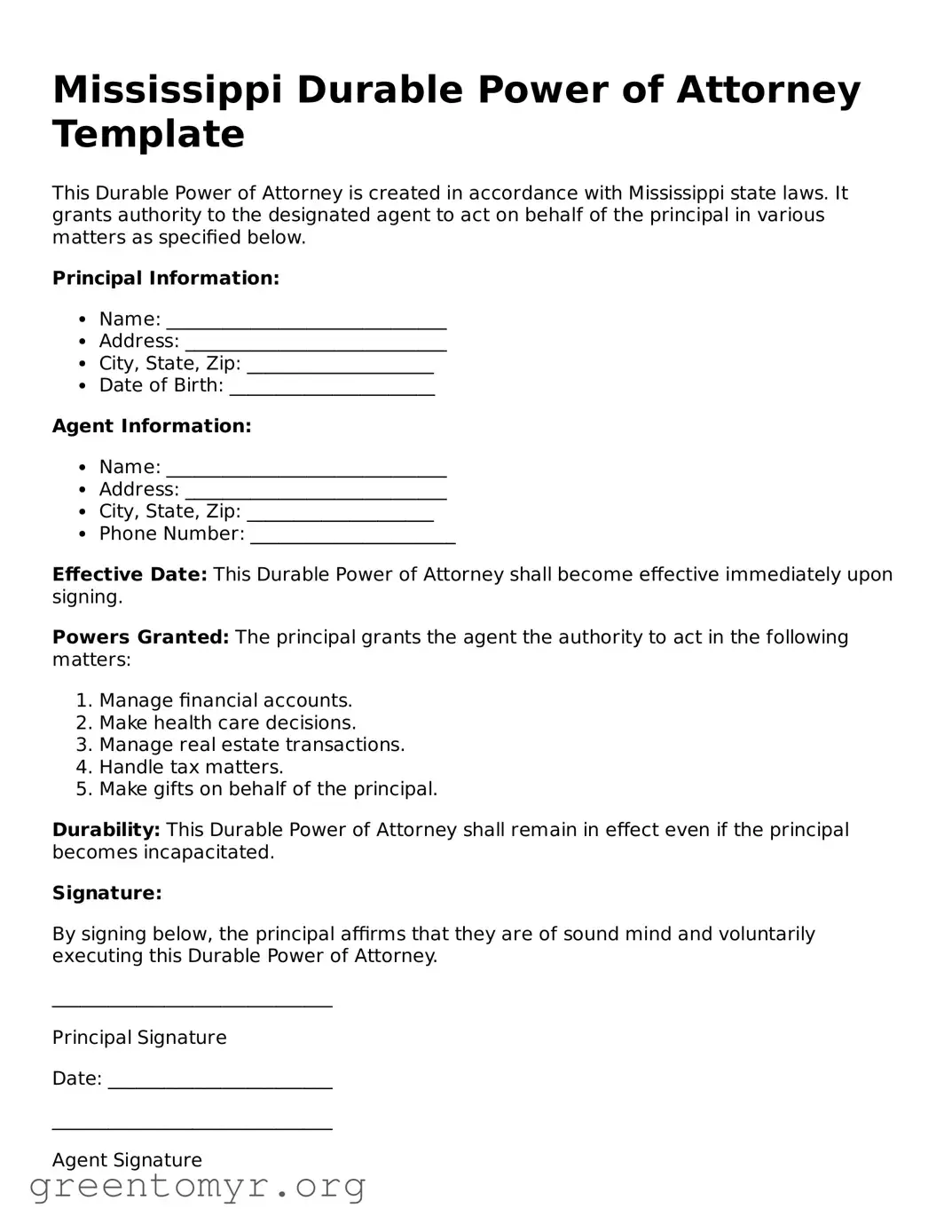
Mississippi Durable Power of Attorney Template
This Durable Power of Attorney is created in accordance with Mississippi state laws. It grants authority to the designated agent to act on behalf of the principal in various matters as specified below.
Principal Information:
Agent Information:
Effective Date: This Durable Power of Attorney shall become effective immediately upon signing.
Powers Granted: The principal grants the agent the authority to act in the following matters:
Durability: This Durable Power of Attorney shall remain in effect even if the principal becomes incapacitated.
Signature:
By signing below, the principal affirms that they are of sound mind and voluntarily executing this Durable Power of Attorney.
______________________________
Principal Signature
Date: ________________________
______________________________
Agent Signature
Date: ________________________
Witnesses:
This document must be signed in the presence of two witnesses or a notary public to be valid.
| Fact Name | Description |
|---|---|
| Definition | A Mississippi Durable Power of Attorney allows an individual to designate another person to make decisions on their behalf, even if they become incapacitated. |
| Governing Law | This form is governed by Mississippi Code Annotated § 87-3-1 through § 87-3-23. |
| Durability | The term "durable" indicates that the authority granted remains effective even if the principal becomes mentally incapacitated. |
| Principal and Agent | The person granting authority is known as the principal, while the individual receiving authority is called the agent or attorney-in-fact. |
| Scope of Authority | The agent can be given broad or limited powers, depending on the principal's wishes. This can include financial decisions, healthcare choices, and property management. |
| Signing Requirements | The document must be signed by the principal in the presence of a notary public and two witnesses to be valid. |
| Revocation | A principal can revoke the Durable Power of Attorney at any time, as long as they are mentally competent. |
| Importance of Selection | Choosing a trustworthy agent is crucial, as they will have significant control over the principal's affairs. |
Filling out the Mississippi Durable Power of Attorney form is an important step in designating someone to make decisions on your behalf. Once the form is completed, it should be signed and dated in the presence of a notary public to ensure its validity.
A Durable Power of Attorney (DPOA) is a legal document that allows you to appoint someone to make decisions on your behalf if you become unable to do so. This authority can cover financial matters, healthcare decisions, or both, depending on how the document is drafted. The key feature of a DPOA is that it remains effective even if you become incapacitated.
In Mississippi, you can appoint any competent adult as your agent. This could be a family member, friend, or a trusted advisor. It is important to choose someone who understands your wishes and can act in your best interest.
To create a DPOA in Mississippi, follow these steps:
Yes, you can revoke a Durable Power of Attorney at any time as long as you are mentally competent. To do this, you must create a written revocation document and notify your agent. It’s also a good idea to inform any institutions or individuals who may have relied on the original DPOA.
If you become incapacitated, your appointed agent can step in and make decisions on your behalf. They will have the authority to manage your financial matters or healthcare decisions, depending on the powers granted in the DPOA. This ensures that your preferences are respected even when you cannot communicate them.
A Durable Power of Attorney can be effective immediately upon signing, or it can be set to take effect only upon your incapacitation. This choice should be clearly stated in the document. If you want your agent to act right away, specify that in the DPOA.
While it is not legally required to have an attorney draft your DPOA, consulting one can help ensure that the document meets all legal requirements and accurately reflects your wishes. An attorney can also provide guidance on specific powers you may want to include.
You can grant a wide range of powers to your agent, including:
It’s important to be clear about the powers you are granting to avoid any confusion later on.
Filling out a Durable Power of Attorney (DPOA) form in Mississippi can be a straightforward process, but many individuals make common mistakes that can lead to complications later on. One frequent error is failing to clearly identify the principal, the person granting the authority. It is crucial to provide complete and accurate information, including the full legal name and address, to avoid any confusion about who is granting the powers.
Another mistake involves the selection of the agent, the individual who will act on behalf of the principal. People often choose someone without considering their ability to handle such responsibilities. It is essential to select someone trustworthy and capable of managing the financial and legal decisions that may arise.
Additionally, individuals sometimes overlook the importance of specifying the powers granted to the agent. A vague description can lead to misunderstandings or disputes about what the agent is allowed to do. Clearly outlining the scope of authority helps to ensure that the agent acts within the intended limits.
Moreover, some people neglect to date the document. A DPOA must be dated to establish when the authority begins. Without a date, questions may arise regarding the validity of the document, especially if it is ever challenged.
Another common oversight is failing to sign the form in the presence of a notary public or witnesses, as required by Mississippi law. Notarization adds a layer of authenticity and helps prevent future disputes regarding the validity of the DPOA. Without proper signatures, the document may not hold up in court.
In some cases, individuals may not consider the potential for revocation of the DPOA. It is important to include a statement about how the principal can revoke the authority at any time, should they choose to do so. This ensures that the principal retains control over their decisions.
People often forget to keep copies of the completed DPOA. After filling out the form, it is vital to provide copies to the agent, financial institutions, and healthcare providers. This ensures that all parties are aware of the arrangement and can act accordingly when needed.
Another mistake is assuming that a DPOA is a one-size-fits-all document. Each situation is unique, and individuals may need to customize the form to fit their specific needs. Failing to do so can lead to gaps in authority or unintended consequences.
Additionally, some individuals may not fully understand the implications of granting power to an agent. It is essential to recognize that this authority can be broad and may include significant financial and legal decisions. Understanding these implications can help the principal make informed choices.
Lastly, a lack of communication with the chosen agent can create confusion. It is important to discuss the responsibilities and expectations with the agent before finalizing the DPOA. Open dialogue ensures that both parties understand their roles and can work together effectively when the time comes.
When creating a Mississippi Durable Power of Attorney, there are several other forms and documents that may be beneficial to consider. These documents can help ensure that your wishes are clearly articulated and legally recognized. Below is a list of common forms that often accompany a Durable Power of Attorney.
These documents work together to create a comprehensive plan for your healthcare and financial decisions. Having them in place can provide peace of mind, knowing that your wishes will be respected and followed in various situations.
When filling out the Mississippi Durable Power of Attorney form, it is essential to follow certain guidelines to ensure the document is valid and effective. Here are six things to consider:
The Mississippi Durable Power of Attorney (DPOA) form is a crucial legal document that allows individuals to designate someone to make decisions on their behalf. However, several misconceptions surround this form that can lead to confusion. Below are nine common misconceptions, along with clarifications for each.
This is not true. Anyone can benefit from a DPOA, regardless of age. Unexpected events can occur at any time, making it essential for all adults to consider this document.
While a DPOA does allow the agent to make decisions on behalf of the principal, the powers granted can be limited to specific areas, such as financial or medical decisions, depending on the principal's wishes.
In Mississippi, a DPOA is effective immediately upon signing unless the principal specifies otherwise. This means the agent can act on the principal's behalf even when they are still capable of making their own decisions.
This is incorrect. A new DPOA does not automatically revoke an older one unless it explicitly states that it does. It is important for individuals to revoke previous documents formally if they wish to make changes.
While many people choose family members as agents, the law does not require it. Anyone over the age of 18 can be appointed, including friends or professionals, as long as they are trustworthy.
A DPOA can cover various areas, including healthcare decisions. Individuals can create separate documents for different aspects of their lives, but a single DPOA can encompass both financial and medical powers.
In Mississippi, while notarization is recommended, it is not strictly required for a DPOA to be valid. However, having it notarized can help prevent disputes regarding its authenticity.
A DPOA remains in effect until the principal revokes it, the principal passes away, or a court invalidates it. It does not have an automatic expiration date unless specified in the document.
This is false. A principal can modify or revoke a DPOA at any time, as long as they are mentally competent. Regular reviews of the document are advisable to ensure it reflects current wishes.
Understanding these misconceptions is vital for anyone considering a Durable Power of Attorney in Mississippi. Clarity on these points can aid individuals in making informed decisions about their legal and financial affairs.
When filling out and using the Mississippi Durable Power of Attorney form, consider the following key takeaways: