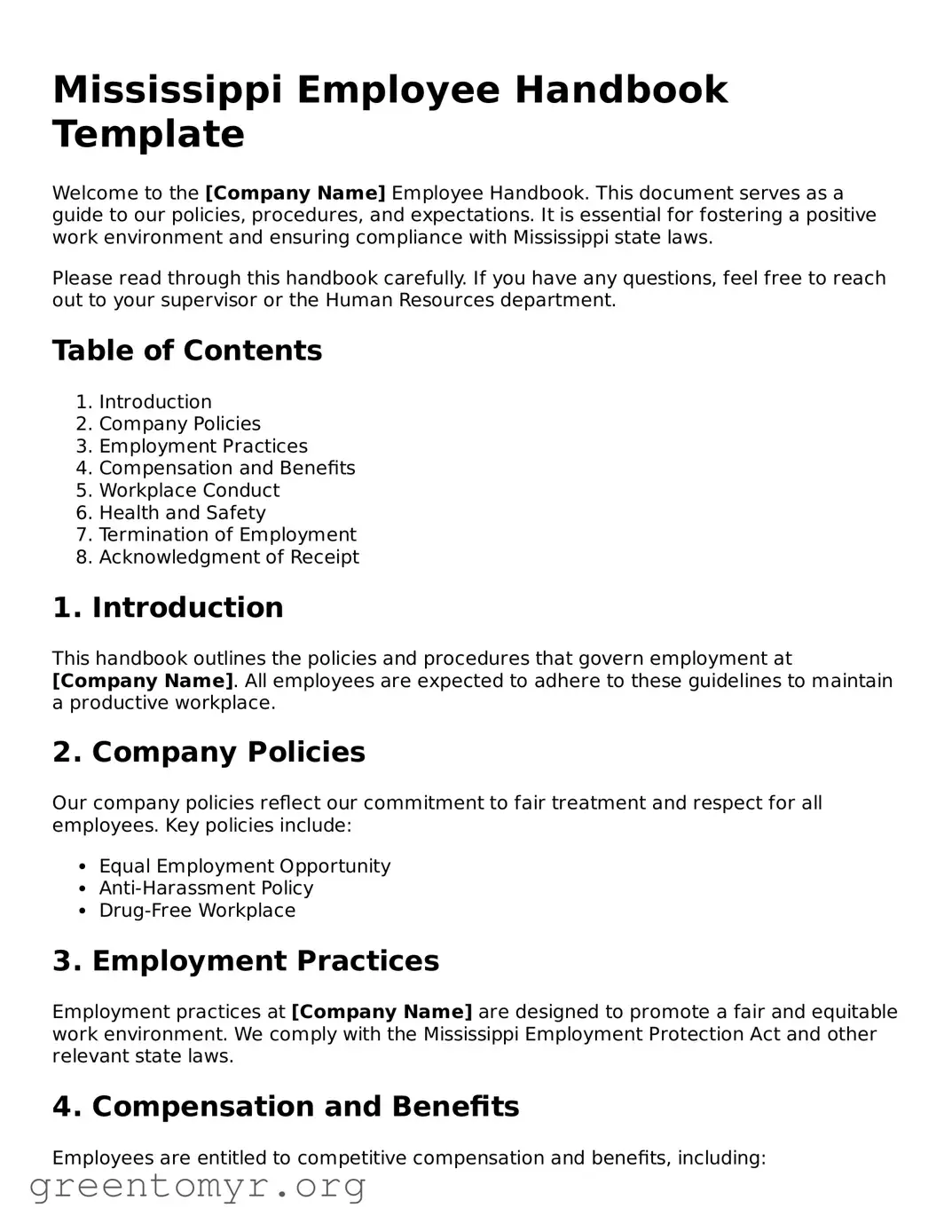
Creating a comprehensive employee handbook is essential for any business operating in Mississippi. This document serves as a vital resource for both employers and employees, outlining workplace policies, procedures, and expectations. The Mississippi Employee Handbook form typically includes sections on company culture, employee rights, and responsibilities, as well as guidelines for conduct, attendance, and performance evaluations. It often covers important legal aspects such as anti-discrimination policies, workplace safety protocols, and the process for addressing grievances. Additionally, the handbook may detail benefits, compensation structures, and leave policies, ensuring that employees are informed about their entitlements. By providing clear and accessible information, this handbook fosters a positive work environment and helps to mitigate potential misunderstandings or disputes.
Mississippi Employee Handbook Template
Welcome to the [Company Name] Employee Handbook. This document serves as a guide to our policies, procedures, and expectations. It is essential for fostering a positive work environment and ensuring compliance with Mississippi state laws.
Please read through this handbook carefully. If you have any questions, feel free to reach out to your supervisor or the Human Resources department.
Table of Contents
1. Introduction
This handbook outlines the policies and procedures that govern employment at [Company Name]. All employees are expected to adhere to these guidelines to maintain a productive workplace.
2. Company Policies
Our company policies reflect our commitment to fair treatment and respect for all employees. Key policies include:
3. Employment Practices
Employment practices at [Company Name] are designed to promote a fair and equitable work environment. We comply with the Mississippi Employment Protection Act and other relevant state laws.
4. Compensation and Benefits
Employees are entitled to competitive compensation and benefits, including:
5. Workplace Conduct
All employees are expected to maintain a professional demeanor. Our conduct policies include:
6. Health and Safety
We prioritize the health and safety of our employees. Compliance with the Mississippi Occupational Safety and Health Act is mandatory. Employees should report any unsafe conditions immediately.
7. Termination of Employment
Termination of employment can occur for various reasons, including:
8. Acknowledgment of Receipt
By signing below, you acknowledge that you have received and read the [Company Name] Employee Handbook. You agree to comply with the policies outlined herein.
Employee Name: [Employee Name]
Signature: [Employee Signature]
Date: [Date]
| Fact Name | Details |
|---|---|
| Purpose | The Mississippi Employee Handbook form serves as a guide for employees regarding company policies, procedures, and expectations. |
| Governing Laws | This form is governed by Mississippi state employment laws, including the Mississippi Employment Security Law. |
| Content Requirements | The handbook must include information on workplace policies, employee rights, and disciplinary procedures. |
| Distribution | Employers are required to provide the handbook to all employees and ensure they acknowledge receipt. |
Completing the Mississippi Employee Handbook form is an important step in ensuring that you understand your rights and responsibilities as an employee. This form will guide you through the necessary information needed to acknowledge receipt and understanding of the handbook. Follow these steps carefully to fill out the form correctly.
The Mississippi Employee Handbook form serves as a crucial document for employers in the state of Mississippi. It outlines the policies, procedures, and expectations that govern the workplace. This handbook is designed to communicate essential information to employees, ensuring they understand their rights and responsibilities within the organization. By providing clear guidelines, employers can foster a positive work environment and promote consistency in the application of workplace policies.
An Employee Handbook is important for several reasons:
Every employee should receive a copy of the Employee Handbook. This includes full-time, part-time, and temporary employees. Providing each individual with a handbook ensures that everyone has access to the same information regarding company policies and expectations. Additionally, employers may consider requiring employees to sign an acknowledgment form, confirming that they have received and understood the handbook.
Updating the Employee Handbook should occur regularly, ideally at least once a year. However, changes may be necessary sooner if there are significant shifts in company policies, employment laws, or industry standards. By reviewing and updating the handbook regularly, employers can ensure that the information remains relevant and compliant with current laws.
A comprehensive Employee Handbook should include, but is not limited to, the following sections:
Yes, an Employee Handbook can play a significant role in legal disputes. If a disagreement arises between an employee and employer, the handbook may serve as a reference point for the policies and procedures that were in place at the time. Courts often look to the handbook to determine whether the employer acted in accordance with their stated policies. Therefore, it is vital for the handbook to be clear, comprehensive, and compliant with applicable laws.
While it is not strictly necessary, having a lawyer review the Employee Handbook is highly recommended. Legal professionals can ensure that the handbook complies with state and federal laws, helping to minimize the risk of potential legal issues. A lawyer can also provide guidance on best practices and suggest modifications that align with current legal standards. This review can be an invaluable step in protecting both the employer and the employees.
Completing the Mississippi Employee Handbook form can seem straightforward, but many individuals make common mistakes that can lead to confusion or even legal issues later on. Understanding these pitfalls can help ensure that the process goes smoothly and that all necessary information is accurately recorded.
One frequent mistake is failing to read the instructions carefully. Each section of the form may have specific requirements or guidelines. Skipping over these can result in incomplete submissions or errors that could have been easily avoided. Take the time to read through the entire document before filling it out.
Another common error is not providing accurate personal information. This includes names, addresses, and contact details. Inaccuracies can lead to difficulties in communication or even affect benefits eligibility. Always double-check the information for accuracy before submitting the form.
Many individuals also neglect to update their information if it has changed since their last submission. Life events such as marriage, divorce, or relocation can impact the details needed on the form. Keeping this information current is essential for maintaining proper records and ensuring that the employer has the latest data.
Some people make the mistake of overlooking signature requirements. A signature is often necessary to validate the form. Failing to sign can result in the document being considered incomplete. Always ensure that you sign where indicated and date the form appropriately.
Additionally, many individuals do not review the form for clarity. Ambiguities in the information provided can lead to misunderstandings later. Clear and concise answers help prevent confusion and ensure that the employer understands your intentions and needs.
Another issue arises when people ignore deadlines for submission. Employers often have specific timelines for when forms must be completed and returned. Missing these deadlines can lead to delays in processing or even loss of benefits. Being aware of these timelines is crucial.
Some individuals also fail to ask questions if they are unsure about something on the form. It’s perfectly acceptable to seek clarification from an HR representative or supervisor. They can provide guidance and help ensure that the form is filled out correctly.
Another mistake is not keeping a copy of the completed form for personal records. Retaining a copy can be helpful in case there are any discrepancies or if future reference is needed. It’s always wise to have documentation of what was submitted.
Lastly, many people do not follow up after submitting the form. It’s important to confirm that the form has been received and processed. A simple check-in can provide peace of mind and ensure that everything is in order.
By being aware of these common mistakes, individuals can navigate the Mississippi Employee Handbook form with greater confidence and accuracy. Taking the time to do it right can save a lot of trouble down the road.
The Mississippi Employee Handbook serves as a crucial document that outlines company policies, procedures, and expectations for employees. In addition to this handbook, several other forms and documents are commonly utilized in the employment context. Each serves a specific purpose and helps ensure clarity and compliance within the workplace.
These documents collectively support the employee-employer relationship, ensuring that both parties understand their rights and responsibilities. Proper use of these forms can help maintain a professional and compliant workplace environment.
Company Policies Manual: Similar to an Employee Handbook, this document outlines the rules and regulations that govern employee behavior and workplace expectations. It serves as a guide for employees to understand their rights and responsibilities within the organization.
Onboarding Checklist: This document helps new employees navigate their initial days at a company. It includes essential tasks and information, ensuring that newcomers have a smooth transition, much like the introductory sections of an Employee Handbook.
Code of Conduct: This document details the ethical standards and expectations for employee behavior. Like the Employee Handbook, it aims to foster a respectful and professional workplace environment.
Job Descriptions: These documents outline the roles and responsibilities of specific positions within the company. They complement the Employee Handbook by providing clarity on what is expected from each employee.
Performance Review Guidelines: This document explains the criteria and processes for evaluating employee performance. It aligns with the Employee Handbook by establishing standards for accountability and growth within the organization.
Health and Safety Manual: This document focuses on workplace safety protocols and procedures. It parallels the Employee Handbook by ensuring that employees are informed about their rights to a safe working environment.
Leave of Absence Policy: This document outlines the procedures and eligibility for taking time off work. Similar to the Employee Handbook, it provides critical information that helps employees understand their benefits and options regarding time away from work.
When filling out the Mississippi Employee Handbook form, it's important to approach the task with care. Here’s a straightforward list of things to do and avoid:
Understanding the Mississippi Employee Handbook form is crucial for both employers and employees. However, several misconceptions often arise that can lead to confusion. Here are six common misconceptions:
In reality, while not every business is legally required to have an employee handbook, it is highly recommended. A well-crafted handbook serves as a vital tool for outlining company policies and expectations.
Employers must ensure that the policies included in the handbook comply with state and federal laws. Policies that violate employee rights can lead to legal issues.
Policies and laws can change, making it essential to review and update the handbook regularly. An outdated handbook can create confusion and may not provide adequate guidance.
Simply providing a handbook does not guarantee that employees will read or understand it. Employers should take the time to review the handbook with employees to ensure clarity.
While the handbook outlines policies, it is not a contract unless explicitly stated. Employers typically include disclaimers to clarify that the handbook is for informational purposes only.
Each employee handbook can be tailored to fit the specific needs and culture of the organization. There is no one-size-fits-all approach, allowing for creativity in presentation and content.
By addressing these misconceptions, both employers and employees can better navigate the complexities of workplace policies and expectations.
When filling out and using the Mississippi Employee Handbook form, there are several important considerations to keep in mind. These guidelines will help ensure that you create a comprehensive and effective handbook that meets both legal requirements and the needs of your employees.
By keeping these key takeaways in mind, you can create an employee handbook that not only complies with legal standards but also fosters a positive work environment.