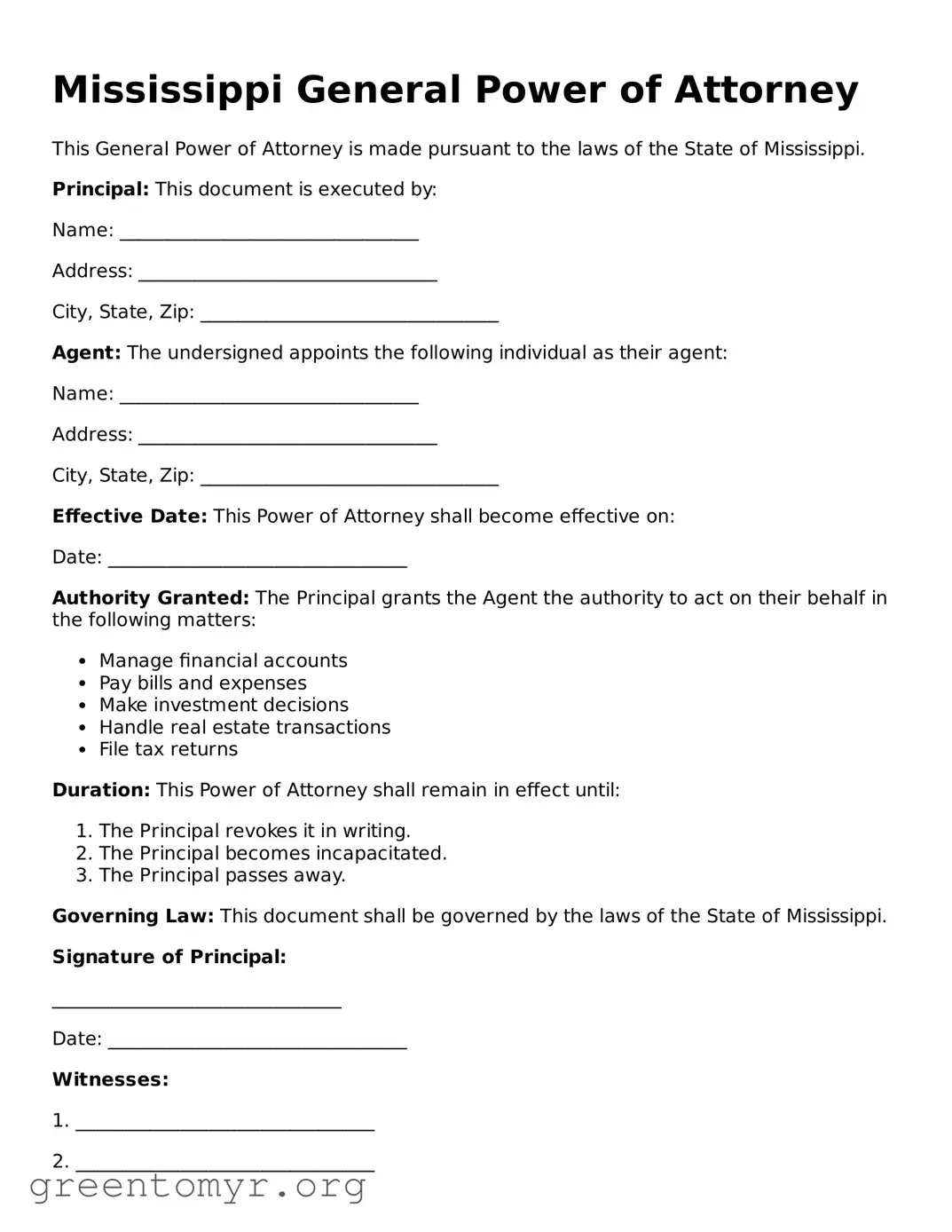
The Mississippi General Power of Attorney form serves as a crucial legal document that empowers an individual, known as the principal, to designate another person, referred to as the agent or attorney-in-fact, to make decisions on their behalf. This form can cover a wide range of financial and legal matters, allowing the agent to handle tasks such as managing bank accounts, signing contracts, and making investment decisions. It is important to note that the authority granted can be broad or limited, depending on the principal's preferences. The document must be signed by the principal in the presence of a notary public to ensure its validity. Furthermore, the Mississippi General Power of Attorney can be durable, meaning it remains effective even if the principal becomes incapacitated, or it can be non-durable, ceasing to be effective upon the principal's incapacitation. Understanding the implications and requirements of this form is essential for anyone considering granting such powers, as it involves entrusting significant responsibilities to another individual.
Mississippi General Power of Attorney
This General Power of Attorney is made pursuant to the laws of the State of Mississippi.
Principal: This document is executed by:
Name: ________________________________
Address: ________________________________
City, State, Zip: ________________________________
Agent: The undersigned appoints the following individual as their agent:
Name: ________________________________
Address: ________________________________
City, State, Zip: ________________________________
Effective Date: This Power of Attorney shall become effective on:
Date: ________________________________
Authority Granted: The Principal grants the Agent the authority to act on their behalf in the following matters:
Duration: This Power of Attorney shall remain in effect until:
Governing Law: This document shall be governed by the laws of the State of Mississippi.
Signature of Principal:
_______________________________
Date: ________________________________
Witnesses:
1. ________________________________
2. ________________________________
Notarization:
State of Mississippi
County of ________________________________
Subscribed and sworn to before me this ____ day of ____________, 20__.
_______________________________
Notary Public
My commission expires: ________________________________
| Fact Name | Description |
|---|---|
| Definition | A Mississippi General Power of Attorney allows one person to grant another person the authority to act on their behalf in financial and legal matters. |
| Governing Law | This form is governed by Mississippi Code Annotated § 87-3-1 et seq. |
| Durability | The General Power of Attorney can be durable, meaning it remains effective even if the principal becomes incapacitated. |
| Agent Authority | The agent can perform a wide range of actions, including managing bank accounts, signing checks, and handling real estate transactions. |
| Revocation | The principal can revoke the power of attorney at any time, provided they are mentally competent. |
| Witness Requirement | The document must be signed in the presence of two witnesses or acknowledged before a notary public. |
| Limitations | Some actions, such as making medical decisions, require a separate medical power of attorney. |
After obtaining the Mississippi General Power of Attorney form, you are ready to fill it out. This document allows you to designate someone to make decisions on your behalf. It is important to ensure that all information is accurate and complete before signing.
A General Power of Attorney is a legal document that allows one person, known as the principal, to grant another person, known as the agent or attorney-in-fact, the authority to make decisions and take actions on their behalf. This can include managing finances, making healthcare decisions, and handling legal matters.
You may need a General Power of Attorney to ensure that someone you trust can manage your affairs if you become unable to do so yourself. This could be due to illness, injury, or absence. Having this document in place can provide peace of mind and help avoid complications in critical situations.
In Mississippi, your agent can be anyone you trust, such as a family member, friend, or professional advisor. However, the agent must be at least 18 years old and mentally competent. It’s important to choose someone who will act in your best interests.
You can grant your agent a wide range of powers, including:
However, you can also limit the powers granted to your agent if you choose.
To create a General Power of Attorney in Mississippi, you need to fill out a form that outlines your wishes. You must sign the document in the presence of a notary public. It’s advisable to consult with a lawyer to ensure that the document meets all legal requirements and accurately reflects your intentions.
Yes, in Mississippi, the General Power of Attorney must be notarized to be legally valid. This adds an extra layer of authenticity and helps prevent potential disputes regarding the document’s legitimacy.
Yes, you can revoke a General Power of Attorney at any time as long as you are mentally competent. To do so, you must create a written revocation document and notify your agent and any relevant third parties, such as banks or healthcare providers, that the power of attorney has been revoked.
If you become incapacitated without a General Power of Attorney, your family may need to go through a court process to obtain guardianship or conservatorship over you. This process can be lengthy, costly, and may not align with your wishes. Having a General Power of Attorney in place can prevent this situation.
A General Power of Attorney can include healthcare decisions, but it is often better to create a separate document called a Healthcare Power of Attorney or Advance Healthcare Directive. This specialized document focuses solely on medical decisions and can provide clearer guidance to your agent regarding your healthcare preferences.
A General Power of Attorney remains in effect until you revoke it, until you pass away, or until a specified expiration date if you included one in the document. If you become incapacitated, the General Power of Attorney will typically remain valid unless it is revoked or a court determines otherwise.
Filling out the Mississippi General Power of Attorney form can be straightforward, but mistakes often happen. One common error is not providing the correct names of the principal and agent. Ensure that both names are spelled correctly and match the legal identification documents. Any discrepancies can lead to complications later.
Another mistake is failing to clearly define the powers granted. The form allows you to specify what your agent can and cannot do on your behalf. If this section is vague or left blank, it may lead to misunderstandings. Be specific about the powers you want to grant.
Many people overlook the importance of signing the form in front of a notary. In Mississippi, a General Power of Attorney must be notarized to be legally binding. Without this step, the document may not hold up in court or be accepted by financial institutions.
Some individuals also forget to date the form. A date is crucial as it establishes when the powers begin. If you neglect to include the date, it can create confusion regarding the validity of the document.
Another frequent oversight is not informing the agent about their role. It’s essential to discuss the responsibilities and powers with your agent before filling out the form. This conversation helps ensure that they are willing and prepared to take on the role.
People sometimes use outdated forms. Laws can change, and using an old version of the General Power of Attorney form may lead to issues. Always check for the most current version to ensure compliance with state laws.
Some individuals mistakenly think that a General Power of Attorney remains effective indefinitely. However, this is not always the case. If you want the document to remain valid even if you become incapacitated, you must specify that it is durable.
Not considering the revocation of previous powers of attorney can also be a pitfall. If you have previously granted someone power of attorney, make sure to revoke it formally before issuing a new one. This prevents confusion and ensures that only the most recent document is valid.
Lastly, failing to keep copies of the completed form can lead to problems. Always make several copies and distribute them to your agent and any relevant institutions. This way, everyone knows who has the authority to act on your behalf.
When dealing with a Mississippi General Power of Attorney, there are several other forms and documents that may be beneficial to have on hand. Each of these documents serves a unique purpose and can help ensure that your legal affairs are managed smoothly and effectively.
Having these documents prepared and organized can provide peace of mind and clarity in various situations. It's essential to choose the right forms to fit your personal needs and ensure that your wishes are respected.
When filling out the Mississippi General Power of Attorney form, it is crucial to follow certain guidelines to ensure the document is valid and effective. Here are six essential dos and don'ts:
Understanding the Mississippi General Power of Attorney form is crucial for anyone considering its use. However, several misconceptions often arise. Here are six common misunderstandings:
Many people think a General Power of Attorney and a Durable Power of Attorney are interchangeable. In reality, a General Power of Attorney becomes invalid if the principal becomes incapacitated, while a Durable Power of Attorney remains effective even in such situations.
Some believe that a General Power of Attorney lasts forever. However, it is only valid until the principal revokes it, passes away, or becomes incapacitated. It is essential to understand the limitations of its duration.
People often assume that the agent can act without restrictions. While the agent has broad powers, those powers are limited to what the principal has specified in the document. It's important to clearly outline the authority granted.
Some think that a General Power of Attorney must be witnessed to be legally binding. In Mississippi, this form does not require witnesses, but it does need to be notarized for added validity.
Many believe that once a General Power of Attorney is executed, it cannot be altered. In fact, the principal can revoke or modify the document at any time, as long as they are of sound mind.
Some individuals think a General Power of Attorney is solely for handling financial affairs. While it can cover financial matters, it can also grant authority over health care decisions and other personal matters, depending on how it is drafted.
Understanding these misconceptions can help individuals make informed decisions about using a General Power of Attorney in Mississippi.
When considering a General Power of Attorney in Mississippi, it's important to understand the following key points:
These takeaways can help you navigate the process of filling out and using the Mississippi General Power of Attorney form effectively.