Creating a Last Will and Testament is an essential step in ensuring that your wishes are honored after your passing. In Mississippi, this legal document serves as a formal declaration of how you want your assets distributed, who will serve as your executor, and guardianship arrangements for any minor children. The Mississippi Last Will and Testament form is designed to provide clarity and structure, allowing individuals to specify their intentions regarding property, debts, and personal belongings. It typically includes sections for naming beneficiaries, detailing specific bequests, and outlining any conditions tied to the inheritance. Additionally, the form requires signatures from witnesses to validate its authenticity, ensuring that your final wishes are legally recognized. Understanding the components of this form can help you navigate the estate planning process more effectively, giving you peace of mind knowing that your affairs are in order.
Mississippi Last Will and Testament
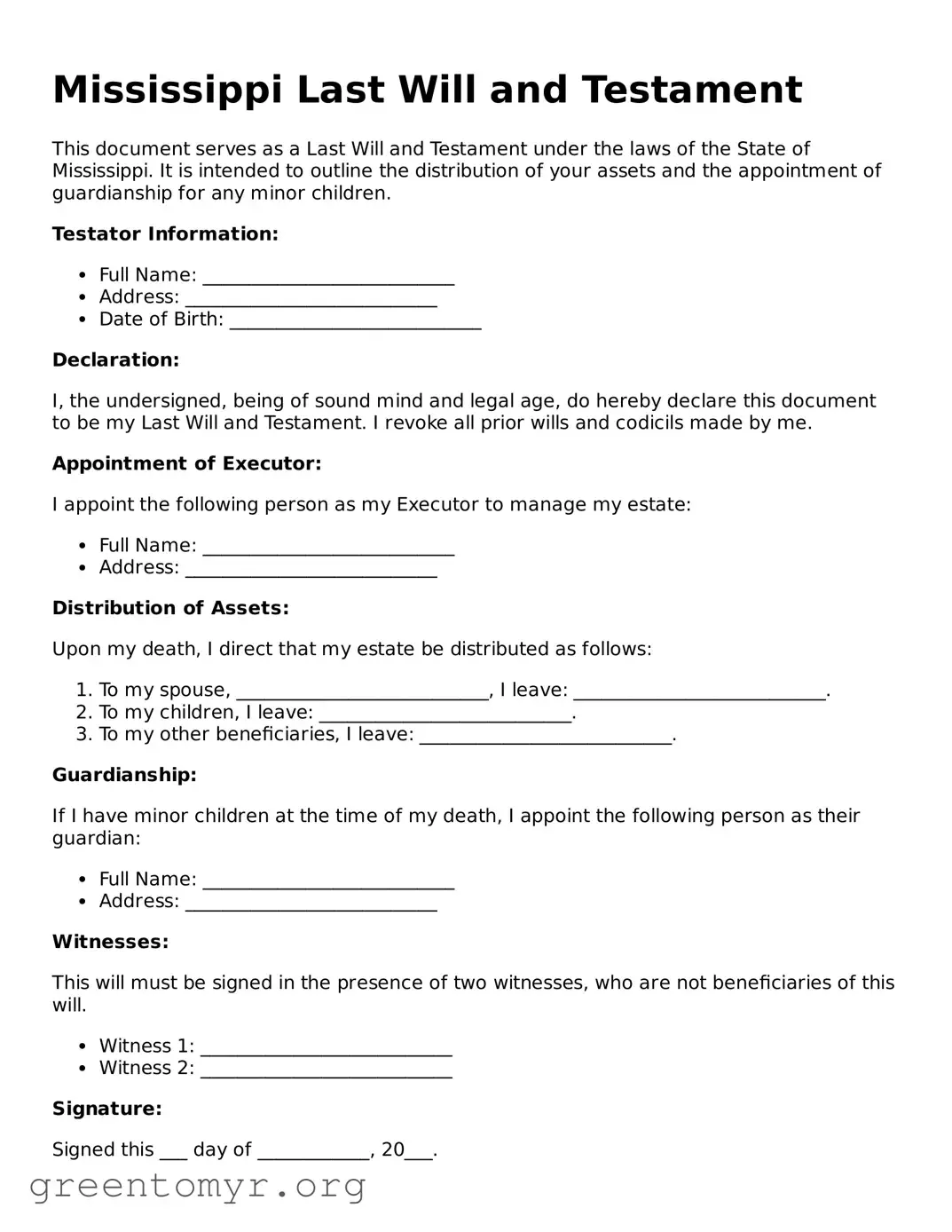
This document serves as a Last Will and Testament under the laws of the State of Mississippi. It is intended to outline the distribution of your assets and the appointment of guardianship for any minor children.
Testator Information:
Declaration:
I, the undersigned, being of sound mind and legal age, do hereby declare this document to be my Last Will and Testament. I revoke all prior wills and codicils made by me.
Appointment of Executor:
I appoint the following person as my Executor to manage my estate:
Distribution of Assets:
Upon my death, I direct that my estate be distributed as follows:
Guardianship:
If I have minor children at the time of my death, I appoint the following person as their guardian:
Witnesses:
This will must be signed in the presence of two witnesses, who are not beneficiaries of this will.
Signature:
Signed this ___ day of ____________, 20___.
___________________________ (Testator Signature)
| Fact Name | Details |
|---|---|
| Governing Law | The Mississippi Last Will and Testament is governed by Mississippi Code Annotated § 91-5-1 to § 91-5-39. |
| Age Requirement | Individuals must be at least 18 years old to create a valid will in Mississippi. |
| Signature Requirement | The testator must sign the will, or someone else can sign it in their presence and at their direction. |
| Witness Requirement | At least two witnesses are required to sign the will, and they must be present at the same time. |
| Holographic Wills | Mississippi recognizes holographic wills, which are handwritten and do not require witnesses if signed by the testator. |
| Revocation of Wills | A will can be revoked by creating a new will or by physically destroying the existing will with the intent to revoke. |
| Codicils | Changes to a will can be made through a codicil, which must also be signed and witnessed according to the same rules. |
| Probate Process | After death, the will must go through probate, where the court validates the will and oversees the distribution of assets. |
| Intestate Succession | If someone dies without a will, Mississippi's intestate succession laws determine how their assets are distributed. |
After you have gathered the necessary information, you can begin filling out the Mississippi Last Will and Testament form. This document is essential for outlining your wishes regarding the distribution of your assets and appointing guardians for any minor children. Make sure to have all required details at hand to ensure a smooth process.
Once you have completed the form, store it in a safe place. Inform your executor and close family members about its location. It’s also a good idea to review your will periodically, especially after significant life changes.
A Last Will and Testament is a legal document that outlines how a person's assets and affairs should be handled after their death. In Mississippi, this document allows individuals to specify who will inherit their property, appoint guardians for minor children, and name an executor to manage the estate. Having a will can help ensure that your wishes are respected and can simplify the probate process for your loved ones.
In Mississippi, any person who is at least 18 years old and of sound mind can create a Last Will and Testament. This means that the individual must understand the nature of the document and its implications. If you are under 18 or deemed mentally incompetent, you cannot legally create a will.
To ensure that a will is valid in Mississippi, it must meet several key requirements:
Yes, you can change or revoke your will at any time while you are still alive and mentally competent. To make changes, you can create a new will that explicitly revokes the previous one or add a codicil, which is an amendment to the existing will. It’s important to follow the same signing and witnessing requirements to ensure that the changes are legally binding.
If you die without a will, you are considered to have died "intestate." In this case, Mississippi law will determine how your assets are distributed. Typically, your property will be divided among your closest relatives, such as your spouse, children, or parents. This process can be complicated and may not reflect your personal wishes, which is why having a will is highly recommended.
While it is not legally required to have an attorney to create a will in Mississippi, it is often advisable. An attorney can provide guidance to ensure that your will meets all legal requirements and accurately reflects your wishes. They can also help navigate any complexities related to your estate, especially if you have significant assets or specific concerns about guardianship or tax implications.
Creating a Last Will and Testament is a crucial step in ensuring that your wishes are honored after your passing. However, many people make mistakes when filling out the Mississippi Last Will and Testament form. One common error is not being specific enough about asset distribution. It’s important to clearly outline who receives what. Vague language can lead to confusion and disputes among heirs, which can undermine the very purpose of the will.
Another frequent mistake is failing to properly sign and date the document. In Mississippi, a will must be signed by the testator, or the person making the will, and it should also be dated. If these steps are overlooked, the will may not be considered valid. Additionally, having witnesses present during the signing process is often required. Without this crucial step, the will could face challenges in probate court.
People often forget to update their wills after significant life events. Changes such as marriage, divorce, or the birth of a child can impact how you want your assets distributed. Failing to revise the will to reflect these changes can lead to unintended consequences, leaving out loved ones or including those you no longer wish to benefit.
Lastly, many individuals neglect to communicate their wishes to their family members. While the will serves as a legal document, discussing your intentions with loved ones can help prevent misunderstandings and disputes down the line. Open communication can ease tensions and ensure that everyone is aware of your desires regarding your estate.
When preparing a Last Will and Testament in Mississippi, individuals often need to consider several additional forms and documents that can support the estate planning process. These documents help clarify intentions, manage assets, and ensure that the wishes of the deceased are honored. Below is a list of commonly used forms and documents.
Incorporating these forms and documents into estate planning can provide clarity and peace of mind. Each serves a distinct purpose and helps ensure that an individual's wishes are respected and followed after their passing.
The Last Will and Testament is an important legal document that outlines how a person's assets will be distributed after their death. However, it shares similarities with several other legal documents. Here are nine documents that are comparable to a Last Will and Testament:
Understanding these documents can help individuals make informed decisions about their estate planning needs. Each serves a unique purpose but ultimately aims to ensure that personal wishes are respected and assets are managed appropriately.
When filling out the Mississippi Last Will and Testament form, it is crucial to approach the task with care. Here are some important dos and don'ts to keep in mind:
Understanding the Mississippi Last Will and Testament form is crucial for anyone looking to prepare their estate plan. However, several misconceptions can lead to confusion. Here’s a list of common misunderstandings:
By understanding these misconceptions, individuals can better navigate the process of creating a Last Will and Testament in Mississippi. Clear knowledge helps ensure that your wishes are respected and your loved ones are taken care of.
When filling out and using the Mississippi Last Will and Testament form, keep these key takeaways in mind:
Following these guidelines will help ensure that your wishes are respected and your estate is handled according to your preferences.