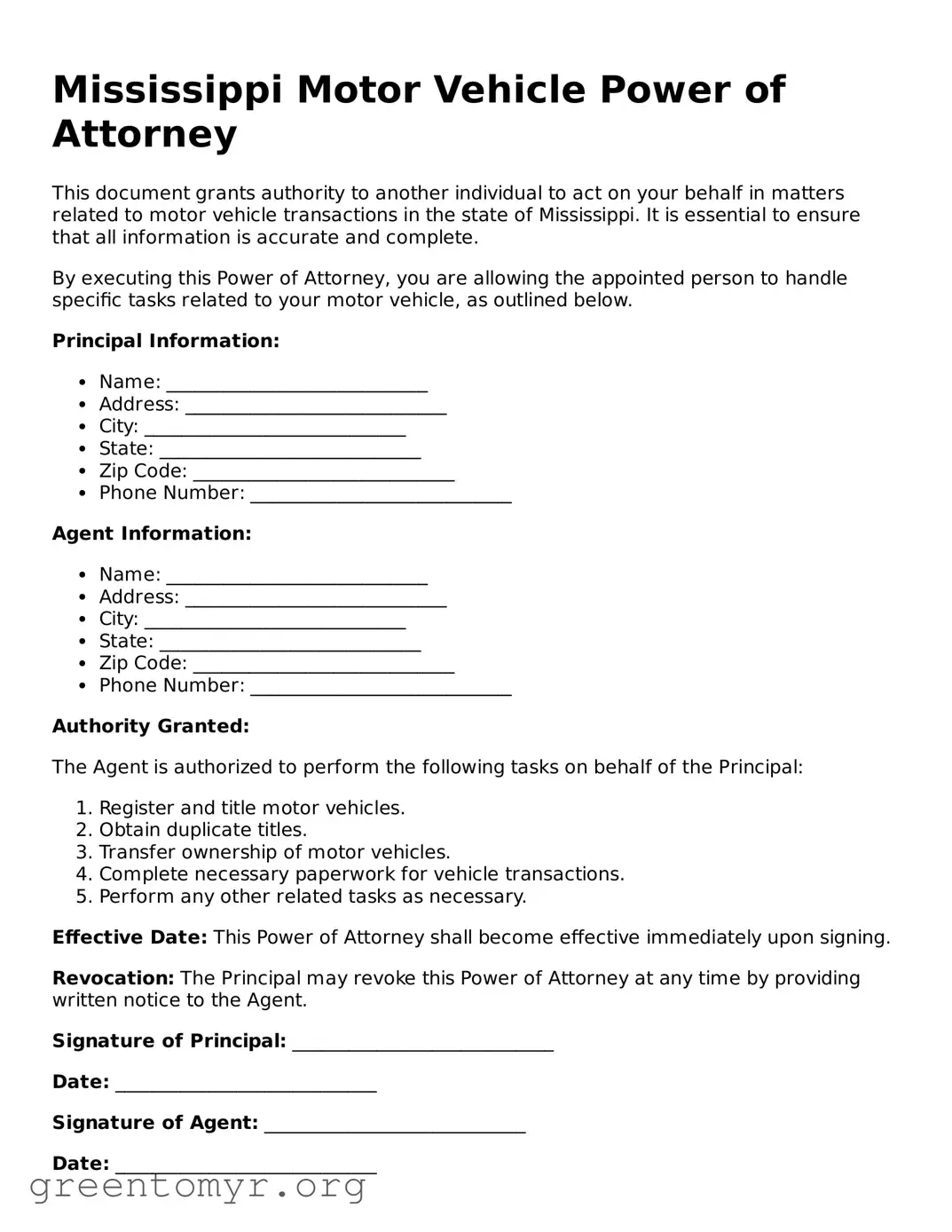
The Mississippi Motor Vehicle Power of Attorney form serves as an essential tool for individuals who need to delegate authority regarding their vehicle to another person. This form allows a designated representative to handle specific tasks, such as signing documents related to the sale, transfer, or registration of a vehicle. By granting this power, the vehicle owner can ensure that their interests are managed effectively, even if they are unable to attend to these matters personally. The form typically requires details such as the names and addresses of both the vehicle owner and the appointed agent, as well as information about the vehicle itself, including its make, model, and identification number. Additionally, it is important for the form to be signed in the presence of a notary public to enhance its validity. Understanding the implications and requirements of this form can provide peace of mind and streamline the process of managing vehicle-related transactions.
Mississippi Motor Vehicle Power of Attorney
This document grants authority to another individual to act on your behalf in matters related to motor vehicle transactions in the state of Mississippi. It is essential to ensure that all information is accurate and complete.
By executing this Power of Attorney, you are allowing the appointed person to handle specific tasks related to your motor vehicle, as outlined below.
Principal Information:
Agent Information:
Authority Granted:
The Agent is authorized to perform the following tasks on behalf of the Principal:
Effective Date: This Power of Attorney shall become effective immediately upon signing.
Revocation: The Principal may revoke this Power of Attorney at any time by providing written notice to the Agent.
Signature of Principal: ____________________________
Date: ____________________________
Signature of Agent: ____________________________
Date: ____________________________
By signing this document, both parties acknowledge that they understand the powers granted herein and agree to abide by the terms set forth.
| Fact Name | Details |
|---|---|
| Purpose | The Mississippi Motor Vehicle Power of Attorney form allows an individual to authorize another person to act on their behalf regarding vehicle-related matters. |
| Governing Law | This form is governed by Mississippi Code Annotated § 87-3-1 et seq. |
| Principal | The individual granting the power is known as the principal. |
| Agent | The person receiving the authority is called the agent or attorney-in-fact. |
| Vehicle Transactions | The form can be used for various vehicle transactions, including buying, selling, or transferring ownership of a vehicle. |
| Signature Requirement | The principal must sign the form in the presence of a notary public to ensure its validity. |
| Duration | The power of attorney remains in effect until revoked by the principal or until the specified expiration date, if any. |
| Revocation | The principal can revoke the power of attorney at any time, provided they notify the agent and any relevant parties. |
| Use in Other States | While primarily for Mississippi, the form may be recognized in other states, but it is advisable to check local laws. |
Once you have the Mississippi Motor Vehicle Power of Attorney form, you will need to complete it accurately. This form allows you to designate someone to act on your behalf regarding motor vehicle transactions. Follow the steps below to fill out the form correctly.
The Mississippi Motor Vehicle Power of Attorney form is a legal document that allows one person (the principal) to authorize another person (the agent) to act on their behalf regarding motor vehicle transactions. This can include tasks such as transferring ownership, registering a vehicle, or signing documents related to the sale or purchase of a vehicle.
This form is useful in various situations, including:
To complete the Mississippi Motor Vehicle Power of Attorney form, follow these steps:
Yes, the Mississippi Motor Vehicle Power of Attorney form typically needs to be notarized to ensure its validity. Notarization helps confirm the identities of the individuals involved and verifies that they signed the document willingly.
The validity of a Motor Vehicle Power of Attorney in Mississippi generally lasts until the specific task is completed or until the principal revokes it in writing. If you want to ensure that the agent’s authority is clear, it’s a good idea to specify an expiration date on the form.
Filling out the Mississippi Motor Vehicle Power of Attorney form can seem straightforward, but many individuals make common mistakes that can lead to complications. Understanding these pitfalls can help ensure that the form is completed accurately and effectively. Here are seven mistakes to avoid when filling out this important document.
First, one of the most frequent errors is failing to provide all necessary personal information. This includes the full legal names, addresses, and contact information for both the principal and the agent. Omitting even a single detail can render the form incomplete, which may cause delays or issues in the future.
Another common mistake involves not clearly defining the powers being granted. The form should specify the exact actions the agent is authorized to perform regarding the vehicle. Vague language can lead to misunderstandings, making it crucial to be precise about the authority being delegated.
Many people overlook the importance of signing and dating the form. Without the principal's signature, the document lacks validity. Additionally, failing to date the form can create confusion regarding when the powers were granted, which may be significant in certain situations.
Another error often seen is neglecting to have the form notarized. In Mississippi, a Power of Attorney form typically requires notarization to be legally binding. Skipping this step can invalidate the document, leaving the agent without the authority to act on behalf of the principal.
Additionally, individuals sometimes forget to inform their agents about the powers granted. Communication is key. If the agent is unaware of their responsibilities or the specific powers bestowed upon them, they may not be able to act effectively when needed.
Some individuals also make the mistake of not keeping copies of the completed form. It’s essential to retain a copy for personal records and to provide one to the agent. This ensures that all parties have access to the same information and can refer back to it as necessary.
Finally, failing to review the form for errors before submission can lead to significant issues. Typos, incorrect information, or unclear instructions can complicate matters. Taking the time to double-check the form can save a lot of trouble down the road.
By being aware of these common mistakes, individuals can navigate the process of completing the Mississippi Motor Vehicle Power of Attorney form with greater confidence and accuracy. Proper attention to detail can make a significant difference in ensuring that the document serves its intended purpose.
When dealing with vehicle transactions in Mississippi, the Motor Vehicle Power of Attorney form is often accompanied by several other important documents. These forms help ensure that the process runs smoothly and that all legal requirements are met. Below are some commonly used documents that may be necessary alongside the Power of Attorney.
Having these documents ready can simplify the process of buying or selling a vehicle in Mississippi. Each one plays a vital role in ensuring that the transaction is legal, transparent, and properly recorded. Always check for the latest requirements to ensure compliance with state laws.
When filling out the Mississippi Motor Vehicle Power of Attorney form, there are important guidelines to follow. Here’s a list of things you should and shouldn’t do:
Following these guidelines will help ensure a smooth process when completing the Power of Attorney form.
Misconception 1: A Power of Attorney is only for financial matters.
Many people believe that a Power of Attorney (POA) can only be used for financial decisions. However, a Mississippi Motor Vehicle Power of Attorney specifically allows an individual to authorize someone else to handle motor vehicle transactions on their behalf. This includes tasks like registering a vehicle, transferring ownership, or obtaining a title.
Misconception 2: The form must be notarized to be valid.
While notarization can add an extra layer of authenticity, it is not always required for the Mississippi Motor Vehicle Power of Attorney form. As long as the document is properly filled out and signed by the principal, it can be valid without a notary's signature. However, some entities may still request notarization, so it’s wise to check in advance.
Misconception 3: The Power of Attorney is permanent and cannot be revoked.
Another common misunderstanding is that once a Power of Attorney is granted, it remains in effect indefinitely. In reality, the principal can revoke the authority at any time, as long as they are mentally competent. This means that if circumstances change, the principal can take back control over their motor vehicle matters.
Misconception 4: Only attorneys can create a Power of Attorney.
Some individuals believe that only legal professionals can draft a Power of Attorney. In Mississippi, anyone can create a Motor Vehicle Power of Attorney as long as they follow the required guidelines. Templates are often available online, making it accessible for anyone who needs to delegate motor vehicle tasks.
Misconception 5: The person granted Power of Attorney must be a family member.
It is a common belief that a Power of Attorney must be assigned to a family member. In truth, the principal can choose anyone they trust, whether it's a friend, neighbor, or colleague. The key is to select someone responsible and reliable, as they will be handling important motor vehicle decisions on behalf of the principal.
When filling out and using the Mississippi Motor Vehicle Power of Attorney form, keep these key takeaways in mind:
Filling out this form correctly ensures that your motor vehicle matters are handled according to your wishes.