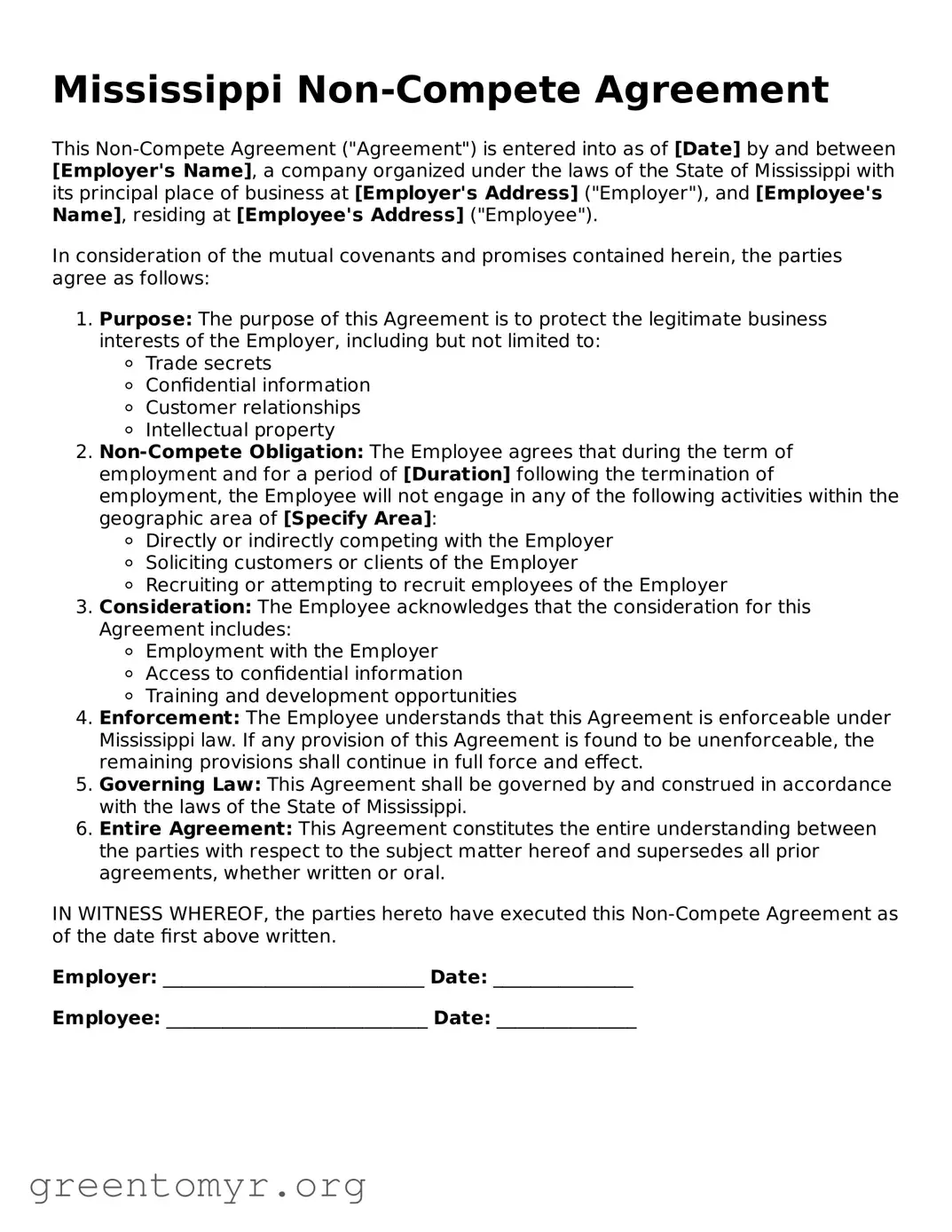
The Mississippi Non-compete Agreement form serves as a crucial tool for employers seeking to protect their business interests while balancing the rights of employees. This legally binding document outlines the terms under which an employee agrees not to engage in similar business activities that could directly compete with their employer after leaving the company. Key aspects of the form include the duration of the non-compete period, the geographical scope of the restriction, and the specific activities that are prohibited. It is essential for both parties to understand the implications of the agreement, as it can impact future employment opportunities for the employee and safeguard trade secrets and proprietary information for the employer. Clarity in the language of the agreement is vital to ensure enforceability, as Mississippi courts may scrutinize these contracts for reasonableness. Furthermore, the agreement must be supported by valid consideration, often in the form of employment or continued employment, to be deemed enforceable. By addressing these elements, the Mississippi Non-compete Agreement form aims to establish a fair and transparent framework for both employers and employees in the competitive landscape of the workplace.
Mississippi Non-Compete Agreement
This Non-Compete Agreement ("Agreement") is entered into as of [Date] by and between [Employer's Name], a company organized under the laws of the State of Mississippi with its principal place of business at [Employer's Address] ("Employer"), and [Employee's Name], residing at [Employee's Address] ("Employee").
In consideration of the mutual covenants and promises contained herein, the parties agree as follows:
IN WITNESS WHEREOF, the parties hereto have executed this Non-Compete Agreement as of the date first above written.
Employer: ____________________________ Date: _______________
Employee: ____________________________ Date: _______________
| Fact Name | Description |
|---|---|
| Definition | A Mississippi Non-compete Agreement is a contract that restricts an employee's ability to work for competitors after leaving a job. |
| Governing Law | The agreement is governed by Mississippi state law, specifically under Mississippi Code Annotated § 75-4-1. |
| Enforceability | For a non-compete to be enforceable, it must be reasonable in scope, duration, and geographic area. |
| Consideration | There must be valid consideration for the agreement, such as employment, training, or access to proprietary information. |
| Duration Limits | Generally, non-compete agreements in Mississippi should not exceed two years in duration. |
| Public Policy | Mississippi courts may refuse to enforce non-compete agreements that are deemed overly restrictive or against public policy. |
Completing the Mississippi Non-compete Agreement form requires careful attention to detail. Each section must be filled out accurately to ensure the agreement is valid and enforceable. Follow the steps below to complete the form correctly.
After completing these steps, review the form for accuracy. Make sure all information is clear and legible. Once verified, the agreement can be executed and retained by both parties for their records.
A Non-compete Agreement is a legal contract between an employer and an employee. This agreement restricts the employee from working for competitors or starting a competing business for a specified period after leaving the employer. In Mississippi, these agreements are enforceable but must meet certain criteria to be valid.
To be enforceable, a Non-compete Agreement in Mississippi must generally meet the following criteria:
Failure to meet these requirements may render the agreement unenforceable in a court of law.
The duration of a Non-compete Agreement in Mississippi must be reasonable. While there is no strict limit, courts typically view agreements lasting from six months to two years as more acceptable. The specific circumstances of the business and the employee’s role will influence the appropriate duration.
Yes, geographic limitations are crucial for the enforceability of Non-compete Agreements. The area restricted must be reasonable and related to the employer's business operations. For example, if a business operates within a specific city or region, the Non-compete Agreement should not extend beyond that area unless justified.
Absolutely. Employees have the right to negotiate the terms of a Non-compete Agreement before signing. This negotiation can include aspects such as duration, geographic scope, and the specific activities restricted. It is advisable for employees to seek legal counsel to ensure the terms are fair and reasonable.
If an employee violates a Non-compete Agreement, the employer may take legal action. This can include seeking an injunction to prevent the employee from continuing the competing activity and potentially claiming damages. Courts will evaluate the agreement's enforceability and the extent of the violation before making a ruling.
Yes, Non-compete Agreements can also be enforced against independent contractors in Mississippi. However, the same principles apply regarding reasonableness in scope, duration, and geographic area. It is essential that the agreement clearly outlines the relationship and the expectations for both parties.
Filling out a Mississippi Non-compete Agreement form can seem straightforward, but many individuals make common mistakes that can lead to complications down the line. One frequent error is failing to clearly define the scope of the non-compete. The agreement should specify the geographic area and the type of work that is restricted. Without these details, the agreement may be deemed too vague and unenforceable.
Another mistake often encountered is neglecting to include a reasonable duration for the non-compete clause. While it might be tempting to impose a long-term restriction, courts typically favor agreements that are reasonable in length. A non-compete that lasts for several years may be challenged, leading to potential legal disputes.
Many individuals also overlook the importance of mutual consideration. This means that both parties should receive something of value in exchange for the agreement. If only one party benefits, the agreement may not hold up in court. It’s crucial to ensure that both sides are acknowledged and compensated fairly.
In addition, failing to seek legal advice before signing the agreement can lead to significant pitfalls. Each situation is unique, and what works for one person may not be appropriate for another. Consulting with a legal professional can provide clarity and help tailor the agreement to specific needs.
Another common mistake is not updating the agreement when circumstances change. If a business expands or alters its operations, the original terms may no longer be relevant. Regularly reviewing and revising the agreement ensures that it remains applicable and enforceable.
People often forget to read the entire document carefully. Skimming through the agreement can result in misunderstandings about obligations and rights. Taking the time to read every section can prevent surprises later on.
Additionally, many individuals neglect to include a clause addressing dispute resolution. Without a clear process for resolving conflicts, parties may find themselves in lengthy and costly legal battles. Including mediation or arbitration clauses can provide a more efficient way to handle disagreements.
Finally, failing to keep a copy of the signed agreement is a mistake that can lead to confusion in the future. Both parties should retain a copy for their records. This ensures that everyone is on the same page regarding the terms of the agreement and can refer back to it when necessary.
When entering into a Non-compete Agreement in Mississippi, several other forms and documents may be relevant. These documents help clarify the terms of the agreement and protect the interests of both parties involved. Here’s a brief overview of some commonly used documents.
These documents work together to create a comprehensive framework for the employment relationship. Understanding each one can help both employers and employees navigate their rights and responsibilities effectively.
A Non-compete Agreement is a legal document that restricts an individual from engaging in certain activities that could compete with their employer after leaving the company. There are several other documents that share similarities with a Non-compete Agreement. Here are five of them:
Each of these documents plays a crucial role in defining relationships and protecting business interests, much like the Non-compete Agreement does.
When filling out the Mississippi Non-compete Agreement form, it is essential to approach the task with care. Below is a list of things to do and avoid during this process.
Taking these steps will help ensure that the Non-compete Agreement is filled out correctly and that you are fully aware of your rights and obligations.
Understanding the Mississippi Non-compete Agreement form can be tricky, and several misconceptions often arise. Here’s a look at some common misunderstandings.
Not true. In Mississippi, these agreements must be reasonable in scope, duration, and geographic area to be enforceable.
This is a misconception. Employers can choose to require non-compete agreements, but they are not mandatory for all employees.
While both protect business interests, they serve different purposes. Non-compete agreements restrict employment opportunities, while non-disclosure agreements protect confidential information.
This is an exaggeration. A well-drafted non-compete should only limit employment in specific areas or for a certain period.
In reality, any employee may be asked to sign one, depending on the employer's needs and the nature of the job.
This is incorrect. Employees can challenge the enforceability of the agreement in court, especially if it is deemed unreasonable.
Each agreement can vary significantly based on the specific terms and conditions set by the employer. They should be tailored to fit the business's needs.
While this form is specific to Mississippi, non-compete agreements exist in many states, each with its own rules and regulations.
When filling out and utilizing the Mississippi Non-compete Agreement form, it is important to consider several key points to ensure the agreement is effective and enforceable.
By paying attention to these aspects, individuals and businesses can create a more effective Non-compete Agreement that stands up in court if challenged.