In the world of business, protecting sensitive information is crucial, and that's where the Mississippi Non-disclosure Agreement (NDA) form comes into play. This legal document serves as a safeguard for parties entering into a relationship where confidential information may be shared. Whether you're a business owner, an entrepreneur, or simply someone looking to protect your ideas, understanding the key components of this agreement is essential. The form outlines the obligations of both parties regarding the handling of proprietary information, specifies what constitutes confidential information, and establishes the duration of the confidentiality obligations. Additionally, it addresses potential consequences for breaches, ensuring that all parties are aware of the seriousness of maintaining confidentiality. By using this form, individuals and businesses can create a clear framework for sharing information while minimizing the risk of unauthorized disclosure. As we delve deeper into the specifics of the Mississippi NDA, you'll gain insights into its importance and how to effectively utilize it in your professional dealings.
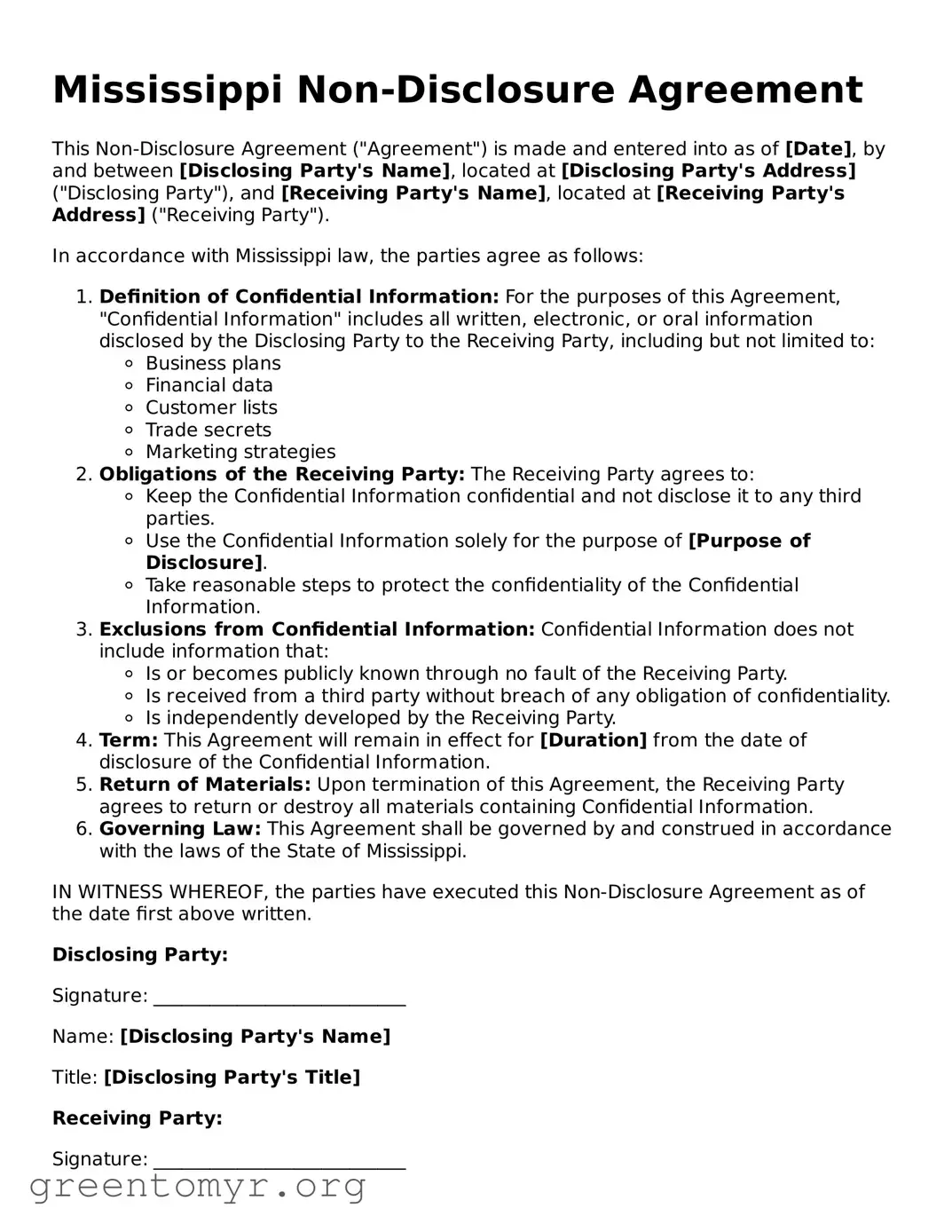
Mississippi Non-Disclosure Agreement
This Non-Disclosure Agreement ("Agreement") is made and entered into as of [Date], by and between [Disclosing Party's Name], located at [Disclosing Party's Address] ("Disclosing Party"), and [Receiving Party's Name], located at [Receiving Party's Address] ("Receiving Party").
In accordance with Mississippi law, the parties agree as follows:
IN WITNESS WHEREOF, the parties have executed this Non-Disclosure Agreement as of the date first above written.
Disclosing Party:
Signature: ___________________________
Name: [Disclosing Party's Name]
Title: [Disclosing Party's Title]
Receiving Party:
Signature: ___________________________
Name: [Receiving Party's Name]
Title: [Receiving Party's Title]
| Fact Name | Details |
|---|---|
| Definition | A Mississippi Non-disclosure Agreement (NDA) is a legal contract that protects confidential information shared between parties. |
| Purpose | The primary purpose of an NDA is to prevent unauthorized disclosure of sensitive information. |
| Governing Law | Mississippi law governs the interpretation and enforcement of NDAs in the state. |
| Parties Involved | Typically, the parties involved are the disclosing party and the receiving party. |
| Duration | The duration of confidentiality obligations can vary but is often specified in the agreement. |
| Exclusions | Common exclusions include information that is public knowledge or independently developed by the receiving party. |
| Enforcement | If breached, the disclosing party may seek legal remedies, including injunctions or monetary damages. |
| Signing Requirement | For the NDA to be enforceable, it must be signed by all parties involved. |
| Use Cases | NDAs are often used in business transactions, employment agreements, and partnerships. |
After obtaining the Mississippi Non-disclosure Agreement form, it is essential to complete it accurately to ensure all necessary information is provided. Once the form is filled out, it will need to be signed by all parties involved. This step is critical for the agreement to be legally binding.
A Mississippi Non-disclosure Agreement is a legal contract that protects confidential information shared between parties. This agreement ensures that sensitive information, such as trade secrets, business plans, and proprietary data, remains private. Both parties agree not to disclose this information to unauthorized individuals or entities.
An NDA is useful in various situations, including:
A comprehensive NDA typically includes the following elements:
The duration of an NDA can vary based on the agreement between the parties. Generally, the confidentiality obligations can last for a specific period, often ranging from two to five years. However, some agreements may require indefinite confidentiality for certain types of sensitive information, such as trade secrets.
Yes, NDAs are enforceable in Mississippi as long as they meet legal requirements. If one party breaches the agreement, the other party can seek legal remedies, which may include monetary damages or injunctive relief. However, the effectiveness of enforcement can depend on the clarity of the NDA's terms and the circumstances surrounding the breach.
If you suspect a violation, take the following steps:
While it is not legally required to have a lawyer draft your NDA, it is highly advisable. A legal professional can ensure that the agreement is tailored to your specific needs and complies with Mississippi law. This can help prevent potential disputes and enhance the enforceability of the NDA.
Filling out a Non-disclosure Agreement (NDA) in Mississippi can be a straightforward process, but mistakes can lead to complications down the line. One common error is failing to clearly define the confidential information. When parties do not specify what information is protected, it can lead to misunderstandings. Without clarity, it becomes difficult to enforce the agreement if a breach occurs.
Another frequent mistake is not identifying all parties involved. It’s essential to list every individual or entity that will have access to the confidential information. Omitting a party can weaken the agreement and leave gaps in protection. This oversight can be costly if sensitive information is leaked.
People also often overlook the duration of the confidentiality obligation. An NDA should clearly state how long the information must remain confidential. If this is not addressed, it may lead to disputes later on. The timeframe should be reasonable and reflect the nature of the information being protected.
Lastly, many individuals fail to seek legal advice before signing the NDA. While it may seem unnecessary, consulting a legal expert can provide valuable insights. They can help ensure that the agreement meets legal standards and adequately protects your interests. Skipping this step can result in signing an agreement that does not fully serve its intended purpose.
The Mississippi Non-Disclosure Agreement (NDA) serves as a vital tool for protecting sensitive information shared between parties. However, several other forms and documents often accompany an NDA to ensure comprehensive legal protection and clarity in business relationships. Below is a list of related documents that may be utilized alongside the NDA.
Incorporating these documents alongside a Mississippi Non-Disclosure Agreement can help create a robust legal framework that safeguards sensitive information and clarifies the expectations of all parties involved. Understanding these forms is essential for anyone engaged in business transactions or partnerships.
Confidentiality Agreement: Similar to a Non-disclosure Agreement, a confidentiality agreement also aims to protect sensitive information. Both documents establish a legal obligation for parties to keep certain information private, ensuring that proprietary details do not fall into the hands of competitors or the public.
Mutual Non-disclosure Agreement: This type of agreement is particularly common in business partnerships where both parties share confidential information. Like a standard Non-disclosure Agreement, it outlines the terms of confidentiality but emphasizes that both sides are obligated to protect each other's sensitive information.
Non-compete Agreement: While primarily focused on restricting competition, a non-compete agreement often includes clauses that address the protection of confidential information. It ensures that employees or partners cannot use sensitive information to benefit a competing entity after leaving a company.
Service Agreement: In many service agreements, confidentiality clauses are included to protect any proprietary information shared during the course of the service. This ensures that the service provider cannot disclose or misuse the information obtained while fulfilling their contractual duties.
Employment Agreement: Many employment agreements contain non-disclosure provisions. These clauses require employees to keep company secrets confidential, safeguarding the employer's intellectual property and business strategies from being disclosed to outside parties.
When filling out the Mississippi Non-disclosure Agreement form, it is essential to approach the task with care and attention to detail. Below are some guidelines that can help ensure the process is smooth and effective.
Following these guidelines can significantly enhance the effectiveness of the Non-disclosure Agreement, ensuring that all parties are on the same page regarding confidentiality expectations.
Misconceptions about the Mississippi Non-disclosure Agreement (NDA) can lead to confusion and mismanagement of sensitive information. Here are seven common misconceptions:
Understanding these misconceptions can help individuals and businesses navigate the complexities of non-disclosure agreements more effectively.
When filling out and using the Mississippi Non-disclosure Agreement (NDA) form, it is important to keep several key points in mind. Here are five essential takeaways:
Understanding these key points can help ensure that the NDA is effective and serves its intended purpose of protecting sensitive information.