The Mississippi Operating Agreement form is an essential document for anyone involved in a limited liability company (LLC) in the state. This form outlines the internal operations and management structure of the LLC, providing clarity and direction for all members. It covers critical aspects such as ownership percentages, decision-making processes, and the distribution of profits and losses. Additionally, it addresses the roles and responsibilities of each member, ensuring that everyone is on the same page. By establishing clear guidelines, the Operating Agreement helps prevent disputes and fosters a cooperative environment among members. Whether you are forming a new LLC or updating an existing agreement, understanding the key components of this form is vital for smooth business operations.
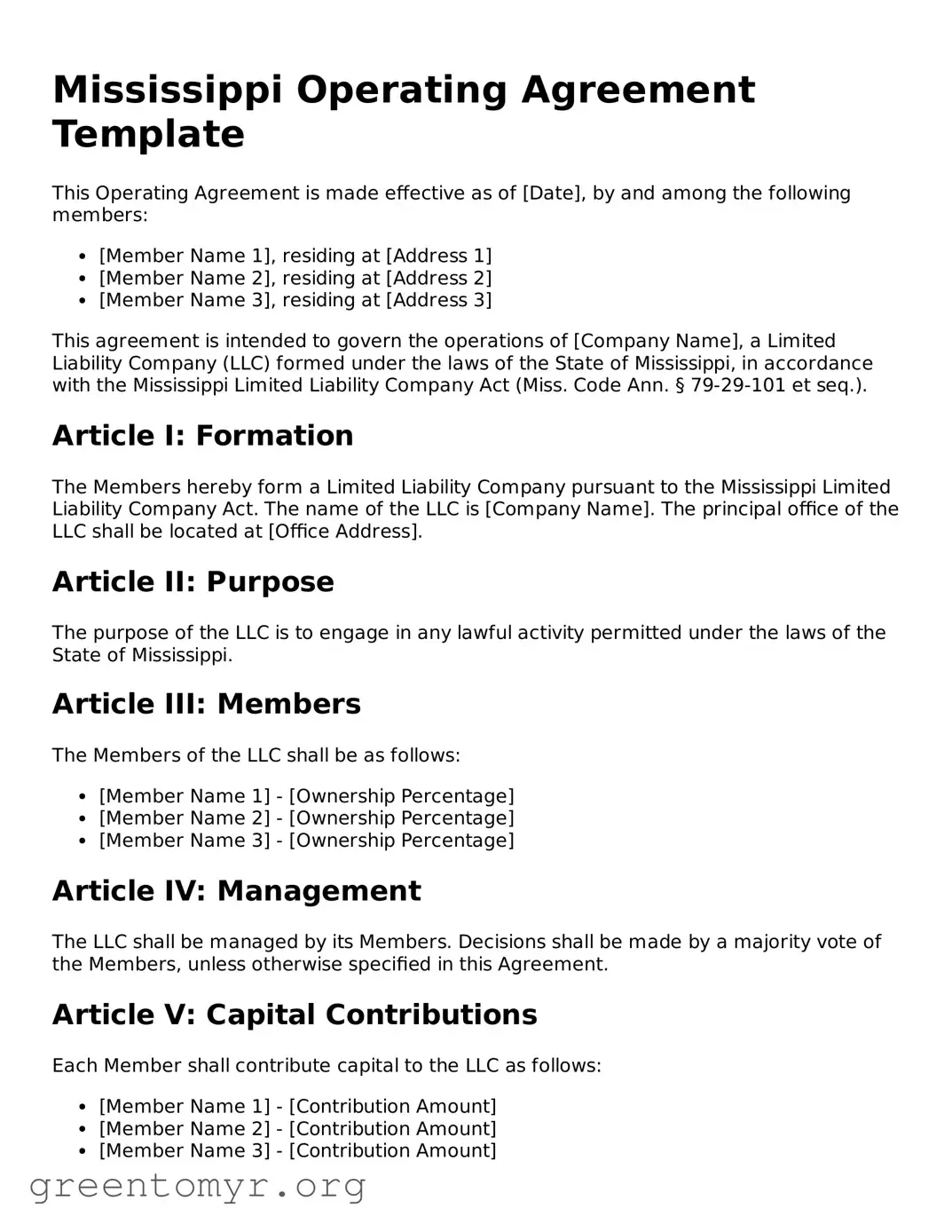
Mississippi Operating Agreement Template
This Operating Agreement is made effective as of [Date], by and among the following members:
This agreement is intended to govern the operations of [Company Name], a Limited Liability Company (LLC) formed under the laws of the State of Mississippi, in accordance with the Mississippi Limited Liability Company Act (Miss. Code Ann. § 79-29-101 et seq.).
Article I: Formation
The Members hereby form a Limited Liability Company pursuant to the Mississippi Limited Liability Company Act. The name of the LLC is [Company Name]. The principal office of the LLC shall be located at [Office Address].
Article II: Purpose
The purpose of the LLC is to engage in any lawful activity permitted under the laws of the State of Mississippi.
Article III: Members
The Members of the LLC shall be as follows:
Article IV: Management
The LLC shall be managed by its Members. Decisions shall be made by a majority vote of the Members, unless otherwise specified in this Agreement.
Article V: Capital Contributions
Each Member shall contribute capital to the LLC as follows:
Article VI: Distributions
Distributions of profits and losses shall be allocated to the Members in proportion to their respective ownership percentages.
Article VII: Indemnification
The LLC shall indemnify each Member against any and all expenses and liabilities incurred in connection with the LLC, except in cases of gross negligence or willful misconduct.
Article VIII: Amendments
This Operating Agreement may be amended only by a written agreement signed by all Members.
Article IX: Governing Law
This Agreement shall be governed by and construed in accordance with the laws of the State of Mississippi.
IN WITNESS WHEREOF, the Members have executed this Operating Agreement as of the date first above written.
_____________________________
[Member Name 1]
_____________________________
[Member Name 2]
_____________________________
[Member Name 3]
| Fact Name | Description |
|---|---|
| Purpose | The Mississippi Operating Agreement outlines the management structure and operating procedures of a limited liability company (LLC). |
| Governing Law | This agreement is governed by the Mississippi Limited Liability Company Act. |
| Members' Rights | It specifies the rights and responsibilities of the members involved in the LLC. |
| Management Structure | The agreement can define whether the LLC is member-managed or manager-managed. |
| Profit Distribution | It outlines how profits and losses will be distributed among members. |
| Amendments | The Operating Agreement can include procedures for making amendments to the agreement. |
| Dispute Resolution | It may establish methods for resolving disputes among members. |
| Duration | The agreement can specify the duration of the LLC, whether it is perpetual or for a defined term. |
| Compliance | Having an Operating Agreement is not mandatory in Mississippi, but it is highly recommended for legal clarity. |
Completing the Mississippi Operating Agreement form is an important step for those forming a limited liability company (LLC). This document outlines the management structure and operating procedures of the LLC. Following these steps will help ensure that you fill out the form accurately and completely.
After completing the form, it is advisable to review it for accuracy. Once verified, the document can be filed with the appropriate state authorities, and copies should be kept for your records.
A Mississippi Operating Agreement is a legal document that outlines the management structure and operating procedures of a limited liability company (LLC) in Mississippi. This agreement serves as a foundational document for the LLC, detailing the rights and responsibilities of its members, how profits and losses are distributed, and the process for making important decisions.
Having an Operating Agreement is crucial for several reasons:
All members of the LLC should participate in creating the Operating Agreement. It is important that everyone has a voice in the process to ensure that the document reflects the collective vision and agreement of the members. While members can draft the agreement themselves, consulting with a legal professional can provide valuable insights and help avoid potential pitfalls.
While each Operating Agreement may vary based on the specific needs of the LLC, some essential elements typically include:
While Mississippi law does not require LLCs to have an Operating Agreement, it is highly recommended. An Operating Agreement provides clarity and structure, helping to protect the interests of all members. Without it, members may face difficulties in decision-making and dispute resolution, as state default laws will apply.
Yes, the Operating Agreement can be amended. The process for making changes should be clearly outlined in the original document. Typically, amendments require the approval of a certain percentage of the members. It is important to document any changes formally to maintain a clear record of the LLC’s operating procedures.
An Operating Agreement plays a significant role in maintaining the limited liability status of an LLC. By clearly defining the roles, responsibilities, and operational procedures, the agreement helps to demonstrate that the LLC is a separate entity from its members. This separation is crucial in protecting members' personal assets from business liabilities. Without an Operating Agreement, it may be easier for courts to disregard the LLC's limited liability status in the event of legal disputes.
When filling out the Mississippi Operating Agreement form, individuals often encounter several pitfalls that can lead to complications down the line. One common mistake is failing to accurately identify all members of the limited liability company (LLC). Each member's name and contribution should be clearly stated. Omitting a member or incorrectly listing their details can create disputes or misunderstandings regarding ownership and responsibilities.
Another frequent error involves neglecting to outline the management structure of the LLC. This section is crucial, as it specifies whether the company will be managed by its members or by appointed managers. Without clear definitions, confusion may arise about decision-making authority, leading to potential conflicts among members.
Additionally, many individuals overlook the importance of including provisions for profit and loss distribution. The Operating Agreement should explicitly state how profits and losses will be allocated among members. Failing to do so can result in disagreements and legal issues, particularly during tax season when members expect to receive their fair share.
People also tend to underestimate the need for a clear process regarding the addition or removal of members. An effective Operating Agreement should include procedures for handling such changes. Without these provisions, the LLC may face challenges when trying to bring in new members or address the exit of existing ones, potentially leading to legal complications.
Lastly, a significant mistake involves not reviewing the Operating Agreement regularly. As the business evolves, so too should the agreement. Changes in membership, business goals, or even state laws may necessitate updates. Neglecting to revisit the document can result in outdated terms that no longer reflect the current state of the LLC, creating confusion and potential legal issues.
The Mississippi Operating Agreement is a crucial document for limited liability companies (LLCs) as it outlines the management structure and operational guidelines. However, there are several other forms and documents that often accompany this agreement to ensure comprehensive governance and compliance. Below is a list of these essential documents, each serving a unique purpose in the formation and operation of an LLC.
In conclusion, while the Mississippi Operating Agreement is a foundational document for any LLC, it is just one piece of the puzzle. Each of the documents listed above plays a vital role in ensuring that the LLC operates smoothly and remains compliant with state and federal regulations. Understanding the purpose of each document can help members make informed decisions and foster a successful business environment.
An Operating Agreement is a crucial document for LLCs, outlining the management structure and operational guidelines. Several other documents serve similar purposes in different contexts. Here’s a look at eight documents that share similarities with an Operating Agreement:
When completing the Mississippi Operating Agreement form, it is crucial to follow certain guidelines to ensure accuracy and compliance. Below is a list of things you should and shouldn't do during this process.
Understanding the Mississippi Operating Agreement form is essential for anyone involved in a limited liability company (LLC). However, several misconceptions often arise. Here are four common misunderstandings:
This is false. Every LLC, regardless of size, should have an operating agreement. It outlines the management structure and operational procedures, protecting the interests of all members.
While Mississippi does not mandate an operating agreement, having one is highly recommended. It helps prevent disputes and provides clarity on how the business will operate.
This is not entirely true. While it is best practice for all members to sign, the agreement can still be valid even if not all members provide a signature, as long as it reflects the consensus of the members.
This is a misconception. An operating agreement can be amended as needed. Flexibility is key, and members can update the agreement to reflect changes in the business or its management.
When filling out and using the Mississippi Operating Agreement form, it is essential to understand several key points to ensure compliance and effectiveness. Below are important takeaways to consider:
By keeping these points in mind, individuals can create a comprehensive Operating Agreement that serves the best interests of the LLC and its members.