When it comes to planning for the future and ensuring that your wishes are honored, a Mississippi Power of Attorney form is an essential tool. This legal document allows you to appoint someone you trust—often referred to as your agent or attorney-in-fact—to make decisions on your behalf when you are unable to do so. Whether it’s managing your financial affairs, making healthcare decisions, or handling real estate transactions, the Power of Attorney empowers your chosen representative to act in your best interests. In Mississippi, this form can be tailored to suit your specific needs, allowing for both general powers and limited powers depending on the circumstances. It’s important to understand the various types of Power of Attorney available, such as durable and medical, as well as the implications of each choice. By taking the time to fill out this form correctly, you not only protect your interests but also provide peace of mind for yourself and your loved ones. Understanding the nuances of this document can make a significant difference in how your affairs are managed in times of need.
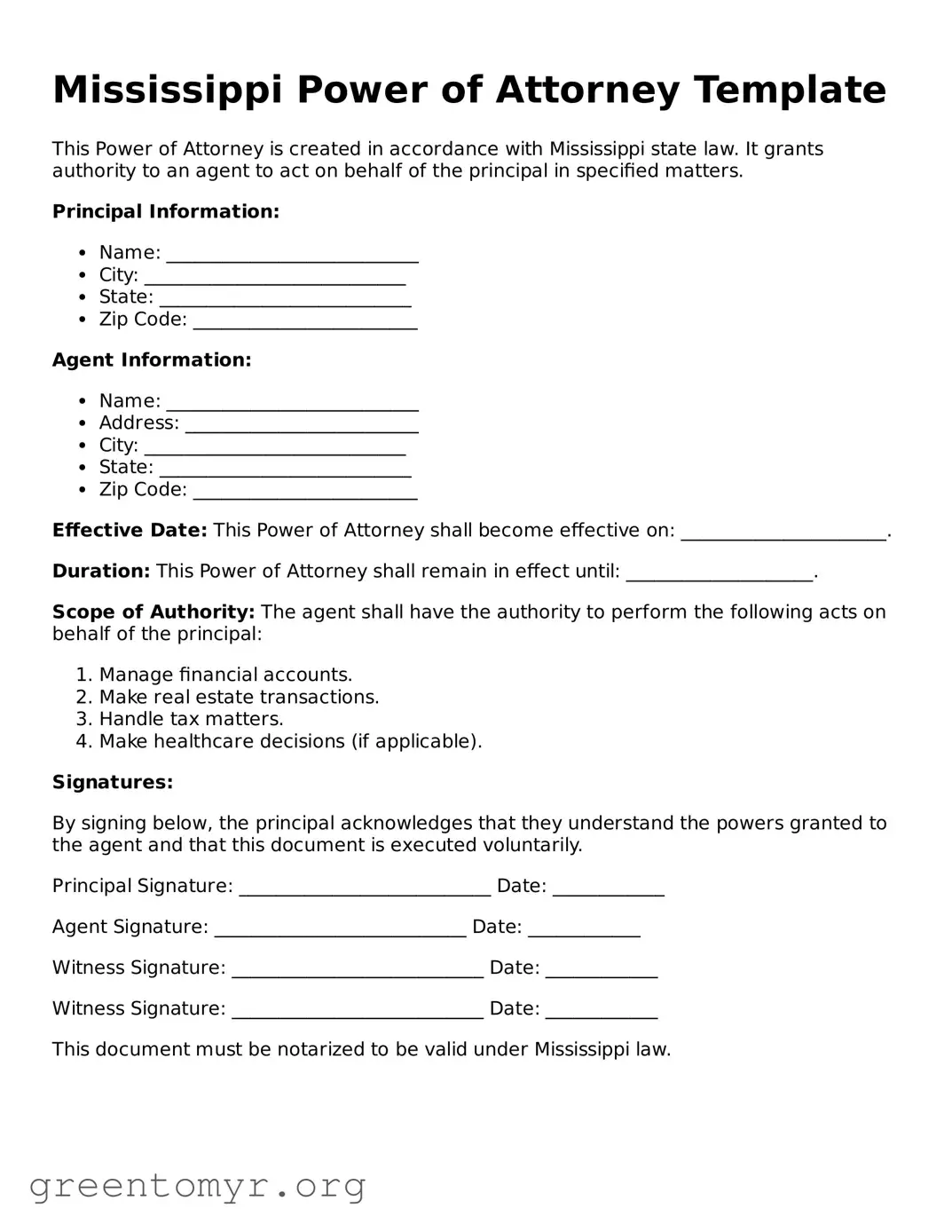
Mississippi Power of Attorney Template
This Power of Attorney is created in accordance with Mississippi state law. It grants authority to an agent to act on behalf of the principal in specified matters.
Principal Information:
Agent Information:
Effective Date: This Power of Attorney shall become effective on: ______________________.
Duration: This Power of Attorney shall remain in effect until: ____________________.
Scope of Authority: The agent shall have the authority to perform the following acts on behalf of the principal:
Signatures:
By signing below, the principal acknowledges that they understand the powers granted to the agent and that this document is executed voluntarily.
Principal Signature: ___________________________ Date: ____________
Agent Signature: ___________________________ Date: ____________
Witness Signature: ___________________________ Date: ____________
Witness Signature: ___________________________ Date: ____________
This document must be notarized to be valid under Mississippi law.
| Fact Name | Description |
|---|---|
| Definition | A Power of Attorney (POA) is a legal document that allows one person to act on behalf of another in financial or legal matters. |
| Governing Law | The Mississippi Power of Attorney is governed by the Mississippi Code Annotated, Title 87, Chapter 3. |
| Types of POA | Mississippi recognizes several types of POAs, including durable, non-durable, and springing powers of attorney. |
| Durable POA | A durable POA remains in effect even if the principal becomes incapacitated. |
| Springing POA | A springing POA only becomes effective upon the occurrence of a specified event, such as the principal's incapacity. |
| Agent's Authority | The agent, also known as the attorney-in-fact, can perform a variety of tasks, including managing finances and making healthcare decisions, depending on the authority granted. |
| Execution Requirements | The POA must be signed by the principal and notarized to be legally valid in Mississippi. |
| Revocation | The principal can revoke the Power of Attorney at any time, as long as they are mentally competent. |
| Importance of Clarity | It is crucial to clearly outline the powers granted to the agent to avoid confusion and ensure the principal's wishes are followed. |
Completing the Mississippi Power of Attorney form is an important step in ensuring that your financial and legal matters are managed according to your wishes. After filling out the form, it will need to be signed and possibly notarized, depending on your specific requirements. Follow these steps carefully to ensure that all necessary information is accurately provided.
After completing these steps, ensure that the form is stored in a safe place and that the appointed agent knows where to find it. This will help facilitate any necessary actions in the future.
A Mississippi Power of Attorney form is a legal document that allows one person, known as the principal, to grant another person, called the agent or attorney-in-fact, the authority to make decisions on their behalf. This can include financial, medical, or legal matters. The principal retains the right to revoke or change the Power of Attorney at any time, as long as they are mentally competent.
In Mississippi, there are several types of Power of Attorney forms:
To create a Power of Attorney in Mississippi, follow these steps:
It is advisable to keep copies of the signed document in a safe place and provide a copy to your agent and any relevant institutions.
While it is not legally required to have a lawyer to create a Power of Attorney in Mississippi, consulting with an attorney can be beneficial. An attorney can help ensure that the document meets all legal requirements and accurately reflects your wishes. This can provide peace of mind and prevent potential disputes in the future.
Yes, you can revoke a Power of Attorney at any time, as long as you are mentally competent. To revoke the document, you should create a written revocation and notify your agent and any institutions or individuals who may have relied on the Power of Attorney. It is also wise to destroy any copies of the original document to prevent confusion.
If an agent abuses their power or acts against your interests, you have several options. You can revoke the Power of Attorney, file a complaint with the appropriate authorities, or take legal action against the agent. It is important to gather evidence of the abuse and consult with a legal professional to understand your rights and the best course of action.
A Power of Attorney created in Mississippi may still be valid in another state, but it is advisable to check the laws of the new state. Different states may have varying requirements for the validity of a Power of Attorney. If you plan to move, consider consulting with a local attorney to ensure that your Power of Attorney remains effective and meets the new state's legal standards.
Filling out a Power of Attorney (POA) form in Mississippi can be a straightforward process, but mistakes often occur. One common error is not specifying the powers granted. Individuals sometimes leave the section blank or provide vague descriptions. This lack of clarity can lead to confusion about what authority the agent has, potentially causing issues when the POA is needed.
Another frequent mistake is failing to date the document. A Power of Attorney must be dated to be valid. Without a date, questions may arise regarding when the authority was granted, which can complicate matters if disputes occur later.
Some people overlook the requirement for witnesses and notarization. In Mississippi, a POA must be signed in the presence of two witnesses and a notary public. Neglecting these steps can render the document invalid. It is essential to ensure that all signatures are properly executed to avoid legal complications.
Additionally, individuals sometimes forget to communicate their intentions with the agent. It is crucial to discuss the powers being granted with the chosen agent beforehand. This conversation ensures that the agent understands their responsibilities and is willing to accept them.
Another mistake involves not considering the potential for future changes. Life circumstances can change, and individuals may need to update their POA. Failing to review and amend the document when necessary can lead to outdated authority being exercised.
Some individuals also neglect to keep copies of the signed document. Retaining copies is vital for both the principal and the agent. Without access to the document, the agent may face challenges when attempting to act on behalf of the principal.
Inaccurate information is another common issue. People may mistakenly provide incorrect personal details, such as names or addresses. This can create confusion and complicate the enforcement of the Power of Attorney.
People sometimes overlook the importance of choosing the right agent. Selecting someone who is not trustworthy or capable can lead to misuse of authority. It is essential to choose an individual who is reliable and understands the responsibilities involved.
Finally, some individuals fail to consider the implications of granting a Power of Attorney. Understanding the extent of the authority being given is critical. Without this awareness, individuals may unintentionally give away more power than they intended.
A Power of Attorney (POA) is a crucial legal document that allows one person to act on behalf of another in various matters, such as financial or medical decisions. In Mississippi, individuals often use additional forms and documents alongside the Power of Attorney to ensure comprehensive management of their affairs. Below is a list of commonly associated documents.
These documents serve to enhance the effectiveness of a Power of Attorney by addressing various aspects of personal and financial management. Together, they create a comprehensive framework for decision-making that respects the individual’s wishes and provides clarity to those involved.
The Power of Attorney (POA) form is an important legal document that allows one person to act on behalf of another. Several other documents share similarities with the POA, often serving related purposes in managing personal, financial, or healthcare decisions. Here are six documents that are similar to the Power of Attorney form:
When filling out the Mississippi Power of Attorney form, it's important to follow certain guidelines to ensure the document is valid and effective. Here are some do's and don'ts to keep in mind:
Understanding the Mississippi Power of Attorney form is crucial for effective planning. However, several misconceptions can lead to confusion. Here are eight common misconceptions:
By dispelling these misconceptions, individuals can better understand the importance and functionality of the Mississippi Power of Attorney form.
When filling out and using the Mississippi Power of Attorney form, consider the following key takeaways: