When two individuals decide to marry, they often envision a future filled with love and partnership. However, it’s also wise to consider the practical aspects of a union, particularly when it comes to financial matters. This is where a prenuptial agreement comes into play, especially in Mississippi. A Mississippi prenuptial agreement form allows couples to outline their financial rights and responsibilities before tying the knot. By addressing issues such as property division, debt allocation, and spousal support, this legal document can help to prevent misunderstandings and disputes down the road. It is essential to understand that both parties must voluntarily agree to the terms, and full disclosure of assets is crucial for the agreement to be enforceable. Moreover, the form should be drafted with clarity to ensure that it reflects the intentions of both partners. By taking the time to create a prenuptial agreement, couples can enter their marriage with a clearer understanding of their financial landscape, allowing them to focus on building their life together with confidence.
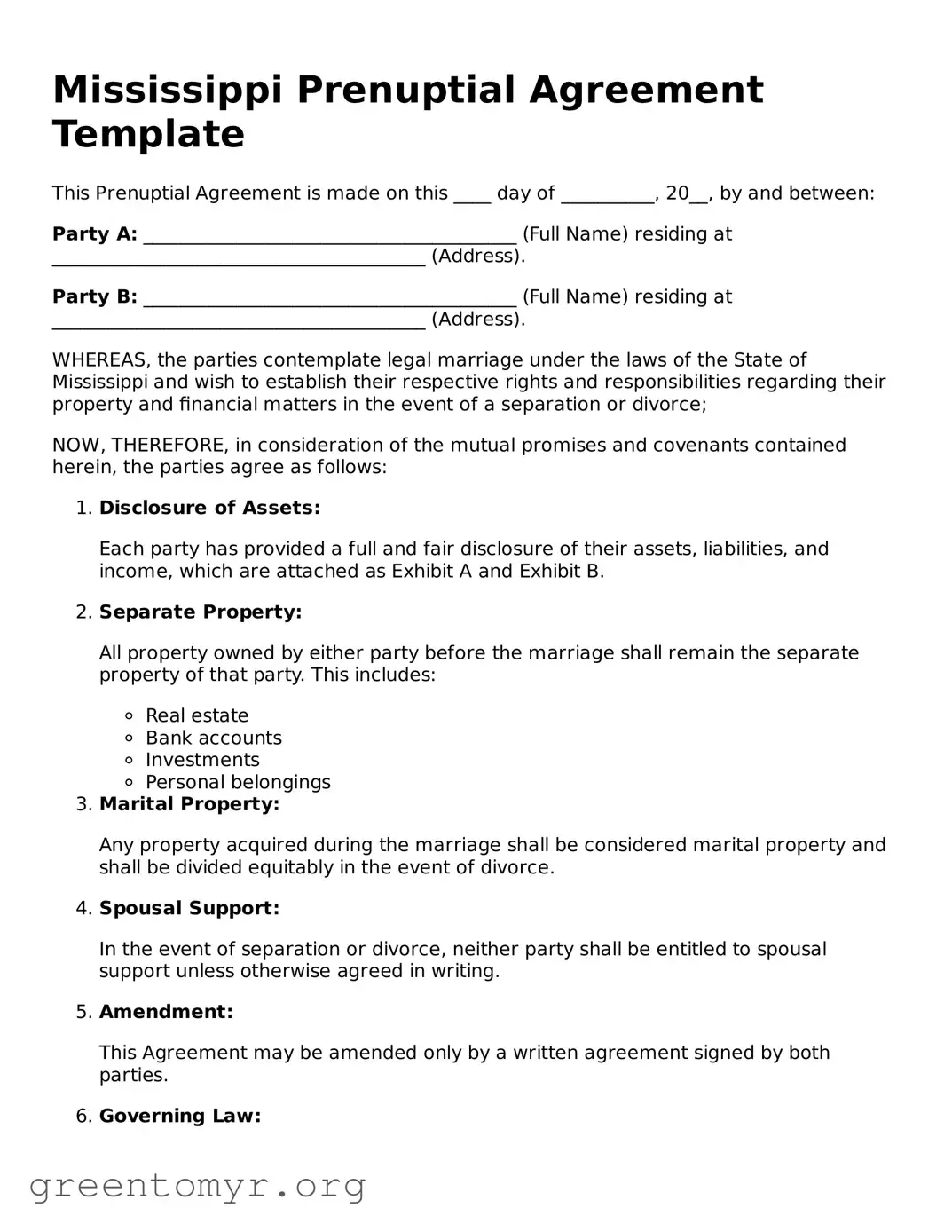
Mississippi Prenuptial Agreement Template
This Prenuptial Agreement is made on this ____ day of __________, 20__, by and between:
Party A: ________________________________________ (Full Name) residing at ________________________________________ (Address).
Party B: ________________________________________ (Full Name) residing at ________________________________________ (Address).
WHEREAS, the parties contemplate legal marriage under the laws of the State of Mississippi and wish to establish their respective rights and responsibilities regarding their property and financial matters in the event of a separation or divorce;
NOW, THEREFORE, in consideration of the mutual promises and covenants contained herein, the parties agree as follows:
Each party has provided a full and fair disclosure of their assets, liabilities, and income, which are attached as Exhibit A and Exhibit B.
All property owned by either party before the marriage shall remain the separate property of that party. This includes:
Any property acquired during the marriage shall be considered marital property and shall be divided equitably in the event of divorce.
In the event of separation or divorce, neither party shall be entitled to spousal support unless otherwise agreed in writing.
This Agreement may be amended only by a written agreement signed by both parties.
This Agreement shall be governed by and construed in accordance with the laws of the State of Mississippi.
IN WITNESS WHEREOF, the parties have executed this Prenuptial Agreement as of the day and year first above written.
Party A Signature: ___________________________ Date: ____________
Party B Signature: ___________________________ Date: ____________
Witness Signature: ___________________________ Date: ____________
Witness Signature: ___________________________ Date: ____________
| Fact Name | Description |
|---|---|
| Governing Law | The Mississippi Prenuptial Agreement is governed by the Mississippi Uniform Premarital Agreement Act. |
| Definition | A prenuptial agreement is a contract entered into by two individuals before marriage, outlining the division of assets and responsibilities in the event of divorce or separation. |
| Requirements | For a prenuptial agreement to be valid in Mississippi, it must be in writing and signed by both parties. |
| Full Disclosure | Both parties must fully disclose their financial situations, including assets, liabilities, and income, for the agreement to be enforceable. |
| Voluntary Agreement | The agreement must be entered into voluntarily, without coercion or undue influence from either party. |
| Notarization | While notarization is not required, it is recommended to enhance the agreement's credibility and enforceability. |
| Modification | A prenuptial agreement can be modified or revoked at any time, but such changes must also be in writing and signed by both parties. |
| Judicial Review | Mississippi courts may review prenuptial agreements for fairness and compliance with state laws before enforcement. |
Filling out the Mississippi Prenuptial Agreement form is a straightforward process. This document allows couples to outline their financial rights and responsibilities before marriage. By carefully completing the form, both parties can ensure clarity and mutual understanding regarding their assets and debts.
A prenuptial agreement, often called a "prenup," is a legal document that a couple creates before they get married. This agreement outlines how assets and debts will be handled in the event of a divorce or separation. In Mississippi, prenuptial agreements can also address issues such as spousal support and property division. It is designed to protect the interests of both parties and provide clarity on financial matters from the outset of the marriage.
Creating a prenuptial agreement involves several key steps:
Yes, there are specific requirements for a prenuptial agreement to be considered valid in Mississippi:
Yes, a prenuptial agreement can be modified or revoked in Mississippi. Both parties must agree to any changes, and the modifications should be made in writing. It is recommended to have these changes reviewed by a lawyer to ensure they are legally enforceable. If a couple wishes to revoke the agreement entirely, they should also do so in writing, ideally with the assistance of legal counsel.
If a couple does not have a prenuptial agreement in place and later decides to divorce, the division of assets and debts will be governed by Mississippi's marital property laws. This means that the court will determine how to fairly divide property acquired during the marriage. Without a prenup, couples may face lengthy legal battles and uncertainty regarding their financial futures. Having a prenuptial agreement can provide peace of mind and clarity, helping to avoid potential conflicts later on.
Filling out a prenuptial agreement form in Mississippi can be a straightforward process, but many people make common mistakes that can lead to complications later. One frequent error is failing to fully disclose assets. Both parties must provide a complete and honest account of their financial situation. Omitting significant assets can render the agreement unenforceable.
Another mistake is not having the agreement reviewed by a legal professional. While it may seem unnecessary, a lawyer can help ensure that the document complies with state laws and adequately protects both parties' interests. Skipping this step can lead to misunderstandings or legal issues down the line.
Some individuals mistakenly assume that a prenuptial agreement is only for the wealthy. This misconception can prevent couples from addressing important financial matters. Regardless of income level, a prenup can clarify financial rights and responsibilities, making it a useful tool for any couple.
Additionally, people often overlook the importance of clear language. Using vague terms can create confusion and lead to disputes later. It is crucial to be specific about the terms of the agreement, including how assets will be divided and any spousal support arrangements.
Another common error is failing to consider future changes. Life circumstances can evolve, and a prenup should account for potential changes in income, assets, or family structure. Neglecting to include provisions for these changes can undermine the agreement’s effectiveness.
Many couples also make the mistake of not discussing the prenup openly. Avoiding this conversation can lead to feelings of distrust or resentment. It’s essential for both parties to communicate their concerns and expectations regarding the agreement.
Some individuals may mistakenly believe that a prenup is permanent and cannot be changed. In reality, couples can modify their agreement as their lives change. Regularly reviewing and updating the prenup can ensure it remains relevant and fair.
Lastly, failing to sign the agreement in front of witnesses or a notary can invalidate it. Proper execution is critical to ensure that the agreement holds up in court. Couples should be diligent about following the necessary legal steps to finalize their prenup.
A prenuptial agreement is a crucial document for couples planning to marry, as it outlines the financial arrangements and responsibilities in the event of a divorce. However, there are several other forms and documents that often accompany this agreement to provide a comprehensive understanding of the couple's financial situation and legal obligations. Below is a list of these documents, each serving a specific purpose.
Each of these documents plays a significant role in safeguarding the interests of both parties in a marriage. By having a clear understanding of financial and legal responsibilities, couples can navigate their relationship with greater confidence and security.
When completing a Mississippi Prenuptial Agreement form, it is important to approach the process with care. Here are some essential do's and don'ts to consider:
Many people hold misconceptions about prenuptial agreements, particularly in Mississippi. Understanding these common myths can help individuals make informed decisions. Below is a list of ten misconceptions about the Mississippi Prenuptial Agreement form, along with explanations to clarify each point.
This is a common belief, but prenuptial agreements can benefit anyone. They help clarify financial responsibilities and protect assets, regardless of income level.
While discussing finances before marriage may feel awkward, having a prenuptial agreement can actually strengthen a relationship by fostering open communication about financial expectations.
When properly drafted and executed, prenuptial agreements are legally enforceable in Mississippi, provided they meet certain requirements.
While these agreements can address many financial issues, they cannot include provisions that violate public policy, such as child custody or child support arrangements.
These agreements can also provide clarity during the marriage, helping couples navigate financial matters and expectations without conflict.
Individuals entering second or subsequent marriages often find prenuptial agreements useful to protect their assets and address the needs of children from previous relationships.
As long as the agreement is fair, transparent, and both parties have disclosed their financial situations, enforcement is typically straightforward in Mississippi.
While couples can create postnuptial agreements to modify their financial arrangements, changes to a prenuptial agreement must be made before marriage.
Even couples with modest assets can benefit from a prenuptial agreement by establishing clear financial expectations and responsibilities.
While they can be complex, a straightforward prenuptial agreement can be created with the help of legal professionals, making the process manageable.
By addressing these misconceptions, individuals can approach prenuptial agreements with a clearer understanding of their purpose and benefits.
When considering a prenuptial agreement in Mississippi, it is essential to understand the implications and requirements of the form. Here are some key takeaways to keep in mind:
Understanding these key aspects can help individuals navigate the process of creating a prenuptial agreement in Mississippi effectively.